Introduction: The Ground Beneath All Myths
Before Zeus hurled his first thunderbolt, before heroes walked, and even before time itself had a clear measure, there was Gaia. She is not merely a character in myth; she is the very stage upon which the drama of the cosmos unfolds. In the silent darkness that followed Chaos, she arose—wide-bosomed, steadfast, and fertile. To the ancient Greeks, Gaia (Γαῖα) was the personification of the Earth, a living, conscious entity from whom all life and most gods descended. This is not a story of a distant, Olympian deity, but of the primal mother whose body is the world itself. Her story is one of creation, rebellion, nurture, and an enduring power that humbled even the king of the gods.
A Name Rooted in the Soil: The Etymology of Earth
The name “Gaia” itself is an ancient whisper meaning “land” or “earth.” It is the poetic, epic form of the more common Attic Greek “Gē” (Γῆ) and Doric “Gā” (Γᾶ). Scholars trace its linguistic roots deep into prehistory, possibly to the Indo-European *dʰéǵʰōm, a progenitor word for “earth” seen in related terms across languages: Latin humus (soil), Sanskrit ksam, and even the Albanian dhé. Some, like linguist Beekes, suggest a Pre-Greek origin, indicating her worship may predate the arrival of Hellenic speakers. In the Linear B script of the Mycenaean era, we find “Ma-ka,” likely transliterated as “Ma-ga”—”Mother Gaia.” Her name wasn’t just a label; it was a fundamental concept, as basic and essential as the ground underfoot.
The All-Nourishing Form: Describing the Indescribable
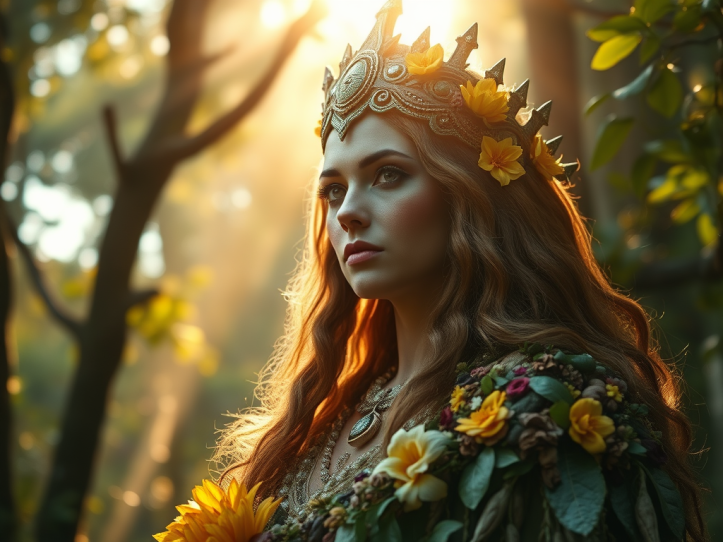
How does one describe a goddess who is the world? Early Homeric poetry presents her as a physical, distinct existence, but not clearly anthropomorphic. She is the “broad earth” (eureia chthon), the plane upon which all things rest. Hesiod gives her more personified form, calling her “broad-breasted” (eurysternos) and the “sure seat of all immortals.” In cult and later poetry, a clearer image emerges: she is Pammētōr (the All-Mother), Pheresvios (Life-Giving), and Polyvoteira (All-Nourishing). She is the deep soil that yields crops, the mountains that scrape the sky, and the hidden depths from which oracles speak. Her essence is captured in epithets of abundance and nurture, reflecting her role as the ultimate source of sustenance and life.
The Primordial Drama: Gaia in Myth
Gaia’s mythology is the foundational narrative of the Greek cosmos. According to Hesiod’s Theogony, Chaos gave birth to Gaia, followed by Tartarus and Eros. Without consort, she bore Uranus (Sky) to cover her and Pontus (Sea). Her union with Uranus produced the Titans, the Cyclopes, and the Hecatonchires. When Uranus imprisoned her monstrous children within her, causing her agony, Gaia fashioned a great sickle and empowered her son Cronus to castrate his father, overthrowing the first cosmic order.
From the blood of Uranus that fell upon her, Gaia produced the Erinyes (Furies), the Giants, and the Meliae nymphs. She later helped her daughter, Rhea, save Zeus from Cronus’s attempt to swallow him, raising the future king of the gods in secret. Even after Zeus’s victory in the Titanomachy, Gaia challenged him, mating with Tartarus to produce the monstrous Typhon. In other tales, she is the mother of Erichthonius of Athens (born from Hephaestus’s spilled seed) and the provider of the Golden Apples of the Hesperides. Her myths are cycles of generational conflict, in which she continually seeks to restore balance, often by challenging the oppressive power of the ruling sky-god.
Whispers from the Deep: The Cult of Gaia
Despite her primordial importance, Gaia’s organized public cult was rare in classical times. She was more often honored alongside other deities in chthonic (earth/underworld) rituals. Her worship seems rooted in indigenous, pre-Olympian practices. Key cult sites reveal her unique nature:
* Delphi: Originally, the oracle was said to belong to Gaia. A temple to “Ge Eurysternos” stood there, and the serpent Python was her guardian, representing the earth’s prophetic spirit.
* Athens: She was worshipped as Gaia Kourotrophos (Nurse of the Young) and associated with Themis (Divine Order). A sanctuary called the Gaion existed near the Olympieion, linked to the myth of Deucalion’s flood.
* Aegae (Achaia): An ancient wooden statue of Gaia Eurysternos was served by a priestess who underwent a ritual test involving bull’s blood, highlighting the dangerous, sacred nature of the role.
* Sparta & Olympia: She shared altars with Zeus, reflecting a primordial pairing of Sky and Earth.
Her rites were often chthonic and oracular. Offerings typically involved black animals, like lambs, and libations poured directly into the earth. The Genesia festival in Athens involved offerings to her and the dead, linking her to the realm of ancestors. Her cult was not about spectacle but about fundamental, nourishing power and communication with the deep, unseen forces of the world.
Scholar’s Lens: Ancient and Modern Interpretations
Ancient Greek poets and philosophers saw Gaia as a cosmic principle. Aeschylus and Euripides used her epithets to signify universal motherhood and justice. A profound fragment from Euripides’ Chrysippus presents a philosophical Gaia: “Everything which is born by the earth returns to the earth, and everything born from aether returns to the sky. Nothing is destroyed, but it is transformed to another form.” Here, Gaia is the principle of cyclical transformation and material sustenance.
In modern scholarship, debates continue. Some 20th-century theorists, like Marija Gimbutas, controversially positioned Gaia as a descendant of a Neolithic “Great Goddess.” While this is speculative and not widely accepted in classical studies, it highlights her perceived archetypal power. Academics specializing in Greek religion, such as Walter Burkert, focus on her role within the Hesiodic cosmic framework and her function in chthonic oath-taking (as seen in Homer, where oaths were sworn upon her). She is interpreted as the embodiment of the physical world’s generative and retaliatory power, a force that pre-dates and undergirds the Olympian pantheon.
Gaia Reawakened: Modern Paganism
In contemporary modern paganism and Hellenic reconstructionist movements, Gaia has experienced a revival. For many, she transcends the realm of myth, becoming a spiritual embodiment of the living planet. This view often merges the ancient Greek conception with ecological consciousness, seeing Gaia as a symbol of interconnectedness, sustainability, and divine immanence in nature. Some practitioners honor her specifically within a Hellenic ritual context using ancient epithets, while others incorporate her into a broader Earth-centered spirituality. This modern worship emphasizes the aspects of nurture, reciprocity, and the sacredness of the physical world that are central to her ancient character.
Conclusion: The Enduring Earth
From the flint sickle that reshaped the heavens to the sacred caves that whispered prophecies, Gaia’s presence is the constant in Greek mythology. She is the primordial source, the reluctant rebel, and the ultimate nurturer. While the Olympians ruled from above, her power remained fundamental, literal, and indispensable. Studying Gaia is not just about cataloging another deity; it is about understanding how the ancient Greeks conceived of the world itself as divine, conscious, and actively engaged in the cosmic order. Her story reminds us that before we look up to the skies for divinity, we must first feel it beneath our feet.
Apollodorus. (c. 1st-2nd century CE). The Library.
Burkert, W. (1985). Greek Religion. Harvard University Press.
Hesiod. (c. 700 BCE). Theogony. (H. G. Evelyn-White, Trans.).
Homer. (c. 8th century BCE). Iliad. (R. Lattimore, Trans.).
Hyginus. (c. 2nd century CE). Fabulae.
Ovid. (c. 8 CE). Metamorphoses. (A. D. Melville, Trans.).
Pausanias. (c. 2nd century CE). Description of Greece. (W.H.S. Jones, Trans.).
West, M. L. (2007). Indo-European Poetry and Myth. Oxford University Press.
 Wicked Dual Blog