Than the Tales of the West
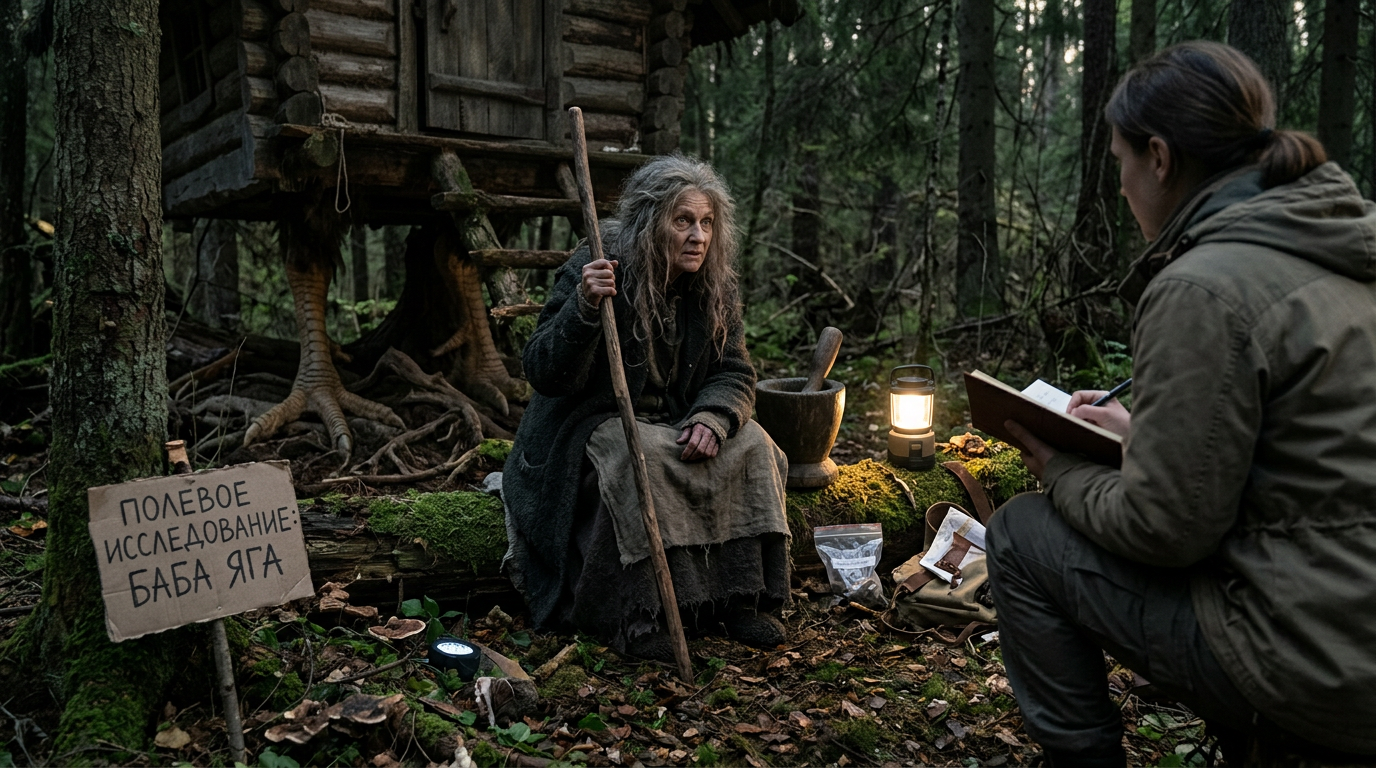
A researcher documents an encounter with a Baba Yaga figure beside a rustic forest hut.
“She is neither wholly monster nor wholly helper, neither to be fled nor trusted. She is the forest itself given a face — and the forest does not sort itself into good and evil for the convenience of the traveler.”
An Archival Chronicle Prepared for the Discerning Collector
Compiled by the Archivist of the Unseen
Contents
I. The Hut That Turns to Face You
II. A Living Inheritance: A Note on a Tradition Still in Use
III. Who Baba Yaga Is: The Ambiguous Crone of the Forest
IV. The Name and Its Unsettling Roots
V. The Attributes: The Mortar, the Pestle, the Fence of Bones
VI. Field Study — The Notable Tales: Vasilisa, Marya Morevna, and the Three Sisters
VII. An Archival Aside: On the Ambiguity That Cannot Be Resolved
VIII. The Central Question: Why the Slavic Dark Runs Deeper
· The Myth of the Gentle Grimms
· The Land, the Winter, and the Forest
· The History of Suffering
· The Ambiguity of the Pagan Root
IX. The Chicken-Legged Hut and Its Strange Origins
X. The Sisters, the Analogues, and the Wider Slavic Dark
XI. Baba Yaga in the Living Present: From the Lubok to the Drone
XII. The Old Woman Who Will Not Be Tamed
Bibliography
I. The Hut That Turns to Face You You have walked too far into the forest. This is the first mistake, and the forest does not forgive first mistakes as the meadow does. The trees have closed behind you; the light has gone the color of old bruises; and somewhere ahead, in a clearing you did not choose to find, stands a hut. But it is standing wrongly. It rests upon two enormous scaled legs — the legs of a monstrous fowl — and as you watch, it turns, slowly, deliberately, upon those legs, until its dark doorway faces you directly, as a face turns to regard an intruder. Around the clearing runs a fence, and upon each post of the fence is set a human skull, and in the empty sockets of the skulls a light is beginning to kindle as the dark comes down.
Inside the hut is an old woman. She is vast and terrible; she lies stretched across the whole span of the room, her iron teeth, her bony leg, her nose grown so long it scrapes the ceiling. She smells you before she sees you — sniffs the air and declares that she scents the Russian smell, the smell of living human flesh where no living human should be. And then she asks you a question, and everything depends upon it, and there is no way to know the right answer: are you here of your own free will, or by compulsion?
This is Baba Yaga, and the terror of her is not simply that she may eat you — though she may, and she will whet her iron teeth to do it. The deeper terror is that you cannot know what she is. She may devour you, or she may give you exactly the gift you came for, the magical thing that will save your life and complete your quest. Which she does depends on how you conduct yourself, on courtesy and courage and the keeping of obscure rules you were never taught. She is not a villain to be defeated nor a helper to be thanked. She is something older and stranger than either: a power of the deep forest, as likely to bless as to kill, who must be dealt with on her own terms, in her own place, according to laws that belong to her and not to you.
This field study takes as its subject Baba Yaga — the ambiguous crone of Slavic folklore, the witch of the chicken-legged hut, one of the most distinctive and unsettling figures in all of European folk tradition. It will examine who she is and where her strange attributes come from; it will recount her most notable tales; and it will confront the larger question her figure raises — why Slavic folklore so often seems to carry a darker, harsher, more morally ambiguous edge than the fairy tales of the West, the sanitized Grimms and their kin. The answer, as always in this archive, is more complicated and more interesting than the question assumes; but Baba Yaga is the perfect guide to it, for she embodies precisely the quality that distinguishes the Slavic dark: the refusal to resolve into the comfortable moral categories that the Western tale, in its later forms, learned to prefer.
The pages that follow are prepared for the discerning collector of the genuinely unresolved — the reader who understands that the most powerful figures in folklore are the ones who cannot be sorted into hero or villain, and who prefers the honest dark of the forest to the tidy morality of the nursery. Baba Yaga is the great ambiguous power of the Slavic wood, and this is the chronicle of why she, and the tradition that made her, refuse to be tamed.
❧ ❧ ❧
II. A Living Inheritance: A Note on a Tradition Still in Use Before proceeding, the living dimension of this material must be set down with particular emphasis, for Baba Yaga is not the folklore of a vanished people but a vividly living figure of contemporary Slavic culture, and this study is offered with full awareness of, and respect for, that living presence.
Baba Yaga remains, today, one of the most recognizable figures of Russian, Ukrainian, Polish, and broader Slavic culture — known to every child, present in books and films and animation, invoked in idiom and in art, as alive in the Slavic imagination as any figure of folklore anywhere in the world. The Slavic nations to whom she belongs are living nations with living languages and living traditions, and Baba Yaga is their cultural property in the fullest sense — not a quaint relic for outside observers to catalogue, but a figure who continues to evolve, to be retold, and to carry meaning within the cultures that created her. Any study of her by an outsider must proceed with this understanding: that she is borrowed, not owned, and that the tradition she belongs to is the ongoing possession of living peoples.
The most striking recent demonstration of her living power comes from the tragic present. During the Russo-Ukrainian war that began in 2022, Russian troops came to refer to the Ukrainian heavy bomber drones that struck them by night in the forests — silent, deadly, descending from the dark — as “Baba Yaga.” The name was not chosen idly. It reached, in a moment of real terror, for the oldest image the culture possessed of death coming out of the night woods: the flying hag, the devourer from the dark forest, the old terror of the trees. That a figure first attested in a grammar book of 1755, and far older in oral tradition, should be invoked by frightened soldiers in a twenty-first-century war to name the thing that kills them in the dark is the clearest possible proof that Baba Yaga is no dead folklore. She is a living image of dread, still potent enough to name the newest instruments of death. The archive records this with the gravity the context demands: the old dark of the forest, reaching into the present through the language of a real and ongoing war.
This study, then, treats Baba Yaga with the respect owed to a living cultural inheritance, and treats the broader question of the Slavic dark not as a judgment upon Slavic culture but as a genuine inquiry into the historical and regional forces that shaped a distinctive folk tradition. With that understanding fixed, the chronicle proceeds.
❧ ❧ ❧
III. Who Baba Yaga Is: The Ambiguous Crone of the Forest Artifact: The Two-Faced Witch
The single most important fact about Baba Yaga — the quality that defines her and that makes her the perfect emblem of the Slavic folk imagination — is her radical ambiguity. She is not a villain, and she is not a helper. She is both, and neither, and which face she shows depends upon the tale, the hero, and the conduct of the one who comes to her. To understand her is to understand that she cannot be understood as either good or evil, because she belongs to a conception of the supernatural older than that division.
In some tales she is a monster of pure horror: a repulsive, ferocious old woman who captures, roasts, and devours children, who whets her iron teeth at the scent of human flesh, who is a genuine and deadly threat to be escaped by cunning and flight. In other tales — sometimes the very same tale-types, with a different hero — she is a helper: a wise old woman who gives the hero food and rest, magical gifts, crucial knowledge, the very things needed to complete the quest and win through to the happy ending. The great folklorist Vladimir Propp observed that the depictions of Baba Yaga taken from various tales do not add up to a single coherent image — and this incoherence is not a flaw in the tradition but its essence. Baba Yaga is not one thing. She is a threshold-power, a guardian of the boundary between the world of the living and the other world of the dead and the magical, and like all such threshold-powers she is dangerous and helpful at once, the gate that may open or may devour.
The scholar Andreas Johns has called her one of the most memorable and distinctive figures in eastern European folklore, and emphasized precisely her enigmatic quality, her striking ambiguity. She has been interpreted, across a century and more of scholarship, as almost everything: a nature-spirit, a goddess of death, a figure of winter, a snake, a bird, an earth-goddess, a totemic ancestress, a female initiator, an archetypal image of the devouring and the nurturing mother at once. That she can support so many readings is itself the point: she is a figure of such depth and such ambiguity that she functions as a kind of mirror, reflecting back whatever the interpreter brings to her. But beneath all the readings lies the same irreducible core — the old woman of the deep forest, mistress of its wildlife and its boundaries, who holds the power of life and death and dispenses it according to laws that are hers alone. She is the forest’s own ambiguity given a face: nurturing and devouring, as the wild itself is nurturing and devouring, and refusing, as the wild refuses, to be simply one or the other.
❧ ❧ ❧
IV. The Name and Its Unsettling Roots Artifact: The Etymology of Dread
The name Baba Yaga divides into two elements, and while the first is clear, the second carries a genuine mystery whose possible meanings all point, unsettlingly, in the same direction — toward horror, disease, and pain. The etymology is worth examining, for the very uncertainty of the name mirrors the uncertainty of the figure, and its darker possibilities illuminate the dread she has always carried.
The first element, baba, is not in doubt. Across the Slavic languages — Serbian, Croatian, Macedonian, Bulgarian, and others — baba means “grandmother” or “old woman.” In modern Polish and Russian it has also acquired a pejorative edge, a dismissive term for a woman, particularly one who is old, dirty, or foolish. So the name begins in the ordinary and the domestic: the old woman, the grandmother, the crone. It is the familiarity of this first element that makes the horror of the second so effective — for Baba Yaga is the grandmother turned terrible, the nurturing old woman of the hearth transformed into the devouring old woman of the forest, the most intimate and trusted figure made monstrous.
The second element, yaga, is where the mystery and the darkness lie, for there is no scholarly consensus on its meaning — and every proposed meaning is grim. In the nineteenth century the great folklorist Alexander Afanasyev proposed a derivation connecting it to roots meaning “serpent,” binding Baba Yaga to the ancient dread of the snake. Other scholars have traced related terms across the Slavic languages, and the cluster they form is a lexicon of horror: the Serbian and Croatian jeza, meaning “horror,” “shudder,” or “chill”; the Slovene jeza, “anger”; the Old Czech jězě, “witch” or “legendary evil female being”; the Polish jędza, “witch,” “evil woman,” or “fury.” In Old Church Slavonic, the term appears meaning simply “disease.” And beyond the Slavic languages, the element has been linked to words in other Indo-European tongues meaning “to abuse” or “to exploit,” “doubt” and “worry” and “pain.”
The discerning reader should mark what this cluster reveals. Whatever the precise origin of yaga, the family of words it belongs to is saturated with horror, anger, disease, and pain — the shudder, the chill, the fury, the sickness. The name Baba Yaga, then, may be understood as something like “the grandmother of horror,” “the old woman of the shudder,” “the crone of disease.” The very name carries the dread; it names not a person but a feeling, the cold shudder of the encounter with the terrible old woman of the woods. And its uncertainty is fitting, for Baba Yaga has always resisted precise definition. Even her name refuses to resolve into a single clear meaning, offering instead a cluster of dark possibilities, all of them true to the figure, none of them final — the etymology itself as ambiguous, and as unsettling, as the crone it names.
❧ ❧ ❧
V. The Attributes: The Mortar, the Pestle, the Fence of Bones Artifact: The Witch’s Apparatus
Baba Yaga is defined, more than almost any other folklore figure, by a set of distinctive and instantly recognizable attributes — the strange apparatus of her power, each element of which carries meaning and each of which contributes to the unique and unsettling texture of her legend. To catalogue them is to assemble the portrait of a figure unlike any witch of the Western tradition.
Most distinctive is her mode of travel. Where the Western witch rides a broomstick, Baba Yaga flies in a giant mortar — the great bowl in which grain or herbs are ground — propelling or steering herself with the pestle, the grinding club, and sweeping away her tracks behind her with a broom or mop. The image is grotesque and unforgettable: the old woman hurtling through the air or across the ground in her kitchen vessel, the instrument of domestic food-preparation transformed into a vehicle of terror. The Russian ethnographer Andrey Toporkov has connected this apparatus to genuine pagan rituals involving women, suggesting that the pestle came first — for it could serve as a weapon and figured in a number of rituals — with the mortar added later by association. The domestic and the deadly are fused in her equipment, as they are fused in her nature: the tools of the kitchen become the tools of the witch, the grandmother’s implements turned to the crone’s dark purposes.
Her body is marked by monstrous and specific features. She bears the epithet kostyanaya noga, “bony leg” — suggesting a skeletal limb, a touch of the corpse about her, a foot already in the grave. She is s zheleznymi zubami, “with iron teeth” — the better to devour. Her nose may grow so long it sticks into the ceiling of her hut. When at home she lies stretched across the entire span of the hut, from one corner to another, her vast bulk filling the space — an image drawn, the sources note, from the genuine Russian practice of sleeping stretched out upon the great stove in winter, but here rendered monstrous, the old woman grown to fill her whole dwelling. And she senses the living by smell, sniffing out the russkiy dukh, the “Russian smell,” the scent of living human flesh that betrays the intruder in her domain. Some narrators dwell, with deliberate grotesquerie, on the repulsiveness of her body — her nose, her breasts, her buttocks — emphasizing the abject and the monstrous in a way the sanitized Western tale would never permit.
And then there is her dwelling, the single most famous of her attributes: the hut that stands upon chicken legs, deep in the forest, turning upon those legs so that its door faces now this way, now that. In many tales the hut stands with its back to the visitor, its door facing away into the trackless forest, and can be made to turn and admit the hero only by the speaking of a magic formula — “turn your back to the forest, your front to me.” Around the hut, in the darkest tellings, runs a fence made of human bones, topped with human skulls whose eye-sockets glow with fire in the night, lighting the dreadful clearing. The chicken-legged hut is examined in its own section below, for its origins are among the most fascinating aspects of the whole legend; but as an image it is the perfect emblem of Baba Yaga herself — the domestic dwelling made uncanny and mobile, the home that is also a trap, the familiar hut of the peasant turned into something that watches, and turns, and waits, ringed with the bones of those who came before.
❧ ❧ ❧
VI. Field Study — The Notable Tales: Vasilisa, Marya Morevna, and the Three Sisters Artifact: The Great Stories
Baba Yaga appears across a wide body of Slavic folktales, collected most famously in the great nineteenth-century compilation of Alexander Afanasyev, and a survey of the most notable of these reveals the full range of her ambiguous power — devourer in one tale, helper in another, and often, unsettlingly, both at once. Several stand out as the essential texts of her legend.
Vasilisa the Beautiful
The most beloved and most fully developed of the Baba Yaga tales is Vasilisa the Beautiful, a story that has been called the Slavic counterpart to Cinderella, though it is far darker than any Western Cinderella. Vasilisa, a good and gentle girl, is persecuted by a cruel stepmother and stepsisters, who send her into the forest to Baba Yaga’s hut on the pretext of fetching fire — an errand meant to be her death. Vasilisa survives only through two things: the magical doll left to her by her dead mother, which she feeds and which helps her in secret; and her own courtesy and courage in the witch’s house. Baba Yaga sets her a series of impossible tasks — to clean the house, to cook, to separate poppy seeds from soil, to sort good grain from mildewed — all on pain of being eaten, and the doll accomplishes them for her by night. In the end Baba Yaga, unable to find fault and unsettled by the blessing upon the girl, sends Vasilisa away — but gives her, as she goes, a skull from the fence, its eye-sockets blazing with fire. Vasilisa carries it home, and its fiery gaze burns her wicked stepmother and stepsisters to ashes. The tale is a perfect study in Baba Yaga’s ambiguity: she is the deadly threat and, simultaneously, the instrument of justice, the terror who becomes, for the worthy girl, the means of deliverance — and the gift she gives is a burning skull.
Marya Morevna
In Marya Morevna, Baba Yaga appears in a darker and more adversarial role. The hero, Ivan Tsarevich, seeking to win a magical horse from Baba Yaga, must serve her by herding her mares for three days — with the warning that if he fails, his head will join the row of skulls upon her fence, for the fence is already lined with the heads of those who tried and failed before him. Ivan succeeds only with the help of the animals he has earlier shown kindness to, and escapes upon the magical foal, pursued by the furious witch. The tale shows Baba Yaga at her most lethal — the keeper of a fence of human heads, the setter of deadly tasks — and yet even here she operates by rules: the task is real, the reward is real, and the hero who meets her terms survives. She is dangerous but not capricious; she keeps her bargains, even as she lines her fence with the skulls of those who could not meet them.
The Three Sisters and the Maiden Tsar
In some tales, strikingly, Baba Yaga appears not as one but as three — a trio of sisters, all bearing the same name, encountered in sequence by the hero. In a version of The Maiden Tsar collected by Afanasyev, the hero Ivan journeys to three identical chicken-legged huts in succession, meeting three Baba Yagas who are sisters. Each sniffs the “Russian smell,” each questions him, and the first two — rather than devouring him — give him aid and directions, sending him onward to the next; the third and youngest, the most dangerous, runs to whet her teeth to eat him, but is thwarted when Ivan, forewarned, uses three magical horns to summon the birds that carry him to safety. The motif of the three sisters deepens the ambiguity still further: the same figure, multiplied, appears as both helper and devourer within a single tale, the earlier sisters aiding what the last would destroy. Baba Yaga appears, too, across many other tales in Afanasyev’s collection — in Marya Morevna, in The Sea Tsar and Vasilisa the Wise, in tales of enchanted realms and legless knights — always recognizable, always ambiguous, always the mistress of the threshold between the ordinary world and the realm of magic.
What unites these tales, and distinguishes them sharply from their Western counterparts, is the moral texture of the encounter. The hero does not defeat Baba Yaga as a Western hero defeats a witch; the hero survives her, by courtesy, by courage, by the keeping of rules, by kindness shown to others earlier in the tale. She is not an obstacle to be overcome but a power to be correctly negotiated. And she gives real gifts — fire, horses, knowledge, escape — to those who meet her terms, even as she devours those who do not. This is the deep structure of the Baba Yaga tale, and it is a structure the sanitized Western fairy tale largely abandoned: the supernatural power who is neither good nor evil, but who must be dealt with rightly, on her own terms, in her own dark house at the edge of the world.
❧ ❧ ❧
VII. An Archival Aside: On the Ambiguity That Cannot Be Resolved It is worth pausing upon the quality that makes Baba Yaga so compelling and so resistant to the tidy categories of the modern imagination: her irreducible ambiguity, her refusal to be either the villain or the helper that a simpler storytelling would require her to be. This ambiguity is not a confusion to be resolved but a wisdom to be preserved, and it lies at the heart of why the older, darker folklore rewards the collector’s attention more richly than its sanitized descendants.
The modern instinct, inherited from centuries of moralized storytelling, is to sort the figures of a tale into the good and the wicked, the helpers and the villains, so that the hero’s path is a matter of defeating the bad and being aided by the good. But the older folklore knew a truth the nursery forgot: that the great powers of the world — the forest, the winter, death itself, the wild — are not good or evil but simply powerful, and must be dealt with not by moral opposition but by correct conduct, by courtesy and courage and the keeping of the old rules. Baba Yaga is the supreme embodiment of this older wisdom. She is what the supernatural looks like before it is moralized — before the witch becomes simply wicked and the fairy simply good — a power as ambiguous as the natural world she governs, as likely to bless as to kill, and answerable to laws older than the human distinction between good and evil. Wicked Dual exists as a repository for precisely this older and truer conception of the dark: the recognition that the most powerful figures of folklore are the ones who cannot be sorted, who hold nurture and destruction in a single hand, and who therefore preserve a wisdom about the world — its danger, its indifference, its terrible reciprocity — that the tidier tales have lost.
This is the disposition the chronicle maintains: that ambiguity is not a defect in a folk figure but a depth, and that the refusal of Baba Yaga to resolve into hero or villain is precisely what makes her more profound, more enduring, and more true than the flattened figures of the sanitized tradition. The chronicle now turns to the central question her figure raises — the question of why the Slavic dark, of which she is the supreme embodiment, runs so much deeper than the tales of the West.
❧ ❧ ❧
VIII. The Central Question: Why the Slavic Dark Runs Deeper The perception that Slavic folklore carries a darker, harsher, more morally ambiguous edge than the fairy tales of Western Europe — the Grimms and their kin — is widespread, and it is not without foundation. But it must be approached with care, for the question conceals a significant complication that the honest chronicler is obliged to expose before offering the genuine reasons behind the real differences that remain.
The Myth of the Gentle Grimms
The first and most important correction is this: the Western fairy tale, and the Grimms above all, were not originally gentle at all. The comparison that casts Slavic folklore as uniquely dark rests, in large part, upon a false image of the Western tradition — the sanitized, softened, child-safe versions of the Grimm tales that most modern readers know, which are the product of extensive later editing and bear little resemblance to the originals. The Brothers Grimm, in their early editions, collected and published tales of appalling darkness: mothers who plot to murder and eat their own children, stepsisters who hack off their own heels and toes to fit the slipper and have their eyes pecked out by birds, villains rolled downhill in barrels studded with nails, endless mutilation, cannibalism, rape, and death. The famous “Grimm” gentleness is a fiction of the nursery — the result of generations of editors, including the Grimms themselves in their later editions, progressively softening the tales for a bourgeois child audience, removing the sexual content, transforming murderous mothers into stepmothers, and pruning away the darkest cruelties. The Western tale was every bit as dark as the Slavic in its origins. What differs is not the original darkness but the history of its sanitization — and this is the first key to the whole question.
For the Slavic tales were, in general, sanitized later, less thoroughly, and less completely than their Western counterparts. The great collections of Slavic folklore, such as Afanasyev’s, were assembled in the nineteenth century by collectors more interested in preserving the tales as they were actually told than in softening them for children, and they were not subjected to the same century-long process of bourgeois domestication that smoothed the Western tales into their familiar nursery forms. The Slavic tales thus preserve, more faithfully, the genuine darkness of the oral folk tradition — the darkness that the Western tales also originally possessed, but that the West largely edited away. Part of the perceived difference, then, is not a difference in the tales themselves but a difference in what happened to them afterward: the Slavic dark is, in part, simply the original folk dark, better preserved, less sanitized, closer to the harsh oral tradition from which all European fairy tales sprang.
The Land, the Winter, and the Forest
Yet when this correction is granted, a genuine residue of difference remains, and it is rooted in the real conditions of Slavic life and landscape. The folklore of a people is shaped by the world that people inhabits, and the Slavic world was, in ways that genuinely distinguish it, harder and darker than much of Western Europe. Consider the forest. The vast, deep, continuous forests of the Slavic lands — the boreal woodland stretching across Russia and eastern Europe, far larger and wilder and more genuinely dangerous than the tamed and fragmented woodlands of the more densely settled West — were a real and present source of dread, a place where one could truly become lost, truly starve, truly be killed by cold or beast, truly vanish. Baba Yaga lives in that forest, and the terror of her is the real terror of a real wilderness that pressed close upon every settlement and swallowed the unwary. The Western fairy-tale forest is often a place of enchantment; the Slavic forest is a place of genuine and deadly danger, and its folklore carries that reality.
Consider, too, the winter. The Slavic winter is long, dark, and lethal in a way that the milder winters of much of Western Europe are not — months of killing cold, of frozen ground and failed harvests and genuine starvation, of darkness that presses upon the spirit. A folklore forged in such a climate carries the knowledge of death by cold and hunger in its bones, and its supernatural figures — Baba Yaga among them, whom some scholars read as a figure of winter and death itself — carry the weight of a genuinely lethal natural world. The land itself was harsher, and the folklore is harsher because the land was. This is not romantic speculation but a real relationship: the tales of a people who lived close to a deadly wilderness and endured a deadly winter will carry a darkness that the tales of gentler lands need not, and the Slavic dark is, in part, the dark of the Slavic land and the Slavic winter, written into story.
The History of Suffering
Consider, further, the history. The Slavic lands endured centuries of a particular and grinding suffering that shaped the temper of their folk culture: the long weight of serfdom, which bound the Russian peasantry in a condition close to slavery into the nineteenth century, far later than comparable systems ended in much of the West; the repeated devastation of invasion, from the Mongol conquest that subjected the Russian lands for centuries to the countless wars that swept across the open plains of eastern Europe; the harshness of autocratic rule, of famine, of a life lived closer to the bone and further from security than in much of the West. A folklore is the accumulated wisdom and dread of a people’s experience, and a people whose experience was harder will produce a harder folklore. The Slavic tales carry the knowledge of genuine suffering — of arbitrary power, of sudden death, of a world that does not reward the good and punish the wicked with the reliability the nursery tale pretends — because the people who told them knew that world intimately. The darkness of the folklore is, in part, the darkness of the history that produced it.
The Ambiguity of the Pagan Root
And consider, finally, the matter of Christianization and the survival of the pagan. The Slavic lands were Christianized comparatively late — the great conversion of the Kievan Rus’ came only at the end of the tenth century, and in the vast rural spaces the old pagan beliefs persisted, half-submerged, for many centuries thereafter, blending with Christianity in a rich folk syncretism rather than being wholly replaced by it. The older, pre-Christian layer of Slavic belief — with its morally ambiguous nature-spirits, its powers that were neither good nor evil but simply potent, its conception of a supernatural world that did not sort itself into the Christian categories of the holy and the demonic — survived more robustly in Slavic folklore than the corresponding pagan layer did in the more thoroughly and earlier Christianized West. Baba Yaga is a creature of that surviving pagan stratum: a power older than the Christian division of good and evil, preserved with her ambiguity intact because the tradition that carried her never fully subjected her to the moralizing pressure that would have made her simply a wicked witch. The Slavic dark, in this final sense, is the dark of a better-preserved paganism — a supernatural world that kept its old moral ambiguity, its old refusal to sort into good and evil, longer and more completely than the West, and that therefore retained figures like Baba Yaga in all their unresolved and unsettling power.
The answer to the central question, then, is layered, and the honest chronicler must hold all its parts together. The perceived difference is partly an illusion — the Western tales were equally dark in origin and were simply sanitized more thoroughly. But a genuine residue of difference remains, and it is rooted in real forces: the deadlier land and forest and winter of the Slavic world; the harder history of serfdom, invasion, and autocratic suffering; and the more robust survival of a morally ambiguous pagan substratum beneath a later and less complete Christianization. The Slavic dark is real, and Baba Yaga is its supreme embodiment — but it is the dark of a harder land, a harder history, and a better-preserved old religion, not the dark of a people more morbid than their Western neighbors. All European folklore began in the same harsh oral dark. The Slavic tradition simply kept more of it.
❧ ❧ ❧
IX. The Chicken-Legged Hut and Its Strange Origins Artifact: The Walking House
Of all Baba Yaga’s attributes, none is more famous or more strange than her dwelling — the hut that stands and walks upon the legs of a giant chicken — and its origins are among the most fascinating and revealing aspects of the whole legend, for they may connect Baba Yaga to genuine practices and genuine cultural encounters of the Slavic and neighboring peoples.
The most compelling theory traces the chicken-legged hut to a real architectural practice of the Finno-Ugric and Siberian peoples with whom the eastern Slavs were in long contact. These northern forest peoples built storehouses raised high off the ground on one or several posts — often tree stumps with the roots left attached, splaying out beneath like clawed feet — to protect stored food and goods from ground moisture and from animals. Such a structure, standing on a single splayed and root-footed post deep in the forest, cramped and small and raised above the earth, bears a genuine and striking resemblance to Baba Yaga’s hut: the small forest dwelling on the strange splayed leg, standing among the trees rather than in a village. The theory holds that the Slavs, encountering these uncanny raised structures in the deep northern forests, wove them into their folklore as the dwelling of the forest-witch — the real storehouse on its root-footed post transformed, in the imagination, into the walking hut on chicken legs.
There is a darker possibility woven into the origins as well, for some scholars have connected the raised forest structure to practices surrounding the dead. Certain northern peoples used raised platforms or small elevated structures in connection with burial — placing the dead in small houses raised above the ground in the forest — and if Baba Yaga’s hut carries an echo of such death-houses, then her dwelling is not merely a storehouse but a tomb, and she herself a guardian of the boundary between the living and the dead, her hut the threshold-house standing between the two worlds. This reading accords powerfully with her whole character as a threshold-power, a being of the boundary, and with the many features of her legend that mark her as associated with death: the bony leg, the fence of human bones, the skulls with their fiery eyes, the devouring. The chicken-legged hut, on this reading, is the house on the border of death, raised in the deep forest where the world of the living gives way to the other world — and Baba Yaga is its keeper, the old woman who guards the threshold and decides who may pass.
Whatever its precise origin, the chicken-legged hut endures as one of the most potent and original images in all of European folklore — a genuine invention of the Slavic and northern imagination, owing nothing to the Western fairy-tale tradition, and carrying in its uncanny, mobile, root-footed strangeness the whole flavor of the Slavic dark. It is the house that should not move and does, the home that should shelter and instead may devour, the familiar peasant hut raised on monstrous legs and set to turning in the deep forest, ringed with bone. No image better captures the distinctive texture of the tradition that produced it: the domestic made uncanny, the familiar made terrible, the deep forest given a dwelling and the dwelling given a dreadful life of its own.
❧ ❧ ❧
X. The Sisters, the Analogues, and the Wider Slavic Dark Baba Yaga does not stand alone; she is the most famous member of a wide family of related figures across the Slavic and neighboring worlds, and a survey of her kin reveals both the breadth of the tradition she belongs to and the deep roots of the Slavic dark she embodies. To see her among her analogues is to see that she is not an isolated monster but the supreme expression of a whole regional conception of the terrible feminine power of the wild.
Among the West Slavic peoples appears Ježibaba — a figure closely related to Baba Yaga, found in Czech and Slovak folklore, similarly ambiguous in character though differing in appearance and in the tale-types she inhabits. The two may descend from a common figure of the medieval period or earlier, a shared ancestor of the Slavic forest-witch. In Polish folklore appears Jędza, another related figure, her name drawn from the same dark root of horror and fury examined earlier. Across the wider region the family extends further still: the Bulgarian gorska maika, the “Forest Mother”; the Serbian Baba Roga, used to frighten children across the former Yugoslavia, and Gvozdenzuba, “Iron-tooth”; the Romanian Muma Pădurii, the “Forest Mother” with her bird-beak nose; and many more — a whole regional population of terrible old women of the woods, forest-mothers and iron-toothed hags, of whom Baba Yaga is the most fully developed and most famous.
The family extends beyond the Slavic world proper, into the neighboring traditions with which the Slavs were in contact. The Hungarian vasorrú bába, the “Iron-nose Midwife”; the Karelian Syöjätär, who carries some of Baba Yaga’s negative aspects; and, in the Germanic and Alpine world to the west, figures such as Perchta and Holda or Holle, the ambiguous old women of Central European tradition who reward the diligent and punish the slovenly, and who carry their own genuine darkness beneath the Grimms’ later softening. The web of analogues reveals that the terrible ambiguous crone of the forest is a figure of enormous geographic reach, a shared inheritance of the peoples of central and eastern Europe — but that in Baba Yaga, the Slavic tradition produced her most complete, most distinctive, and most enduring form, the one against which all the others are measured.
The existence of this vast family of related figures reinforces the central argument of this study. Baba Yaga is not an aberration, not a uniquely morbid invention, but the supreme flowering of a conception shared across a whole region — the terrible, ambiguous, powerful old woman of the wild, who holds life and death in her hands and answers to no simple morality. That so many neighboring peoples produced so many versions of her testifies to the depth and breadth of the tradition, and to the reality of the forces — the deadly forest, the killing winter, the hard history, the surviving paganism — that produced across the whole region a folklore willing to look the dark in the face and give it the shape of an old woman in a hut of bone.
❧ ❧ ❧
XI. Baba Yaga in the Living Present: From the Lubok to the Drone Baba Yaga’s life did not end with the oral tradition or the nineteenth-century collectors; she has remained a vividly living figure across the centuries, evolving and being reinterpreted in every age, and her continuing presence — down to the terrible present — is among the clearest demonstrations of her enduring power. To trace her modern life is to see a folk figure that has never for a moment stopped being alive.
As early as the late seventeenth and early eighteenth centuries, Baba Yaga appeared on the lubki — the popular woodblock prints of early modern Russia — in images that already show her being adapted and reinterpreted. In some of these prints she appears astride a pig, going to battle against a reptilian “crocodile,” and scholars have read these images as political parody: the crocodile as Peter the Great, persecutor of the Old Believers who called him by that name, and Baba Yaga, in her Finnish dress, as a mocking figure of his wife Catherine. Whether read as literal witch or as figurative political caricature, the lubki show Baba Yaga already, three centuries ago, being pressed into new service by each age — the ancient forest-witch made a vehicle for contemporary meaning, a process that has continued ever since.
Through the nineteenth and twentieth centuries she passed into literature, art, music, and film — the illustrator Ivan Bilibin gave her her definitive visual form in his famous images for the tale of Vasilisa; composers and writers and filmmakers returned to her again and again; she became, and remains, a fixture of Slavic children’s culture and of the wider global imagination, appearing now in fantasy novels and animated films and video games far beyond her Slavic homeland. And then, in the tragic present, she returned to her oldest and most terrible meaning. During the Russo-Ukrainian war that began in 2022, Russian soldiers gave the name Baba Yaga to the Ukrainian heavy bomber drones that struck them by night in the forests — the deadly thing that comes flying out of the dark trees to kill. The naming is a profound and terrible testament to her living power: that in a modern war, frightened soldiers reached instinctively for the oldest image their culture possessed of death descending from the night forest, and found it in the flying hag of the folktales. The witch who flies through the air in her mortar became the drone that flies through the night sky with its bombs; the old terror of the forest became the new terror of the war. She has flown, in the space of the tellings, from the oral folktale to the woodblock print to the illustrated book to the night sky above a real battlefield — and she is flying still.
This continuous life, from the deep past to the terrible present, is the final proof of Baba Yaga’s power and of the reality of the tradition she embodies. She is not a dead figure preserved in old books but a living image of dread, potent enough to name the newest instruments of death, flexible enough to be reinterpreted by every age, and rooted deeply enough in the Slavic imagination that she shows no sign of ever fading. The old woman of the chicken-legged hut endures because the dark she embodies endures — the dark of the deep forest, the killing winter, the hard history, and the deadly night — and because a culture that has looked that dark in the face for a thousand years is not about to look away now.
❧ ❧ ❧
XII. The Old Woman Who Will Not Be Tamed At the end of every path of inquiry into Baba Yaga, the same quality waits: her refusal to be resolved, to be tamed, to be sorted into the comfortable categories of good and evil that the sanitized tale demands. She remains, after three centuries of attestation and a thousand years of oral tradition, exactly what she was at the beginning — the ambiguous power of the deep forest, as likely to bless as to devour, answerable only to her own dark laws, and inexhaustibly resistant to every attempt to make her simply a villain or simply a helper. This is her enduring power, and it is the enduring power of the whole tradition she embodies: the refusal to pretend that the great forces of the world are anything other than what they are — powerful, ambiguous, indifferent to human morality, and terrible.
The question with which this study began — why the Slavic dark runs deeper than the tales of the West — finds its answer at last in her figure, and the answer is finally a kind of tribute. The Slavic tradition kept its dark because it kept its honesty: it refused, more thoroughly than the sanitizing West, to soften the harsh truths of a hard world into the reassuring falsehoods of the nursery. It kept the deadly forest deadly, the killing winter killing, the ambiguous powers ambiguous. It kept Baba Yaga in all her unresolved terror because it never fully surrendered to the pressure to make the supernatural safe, to sort it into the holy and the demonic, to pretend that the world rewards the good and punishes the wicked with the reliability the comfortable tale prefers. The Slavic dark is deeper because it is, in a sense, truer — closer to the harsh oral tradition from which all European folklore sprang, closer to the real conditions of a hard land and a hard history, closer to the genuine ambiguity of a natural world that does not care whether we live or die. Baba Yaga is the guardian of that honesty, the old woman who will not be tamed into a simple witch, and who preserves, in her irreducible ambiguity, a wisdom about the world that the tidier tales threw away.
She waits still, in the deep forest of the imagination, in her hut on its turning legs, ringed with the fence of glowing skulls. She will ask you the unanswerable question — are you here of your own free will, or by compulsion? — and she will decide, by laws you cannot know, whether to devour you or to give you the gift that will save your life. She is the forest, and the winter, and the hard history, and the surviving old religion, all given the shape of a terrible grandmother in a house of bone. She is the Slavic dark made flesh — and she is not going anywhere, for the culture that made her is alive, and the dark she embodies is alive, and the old woman of the chicken-legged hut is flying still, through the folktale and the woodblock print and the night sky of a real and present war. The forest has not been tamed. Baba Yaga guards it yet.
❧ ❧ ❧
This field study is preserved as one vestige among many within the haunted archive of Wicked Dual, an artisan boutique devoted to the reclamation of history’s clandestine and enduring corners. Baba Yaga — the ambiguous crone of the chicken-legged hut, the guardian of the Slavic dark — is but one chronicle among the collection’s deeper holdings, kept with respect for the living tradition to which she belongs.
Read the written chronicles on the blog, the Wicked Archive: www.wickeddualblog.com
Secure the physical artifacts drawn from these histories at the Wicked Dual boutique: https://www.etsy.com/shop/Wickeddual
We invite you to enter the haunted archive and secure a piece for your private collection; it is a necessary addition for those who curate the darker corners of human history.
— The Archivist of the Unseen
Bibliography
The following works constitute credible folkloric, historical, and literary literature underlying this field study; readers pursuing formal citation are advised to verify editions and pagination against a library catalogue.
Afanasyev, A. (1973). Russian fairy tales (N. Guterman, Trans.). Pantheon Books. (Original work published 1855–1863)
Johns, A. (2004). Baba Yaga: The ambiguous mother and witch of the Russian folktale. Peter Lang.
Propp, V. (1968). Morphology of the folktale (L. Scott, Trans.; 2nd ed.). University of Texas Press. (Original work published 1928)
Propp, V. (2012). The Russian folktale (S. Forrester, Ed. & Trans.). Wayne State University Press.
Tatar, M. (2003). The hard facts of the Grimms’ fairy tales (2nd ed.). Princeton University Press.
Warner, M. (1994). From the beast to the blonde: On fairy tales and their tellers. Chatto & Windus.
Zipes, J. (2012). The irresistible fairy tale: The cultural and social history of a genre. Princeton University Press.
Ivanits, L. J. (1989). Russian folk belief. M. E. Sharpe.