of Warriors Became the Word for Satan

“Gods are rarely destroyed. More often they are renamed, and the new name is placed where it will do the most harm.” — The Journal of the Archivist of the Unseen, Entry VII
An Archival Chronicle Prepared for the Discerning Collector
Compiled by the Archivist of the Unseen
Contents
I. Two Words Beneath a Ribbon
II. A Note on This Study, Its Companion Entry, and Its Limits
III. The Igbo Spiritual World
IV. Field Study — Who Was Ekwensu?
V. The Missions Arrive
VI. Field Study — The Problem of a Word
VII. What the Word Did
VIII. Field Study — The Debate Among Igbo Scholars
IX. Translation Reconsidered
X. The Pattern: Baal, Beelzebub, and Others
XI. Field Study — The Ledger of a Name
XII. The Archivist’s Conclusion
Bibliography
I. Two Words Beneath a Ribbon
In the translators’ room of the west wing at Faulkenmire, on a close, wet night after a storm, two books lay open side by side: an old bilingual word-list of the kind missionaries compiled, its pages brittle and foxed, and an English Bible. A faded ribbon had been drawn across both, so that it rested on a single word in each. In the Bible the word was Satan. In the word-list it was Ekwensu.
By dawn, when the Archivist lifted the ribbon, it had left a faint pale line across both pages, the same line in each.
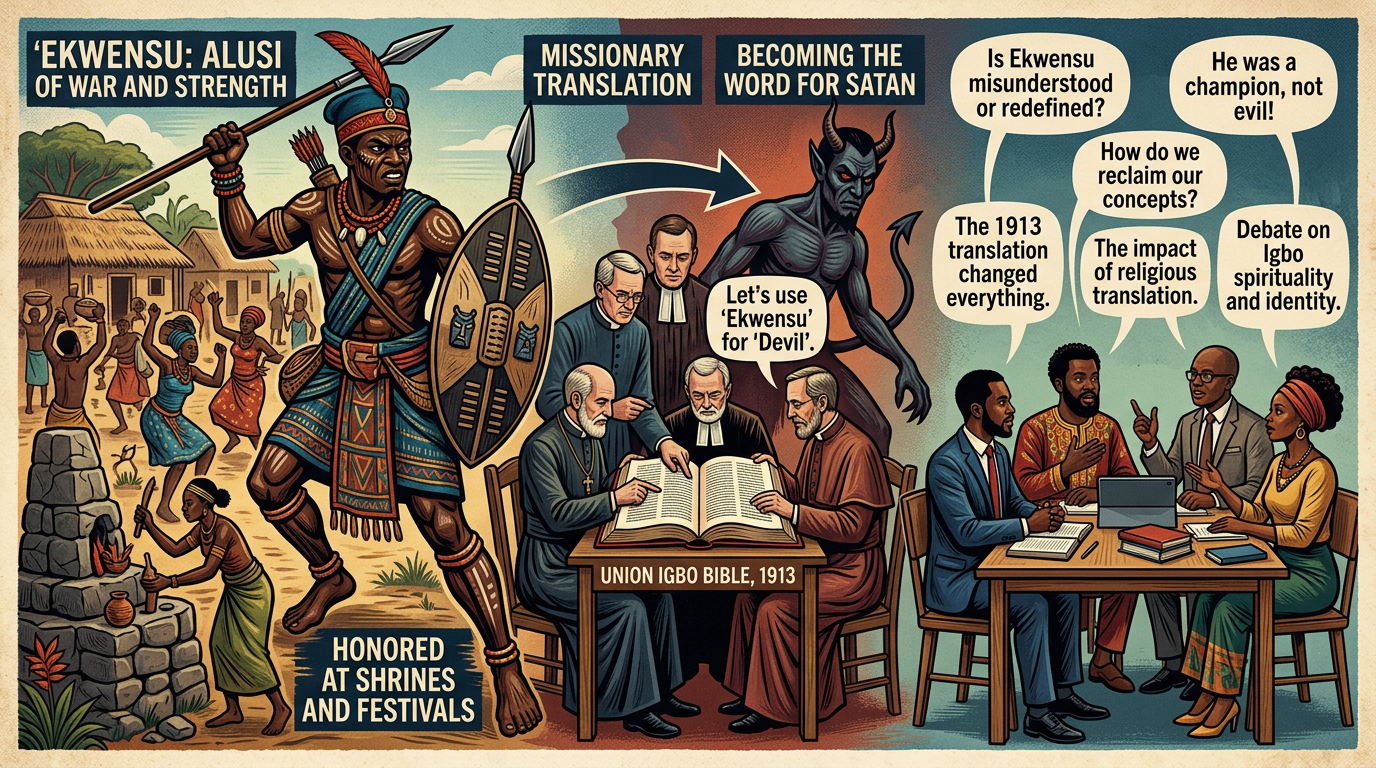
That image, from Entry VII of the Journal of the Archivist, On a Name Given to the Enemy, captures the subject of this field study. Ekwensu was a spiritual power of the Igbo people of southeastern Nigeria, honored as a patron of war and victory, with shrines, festivals, and places named for him. In the age of Christian missions, his name was chosen to translate the Devil. Today, in the Igbo-speaking Christian world, Ekwensu means Satan.
This study follows how that happened, what it meant, and how Igbo scholars have argued about it since. It is prepared for the careful reader of other people’s faiths, who understands that a single word, placed in a new book, can change the meaning of a people’s past.
❧ ❧ ❧
II. A Note on This Study, Its Companion Entry, and Its Limits
This field study accompanies Entry VII and follows its principles. The most important of them is stated plainly in the entry: Ekwensu belongs to the religious tradition of the Igbo people, a tradition that is living, practiced, and debated by its own people today. The Archive approaches it as an outsider, through the work of Igbo scholars and historians. What follows is a record of what they have written, not a claim to speak for them.
Most Igbo people today are Christian, and for many of them the identification of Ekwensu with the Devil is part of their faith. Others practice or are reviving the older tradition, often called Odinani or Omenala. Igbo scholars disagree about how Ekwensu should be understood, and the disagreement is theirs to conduct. This study sets out the evidence and the arguments, and it does not declare a winner.
The study also records the limits of the evidence. Sources for Ekwensu before the missions are largely oral traditions recorded later, and some popular accounts of his character rest on weak or uncited sources. Where that is so, it is noted.
❧ ❧ ❧
III. The Igbo Spiritual World
To understand what Ekwensu was, it is necessary to understand the world in which he was honored. The Igbo spiritual tradition varied considerably from community to community, for the Igbo lived for most of their history in many independent towns and village groups rather than under a single kingdom. What follows is a general outline drawn from Igbo scholarship.
Chukwu and the Alusi
At the summit of the Igbo spiritual order stood Chukwu, also called Chineke, the supreme God and creator, remote and great. Between Chukwu and human beings lay a multitude of spiritual powers, the alusi, each with its own domain. Among the most important was Ala, or Ani, the earth goddess, guardian of morality and fertility. Others governed thunder, rivers, markets, divination, and war. Each person also had a chi, a personal spiritual counterpart that shaped their destiny.
Where Evil Lived
As the companion entry noted, Igbo scholars describe the older moral world as having no single being of absolute evil set against the supreme God. Spiritual powers acted within their own spheres. A power that brought harm might be enforcing justice, punishing an offense against the earth or the community. Wrongdoing was understood largely in terms of human conduct: abominations against the earth, called nso ala, which disturbed the moral order and required ritual correction.
Gods Who Could Be Dismissed
The relationship between communities and their alusi was, in important respects, reciprocal. A power was honored because it served its people. Chinua Achebe and other Igbo writers have described how a community could abandon or even destroy the shrine of a deity that failed it. The Igbo spiritual world was not a fixed hierarchy of good against evil, but a set of relationships, negotiated and renegotiated, between people and the powers around them.
❧ ❧ ❧
IV. Field Study — Who Was Ekwensu?
A Power of War
In the work of Igbo scholars, Ekwensu appears above all as an alusi of war and victory, the power to whom warriors looked for protection and success in battle when lives, land, and property were threatened. In a world of independent communities, where conflict over land and resources was a real and recurring danger, such a power was essential. A patron of war was not a patron of evil. He was a defender of the community.
Cunning and Bargaining
Some accounts extend Ekwensu’s domain to cunning, negotiation, and the hard intelligence of trade, and associate him with trickster qualities. Other accounts connect him with violence and disorder. These characterizations vary between communities and between writers, and some appear in popular sources with weak documentation. It is likely that Ekwensu was understood differently in different places, as many alusi were, and that the forceful, dangerous aspects of a war power made him ambivalent rather than simply benign.
The Evidence of Shrines and Festivals
The strongest evidence for how Ekwensu was regarded comes from his place in community life. The Igbo scholar Damian Opata, in his 2005 study Ekwensu in the Igbo Imagination, documented shrines to Ekwensu in the Nsukka area, including, in some communities, a shrine at which the final rite of a high title was performed. The historian Elizabeth Isichei recorded an annual Ekwensu festival at Asaba. Hills, groves, and other places bear his name. As the companion entry put it, one does not ordinarily name a hill after a thing one regards as purely evil.
These are the facts on which Igbo scholars such as Chika Okpalike and Christian Chukwu, in their 2022 study, base their argument that the older tradition did not conceive Ekwensu as evil. A deity honored in festivals, associated with high titles, and remembered in the landscape was a respected power of the community, whatever his dangers.
❧ ❧ ❧
V. The Missions Arrive
Christian missions came to Igboland in the second half of the nineteenth century.
Onitsha, 1857
In 1857 the Church Missionary Society, the evangelical Anglican mission, established a station at Onitsha on the Niger River. The mission was led by Samuel Ajayi Crowther, a Yoruba man who had been enslaved as a boy, freed, educated in Sierra Leone, and ordained; he would become the first African Anglican bishop. Working with him was John Christopher Taylor, a Sierra Leonean of Igbo descent, who began translating Christian texts into Igbo. Roman Catholic missions followed in the 1880s, with the Holy Ghost Fathers at Onitsha, and the two churches competed vigorously for converts in the following decades.
Schools and Scripture
The missions brought schools, literacy, and printed books in Igbo: primers, catechisms, hymnals, and portions of scripture. Conversion was slow at first, but in the early twentieth century, under colonial rule and with the growth of mission education, it accelerated dramatically. Over the following generations, the Igbo became one of the most heavily Christian peoples of Africa.
❧ ❧ ❧
VI. Field Study — The Problem of a Word
A Concept Without a Name
Translation of the Christian scriptures required words for Christian concepts. Some were easy: the language had words for God, spirit, sin, and sacrifice, even if their meanings did not match exactly. But Christianity also required a word for the Devil, Satan, the supreme adversary of God, the personification of absolute evil. As the companion entry observed, Igbo had no ready equivalent, because, on the account of Igbo scholars, the older tradition had no such concept.
The Choice
A translator facing this gap has a few options: borrow the foreign word, invent a new term, or adopt an existing word whose meaning can be stretched. In Igbo, the choice fell on Ekwensu. Why this power, rather than another, is not documented in any statement by the translators that the Archive has found. Igbo scholars have suggested that Ekwensu’s association with war, violence, cunning, and danger made him seem, to outsiders and perhaps to some converts, the nearest available counterpart to a figure of destruction and deception.
When and Where
The companion entry noted that it could not establish in which text the equation of Ekwensu with Satan first entered print, and that it distrusted confident dates offered without evidence. This study shares that caution. What can be said is that the identification was established in the Christian literature of Igboland during the mission era, and that it was fixed for generations by the Union Igbo Bible. That translation, led by the Anglican archdeacon Thomas John Dennis, was published as a New Testament in 1908 and as a complete Bible in 1913. Dennis died in 1917 when his ship was torpedoed off the coast of Ireland. His Bible, written in a standardized form of Igbo designed to serve all dialects, became one of the most widely read books in the language.
A Contested Book
The Union Igbo Bible was itself controversial. Its artificial standard language was criticized for decades, and Chinua Achebe, the greatest of Igbo novelists, was among those who argued that it had harmed the development of the Igbo language. It was nonetheless enormously influential, and through it the identification of Ekwensu with Satan entered the daily speech of Igbo Christians.
❧ ❧ ❧
VII. What the Word Did
The consequences of the translation reached far beyond the pages of scripture.
A New Moral Map
With the Devil came a new moral structure: a world divided between God and his adversary, in which evil was not only human wrongdoing but the work of a cosmic enemy. In a separate study of the origins of the Christian Devil and its connection to Ekwensu, Okpalike describes how, among Igbo Christians, Ekwensu has come to be blamed as the cause of everything negative: failures, accidents, illness, even mechanical breakdowns. A war power of the older tradition became the explanation for every misfortune in the new one.
The Shrines Judged by the Name
Once Ekwensu meant Satan, his shrines became, in Christian eyes, shrines to the Devil; his festivals became devil worship; those who honored him became, by definition, worshippers of evil. As the companion entry observed, when a name is chosen to carry a foreign meaning, it carries its shrines and its festivals with it, and they are judged by what the name has been made to mean.
A Word in Daily Life
Today, the word Ekwensu is heard in Igbo churches, prayers, sermons, and songs as the name of the Devil. For many Igbo Christians, this is simply what the word means, and they use it without reference to its older history. The older meaning survives in scholarship, in some traditional communities, and in the work of those who seek to revive or reinterpret the older religion.
❧ ❧ ❧
VIII. Field Study — The Debate Among Igbo Scholars
The meaning of Ekwensu is the subject of a real and continuing debate, conducted largely by Igbo writers.
The Demonization Argument
Damian Opata’s 2005 study, whose title asks whether Ekwensu is a heroic deity or a Christian devil, argues that a respected deity of war was deliberately demonized in the service of conversion. Okpalike and Chukwu’s 2022 study similarly points to the shrines, rituals, festivals, and place names as evidence that the ancient Igbo did not regard Ekwensu as evil, and argues that Igbo thought located evil in human conduct rather than in a spirit opposed to God. Okpalike’s related work traces the Christian Devil to Jewish and Western sources and argues that Ekwensu took on the Devil’s identity only through Christianity.
The Christian Reading
Other Igbo writers, writing from within Igbo Christianity, have accepted the identification and described Ekwensu as the most wicked of spirits. From this perspective, the older tradition’s war power is rightly understood as a spirit of violence and destruction, and the translation recognized something real rather than inventing it. The companion entry was right to record this view without dismissing it: it is held sincerely by many Igbo Christians, and it is part of the history of Igbo Christianity.
The Revival
In recent years, some Igbo people, particularly those involved in reviving or reaffirming Odinani, have sought to recover Ekwensu’s older meaning and to challenge his identification with the Devil. Their work takes many forms, from scholarship to public discussion and teaching.
Whose Debate
The Archive does not take a side. The debate concerns the identity, history, and faith of the Igbo people, and it belongs to them. What the Archive can record is that the evidence for Ekwensu’s honored place in the older tradition is substantial, and that the identification with Satan is a product of the mission era. How Igbo people today choose to understand that history is theirs to decide.
❧ ❧ ❧
IX. Translation Reconsidered
It would be too simple to treat missionary translation only as a weapon. The Gambian scholar Lamin Sanneh, in his influential study Translating the Message, argued that the translation of Christian scripture into African languages had profound and often unexpected effects. By treating African languages as worthy vehicles for the sacred, translation helped preserve and standardize them, encouraged literacy, and gave African Christians the means to interpret Christianity on their own terms.
The Igbo case shows both sides. The missionary enterprise produced the first printed Igbo books, a standard written language, and generations of readers. It also fixed, in the most authoritative text available, a meaning for Ekwensu that cast a respected power of the older religion as the enemy of God. The same process that dignified the Igbo language could, in a single word, diminish an Igbo tradition.
The Archivist’s observation in the companion entry stands: a translation is never only a matter of words.
❧ ❧ ❧
X. The Pattern: Baal, Beelzebub, and Others
The companion entry placed Ekwensu beside a case the Archive has studied before, in Field Study No. XXVI: Baal, the storm god of the ancient Levant.
Baal
Baal is known to us chiefly through the writers of the Hebrew Bible, who opposed his worship. In the second book of Kings, a god of the Philistine city of Ekron is called Baal-zebub, often translated “lord of the flies,” a name many scholars believe was a mocking distortion of Baal-zebul, “Baal the prince.” By the time of the New Testament, Beelzebul had become a name for the prince of demons, and in later Christian demonology Beelzebub was a great lord of hell. A Canaanite god of storm and fertility had become a devil.
A Pattern, Not a Lineage
As the companion entry insisted, the resemblance between the two cases is one of pattern, not of history. Nothing connects Ekwensu to Baal but a habit common to many religions in many centuries: the habit of turning another people’s god into one’s own enemy. The Greek word daimon, which once meant a divine power or guiding spirit, became the Christian demon. The pattern recurs because it serves a purpose. It allows a new faith to explain the old one, not as a different truth, but as the work of the adversary.
The Next Carrel
The companion entry ended by noting that, in the next carrel, a study of Èṣù, the Yoruba keeper of crossroads and messages, was already growing thicker, because his name met a similar fate in another translation. That study is for another night.
❧ ❧ ❧
XI. Field Study — The Ledger of a Name
Established
Ekwensu was an alusi of the Igbo spiritual tradition, associated in Igbo scholarship with war and victory and honored with shrines, festivals, and place names; the Church Missionary Society established its mission at Onitsha in 1857; Christian translation into Igbo adopted Ekwensu as the word for Satan; the Union Igbo Bible, published in 1908 and 1913, fixed that usage for generations; in Igbo Christian speech today, Ekwensu means the Devil.
Supported by Igbo Scholarship
That the older tradition did not conceive of a single being of absolute evil opposed to Chukwu; that Ekwensu was not regarded as evil before the missions; that the identification was a product of the mission era.
Uncertain
The first printed text in which Ekwensu was equated with Satan; the reasons the translators chose Ekwensu; the full range of his character in different communities, including the trickster and bargaining associations, which are variably documented.
Contested
Whether the identification was a deliberate demonization or a translation that recognized a real character of the deity; how Ekwensu should be understood today. These questions belong to the Igbo people and their scholars.
❧ ❧ ❧
XII. The Archivist’s Conclusion
Ekwensu was, by the evidence of his shrines, his festivals, and the hills that bear his name, a respected power of the Igbo world: a patron of warriors and of victory, honored by communities that needed his protection. He may also have been dangerous, cunning, and ambivalent, as war itself is. He was not, by the evidence Igbo scholars have gathered, the absolute enemy of the supreme God, because the older tradition had no such figure.
He became that figure through translation. When the Christian scriptures were rendered into Igbo, a word was needed for the Devil, and his name was chosen. Through the Union Igbo Bible and generations of preaching, the choice became permanent. The older Ekwensu survives in scholarship, in memory, and in the work of those who seek to restore him. The newer Ekwensu lives in the prayers of millions.
The Archive does not ask which is right. It asks only that both be remembered, and that the reader understand how one became the other. In the translators’ room at Faulkenmire, the ribbon has been lifted, but the pale line it left across both pages remains. It is the same line in each. That is what a translation can do: join two words so closely that, long after the ribbon is gone, the mark of their joining cannot be erased.
❧ ❧ ❧
This field study is preserved as one vestige among many within the haunted archive of Wicked Dual, an artisan boutique devoted to the reclamation of history’s clandestine and silenced corners. It is filed as the companion to Entry VII of the Journal of the Archivist, On a Name Given to the Enemy, and is kept with respect for the Igbo people, Christian and traditional alike, to whom this history and its debate belong.
Read the written chronicles on the blog, the Wicked Archive: www.wickeddualblog.com
Secure the physical artifacts drawn from these histories at the Wicked Dual boutique: https://www.etsy.com/shop/Wickeddual
We invite you to enter the haunted archive and secure a piece for your private collection; it is a necessary addition for those who curate the darker corners of human history.
— The Archivist of the Unseen

Bibliography
The following works include the further studies named in the companion entry, Igbo scholarship on Ekwensu and the Christian Devil, histories of the missions in Igboland, and studies of missionary translation; Opata’s title appears in slightly different forms in the literature, and readers pursuing formal citation are advised to verify editions and pagination against a library catalog.
Achebe, C. (1958). Things fall apart. Heinemann.
Isichei, E. (1976). A history of the Igbo people. Macmillan.
Pagels, E. (1995). The origin of Satan. Random House.
Sanneh, L. (2009). Translating the message: The missionary impact on culture (2nd ed.). Orbis Books.
Related Chronicles in the Archive
Journal of the Archivist, Entry VII — On a Name Given to the Enemy
Field Study No. XXVI — The Lord of the Storm: Baal
Field Study No. XXXI — The Dancers Beneath the Mamelles: The Yumboes of Senegal
Leave a Reply