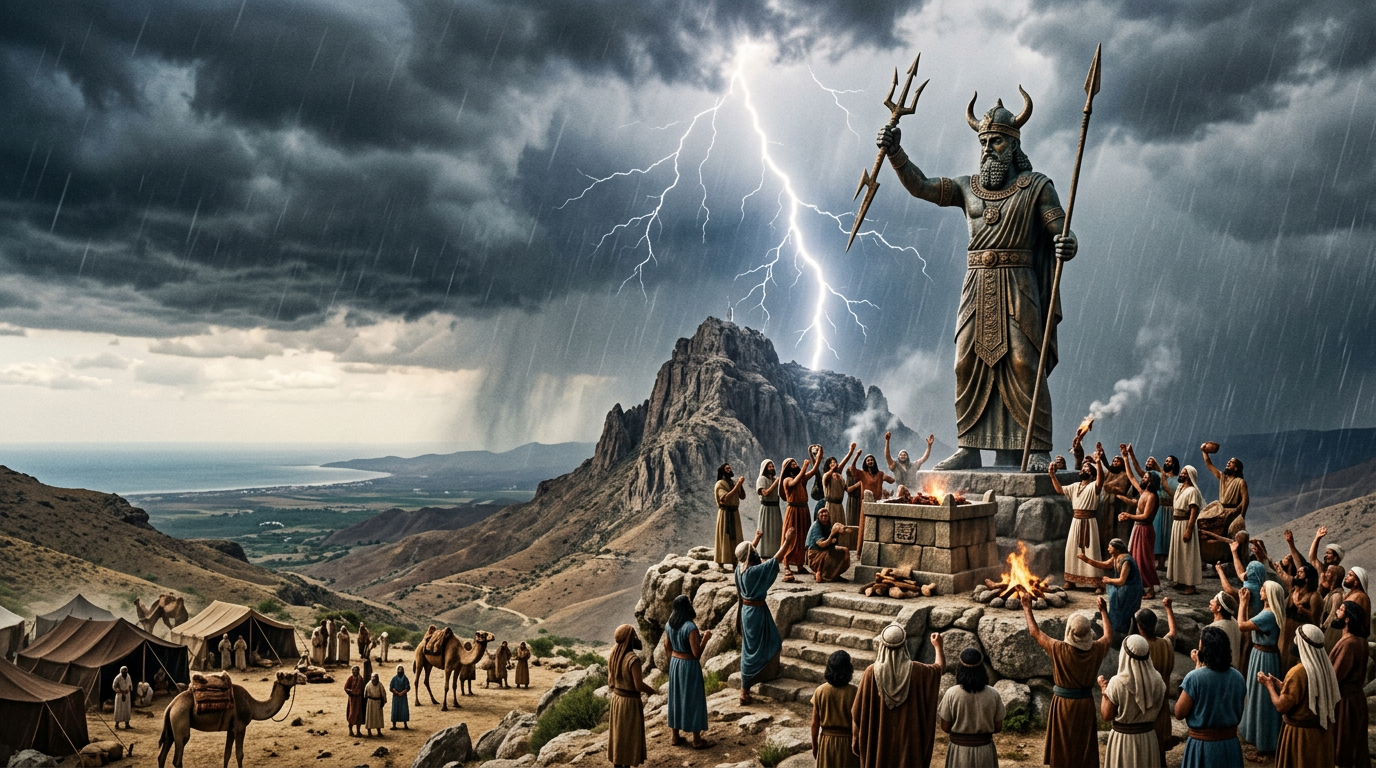
and the Enemy of the God of Israel

“To his worshippers he was the rider on the clouds, the god who died and rose with the rains, the lord who gave the land its life. To the prophets of Israel he was the great rival, the false god, the enemy at the heart of the nation. He is one god, seen through two sets of eyes.”
An Archival Chronicle Prepared for the Discerning Collector
Compiled by the Archivist of the Unseen
Contents
I. The God With Two Faces
II. A Note on Sources: The God, His Enemies, and the Buried Library
III. The Name That Means ‘Lord’: What Baal Actually Was
IV. Field Study — Ugarit: The God Recovered From the Dust
V. The Baal Cycle: The Storm God’s Myth of Death and Return
VI. The God as Worshipped: Storm, Fertility, and Kingship
VII. An Archival Aside: On the Writing of History by the Victors
VIII. Baal in the Hebrew Bible: The Great Rival
IX. Field Study — The Contest on Mount Carmel
X. Jezebel, the Prophets, and the War Against Baal
XI. The Interconnection: One God, Two Portraits
XII. The Difficult Questions: Sacrifice, Polemic, and the Evidence
XIII. The Afterlife of the Name: From God to Demon
XIV. The Lord of the Storm and the Silence That Followed
Bibliography
I. The God With Two Faces
Picture two men, in two different lands, speaking of the same god. The first stands in a temple in the great port city of Ugarit, on the coast of what is now Syria, more than three thousand years ago. He lifts his eyes and speaks of Baal with love and awe: the rider on the clouds, the god of the storm whose voice is the thunder and whose spear is the lightning, the lord who brings the rains that make the barley grow and the flocks increase; the god who did battle with Death itself, who died and descended into the underworld, and who rose again with the returning rains, so that the land might live. To this man, Baal is life itself — the great and beloved god who stands between his people and the barren death of drought.
The second man stands in the hills of Israel, some centuries later, and when he speaks the same name it is with loathing and fury. To him, Baal is the great enemy — the false god, the abomination, the idol whose worship draws his people away from the one true God of Israel; the rival for the soul of the nation; the deity whose prophets must be confronted, whose altars must be thrown down, whose very name must be blotted out. To this man, Baal is not life but the deepest of betrayals, the seductive lie against which the whole faith of Israel defines itself.
Same god; two faces; two sets of eyes. This field study takes as its subject Baal — one of the most important gods of the ancient Near East, and one of the most reviled figures in the Hebrew Bible — and its central purpose is to trace the interconnection between these two Baals: the great and genuinely worshipped storm god of Canaan, known to us from the recovered libraries of the ancient Levant, and the hated rival of the God of Israel, known to us from the pages of scripture. For they are not two different figures but one, described by his devotees and by his enemies — and the gap between the two portraits, and the genuine religious conflict that produced it, is among the most fascinating and consequential stories in the entire history of religion. To understand Baal is to understand both how a god was loved and how a god was hated, and to see, in the space between, the birth of one of the world’s great faiths.
The pages that follow are prepared for the discerning collector of the god seen from both sides — the reader who wishes to understand not only what a people believed but what their enemies said of them, and who values the honest reconstruction of a maligned figure from beneath the polemic of his opponents. Baal was a great god and a great villain, depending on who held the pen; and this chronicle attends to both the worship and the war, the storm god of Canaan and the enemy of the Lord.
❧ ❧ ❧
II. A Note on Sources: The God, His Enemies, and the Buried Library
Before the two Baals can be understood, a note on the sources is essential — more essential here than in almost any other study in this archive — for the peculiar history of what we know about Baal, and how we came to know it, governs everything that follows and is itself the key to the whole subject. For most of the last two thousand years, Baal was known almost entirely through the words of his enemies.
Until less than a century ago, the principal source for Baal was the Hebrew Bible — that is, the writings of the very religious tradition that opposed him most fiercely. The Baal of Western memory was therefore, for most of history, the Baal of his opponents: a figure known only through hostile eyes, described only by those who wished to discredit him, his worship characterized only by those who sought to destroy it. This is a situation almost unique in the study of ancient religion, and it produced a deeply distorted picture — for to know a god only through his enemies is to know a caricature, a villain, a straw idol, rather than the living object of genuine devotion he was to his own worshippers. The Baal of the Bible is real, but he is Baal as his enemies saw him, and for two millennia that was the only Baal the West knew.
This changed, dramatically and suddenly, in the twentieth century. In 1928, a chance discovery in Syria led to the excavation of the ancient city of Ugarit, at a site called Ras Shamra, and there archaeologists uncovered something extraordinary: a buried library of clay tablets, written in a previously unknown alphabetic cuneiform script, dating to the Late Bronze Age, more than three thousand years old. When the script was deciphered, the tablets proved to contain, among much else, the actual religious texts of the Canaanite world — the myths, the hymns, the rituals — including a great cycle of poems about Baal himself. For the first time in more than two millennia, Baal could be heard in the words of his own worshippers rather than only those of his enemies. The buried library of Ugarit gave back to the world the Baal that the Bible had buried: the beloved storm god, described with reverence by the people who worshipped him. This study depends utterly on that recovery, and on the resulting ability to compare the two Baals — the god of his devotees and the villain of his enemies — which was impossible before 1928 and is the central opportunity of the modern study of the subject. The discerning reader should hold this always in mind: we now possess both portraits, and the truth of Baal lies in reading them together.
❧ ❧ ❧
III. The Name That Means ‘Lord’: What Baal Actually Was
Artifact: The Title and the God
The first and most important clarification in any honest study of Baal concerns the name itself, for it is the source of enormous confusion, both ancient and modern: “Baal” is not, in origin, a personal name at all, but a title — and understanding this transforms the whole picture of who and what Baal was. The word carries within it the key to much of the biblical polemic and much of the modern misunderstanding.
The word baʿal in the Northwest Semitic languages — the family of tongues that includes Ugaritic, Phoenician, and Hebrew — means simply “lord,” “master,” or “owner.” It is an ordinary word, used of husbands, of property-owners, of anyone in a position of mastery. As a divine title, it could be, and was, applied to many different gods — “the lord” of this or that place, “the lord” in this or that aspect — so that there was not one “Baal” but many local Baals, each the “lord” of a particular city or shrine or function: Baal of this town, Baal of that mountain, and so on. This plurality is genuine and important, and the Hebrew Bible itself reflects it, sometimes speaking of “the Baals” in the plural, the many local lords worshipped across the land. When the Bible rails against “Baal,” it is often railing against this whole category of local “lord” gods, not always a single specific deity.
But behind the many local Baals stood one great god who was the Baal, the lord above all, and it is he who is the principal subject of this study and the chief “Baal” of both the Ugaritic texts and the biblical polemic. His proper name was Hadad (or Haddu), and he was the great storm god of the Levant — so preeminent that “the Lord,” Baal, became his usual title and effectively his name, much as a supremely important person might come to be known simply as “the Boss” or “the Chief.” Baal Hadad, the storm god, the rider on the clouds, was one of the most important deities of the entire ancient Near East, worshipped across a vast region and a span of many centuries. When this study speaks of “Baal” without qualification, it is chiefly this great storm god, Baal Hadad, who is meant — the specific and mighty deity behind the general title, the true “Lord” whose myth and whose worship the recovered texts of Ugarit reveal, and whose rivalry with the God of Israel the Bible records. The title became the name of the god who most deserved it.
This distinction — between “Baal” as a general title for many local lords and “Baal” as the effective name of the great storm god Hadad — resolves much confusion and sharpens the whole subject. It explains why the Bible can speak of both “the Baals” in the plural and “Baal” as a single great rival; it explains the god’s vast geographic spread under many local forms; and it directs our attention to the genuine central figure, the storm god, whose recovered myth is the necessary foundation for understanding both the god as worshipped and the god as reviled. The chronicle now turns to that recovered myth, and to the buried city that gave it back.
❧ ❧ ❧
IV. Field Study — Ugarit: The God Recovered From the Dust
Artifact: The Ras Shamra Tablets
The recovery of the true Baal — the god as his worshippers knew him — rests upon one of the great archaeological discoveries of the twentieth century, the excavation of Ugarit, and this discovery deserves its own examination, for it is the pivot on which the entire modern understanding of Baal turns, and a genuine drama of the buried past restored to the light. Without Ugarit, this study could not be written.
Ugarit was a wealthy and cosmopolitan city-state on the Mediterranean coast of northern Syria, which flourished in the Late Bronze Age and was destroyed around the twelfth century before the common era, in the great wave of collapse that ended the Bronze Age civilizations. Then it was forgotten — buried, its very name lost, for more than three thousand years. Its rediscovery came by chance: in 1928, a local farmer struck an ancient tomb while ploughing, and the resulting archaeological investigation of the mound called Ras Shamra revealed the lost city beneath. Among its buildings, excavators found archives of clay tablets, and when scholars deciphered their previously unknown script — an early alphabetic cuneiform, now called Ugaritic — they found themselves reading the actual texts of the Canaanite world, a civilization known before chiefly through the hostile lens of the Bible and scattered classical references. It was as though a door had opened directly into the religious world of ancient Canaan.
The religious significance of the find was immense, and it centered on Baal. Among the Ugaritic tablets were the great mythological texts of the Canaanites — and chief among these was a cycle of poems concerning Baal, now known as the Baal Cycle, the fullest surviving account of the storm god’s myth in the words of those who worshipped him. Here, at last, was Baal as his own people saw him: not the villain of his enemies but the beloved hero-god of his devotees, with his own rich mythology, his battles and his triumphs, his death and his resurrection, his kingship among the gods. The Ugaritic texts also revealed the broader Canaanite pantheon — the high god El, the goddesses Asherah and Anat and Astarte, the sea god Yam, the death god Mot — and thereby illuminated the entire religious world against which the faith of Israel would define itself, and from which, in many respects, it emerged. The discovery of Ugarit transformed the study of ancient Near Eastern religion and of the Bible alike, and it gave back to Baal the voice that his enemies had, for two thousand years, silenced.
The discerning collector should appreciate the profound and almost poetic justice of this recovery. A god known for millennia only through the words of those who hated him, whose worship survived only as the villain of someone else’s scripture, was suddenly given back his own voice — his own myths, his own hymns, his own portrait, drawn by loving hands and buried in the dust for three thousand years until the plough and the spade restored them. It is the archive’s deepest work made literal: the recovery of a silenced voice, the restoration of a buried truth, the return of a god from the oblivion to which his enemies had consigned him. The chronicle now turns to what that recovered voice actually says — to the myth of Baal as Ugarit preserved it.
❧ ❧ ❧
V. The Baal Cycle: The Storm God’s Myth of Death and Return
Artifact: The Great Poem
The heart of the recovered Baal is the Baal Cycle — the great sequence of Ugaritic poems recounting the god’s central myth — and it must be recounted in its essentials, for it reveals the true character and significance of the storm god as his worshippers understood him, and it stands as one of the major mythological texts of the ancient Near East, a worthy companion to the epics of Mesopotamia and the myths of Greece. The Cycle tells of Baal’s struggle to achieve and secure his kingship, through two great conflicts.
The first great conflict is Baal’s battle against Yam, the god of the sea — the personification of the chaotic, destructive waters, the roaring and untamable ocean. Yam demands mastery and tribute, threatening the order of the divine world; and Baal, the storm god, goes to war against him. Armed with two magical weapons fashioned by the divine craftsman, Baal strikes down Yam and defeats the chaos of the sea, establishing himself as a mighty god and a defender of cosmic order against the forces of chaos. This victory of the storm god over the sea is a genuinely ancient and widespread mythological theme — the divine warrior who defeats the chaos-waters and thereby establishes order — and it resonates across the mythologies of the ancient Near East, with echoes, as scholars have long noted, in certain poetic passages of the Hebrew Bible itself, where the God of Israel is likewise depicted defeating the sea and its monsters.
The second and more profound conflict is Baal’s confrontation with Mot — Death itself, the god of the underworld, of sterility and the barren land. In this part of the Cycle, Baal is summoned down to the realm of Mot, and there the storm god — the god of life-giving rain — is swallowed by Death and dies, descending into the underworld. With Baal dead, the effect upon the earth is catastrophic: the rains fail, the land withers, drought and sterility grip the world, for the god of the fertilizing storm is gone. The high god El and the fierce goddess Anat, Baal’s sister and ally, mourn him terribly; and Anat, in her grief and rage, pursues Mot, seizes Death, and destroys him — splitting, winnowing, burning, and grinding him like grain. And with the destruction of Death, Baal returns to life, rising from the underworld, and with his resurrection the rains return, the land revives, and fertility floods back into the world. The storm god has died and risen, and the earth dies and lives with him.
The meaning of this myth is transparent and profound, and it reveals exactly why Baal was so beloved and so central. The death and resurrection of Baal is the myth of the agricultural year in the Levantine climate — the annual cycle of the fertile rainy season and the killing dry season, figured as the death and return of the storm god. When Baal is dead, in the grip of Mot, it is the dry season, the drought, the barren months when nothing grows; when Baal rises, it is the return of the rains, the revival of the land, the renewal of life. This bound the god intimately to the survival of his people, for in an agricultural society dependent on the seasonal rains, the god who brought those rains — who died and rose that the land might live — was quite literally the god of life and death, of survival itself. Baal was not an abstract deity but the very power that stood between his people and starvation, the god whose death was drought and whose resurrection was the saving rain. To worship Baal was to pray for the rains that meant life; and this, more than anything, explains both the depth of his worship and the ferocity of the conflict when the prophets of Israel demanded that their people abandon him.
❧ ❧ ❧
VI. The God as Worshipped: Storm, Fertility, and Kingship
Artifact: The Beloved Lord
Drawing together the recovered evidence, a fuller portrait of Baal as he was genuinely worshipped can be assembled — the god as his devotees knew and loved him, across the many centuries and the wide lands of his cult — and this portrait is essential as the counterweight to the biblical polemic, for it shows the living god behind the scriptural villain. Baal was, to his worshippers, a magnificent and beloved deity.
He was, first, the god of the storm — the rider on the clouds, whose voice was the thunder, whose weapon was the lightning, whose gift was the rain. He was depicted in art as a powerful warrior god, often striding forward with a raised mace or club and a spear or thunderbolt, the very image of divine power and martial vigor. He was, second and inseparably, the god of fertility — not in the crude sense the polemic implies, but in the fundamental sense that the rains he brought were the source of the land’s fertility, the water without which the crops failed and the people starved. His storms watered the earth; his death was drought and his resurrection was abundance; he was the god who made the land productive and the people fed. And he was, third, a god of kingship and order — the divine warrior who defeated chaos (Yam) and death (Mot), who won and held kingship among the gods, who maintained the cosmic order against the forces that would unmake it. His temple at Ugarit was among the greatest structures of the city, and his worship was central to the life of the community.
This was a god worthy of devotion, and devotion he received, across a vast region and for many centuries — in Ugarit and the Canaanite cities, among the Phoenicians who carried his worship across the Mediterranean, and, crucially for the biblical story, among the very people of Israel, many of whom worshipped Baal alongside or instead of the God of Israel throughout the biblical period. This last point is essential and is confirmed by both the Bible and the archaeological record: Baal was not merely the god of Israel’s foreign enemies but a genuine and persistent object of worship within Israelite society itself, a deity to whom many Israelites were sincerely devoted, and whose cult was deeply rooted in the land. The conflict over Baal, as the next sections will show, was therefore not a war against a foreign god alone but a struggle for the religious soul of Israel itself — a civil war of the spirit, fought over a god whom many Israelites loved and many others came to see as the ultimate betrayal. To understand the ferocity of the biblical polemic, one must first understand this: that Baal was a beloved and beautiful god, genuinely worshipped by many of the very people whose scripture would come to revile him, and that the prophets were fighting not a distant enemy but a beloved rival in the hearts of their own people.
❧ ❧ ❧
VII. An Archival Aside: On the Writing of History by the Victors
It is worth pausing upon the profound methodological and moral lesson that the study of Baal so vividly teaches: that history is written by the victors, that the vanquished are remembered through the words of those who defeated them, and that the honest recovery of a maligned figure requires the deliberate effort to hear the silenced voice beneath the triumphant one. Baal is among the clearest cases in all of history of a figure known, for most of time, only through his enemies.
The discerning collector will recognize the pattern, for it is one of the deepest and most consequential in the whole record of the past: the defeated party, the losing side, the suppressed religion, remembered only in the account of the victors, its truth distorted or erased, its adherents transformed into villains in someone else’s story. For two thousand years, Baal was such a figure — a great god reduced to a scriptural byword for idolatry and abomination, his rich mythology and sincere worship forgotten, his very name become a synonym for false religion. Had Ugarit never been found, this would be all we ever knew of him: the villain of his enemies, with no voice of his own. The recovery of the Ugaritic texts is therefore a parable of the archive’s deepest purpose — the restoration of the silenced voice, the recovery of the vanquished’s own truth, the insistence that even the defeated deserve to be heard in their own words rather than only in the words of those who overcame them. Wicked Dual exists in sympathy with precisely this work: the conviction that history’s losers, its maligned and suppressed and forgotten, deserve recovery and a fair hearing, and that to restore a buried voice — even the voice of a god his enemies thought they had silenced forever — is among the truest and most necessary labors that the keeping of the past can perform.
This is the disposition the chronicle maintains: that Baal deserves to be understood as his worshippers understood him, not merely as his enemies portrayed him, and that the honest study of him requires holding both portraits together — the beloved god and the reviled villain — while remembering always that for most of history only the villain was heard. This does not mean dismissing the biblical portrait, which is a genuine and important historical source in its own right and the record of a real and momentous religious struggle; it means reading that portrait critically, as the account of one side in a conflict, and setting it beside the recovered voice of the other. The chronicle now turns to that biblical portrait — to Baal as the Hebrew Bible presents him, the great enemy of the God of Israel.
❧ ❧ ❧
VIII. Baal in the Hebrew Bible: The Great Rival
Artifact: The Scriptural Enemy
In the Hebrew Bible, Baal appears not as a beloved god but as the great and recurring enemy — the false god above all others, the idol whose worship represents Israel’s deepest and most persistent temptation and betrayal — and the biblical portrait, however hostile, must be understood in its own terms, for it is a genuine historical record of a real religious conflict and one of the central themes of the entire Hebrew scripture. Baal is, in a sense, the Bible’s chief theological antagonist among the gods.
The struggle against Baal runs through much of the Hebrew Bible, and especially through the historical and prophetic books. Again and again, the biblical narrative describes the people of Israel “going after” Baal — abandoning the worship of their own God to serve the storm god of Canaan — and again and again this is presented as the gravest of sins, the fundamental apostasy, the betrayal that brings down divine judgment upon the nation. The prophets thunder against Baal-worship; the reforming kings tear down his altars; the narrative frames the entire history of Israel and Judah in significant part as a long struggle between the worship of the true God and the seductive apostasy of Baal. This was, the Bible makes clear, no minor or occasional matter but a central and recurring crisis, the great religious battle of Israel’s existence — and the persistence with which the theme recurs is itself evidence of how deeply rooted and how genuinely tempting the worship of Baal was within Israelite society.
The reason for the conflict’s intensity lies in the nature of the two religions and their claims. The emerging faith of Israel was moving toward monotheism — or at least toward the exclusive worship of one God, who demanded that his people worship him alone — while the surrounding Canaanite religion, including the worship of Baal, was polytheistic, comfortably accommodating many gods. For a people accustomed to worshipping many deities, adding Baal — the great and beloved storm god who brought the rains — to their devotions, or turning to him in time of drought, was natural and easy; but to the prophets of the exclusive God of Israel, this was the ultimate betrayal, a violation of the fundamental demand that Israel worship its God and no other. The conflict over Baal was thus, at bottom, the conflict between polytheism and the emerging monotheism — between the easy inclusiveness of the old religion and the jealous exclusiveness of the new — and Baal, as the greatest and most beloved of the rival gods, became the focal point and symbol of the whole struggle. To worship Baal was to embody everything the new faith defined itself against; and so the storm god of Canaan became, in the pages of scripture, the great enemy of the God of Israel.
❧ ❧ ❧
IX. Field Study — The Contest on Mount Carmel
Artifact: The Great Confrontation
The single most famous and most dramatic episode in the biblical struggle against Baal — and the story that best captures the whole conflict — is the contest on Mount Carmel between the prophet Elijah and the prophets of Baal, recounted in the biblical book of Kings. It is a set-piece of extraordinary power, and it deserves close examination, for it dramatizes the entire religious conflict in a single vivid confrontation and reveals the theological heart of the struggle.
The story is set in a time when the worship of Baal had, according to the biblical account, gained powerful royal support in the northern kingdom of Israel, promoted by the king Ahab and, especially, his queen Jezebel, a Phoenician princess and devoted worshipper of Baal. The prophet Elijah, champion of the God of Israel, proposes a direct and public test to determine which god is real. On Mount Carmel, before the assembled people, two altars are prepared — one to Baal, one to the God of Israel — each with a sacrificial bull upon it, but neither set alight. The prophets of Baal, hundreds of them, are to call upon Baal to send fire to consume their offering; Elijah, alone, will call upon his God to do the same. The god who answers with fire is the true God. It is a contest, fittingly, of divine power made visible — and fire from heaven is, tellingly, exactly what one might expect of a storm god who wields the lightning, so that the test is staged, in a sense, on Baal’s own ground.
The prophets of Baal go first, and the account of their failure is vivid and, in the biblical telling, pointedly mocking. They call upon Baal from morning to noon, crying “Oh Baal, answer us!” but there is no response; they dance about the altar; they cut themselves with blades until the blood flows, in an ecstatic ritual to rouse their god — and still nothing. Elijah taunts them, suggesting with heavy sarcasm that perhaps their god is busy, or traveling, or asleep, or relieving himself, and must be woken. From noon until evening they rave and cry, and still there is no voice, no answer, no fire. Then Elijah builds his altar, soaks it and the offering with water three times over to make the miracle unmistakable, and calls once upon his God — and fire falls from heaven, consuming the offering, the wood, the stones, and even the water in the trench around the altar. The people fall on their faces and proclaim the God of Israel the true God; and in the story’s violent conclusion, the prophets of Baal are seized and slaughtered.
The Carmel narrative is a masterpiece of religious polemic, and it repays reading as such — as the account, from the victorious side, of the defeat of Baal, designed to demonstrate the powerlessness of the storm god against the true God of Israel. Its details are pointed: Baal, the god of storm and lightning, cannot produce fire from heaven, while the God of Israel does so effortlessly, defeating the storm god in his own supposed domain; Baal, for all the frantic devotion of his prophets, is silent, absent, powerless, perhaps (as Elijah mockingly suggests) not there at all; while the God of Israel answers at once. The story dramatizes the entire theological claim of the biblical struggle — that Baal is a false and powerless god, an idol who cannot answer, while the God of Israel is the true and living God — in a single unforgettable scene. The discerning reader should appreciate it both as a genuine and powerful piece of ancient religious literature and as exactly what it is: the victors’ account of the rival’s defeat, the polemic against Baal raised to the level of high drama, the silencing of the storm god rendered as a story. That we can now set beside it the Ugaritic texts, in which the same Baal is a mighty and answering god, is the great gift of the modern recovery — and the reason we can read Carmel as one side of a story rather than the whole of it.
❧ ❧ ❧
X. Jezebel, the Prophets, and the War Against Baal
The struggle against Baal was embodied, in the biblical narrative, in a series of memorable human figures — the royal patrons of Baal and the prophetic champions of the God of Israel — and their stories flesh out the conflict and reveal its political as well as its religious dimensions. Chief among the human faces of the struggle is Jezebel, whose very name has become, through the biblical polemic, a byword.
Jezebel, according to the biblical account, was a princess of the Phoenician city of Tyre — a center of Baal worship — who married Ahab, king of the northern kingdom of Israel, and brought her devotion to Baal with her into the heart of the Israelite monarchy. The Bible presents her as the great royal patron and promoter of Baal-worship, supporting his prophets, opposing and persecuting the prophets of the God of Israel, and using royal power to advance the storm god’s cult — the human embodiment of the Baal apostasy at its most powerful and most dangerous. She is portrayed as ruthless, idolatrous, and wicked, the great villainess of the narrative, and her eventual violent death is presented as fitting divine judgment. So thoroughly did the biblical polemic succeed that her name, “Jezebel,” became and remains a synonym for a wicked, scheming, or immoral woman — a striking example of the power of the victors’ account to shape memory across three thousand years. The discerning reader should note, as scholars do, that Jezebel is known to us essentially only through the account of her bitter enemies, and that a Phoenician princess devoted to her ancestral god, promoting that god’s worship in her new kingdom, would have seen herself and been seen by her own people very differently — not as a villainess but as a faithful royal patron of a great and legitimate deity.
Against Jezebel and the royal house stood the prophets — Elijah and, after him, Elisha, and the broader prophetic movement — who championed the exclusive worship of the God of Israel and led the resistance to Baal. The conflict, as the Bible presents it, was thus also a political struggle between the monarchy, which for a time supported Baal, and the prophetic movement, which opposed it; a struggle that ran through the history of the northern kingdom and culminated in violent upheavals, the overthrow of dynasties, and the bloody suppression of Baal-worship by kings and prophets who championed the God of Israel. The war against Baal was fought with real violence — the slaughter of Baal’s prophets at Carmel, the killing of Jezebel, the destruction of Baal’s temple and worshippers in later purges — and the biblical narrative presents this violence as righteous, the necessary purging of a deadly apostasy. Here too the discerning reader must hold the two perspectives together: what the Bible presents as righteous zeal against false religion was, from the other side, the violent suppression of a genuine and beloved faith and the killing of its devoted adherents. The war against Baal was real, and bloody, and its history — like all such histories — was written by the side that won.
❧ ❧ ❧
XI. The Interconnection: One God, Two Portraits
Having examined both the Baal of Ugarit and the Baal of the Bible, the chronicle can now address directly its central question: how the two interconnect — how the beloved storm god of Canaan and the reviled enemy of the God of Israel are related, and what their relationship reveals. The answer is the key to the whole subject, and it is both simple and profound: they are the same god, seen from opposite sides of a religious war.
The interconnection is, at its foundation, one of simple identity: the Baal whom the Ugaritic texts celebrate and the Baal whom the Bible reviles are, substantially, the same deity — the great Northwest Semitic storm god, Baal Hadad, and his local Canaanite forms. The god whose death and resurrection the Baal Cycle recounts with reverence is the same god whose prophets Elijah defeats and mocks on Mount Carmel. The two portraits differ not because they describe different gods but because they are drawn by opposite parties in a genuine religious conflict: the one by his devoted worshippers, celebrating his power and his gifts; the other by his fiercest enemies, denying his power and condemning his worship. To read the two together is to see a single god in stereo — the same figure rendered in love and in hatred, in worship and in polemic — and the space between the two portraits is precisely the space of the religious struggle that produced them. This is the deepest sense of the interconnection: Baal is the point where two religions met and fought, and his double portrait is the record of that meeting, drawn from both sides.
But the interconnection runs deeper still, into the very formation of the faith of Israel, for the two were not merely opponents but were bound together in a relationship of profound and intimate influence. Scholars have long recognized that the religion of Israel emerged from within the broader Canaanite religious world — that the Israelites were, in significant part, culturally Canaanite themselves, and that their religion developed in dialogue with, and in reaction against, the surrounding Canaanite religion of which Baal was a central figure. This produced deep and fascinating interconnections. Some of the imagery and language once associated with Baal appears, in the Hebrew Bible, transferred to the God of Israel — the God of Israel, too, is depicted as a storm god who rides the clouds, who thunders, who gives the rain, who defeats the chaos-sea and its monsters, attributes that Baal’s worshippers ascribed to their own god. In defining itself against Baal, the emerging faith of Israel both rejected the storm god and, in certain respects, absorbed and transformed his attributes into its own conception of God. The relationship was thus not simply opposition but a complex process of rivalry, reaction, differentiation, and absorption — the new faith forging its identity in a long and intimate struggle with the old, taking from it even as it rejected it. Baal was not merely the enemy of the God of Israel; he was, in a sense, part of the religious matrix from which that God’s worship emerged and against which it defined itself.
This, then, is the full interconnection: the same storm god, seen in worship and in polemic; the focal point of the religious war between Canaanite polytheism and Israelite monotheism; and, more intimately still, a formative rival woven into the very emergence of the faith that opposed him, whose attributes were partly absorbed even as his worship was condemned. The two Baals — the beloved god and the reviled enemy — are one god, and their doubled portrait is the record of one of the most consequential religious transformations in human history: the long struggle out of which the monotheism that would shape the Western world emerged, fought over the beautiful and beloved storm god of Canaan. To understand Baal is to stand at the crossroads where two religions met, and to see, in a single god’s two faces, the birth of a new conception of the divine.
❧ ❧ ❧
XII. The Difficult Questions: Sacrifice, Polemic, and the Evidence
No honest study of Baal can avoid the difficult and sensational questions that cluster around his worship — above all the lurid claims of child sacrifice and orgiastic rites — and these must be addressed directly but with heavy scholarly caution, for they are precisely the area where polemic and evidence are most tangled, and where the honest chronicler must work hardest to separate what is known from what was alleged by enemies. The discerning reader deserves a careful accounting rather than either sensationalism or denial.
The popular image of Canaanite and Baal-related religion is dominated by two lurid charges: child sacrifice and sexual license, the “fertility rites” and “temple prostitution” of popular imagination. These charges must be approached with great care, because their principal sources are hostile — the biblical polemic and later classical and Roman-era accounts, all written by opponents or outsiders with strong motives to portray the rival religion as monstrous. The accusation of monstrous practices is one of the oldest and most universal tools of religious polemic, deployed by virtually every religion against its rivals throughout history, and it must always be treated with suspicion when it comes from the mouths of enemies. Much of the lurid popular image of Baal-worship is precisely such polemic — the demonization of a rival faith by those who opposed it — and should not be accepted at face value as historical fact. The “orgies” and “sacred prostitution” in particular are increasingly doubted by scholars, who find the evidence for them thin and heavily dependent on hostile interpretation.
The question of child sacrifice is more genuinely difficult and cannot be so readily dismissed, for here there is some real evidence beyond the polemic. The practice of child sacrifice in the Phoenician-Canaanite world — particularly associated with the term Moloch or molk in the biblical sources, and with the Carthaginian colonies of the Phoenicians in the western Mediterranean — is attested not only in hostile texts but, some archaeologists argue, in physical remains, such as the tophet burial grounds of Carthage and elsewhere, which contain the cremated remains of infants and young children. This is a genuinely contested area of scholarship: some scholars accept that ritual child sacrifice was practiced, at least in certain times and places and under certain circumstances, while others argue that the tophet remains reflect infant mortality and ordinary burial of the very young rather than sacrifice, and that the practice has been exaggerated by hostile sources. The honest position is that the matter remains genuinely debated; that some form of child sacrifice may have been practiced in some parts of the Phoenician-Canaanite world, particularly under duress; but that its extent, its regularity, and its precise connection to the worship of Baal specifically (as opposed to other deities, or as a rare emergency rite) are all uncertain and contested, and that the lurid popular image vastly overstates what the evidence can support.
The discerning collector should therefore hold these difficult questions with appropriate caution and refuse the easy sensationalism that has always surrounded them. Baal-worship was a genuine and, to its adherents, legitimate and beautiful religion, centered on the storm god who brought the life-giving rains; the lurid charges against it come overwhelmingly from its enemies and must be treated as the polemic they largely are; and even the more genuinely evidenced practices, such as child sacrifice, are contested in their extent and their connection to Baal specifically, and must not be allowed to define a whole religion on the basis of hostile exaggeration. The honest verdict is one of careful uncertainty: some dark practices may have existed, particularly the contested matter of child sacrifice; but the monstrous popular image of Baal-worship is very largely the creation of its enemies, and the recovered evidence of Ugarit shows a religion far richer, more sophisticated, and more genuinely devotional than the caricature of orgies and infant-burning that polemic has bequeathed to the popular imagination. The truth, as so often, lies not in the sensational charge but in the careful weighing of contested evidence.
❧ ❧ ❧
XIII. The Afterlife of the Name: From God to Demon
The story of Baal did not end with the triumph of monotheism and the silencing of his worship, for the name lived on — transformed, in the traditions of the religions that had opposed him, from the name of a god into the name of a demon — and this afterlife is a fascinating final chapter, and a further illustration of how thoroughly the victors’ account can reshape a defeated god. Baal fell, but his name descended into a new and darker role.
As the faith of Israel and, later, Christianity triumphed and the old gods were rejected, the deities of the defeated religions were not always simply forgotten; often they were demonized — transformed, in the theology of the victorious religion, from false gods into actual demons, evil spirits masquerading as deities. Baal underwent precisely this transformation. His name, once the proud title of the great storm god, became in later Jewish and Christian demonology the name of a demon — and the process is vividly visible in the figure of Beelzebub, a name that appears in the New Testament as a name for the prince of demons or the devil himself. “Beelzebub” derives from Baʿal Zebul (“Baal the Prince”) or the mockingly distorted Baʿal Zebub (“Lord of the Flies”), a title of Baal transformed by his enemies first into a term of contempt and then into the name of a demon. The storm god who brought the rains became, in the theology of his conquerors, a lord of demons and a name for the devil — the ultimate demotion, from the giver of life to the prince of hell.
This demonization is the final and most complete form of the victors’ reshaping of Baal, and it carried his transformed name down through the centuries into Western demonology, medieval grimoires, and eventually popular culture, where “Baal” and “Beelzebub” endure as names of demons, their origin as the beloved storm god of Canaan almost entirely forgotten. It is a striking and poignant trajectory: a great god, worshipped for millennia as the giver of the life-bringing rains, reduced first to the villain of his enemies’ scripture and then to a demon in their theology, his very name become a synonym for evil and a byword for the diabolical. The recovery of Ugarit has, in a sense, begun to reverse this long descent, restoring to scholarly and popular awareness the genuine storm god behind the demon’s name; but in the broad popular imagination, Baal remains far better known as a demon than as the god he actually was — a final testament to the thoroughness with which a defeated god can be remade by those who overcame him, and to the long labor of recovery still required to restore him to the truth. The lord of the storm became the lord of the flies; and only the buried library gave back the rain.
❧ ❧ ❧
XIV. The Lord of the Storm and the Silence That Followed
Baal is, in the end, one of history’s most completely transformed figures — a god who traveled the entire distance from beloved deity to reviled enemy to outright demon, and who was, for two thousand years, known almost entirely through the words of those who destroyed his worship. This chronicle has attempted to hold his whole story together: the great storm god as his own people loved him, recovered from the buried library of Ugarit; the hated rival as the Bible reviled him, the enemy against whom the faith of Israel defined itself; and the intimate interconnection between the two, the single god seen from both sides of one of history’s most consequential religious wars.
The deepest truth of Baal is that he is one god with two faces, and that the two faces are the record of a transformation that shaped the Western world. For the struggle against Baal was not a minor episode but a central chapter in the emergence of monotheism — the long, fierce, and intimate contest out of which came the exclusive worship of one God that would, through Judaism, Christianity, and Islam, shape the religious history of half the world. Baal was the great rival in that contest, the beloved and beautiful god who had to be defeated for the new conception of the divine to prevail; and his defeat, his demonization, and his long silence are the measure of how completely the new faith triumphed. That we can now hear his own voice again — the reverent hymns of Ugarit, the myth of the storm god who died and rose with the rains — is the gift of the archaeologist’s spade and the scholar’s patience, and it allows us, for the first time in two thousand years, to see the whole of him: not merely the villain of his enemies, but the god his own people loved, and the profound religious drama in which he was both worshipped and overthrown.
And so the lord of the storm endures, in the recovered tablets and in the pages of scripture alike — the god who rode the clouds and brought the rain, who died into the drought and rose with the returning water, who was loved as the giver of life and hated as the great betrayal, who was defeated and demonized and silenced, and who has, at last, in the modern recovery of his buried voice, begun to be understood again as what he truly was: not a demon, not merely a villain, but one of the great gods of the ancient world, the beloved storm god of Canaan, at whose overthrow the monotheism that would remake the world was born. His worship is gone; his temples are dust; his name has been a byword for evil for three thousand years. But the rains he was thought to bring still fall, as they fell on the barley fields of Ugarit and the hills of Canaan; and in the recovered poems of his death and resurrection, the lord of the storm rides the clouds once more, restored from the long silence to which his enemies consigned him — a god remembered, at last, not only by those who hated him, but in the words of those who loved him, and gave him back his voice from the dust of three thousand years.
❧ ❧ ❧
This field study is preserved as one vestige among many within the haunted archive of Wicked Dual, an artisan boutique devoted to the reclamation of history’s clandestine and silenced corners. Baal — the beloved storm god of Canaan, the reviled enemy of the God of Israel, the demon of later theology, recovered at last from the buried library of Ugarit — is but one chronicle among the collection’s deeper holdings.
Read the written chronicles on the blog, the Wicked Archive: www.wickeddualblog.com
Secure the physical artifacts drawn from these histories at the Wicked Dual boutique: https://www.etsy.com/shop/Wickeddual
We invite you to enter the haunted archive and secure a piece for your private collection; it is a necessary addition for those who curate the darker corners of human history.
— The Archivist of the Unseen

Bibliography
The following works constitute credible ancient Near Eastern, archaeological, and biblical-studies literature underlying this field study; readers pursuing formal citation are advised to verify editions and pagination against a library catalogue.
Day, J. (2000). Yahweh and the gods and goddesses of Canaan. Sheffield Academic Press.
Smith, M. S. (1994–2009). The Ugaritic Baal cycle (Vols. 1–2). Brill.
Pardee, D. (2002). Ritual and cult at Ugarit. Society of Biblical Literature.
Miller, P. D. (2000). The religion of ancient Israel. Westminster John Knox Press.
Leave a Reply