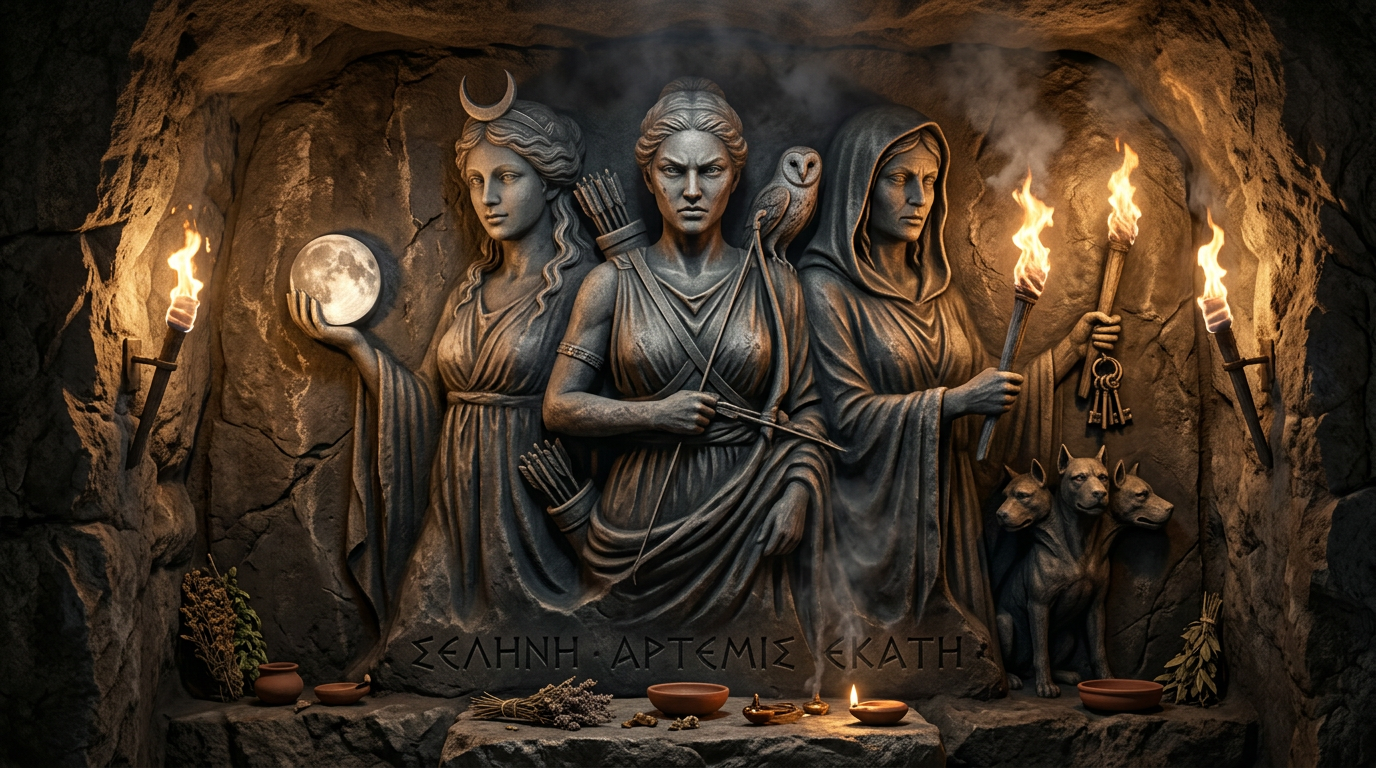
of the Goddesses and the Modern Triple Moon

“One rode the moon across the sky; one hunted the moonlit wild; one held the torch at the crossroads and the door of the dead. In time the three became reflections of a single face — though not, perhaps, the face the modern world has given them.”
An Archival Chronicle Prepared for the Discerning Collector
Compiled by the Archivist of the Unseen
Contents
I. The Goddess in the Mirror of the Moon
II. A Living Inheritance: A Note on a Continuing Devotion
III. The Three Before They Were One: Who They Separately Were
· Selene, the Moon Itself
· Artemis, the Huntress of the Wild
· Hekate, the Keeper of the Crossroads
IV. The Logic of the Merging: The Moon and the Three Realms
V. Field Study — The Ancient Syncretism in the Texts
VI. The Magical Papyri: The Fused Goddess of the Spells
VII. An Archival Aside: On the Merging and Dividing of the Divine
VIII. The Goddess of Three Forms: Triformis and the Crossroads
IX. The Turn — From Ancient Fusion to Modern Triple Goddess
X. Field Study — The Maiden, the Mother, and the Crone
XI. The Honest Distinction: What Is Ancient and What Is Modern
XII. The Goddesses in Modern Pagan Practice
XIII. The Moon That Holds All Their Faces
Bibliography
I. The Goddess in the Mirror of the Moon
Look up at the moon on three different nights. On the first, it rides full and bright and remote across the black sky, a pale disc sailing above the world, serene and untouchable. On the second, it is the moon of the hunt, silvering the forest and the field, the light by which the wild things move and the huntress walks. And on the third, it is the dark moon, or the moon gone red and low, the moon of the crossroads at midnight, of the dogs that howl at nothing, of the door left open between the living and the dead. Same moon; three faces; three moods; three powers.
The Greeks gave these faces three names — Selene, who was the moon itself in the sky; Artemis, who hunted beneath its light in the wild places of the earth; and Hekate, who held her torches at the crossroads and the threshold of the underworld. For a long age they were three distinct goddesses, with distinct myths, distinct cults, distinct domains. And then, slowly, across the centuries of the ancient world, they began to merge — to be identified with one another, to blur into a single goddess of three forms, a lunar and liminal power who could be called by any of the three names and who wore all three faces at once. The three became one; and that one, in a far later age, would be remade again, into something the ancient world would not have recognized.
This field study takes as its subject the long and fascinating history of these three goddesses — Selene, Artemis, and Hekate — and the two great acts of merging that have defined them. The first is the genuine ancient syncretism, by which the classical world gradually identified the three as aspects of a single lunar and liminal goddess, a process visible in the poetry, the philosophy, and above all the magical texts of the Hellenistic and Roman ages. The second is the modern reinvention, by which the neopagan revival of the twentieth century gathered these figures into the now-famous “Triple Goddess” of Maiden, Mother, and Crone — a framework of real power and beauty, but one that is, as this chronicle will honestly show, a modern construction rather than an ancient inheritance. To trace both mergings, and to distinguish clearly between them, is to understand not only these three goddesses but the very process by which the divine is continually merged, divided, and remade across the ages.
The pages that follow are prepared for the discerning collector of the divine in flux — the reader who wishes to understand both what the ancients genuinely believed and what the modern world has made of it, and who values the honest distinction between the two above the comfortable blurring of them. Selene, Artemis, and Hekate are three goddesses, and one, and three again — and their story is the story of how the human imagination has always gazed into the moon and seen there the faces it needed to see.
❧ ❧ ❧
II. A Living Inheritance: A Note on a Continuing Devotion
As with the other traditions of the ancient world kept in this archive, a note on the living dimension of this material is owed, for the worship of these goddesses — and Hekate above all — is not merely a matter of dead antiquity but of genuine and growing living practice, and the modern devotion must be treated with the respect due to a living spirituality.
The ancient public cults of Selene, Artemis, and Hekate ended, like the rest of Greek and Roman religion, with the triumph of Christianity in late antiquity. But the goddesses did not vanish from the human imagination, and in the modern era they have been the objects of a genuine revival. Contemporary Hellenic polytheism — the reconstructed worship of the ancient Greek gods, recognized as a religion in Greece and practiced by communities around the world — has restored their veneration to living practice. And Hekate in particular has become one of the most widely and devoutly honored deities of the entire modern pagan and witchcraft revival, the subject of extensive contemporary devotion, ritual, and scholarship, worshipped by many thousands of practitioners as a living goddess of magic, the crossroads, the moon, and the liminal. The modern devotion to these figures is real, serious, and growing, and this study approaches it as such — not as a curiosity but as a genuine contemporary spirituality with its own integrity and its own devotees.
This study, therefore, honors both the ancient reality and the modern practice, while maintaining throughout the honest distinction between them that intellectual integrity requires. To respect the modern devotion does not mean pretending that its every claim about antiquity is historically accurate; and to describe the ancient reality accurately does not mean dismissing the modern practice as illegitimate. The two can be held together, as this chronicle will hold them: the genuine ancient syncretism described as it truly was, the genuine modern devotion respected as the living thing it is, and the relationship between them — including the places where the modern framework departs from the ancient evidence — mapped honestly and without either credulity or contempt. The goddesses belong now to their modern devotees as once they belonged to the ancients, and both deserve the truth. With that understanding fixed, the chronicle proceeds to the three goddesses as they first, separately, were.
❧ ❧ ❧
III. The Three Before They Were One: Who They Separately Were
Before the merging can be understood, the three goddesses must be known as they originally and separately were — for they began as genuinely distinct deities, with different origins, different domains, and different characters, and it is only against this original distinctness that the significance of their later fusion becomes clear. Each was a full and independent goddess long before she became a face of the composite.
Selene, the Moon Itself
Selene was, most simply and directly, the moon — not merely a goddess associated with the moon but the divine personification of the moon itself, the celestial body given a face and a chariot. She was numbered among the Titans in the older generation of Greek divinity, the daughter of the Titans Hyperion and Theia, and sister of Helios the sun and Eos the dawn. Each night she was imagined to drive her chariot, drawn by pale horses or oxen, across the night sky, carrying the moon on its journey — the luminous disc itself, sailing above the sleeping world. Her most famous myth is one of love and longing: her devotion to the beautiful mortal shepherd Endymion, whom she caused to sleep eternally, ageless and unchanging, so that she might visit him each night and gaze upon his unfading beauty forever. Selene is the moon in its purest and most literal divine form — remote, luminous, celestial, the light of the night sky personified — and it is this direct identification with the physical moon that would make her the natural center of the later lunar syncretism.
Artemis, the Huntress of the Wild
Artemis was a goddess of an entirely different origin and character — one of the great Olympians, the daughter of Zeus and Leto and the twin sister of Apollo, and one of the most important and widely worshipped deities of the Greek world. She was the goddess of the hunt, of wild animals and the wilderness, of the untamed places beyond the city; a virgin goddess, fiercely protective of her chastity and her independence; a goddess of young women and of childbirth; and an archer, roaming the mountains and forests with her band of nymphs and her hounds. Her connection to the moon was originally secondary — she was the goddess of the wild and the hunt first, and her lunar association developed and strengthened over time, partly through her twin brother Apollo’s identification with the sun. But her domain of the moonlit wilderness, the forest by night, the silver light in which the huntress moved, made her a natural third to the lunar grouping, and her fierce virgin independence would later make her the obvious candidate for the “Maiden” of the modern triad.
Hekate, the Keeper of the Crossroads
Hekate was the strangest, the most complex, and in many ways the most powerful of the three — a goddess of ancient and somewhat mysterious origin, possibly from outside the core Greek pantheon, who occupied a unique position in Greek religion. In the earliest major source, the poet Hesiod praises her extravagantly as a goddess of enormous honor and power, holding sway over the sky, the earth, and the sea, able to grant or withhold blessings across every domain. Over time she became associated above all with magic, witchcraft, ghosts, the crossroads, the night, the moon, and the boundary between the living and the dead — the goddess of liminal places and liminal states, of thresholds and transitions, of the door between worlds. She was depicted bearing torches, accompanied by dogs whose howling announced her approach, haunting the crossroads where offerings were left to her in the dark. She was the goddess to whom one turned for magic and for protection against the restless dead, the keeper of the keys to the underworld, the mistress of the liminal. And it was this dark, magical, underworld-associated, moon-connected character that would make her the third and darkest face of the lunar goddess — and, far later, the natural “Crone” of the modern triad.
Three goddesses, then, of three origins and three domains: Selene the celestial moon, Artemis the earthly huntress of the moonlit wild, Hekate the underworld-touching keeper of the liminal crossroads. Distinct in myth, distinct in cult, distinct in character — and yet linked, all three, by a common thread that the ancient imagination would eventually pull tight: the moon, and the night, and the mysterious feminine power that moved through both. The chronicle now turns to the logic by which these three separate goddesses were drawn together into one.
❧ ❧ ❧
IV. The Logic of the Merging: The Moon and the Three Realms
Artifact: The Threefold Logic
The ancient merging of Selene, Artemis, and Hekate was not arbitrary but followed a genuine and elegant logic — a set of real conceptual connections that drew the three together in the ancient mind — and understanding this logic is essential to understanding why these three, of all the goddesses of the Greek pantheon, became a group. Two principal threads bound them: the moon, and the three realms.
The first and most obvious thread was the moon. All three goddesses came to be associated with the moon, though in different ways and to different degrees: Selene was the moon itself; Artemis was the goddess of the moonlit wild, her lunar association strengthening over time; and Hekate was a goddess of the night and the dark moon, of the moon in its magical and liminal aspect. The moon thus provided the common ground, the shared celestial association that made the three natural companions. And the moon’s own nature suggested a threefold division, for the moon visibly changes — waxing, full, and waning; bright and dark; rising, riding high, and setting — and this natural triplicity of the moon lent itself to division among three goddesses, each governing an aspect or phase. The changing moon was, in a sense, already three, and three goddesses could naturally be mapped onto its three faces.
The second and deeper thread was the logic of the three realms — sky, earth, and underworld — which the three goddesses could be understood to divide among themselves. In this elegant scheme, Selene was the moon in the sky, the celestial aspect; Artemis was the goddess of the moon on the earth, in the wild places and forests of the terrestrial world; and Hekate was the moon’s power in the underworld and the realm of the dead and of magic, the chthonic aspect. Thus the three together spanned the entire cosmos — heaven, earth, and the world below — the single lunar goddess extending her power through all three realms in her three forms. This “three realms” logic is genuinely attested in the ancient understanding and is the true conceptual heart of the syncretism: not the modern life-stages of Maiden, Mother, and Crone, but the cosmic realms of sky, earth, and underworld, unified by the moon and its threefold light. The ancient triple goddess was a goddess of places — of the three levels of the cosmos — far more than a goddess of the stages of a woman’s life.
These two threads — the moon with its natural triplicity, and the three cosmic realms unified by lunar power — together provided the genuine ancient logic of the merging, and they explain both why these three goddesses were drawn together and what the resulting composite actually meant. The discerning reader should hold this ancient logic clearly in mind, for it is the key to distinguishing the genuine ancient syncretism from its modern reinvention: the ancient triple goddess was celestial, terrestrial, and chthonic — a goddess of the three realms of the cosmos, seen through the changing faces of the moon. The chronicle now turns to the actual evidence of this merging in the ancient texts themselves.
❧ ❧ ❧
V. Field Study — The Ancient Syncretism in the Texts
Artifact: The Literary Record
The merging of the three goddesses is not a modern inference but a genuine development visible in the ancient sources themselves, traceable across the poetry, drama, and philosophy of the Greek and Roman world — and a survey of this textual evidence establishes that the syncretism was real, ancient, and increasingly explicit as the classical age gave way to the Hellenistic and Roman periods. The three genuinely were identified with one another by the ancients; the only question is precisely how, and into what.
The identification developed gradually. In the classical period, the associations were already forming — Artemis and Selene were increasingly linked, as were Artemis and Hekate, and the tragedians and poets began to blur the boundaries between them. By the Hellenistic period, the identification had become common and explicit: poets and writers freely identified Artemis with Selene and with Hekate, treating the three names as increasingly interchangeable aspects of a lunar goddess. The Roman poets carried the fusion further still. The learned poetry of the late Republic and the Empire regularly presents the three as one — a single goddess addressed by all three names, or by the names of their Roman equivalents (Luna for Selene, Diana for Artemis, and Hekate retaining her Greek name or identified with Trivia, “she of the three ways”). The Roman poet who wished to invoke the moon-goddess in her full power might name her as Luna in the sky, Diana on earth, and Hekate below — the three-in-one made explicit in verse.
Perhaps the most influential single formulation was the identification of the goddess as diva triformis — the “three-formed goddess” — a phrase and concept that captured the fused deity in her threefold nature. The Roman poets, drawing on and developing the Greek syncretism, gave the triple goddess this memorable formulation, and it became a standard way of referring to the composite lunar deity: one goddess, three forms, spanning the three realms. The philosophers, too, particularly in the Neoplatonic tradition of late antiquity, engaged deeply with Hekate as a cosmic figure, and the mystical and theological texts of that late period gave the goddess elaborate metaphysical significance, further developing the conception of a single great goddess of many names and forms. By the close of antiquity, the identification of Selene, Artemis, and Hekate as aspects of a single lunar and liminal goddess was thoroughly established in the literary, poetic, and philosophical record — a genuine and well-attested ancient syncretism.
The discerning reader should note the character of this ancient fusion carefully, for it differs in important ways from the modern version. The ancient syncretism was primarily the work of poets, philosophers, and above all the practitioners of magic; it was a fusion of three goddesses into a single lunar and cosmic power spanning sky, earth, and underworld; and it retained, always, the individual goddesses’ own distinct characters even as it merged them, so that the composite goddess was Selene-Artemis-Hekate in her various aspects rather than a wholly new deity. It was a syncretism of the learned and the magical, a fusion of cosmic realms and lunar phases, and it is genuinely and richly attested. The chronicle now turns to the single body of evidence in which this ancient fusion is most vivid and most complete: the magical papyri.
❧ ❧ ❧
VI. The Magical Papyri: The Fused Goddess of the Spells
Artifact: The Greek Magical Papyri
The richest and most vivid evidence for the ancient fusion of the three goddesses comes not from the polished poetry of the elite but from the working documents of ancient magic — the collection of spells, hymns, and rituals known as the Greek Magical Papyri, preserved chiefly from Roman Egypt — and this material deserves its own examination, for in it the merged goddess appears in her fullest and most powerful form, invoked by practitioners who genuinely sought her aid. Here the syncretism is not a literary conceit but a living magical reality.
The Greek Magical Papyri are a body of ancient texts — practical manuals of magic, containing spells for every purpose, hymns to the gods, and detailed ritual instructions — that survive from the multicultural world of Roman Egypt, where Greek, Egyptian, Jewish, and other traditions mingled freely. In these texts, Hekate — fused with Selene and Artemis — is one of the most important and most frequently invoked of all deities, the great goddess of magic addressed in long and elaborate hymns that pile up her names, titles, and attributes in overwhelming profusion. And crucially, these invocations explicitly identify the three goddesses as one: the practitioner addresses a single goddess as Hekate and Selene and Artemis together, naming her by all three names and by many others besides, invoking her as the moon in the sky, the huntress on earth, and the mistress of the dead and the crossroads below — the three-realmed, three-named, three-formed goddess of magic, called upon to work the practitioner’s will.
The character of the goddess in these magical texts is dark, powerful, and liminal, drawing especially on Hekate’s associations. She is the goddess of the night and the dark moon, of the crossroads where three ways meet, of the restless dead and the howling dogs, of magic and compulsion and the boundary between worlds. She is invoked with offerings and in secret rites, called by her many names to descend and lend her terrible power to the spell. This is the ancient triple goddess in her most complete and most vivid form — not the serene Maiden-Mother-Crone of the modern imagination, but a dark and formidable goddess of magic and the liminal, spanning the three realms, commanding the dead and the moon, invoked in the dangerous dark by those who dared to seek her power. The magical papyri preserve the fused goddess as she was actually invoked and actually understood by the practitioners of ancient magic, and they are the single most important source for understanding what the ancient syncretism genuinely produced: a goddess of magic and the three realms, powerful and dark, one and three at once.
The magical papyri are thus the true heart of the ancient evidence, and they establish beyond doubt that the fusion of Selene, Artemis, and Hekate was a genuine and living feature of ancient religion and magic, not merely a poetic conceit. They also establish the genuine character of the ancient triple goddess — lunar, liminal, magical, chthonic, spanning the three cosmic realms — against which the modern reinvention can be measured. The discerning collector who wishes to know the authentic ancient triple goddess should look here, to the spells and hymns of the ancient magicians, where she was genuinely invoked in all her dark and threefold power. The chronicle now pauses to reflect on the deeper meaning of this merging, before turning to the modern age and its very different reinvention of the three.
❧ ❧ ❧
VII. An Archival Aside: On the Merging and Dividing of the Divine
It is worth pausing upon the fascinating process that the story of these three goddesses so vividly illustrates: the constant merging and dividing of the divine across the ages, the way that gods are perpetually being fused into one another and split apart again, identified and distinguished, gathered and scattered, as the religious imagination works and reworks its materials. The three faces of the moon are a supreme case study in this endless divine alchemy.
The discerning collector will recognize that the divine has never been fixed, that the gods are not stable and eternal entities but living materials of the human imagination, endlessly reshaped. Three distinct goddesses — Selene, Artemis, Hekate — with separate origins and separate cults, were gradually merged into one across the centuries of antiquity; and then, after the long sleep of the intervening ages, they were merged again, differently, into the modern Triple Goddess; and in the hands of individual devotees and scholars they are perpetually being distinguished again, separated back into their individual identities, and re-fused in new combinations. This is not a corruption of some original pure form but the very nature of living religion, which is always syncretizing and analyzing, always finding new unities and new distinctions in its inherited materials. Wicked Dual exists as a repository for precisely this recognition: that the divine is a living and shifting thing, that the gods are continually made and remade, and that to trace the merging and dividing of a goddess across three thousand years is to witness the human imagination in its deepest and most enduring work — the endless refashioning of the sacred to meet the needs of each new age.
This is the disposition the chronicle maintains: that neither the ancient fusion nor the modern one is the “true” form of these goddesses, because there is no single true form — there is only the long history of their making and remaking, each version genuine to its own age and its own devotees. The task of the honest archive is not to declare one version correct and the others false, but to trace the whole history clearly, to distinguish its phases accurately, and to honor each for what it genuinely is. Having established the genuine ancient syncretism, the chronicle now turns, with this understanding, to the great modern remaking of the three — the Triple Goddess of Maiden, Mother, and Crone — and to the honest distinction between what the ancients believed and what the modern world has made.
❧ ❧ ❧
VIII. The Goddess of Three Forms: Triformis and the Crossroads
Artifact: The Three-Bodied Image
Before turning to the modern era, one further ancient element deserves examination, for it is both genuinely ancient and easily confused with the modern triad: the depiction of the goddess — especially Hekate — as literally three-formed or three-bodied, an image of real antiquity that has powerfully shaped all later conceptions of the triple goddess. The ancient goddess was not merely three goddesses merged but was, in her own iconography, sometimes shown as a single figure with three bodies or three faces.
The three-formed depiction of Hekate — Hekate Triformis or the three-bodied Hekate — was a genuine and widespread feature of ancient art and cult. She was represented as three figures standing back to back, or as a single body with three faces or three sets of features, often placed at crossroads where three ways met, so that her three forms could gaze down each of the three roads at once. This hekataion, the three-formed image of Hekate at the crossroads, was a common sight in the ancient world, marking the liminal meeting-place of the ways and the points where offerings were left to the goddess in the dark. The three-formed image expressed several genuine ancient ideas at once: Hekate’s dominion over the three ways of the crossroads; her power over the three realms of sky, earth, and underworld; and, in the syncretic understanding, her identity as the three-in-one lunar goddess, Selene-Artemis-Hekate in a single three-bodied form. The image is genuinely ancient, genuinely attested, and genuinely powerful — the visual embodiment of the goddess’s threefold nature.
The discerning reader should note, however, precisely what this ancient three-formed image did and did not mean, for it is the point at which ancient and modern most easily blur. The ancient triformis was about the three ways of the crossroads and the three realms of the cosmos — a goddess facing three directions, ruling three domains, spanning sky and earth and underworld. It was not, in antiquity, about the three stages of a woman’s life; the three forms of the ancient Hekate were not maiden, mother, and crone but three identical or cosmically-distributed faces of a single liminal power. The modern imagination, encountering the genuinely ancient three-formed goddess, has often read into her the modern life-stage triad — seeing Maiden, Mother, and Crone in an image that originally meant the three ways and the three realms. The three-formed goddess is thus a genuine bridge between the ancient and modern conceptions, but a bridge that must be crossed carefully, with awareness that the same three-bodied image has carried very different meanings in different ages. The chronicle now turns fully to the modern meaning, and to how it arose.
❧ ❧ ❧
IX. The Turn — From Ancient Fusion to Modern Triple Goddess
Between the ancient syncretism and the modern Triple Goddess lies a great gulf of time — the long centuries of Christian dominance during which the public worship of the goddesses ceased — and then, in the modern era, a deliberate and creative revival that reimagined the three in an entirely new framework. Understanding this turn, and the modern figures who accomplished it, is essential to grasping how the ancient goddesses became the very different Triple Goddess of contemporary paganism.
The modern concept of the Triple Goddess — the divine feminine in three aspects of Maiden, Mother, and Crone, corresponding to the waxing, full, and waning moon and to the three stages of a woman’s life — is a creation of the twentieth century, though it drew on genuinely ancient materials. Its principal architect was the poet and scholar Robert Graves, whose influential and idiosyncratic 1948 work The White Goddess powerfully articulated the idea of a single great Triple Goddess of Maiden, Mother, and Crone underlying all of mythology — a poetic and imaginative thesis rather than a work of sober scholarship, but one of enormous influence. Graves’s vision was taken up and developed by the emerging movement of modern Wicca and neopaganism in the mid-twentieth century, above all by figures such as Gerald Gardner and later writers, who made the Triple Goddess a central element of the new pagan theology. In this developing tradition, the ancient goddesses — Selene, Artemis, Hekate, and many others — were gathered into the Maiden-Mother-Crone framework, each assigned a role: Artemis, the virgin huntress, as the Maiden; Selene, the full and luminous moon, as the Mother; and Hekate, the dark and aged goddess of the crossroads and the underworld, as the Crone.
The result was a framework of genuine beauty, power, and spiritual utility — one that has given profound meaning to countless modern practitioners, and that draws on real ancient associations (the lunar connection, the threefold nature, the individual characters of the goddesses). But it was, and is, a modern framework, assembled in the twentieth century from ancient materials, and it differs in fundamental ways from the genuine ancient syncretism. The modern Triple Goddess is organized around the stages of a woman’s life — maiden, mother, crone — and the phases of the moon mapped onto those stages; the ancient triple goddess was organized around the three realms of the cosmos — sky, earth, underworld — and was a goddess of magic and the liminal rather than of feminine life-stages. The modern framework emphasizes the mother; the ancient magical goddess was more often invoked in her dark and formidable aspects. The two are genuinely related, drawing on the same ancient figures and the same lunar logic, but they are not the same, and the honest chronicle must now make the distinction between them fully explicit.
❧ ❧ ❧
X. Field Study — The Maiden, the Mother, and the Crone
Artifact: The Modern Triad
The modern Triple Goddess of Maiden, Mother, and Crone deserves examination on its own terms, both for its genuine spiritual power and for the specific way it deploys the three ancient goddesses — for it is a rich and coherent framework, whatever its historical accuracy, and it has become one of the most influential religious ideas of the modern pagan revival. To understand how Selene, Artemis, and Hekate function in contemporary practice is to understand this triad.
The framework maps three aspects of the divine feminine onto three stages of life and three phases of the moon. The Maiden is the goddess of youth, independence, new beginnings, and potential, associated with the waxing moon — and Artemis, the virgin huntress, fierce and free and self-possessed, is her most natural embodiment among the three, though other goddesses (Persephone in her Kore aspect, for instance) may also fill the role. The Mother is the goddess of fullness, fertility, nurturing, and creative power, associated with the full moon — and Selene, the full and luminous moon itself, serves naturally here, though the role is often filled by explicitly maternal goddesses such as Demeter as well. The Crone is the goddess of age, wisdom, death, endings, and magic, associated with the waning and dark moon — and Hekate, the aged and formidable goddess of the crossroads, the underworld, and witchcraft, is her supreme embodiment, the Crone par excellence of the modern tradition. Thus the three ancient goddesses map, with a certain elegance, onto the three modern aspects: Artemis the Maiden, Selene the Mother, Hekate the Crone.
The framework carries genuine spiritual meaning and power for its practitioners. It offers a vision of the divine feminine that honors the whole arc of a woman’s life — including age, which is so often devalued — and that finds the sacred in each stage; it provides a rich structure for ritual, meditation, and devotion, keyed to the ever-present cycle of the moon; and it restores to a modern context the reverence for goddess and for the feminine divine that the dominant religions of the intervening centuries had largely suppressed. For its devotees, the Triple Goddess is not a historical claim but a living spiritual reality, a way of relating to the divine that has genuine transformative power in their lives. And the framework’s embrace of the Crone in particular — the honoring of age, wisdom, death, and the dark, embodied in Hekate — has given many practitioners, especially women, a powerful and affirming image of the sacredness of the later stages of life that few other religious traditions offer. Whatever its historical accuracy, the modern Triple Goddess is a genuine and meaningful religious creation.
The discerning reader should therefore approach the modern triad with respect for what it genuinely is — a powerful and meaningful modern spiritual framework — while retaining a clear awareness of what it is not, namely an accurate representation of ancient belief. The three ancient goddesses are used in the modern framework, but they are used in a new way, assigned to roles the ancients did not assign them, gathered into a structure the ancients did not employ. This is entirely legitimate as living religion — the reworking of inherited materials into new and meaningful forms is exactly what religion has always done, as this chronicle has emphasized — but it requires, for intellectual honesty, that the modern framework not be mistaken for the ancient one. The chronicle now makes that crucial distinction as clear and explicit as possible.
❧ ❧ ❧
XI. The Honest Distinction: What Is Ancient and What Is Modern
Intellectual honesty requires a clear and explicit statement of the distinction that this chronicle has been developing throughout: the difference between the genuine ancient syncretism of Selene, Artemis, and Hekate, and the modern Maiden-Mother-Crone Triple Goddess into which they have been gathered. Both are real and both are legitimate, but they are not the same, and conflating them — as much popular writing does — obscures the truth of both. The discerning collector deserves the distinction drawn plainly.
What is genuinely ancient is this: that Selene, Artemis, and Hekate were three distinct goddesses who came, over the centuries of antiquity, to be identified and merged as aspects of a single lunar and liminal goddess; that this fused goddess was understood primarily through the logic of the three realms (sky, earth, underworld) and the threefold moon; that she was above all a goddess of magic, the crossroads, the night, and the liminal, invoked in her fullest form in the Greek Magical Papyri; and that she was depicted, especially as Hekate, in a genuinely ancient three-formed image. This ancient syncretism is well-attested and real. What is modern is the specific framework of Maiden, Mother, and Crone — the organization of the divine feminine around the three stages of a woman’s life, mapped onto the waxing, full, and waning moon, with Artemis as Maiden, Selene as Mother, and Hekate as Crone. This framework was constructed in the twentieth century, principally through the influence of Robert Graves and the developing Wiccan and neopagan movements, and it is not attested in antiquity. The ancient world did not conceive of these three as Maiden, Mother, and Crone; that reading is a modern creation.
The key differences can be stated precisely. The ancient triple goddess was organized around cosmic realms; the modern one is organized around life stages. The ancient goddess was primarily magical, dark, and liminal; the modern framework is primarily about the feminine life cycle and often emphasizes nurturing and wholeness. The ancient fusion retained the individual goddesses’ distinct characters even while merging them; the modern framework assigns them to predetermined roles that sometimes fit awkwardly (Selene, a goddess with no particular maternal mythology, as the “Mother”). And crucially, the very concept of a universal “Maiden-Mother-Crone” goddess underlying world mythology — Graves’s thesis — is not accepted by mainstream scholarship, which sees it as a modern poetic construction rather than a historical reality. None of this diminishes the modern framework as a living spiritual practice; it simply locates it correctly, as a modern creation drawing on ancient materials rather than a direct inheritance from antiquity.
This distinction is not offered to diminish anyone’s belief but to honor the truth, which is the archive’s only purpose. The modern practitioner who honors Artemis as Maiden, Selene as Mother, and Hekate as Crone is engaged in a genuine and meaningful spiritual practice, and the modern origin of that framework makes it no less real or valuable as living religion — for all religion, as this chronicle has insisted, is the ongoing reworking of inherited materials, and a tradition need not be ancient to be true. But the practitioner, and the scholar, and the discerning collector alike are better served by knowing what is genuinely ancient and what is genuinely modern than by a comfortable blurring that does justice to neither. The ancient goddesses were merged into a dark magical goddess of the three realms; the modern age has remade them into the Triple Goddess of the feminine life cycle; both are real, and the truth of each is best honored by distinguishing them clearly.
❧ ❧ ❧
XII. The Goddesses in Modern Pagan Practice
Artifact: The Living Devotion
Having distinguished the ancient from the modern, the chronicle turns finally to the genuine and vibrant life these three goddesses enjoy in contemporary pagan and witchcraft practice — for whatever the historical questions, the modern devotion to Selene, Artemis, and Hekate is a real, widespread, and deeply meaningful phenomenon, and it deserves to be described as the living spirituality it is. The goddesses are worshipped today, and their modern cult is worth understanding on its own terms.
In contemporary practice, the three goddesses appear in several distinct but overlapping ways. Within the broad Wiccan and neopagan traditions, they are honored above all through the Triple Goddess framework, invoked as Maiden, Mother, and Crone in rituals keyed to the phases of the moon — the waxing moon for the Maiden, the full moon for the Mother, the waning and dark moon for the Crone — so that the lunar cycle becomes a continual celebration of the threefold goddess. The full moon in particular is a central occasion of modern pagan practice, often marked by rituals (sometimes called esbats) honoring the goddess in her lunar aspect. Beyond the general Triple Goddess framework, each of the three is also honored individually by devotees who focus on her specifically: Artemis by those drawn to her fierce independence, her protection of women and the wild, and her virgin strength; Selene by those drawn to the pure lunar devotion and the beautiful mythology of the moon; and Hekate, above all, by the enormous and growing body of modern devotees who honor her as the goddess of witchcraft, magic, the crossroads, and the liminal.
Hekate’s modern devotion is especially notable and deserves particular mention, for she has become one of the most widely and intensely worshipped deities of the entire modern pagan and witchcraft revival — arguably more prominent in contemporary practice than she was even in much of antiquity. Modern Hekate devotion is rich and varied: practitioners leave her offerings at crossroads or thresholds, honor her at the dark moon and at the monthly rite the ancients called the Deipnon (the “supper” of Hekate, left for her at the month’s end), invoke her as a guardian and guide through transitions and initiations, and turn to her as the patron goddess of witches and magical practitioners. There exist modern devotional organizations, extensive contemporary literature, and a genuine and growing global community of Hekate’s devotees. This modern Hekate draws on the genuine ancient goddess of magic and the crossroads — the very goddess of the magical papyri — while also incorporating modern elements, and she stands as perhaps the most vivid example of an ancient deity genuinely and powerfully revived in the modern world, worshipped today with a devotion as real as any in antiquity.
The modern practice, then, is the living continuation — and reinvention — of the ancient devotion, and it completes the long arc this chronicle has traced. Three goddesses, distinct in origin, were merged in antiquity into a dark lunar goddess of the three realms and of magic; that fusion faded with the old religion; and in the modern age the three have been revived and remade, gathered into the Triple Goddess of Maiden, Mother, and Crone, and honored anew by a genuine and growing community of devotees, with Hekate in particular restored to a prominence she may never have enjoyed even in her ancient heyday. The goddesses live again, in new forms, honored by new devotees, under the same moon whose changing faces first drew them together. The chronicle closes with a reflection on that enduring moon, and the faces the human imagination has always found in it.
❧ ❧ ❧
XIII. The Moon That Holds All Their Faces
The long history of Selene, Artemis, and Hekate — three goddesses, merged into one, faded, and remade into a new one — is finally the history of the human gaze turned upward to the moon, and of the faces we have always found reflected there across the changing ages. The moon has not changed; it rides the night sky now as it did over ancient Greece, waxing and full and waning, bright and dark. But the faces we have seen in it have changed continually, as each age has gazed up and found there the goddess it needed.
The ancients gazed up and saw three goddesses who became one: Selene the celestial moon, Artemis the huntress of the moonlit earth, Hekate the dark mistress of the crossroads and the underworld — merged, through the logic of the moon and the three realms, into a single dark and formidable goddess of magic and the liminal, invoked in the dangerous dark by those who sought her power. The modern age gazes up at the same moon and sees a different threefold goddess: the Maiden of the waxing crescent, the Mother of the full bright disc, the Crone of the waning dark — the divine feminine in the three stages of life, honored anew by devotees who have found in this framework a living and transformative spirituality. Two different triple goddesses, two different ages, one unchanging moon — and the honest recognition that both are genuine creations of the human religious imagination, each true to its own time, each a real way of finding the sacred in the pale light of the night sky. Neither is the “true” moon goddess, because the moon holds all their faces, and will hold the faces of ages yet to come.
And perhaps this is the deepest lesson of the three faces of the moon: that the divine is not a fixed inheritance to be received unchanged, but a living relationship to be continually remade, as each generation gazes up at the same enduring mysteries — the moon, the night, the wild, the crossroads, the door of the dead — and finds there the goddess it needs to name them. Selene, Artemis, and Hekate were made and merged and remade across three thousand years, and they are being remade still, in the practice of every modern devotee who honors them under the full or the dark moon. The moon rides on, indifferent and luminous, holding in its changing light every face the human heart has ever given it — the celestial rider, the moonlit huntress, the torch-bearer at the crossroads, the Maiden, the Mother, the Crone — all of them true, all of them the moon, all of them the enduring answer of the human imagination to the pale and changing mystery that has hung above every night of human history, and will hang above every night to come. Three faces, or one, or many: the moon holds them all, and offers them, still, to whoever looks up and dares to name what they see.
❧ ❧ ❧
This field study is preserved as one vestige among many within the haunted archive of Wicked Dual, an artisan boutique devoted to the reclamation of history’s clandestine and enduring corners. The three faces of the moon — Selene, Artemis, and Hekate, merged in antiquity and remade in the modern age — are but one chronicle among the collection’s deeper holdings, kept with respect for the living devotion they still inspire.
Read the written chronicles on the blog, the Wicked Archive: www.wickeddualblog.com
Secure the physical artifacts drawn from these histories at the Wicked Dual boutique: https://www.etsy.com/shop/Wickeddual
We invite you to enter the haunted archive and secure a piece for your private collection; it is a necessary addition for those who curate the darker corners of human history.
— The Archivist of the Unseen

Bibliography
The following works constitute credible classical, historical, and religious-studies literature underlying this field study; readers pursuing formal citation are advised to verify editions and pagination against a library catalogue.
Burkert, W. (1985). Greek religion (J. Raffan, Trans.). Harvard University Press.
Graves, R. (1948). The white goddess: A historical grammar of poetic myth. Faber & Faber.
Leave a Reply