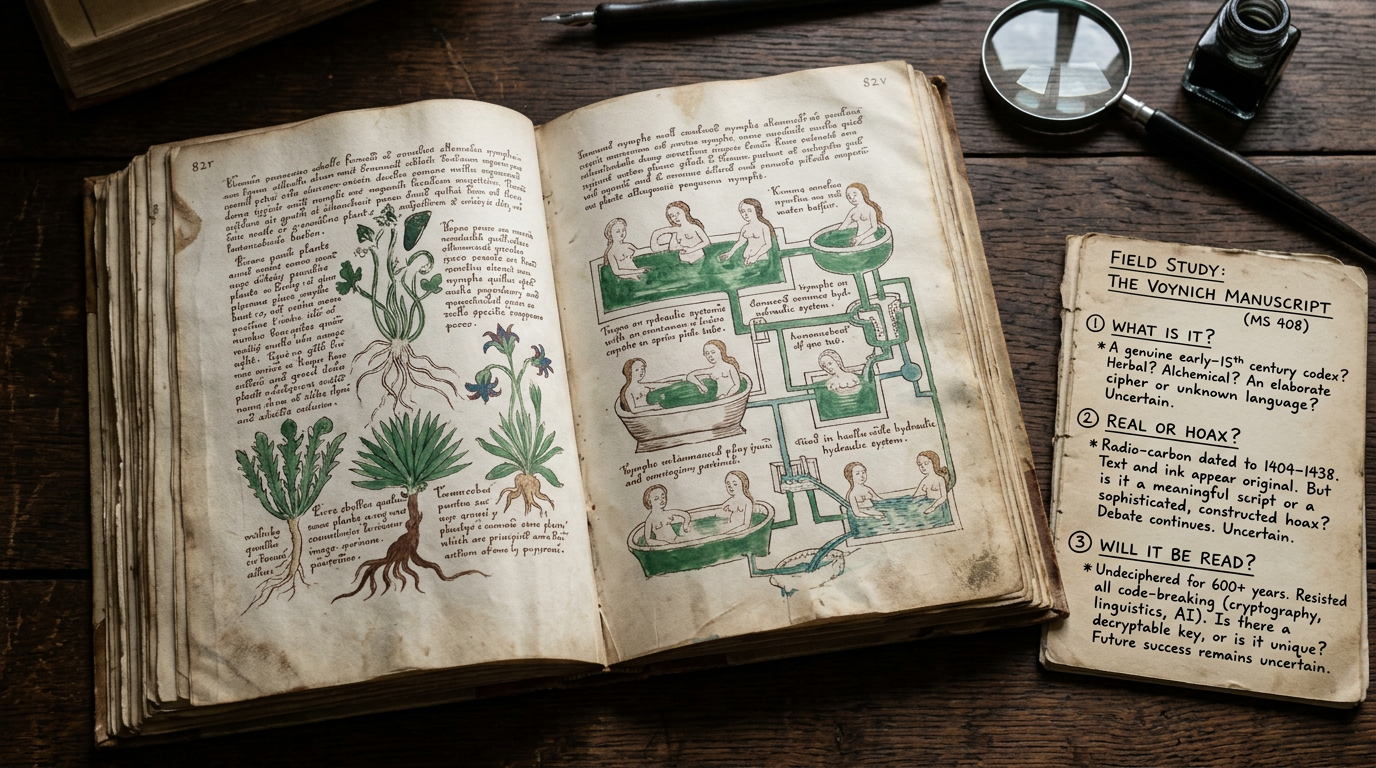
and Whether It Will Ever Be Deciphered

“Such Sphinxes as these obey no one but their master. So wrote the man who gave the book away in 1665, unable to read a word of it. Four centuries on, it obeys no one still.”
An Archival Chronicle Prepared for the Discerning Collector
Compiled by the Archivist of the Unseen
Contents
I. The Sphinx in the Library
II. What It Is: A Physical Description of the Impossible Book
III. The Certainty of the Vellum: What Science Has Proven
IV. Field Study — The Six Sections and Their Baffling Images
V. Voynichese: The Script That Behaves Like a Language
VI. An Archival Aside: On the Keeping of the Unreadable
VII. The Long Provenance: From Prague to Yale
VIII. The First Question — What Is It? The Competing Theories
IX. The Second Question — Real or Fake? The Case for and Against a Hoax
X. The Codebreakers Who Failed: A Century of Defeat
XI. The Parade of False Solutions
XII. The Third Question — Will It Ever Be Deciphered?
XIII. The Book That Keeps Its Secret
Bibliography
I. The Sphinx in the Library
Open it, if you are ever permitted to — though you will not be, for it lies now behind glass and climate control in a rare-book library in Connecticut, and few living hands are allowed to turn its pages. But suppose you could. You would find a book of some two hundred and forty pages of soft calfskin vellum, worn smooth by centuries of thumbing, filled edge to edge with a flowing, confident script in a language no one has ever identified, illustrated with plants that grow nowhere on earth, with naked women bathing in impossible green pools connected by organic pipework, with circular star-charts and zodiac wheels and a great fold-out map of nine islands linked by causeways. Every page is covered in writing. The writing runs left to right, smoothly, without hesitation, in the hand of someone who plainly knew what they meant to say.
And you would not be able to read a single word of it. No one can. No one ever has — not in the four hundred years since it first surfaced in the possession of a Prague alchemist, not through the efforts of the finest cryptographers of the First World War and the Second, not through a century of assault by professionals and amateurs, linguists and computer scientists, cranks and geniuses alike. The book has been photographed, digitized, carbon-dated, chemically analyzed, and subjected to every statistical and computational method the modern age can devise. And it has surrendered nothing. It sits in its case at Yale, catalogued dryly as Beinecke MS 408, and it keeps its secret as completely today as it did when a bewildered seventeenth-century scholar complained that the thing had been “taking up space uselessly in his library” for years, defeating his every attempt to read it.
This field study takes as its subject the Voynich manuscript — the single most famous undeciphered document in the world, the book that cannot be read — and it will confront directly the three questions that every encounter with it provokes. What is it? Is it real, or an elaborate hoax? And if it is real, will it ever be deciphered? The honest answer to all three, the discerning reader should be warned at the outset, is that we do not fully know; but the shape of the uncertainty is itself the most fascinating artifact in the whole affair, and this chronicle will map that uncertainty with all the precision the evidence permits — separating what has been genuinely proven from what remains conjecture, and confronting the real possibility that the book may never give up its meaning at all.
The pages that follow are prepared for the discerning collector of the genuinely unsolved — the reader who understands that the most compelling artifact is not the mystery that has been explained but the one that has, against every effort, refused to be. The Voynich manuscript is the supreme such artifact: a real, physical, datable object that has defeated four centuries of the cleverest minds who ever tried to read it, and that may, in the end, defeat us all. This is the chronicle of the book that keeps its secret.
❧ ❧ ❧
II. What It Is: A Physical Description of the Impossible Book
Artifact: Beinecke MS 408
Before entering the thickets of theory and cipher, the discerning reader deserves a clear account of what the Voynich manuscript physically is — for whatever mysteries surround its meaning, the object itself is thoroughly real, thoroughly documented, and thoroughly studied, and the firm ground of its physical description is the necessary foundation for everything that follows.
The manuscript is a codex — a bound book — measuring roughly twenty-three and a half by sixteen centimeters, about the size of a modern hardcover, and some five centimeters thick. It is written on vellum, or parchment, made from calfskin — the skins, by one analysis, of at least fourteen or fifteen entire calves. It survives today at around two hundred and forty pages, though the evidence of its own numbering shows it once had at least two hundred and seventy-two, so that some thirty-odd pages, and whole gatherings, were already lost before it entered the modern record. Its pages are gathered into quires in the ordinary medieval fashion, and some of them open out into foldable sheets of larger size — the famous foldouts, including one great six-page spread. The parchment is of average quality, with the holes and flaws common to the material, and it bears no luxury at all: no gold leaf, no fine illumination, none of the marks of a treasured or ceremonial book.
The physical evidence of its use is, in fact, one of the most revealing things about it. The medievalist Lisa Fagin Davis has described the parchment as soft — a texture found in books that have been, in her phrase, “heavily thumbed,” handled and paged through a great deal. This is a crucial observation, for it suggests that the Voynich manuscript was not a curiosity made to be locked away but a working book, something consulted and used routinely, like a medical manual or a celestial almanac. The heavy wear, the cheap materials, the absence of any luxurious touch, all point in the same direction: toward a workmanlike object with some routine practical function, handled often by someone who found it useful — which only deepens the mystery, for what routine practical use could be served by a book that no one, apparently, could read?
The text itself runs to roughly thirty-eight thousand words, of which some nine thousand are unique, written in a script of perhaps twenty to twenty-five distinct characters, most formed of one or two simple pen-strokes, with no obvious punctuation. It flows in a single column down most pages, with a slightly ragged right margin and clear paragraph divisions, and stars marking entries in the margins of some sections. Coloured paint — blue, white, red-brown, green, made from inexpensive pigments like ground azurite and red ochre — was applied, somewhat crudely and possibly at a later date, to the ink-outlined figures. It is, in sum, a real and ordinary-seeming late-medieval book in every physical respect but one: the one that matters, the writing, which no one can read, in a language no one can name, illustrating things that do not exist.
❧ ❧ ❧
III. The Certainty of the Vellum: What Science Has Proven
Artifact: The Datable Facts
Amid the vast uncertainty that surrounds the Voynich manuscript’s meaning, there exists a small and precious body of genuine certainty — the hard facts that modern science has established about the physical object — and it is essential to separate this proven ground from the swamp of speculation, for the scientific findings sharply constrain what the manuscript can possibly be, and in particular they bear directly on the question of whether it is a modern hoax.
The single most important fact is the date of the vellum. In 2009, samples from several parts of the manuscript were subjected to radiocarbon dating at the University of Arizona, and the results were consistent across all samples: the parchment dates to the early fifteenth century, between approximately 1404 and 1438. This is not conjecture but physical measurement, and it is the bedrock of all serious Voynich study. The animal skins on which the manuscript is written were prepared in the first decades of the fourteen-hundreds. Whatever the Voynich manuscript is, it is written on genuinely early-fifteenth-century material — a finding that, as a later section will show, deals a heavy blow to the theory that the book is a modern forgery, for a modern forger would have needed not merely to acquire six centuries’ worth of blank medieval vellum but to write upon it in a manner chemically and stylistically consistent with the period.
Further analysis has reinforced the picture of a genuine period object. Protein testing confirmed the parchment as calfskin; multispectral analysis showed that it is not a palimpsest — that is, the vellum was not scraped clean of some earlier writing and reused, but was written upon fresh. Chemical analysis of the inks, using X-ray and spectroscopic methods, found them to be iron gall ink of a composition entirely consistent with the medieval and early-modern period, applied with a quill pen; and the similarity between the ink of the text and the ink of the figure-outlines suggests they were made at the same time, by the same hand or hands, as a single coherent act of creation. The pigments of the paint, too, were found to be materials expected from that period of European history. The stylistic analysis of the illustrations and script points to an origin in Europe, and possibly specifically in Italy during the Renaissance. Every physical test that has been applied to the manuscript is consistent with its being a genuine product of early-fifteenth-century Europe.
This body of proven fact is the firm island in the Voynich sea, and the discerning reader should hold it fast against the wilder currents of theory. The book is real, in the sense that matters most: it is a genuine physical artifact of the early fifteenth century, made of period materials, written in period ink, in a manner consistent with its apparent age. Whatever else is uncertain — who made it, why, in what language, to what end — the object itself is not a modern fabrication dressed up to look old. The mystery is a genuinely old mystery, six hundred years deep, and any theory that would explain the manuscript must reckon with the hard fact of that antiquity. Science has not read the book; but it has proven that the book is what it appears to be — a real, old, and genuinely baffling thing.
❧ ❧ ❧
IV. Field Study — The Six Sections and Their Baffling Images
Artifact: The Illustrated Enigma
Because the text cannot be read, scholars have been forced to organize the Voynich manuscript by its illustrations — dividing it into sections according to the kinds of pictures that accompany the impenetrable writing — and these images are themselves among the strangest features of the whole object, for while they resemble the familiar genres of medieval knowledge, their specific content matches nothing in the real world. The manuscript looks, at a glance, like an ordinary compendium of natural knowledge; look closer, and everything in it dissolves into the impossible.
The largest section, running to some one hundred and twenty-six pages, is the herbal: each page displays one or two plants with accompanying text, in the exact format of the European herbals of the period, the illustrated guides to medicinal plants. But here is the first impossibility — none of the plants can be reliably identified. A few resemble real species, a wild pansy, a maidenhair fern; but most match no plant that grows on earth, and some appear to be composites, the roots of one species fastened to the leaves of another and the flowers of a third, chimerical plants assembled from parts that never grew together. The astronomical section offers circular diagrams with suns, moons, and stars, and a series of zodiac symbols — the fish of Pisces, the bull of Taurus — each surrounded by rings of small female figures, most of them nude, each holding or tethered to a star. It looks like astrology; it corresponds to no known astrological system.
Stranger still is the balneological section — the section of bathing — twenty pages of dense text interspersed with drawings of small nude women, some crowned, bathing in pools and tubs connected by an elaborate network of organic-looking pipes, through which green liquid seems to flow from one page to the next. Nothing quite like it exists elsewhere in medieval art. The cosmological section offers more circular diagrams of obscure meaning, including the famous fold-out “Rosettes” page, a great map-like design spanning six pages, depicting nine islands or rosettes connected by causeways, dotted with castles and what may be a volcano — a map of nowhere, a geography of an unknown world. The pharmaceutical section shows labelled drawings of plant-parts and apothecary jars; and the final recipes section is pure text, page after page of short star-marked paragraphs, as if listing formulae or instructions, with almost no illustration at all.
The overall impression is unmistakable and deeply strange: the Voynich manuscript looks exactly like a practical compendium of natural knowledge — a book of plants, stars, medicines, and recipes, of precisely the kind a fifteenth-century scholar or physician might own and use. It has the format, the sections, the structure of such a book. And yet its actual content, in every section, is impossible: plants that do not exist, an astrology that matches no system, a geography of no known world, all described in a language no one can read. It is the form of knowledge without its substance — a book that performs the appearance of meaning in every particular while withholding the meaning itself. This quality, more than any other, is what has driven the central debate about the manuscript: is this the disguised record of real knowledge, encoded or written in an unknown tongue — or is it the elaborate imitation of a knowledge-book that never contained any knowledge at all?
❧ ❧ ❧
V. Voynichese: The Script That Behaves Like a Language
Artifact: The Impossible Text
At the heart of the mystery lies the text itself — the flowing, confident, utterly unreadable script that scholars have named “Voynichese” — and the most important and most maddening fact about it is this: it behaves, in a great many measurable respects, exactly like a real language, and yet in certain crucial respects like no language on earth. It is this double character, this hovering between the linguistic and the impossible, that has defeated every attempt to resolve it, and that the discerning reader must understand to grasp why the manuscript is so genuinely hard.
Consider first the ways in which Voynichese behaves like a natural language, for they are numerous and striking. The frequency of its words follows Zipf’s law — the statistical distribution, found in all natural human languages, in which the most common word appears about twice as often as the second most common, three times as often as the third, and so on. This is a subtle and difficult property to fake, and its presence is strong evidence that the text is not random gibberish. The ratio of unique words to total words, the distribution of word-lengths, the way certain words follow others in seemingly grammatical order, the way different sections of the book feature different characteristic vocabularies — exactly as the chapters of a real book on different subjects would — all of these are consistent with genuine linguistic structure. Statistical studies, including a notable analysis from the University of São Paulo, have concluded that the text is compatible with a natural language rather than a random sequence, and the linguist Claire Bowern, applying rigorous methods, has dismissed the theory that the manuscript is mere gibberish. Something systematic and language-like is genuinely going on in the text.
And yet — here is the maddening turn — Voynichese also behaves in ways no natural language does. Its structure is too regular. The characters follow rigid positional rules: some appear only at the beginnings of words, some only in the middle, some only at the end, like the final form of the Greek sigma. Words differing by only a single letter repeat with unusual frequency; the same word may appear three, four, five times in a row, a thing that virtually never happens in natural language. Most tellingly, a measure called conditional entropy — which captures how predictable each character is from the one before — is far lower for Voynichese than for any natural language: where natural languages score between three and four, Voynichese scores around two, meaning its character-sequences are far more predictable, far more repetitive, than any human tongue. The grammatical markers that natural languages place at the beginnings and ends of words never appear in the middle of Voynich “words,” a pattern one expert calls “unheard of for any Indo-European, Hungarian, or Finnish language.” The text is at once too language-like to be random and too regular to be any known language — and it is precisely in this impossible middle ground that its secret has hidden for six hundred years.
The picture is further complicated by the discovery that Voynichese is not even entirely uniform. Researchers have identified at least two distinct statistical “dialects,” dubbed Voynich A and Voynich B, which appear in different sections of the manuscript and differ in their most common vocabulary — suggesting either two languages, two encoding systems, two topics, or two scribes, layered within the single book. And the handwriting analysis of Lisa Fagin Davis has concluded that the manuscript was very likely the work of five different scribes, all writing in the same strange script — a finding of enormous importance, for it suggests that Voynichese was not the private invention of a single isolated mind but a system known to and shared by a group, a community of people who could all write fluently in a script that no one since has been able to read. Whatever Voynichese is, it was, apparently, a functioning system that more than one person commanded — which makes the theory of a single mad hoaxer harder to sustain, and the mystery correspondingly deeper.
❧ ❧ ❧
VI. An Archival Aside: On the Keeping of the Unreadable
It is worth pausing upon the peculiar nature of this artifact, for the Voynich manuscript presents the archive with a challenge unlike almost any other: it is a document that cannot be read, a text that withholds the very meaning that texts exist to convey, and yet it is among the most intensely studied and fiercely treasured objects in the world. What does it mean to keep, to value, to be haunted by, a book whose content is entirely inaccessible?
The answer reveals something profound about the nature of mystery itself, and about why some artifacts hold the human mind as they do. The Voynich manuscript is valuable and fascinating precisely because it cannot be read — because it represents the pure form of the unsolved, the mystery that has resisted every effort at solution and thereby become an almost perfect mirror for the human hunger to know. Every generation of codebreakers, linguists, and enthusiasts who has thrown itself against the manuscript has seen in it a reflection of its own methods and obsessions, and every one has been defeated, and the defeat has only deepened the fascination. A solved mystery is a closed door; an unsolved one is an open question, and the Voynich manuscript is the greatest open question in the history of the written word. Wicked Dual exists as a repository for precisely this order of artifact: the object whose power lies not in what it reveals but in what it withholds, the genuine and permanent mystery that resists the modern conviction that everything can be known. To keep the Voynich manuscript in the imagination is to keep faith with the unsolved — to honor the possibility that some secrets are real, that some doors stay closed, and that the world still contains, even now, a book that no one can read.
This is the disposition the chronicle maintains: that the unreadability of the Voynich manuscript is not a failure to be overcome but a quality to be reckoned with, and that the honest study of it means neither the credulous embrace of some triumphant “solution” nor the cynical dismissal of the whole thing as a hoax, but the harder and more rewarding work of mapping precisely what is known, what is unknown, and what may be permanently unknowable. The chronicle now turns to the long and genuine history of the object — for whatever its meaning, its journey through four centuries of hands is thoroughly documented, and thoroughly strange.
❧ ❧ ❧
VII. The Long Provenance: From Prague to Yale
Artifact: The Chain of Custody
Unlike its meaning, the Voynich manuscript’s history — at least from the seventeenth century onward — is genuinely documented, a chain of named owners stretching from the alchemists of imperial Prague to a rare-book library in modern Connecticut. This provenance is worth tracing, both because it is inherently fascinating and because it bears on the question of authenticity: a hoax would have to account for this documented chain, and the chain reaches back to a period when the manuscript was already old and already baffling.
The earliest firmly confirmed owner was Georg Baresch, a seventeenth-century alchemist of Prague, in whose library the manuscript sat, by his own frustrated account, “taking up space uselessly” for years while he failed to read it. In 1639, Baresch wrote to the famous Jesuit scholar Athanasius Kircher in Rome — who had claimed to decipher Egyptian hieroglyphs — sending a copy of the strange script and begging for help; this 1639 letter is the earliest confirmed mention of the manuscript in all of history. Kircher was interested enough to try to acquire the book, but Baresch would not part with it. Upon Baresch’s death the manuscript passed to his friend Jan Marek Marci, rector of Charles University in Prague, who in 1665 or 1666 finally sent it to Kircher, with the now-famous cover letter that still accompanied the book when it surfaced in the twentieth century — the letter containing the haunting line that “such Sphinxes as these obey no one but their master,” and reporting the tradition that the book had once belonged to Rudolf II, the Holy Roman Emperor and great collector of the esoteric, who was said to have paid the enormous sum of six hundred ducats for it.
The imperial connection, though unproven, is tantalizing and plausible: a faint, nearly invisible signature on the first page has been read as that of Jacobus Horcicky de Tepenecz, the head of Rudolf II’s botanical gardens, suggesting the book did pass through the imperial court at Prague around the turn of the seventeenth century. After Kircher received it in the 1660s, the manuscript vanished for some two hundred years — almost certainly stored, unread and forgotten, among Kircher’s vast correspondence in the library of the Collegio Romano in Rome. There it apparently remained until the upheavals of Italian unification in 1870, when the library’s holdings were hastily dispersed to the private libraries of the Jesuit faculty to escape confiscation, and the manuscript passed, with Kircher’s papers, to the Villa Mondragone near Rome. And there, in 1912, it was purchased — among a group of thirty manuscripts the cash-strapped Jesuits were quietly selling — by the Polish book dealer Wilfrid Voynich, who gave the book the name it now bears and spent the rest of his life trying, and failing, to have it read.
From Voynich the manuscript passed, on his death in 1930, to his widow Ethel Voynich — herself a figure of note, a successful novelist and the daughter of the mathematician George Boole — and then to her friend Anne Nill, who sold it in 1961 to the antiquarian book dealer Hans Kraus. Kraus, unable to find a buyer for so unsellable an enigma, donated it in 1969 to Yale University, where it entered the Beinecke Rare Book and Manuscript Library as MS 408, and where it remains to this day; in 2020 Yale published the entire manuscript online, so that the book that no one can read is now freely available for everyone on earth to fail to read. The documented chain — Baresch, Marci, Kircher, the Collegio Romano, the Villa Mondragone, Voynich, Yale — is a genuine and traceable provenance reaching back nearly four centuries, to an era when the manuscript was already an ancient and insoluble puzzle. Whatever it is, it has been baffling its owners for a very long time.
❧ ❧ ❧
VIII. The First Question — What Is It? The Competing Theories
The first of the three great questions the Voynich manuscript poses is the most fundamental: what, at bottom, is it? What kind of thing is this text — what is the nature of the writing, quite apart from its specific content? Scholars have proposed a range of competing answers, and the discerning reader should understand the principal possibilities, for the whole debate about decipherment turns upon which of them is true. The theories fall into several broad families.
A Natural Language in an Unknown Script
The first possibility is that Voynichese is a genuine natural human language — some real tongue, spoken by real people — written in an invented or unfamiliar script. On this theory, the reason we cannot read the manuscript is simply that we have not identified the language and cracked the correspondence between its strange characters and known sounds. The language-like statistical properties support this view; the difficulty is that no known language matches Voynichese’s peculiar structure, and candidates from an exotic or extinct tongue to a heavily abbreviated form of a known language have all failed to yield a coherent reading. A variant holds that the language is real but was written in a heavily abbreviated or shorthand form that has obscured it.
A Cipher or Code
The second possibility is that the manuscript is written in some form of cipher or code — a real message in a known language, deliberately enciphered to conceal it. This was long the most popular theory, and it is what drew the great military codebreakers to the manuscript. But it faces a serious obstacle: the smoothness of the writing. The text flows without hesitation, with none of the delays and corrections one would expect from someone laboriously enciphering a message character by character. And the linguist Claire Bowern’s analysis has concluded that the statistical properties are not consistent with the known cipher methods of the period — neither a simple substitution cipher nor a more complex polyalphabetic one. If it is a code, it is a code of a kind not otherwise known from the age.
A Constructed Language
A third possibility, increasingly favored, is that Voynichese is a constructed or artificial language — an invented tongue, deliberately created, of the kind that would later be attempted by various scholars and mystics seeking a “perfect” or philosophical language. This would elegantly explain the text’s double character: its language-like properties (it was designed to function like a language) and its unnatural over-regularity (it was constructed by rule rather than grown organically, and so lacks the messy irregularity of a natural tongue). A constructed language would be systematic, learnable, shareable among a group — consistent with the evidence of multiple scribes — and yet correspond to no natural language on earth.
A Hoax, or Glossolalia, or Fiction
The remaining possibilities hold that the manuscript contains no decipherable meaning at all. It might be a deliberate hoax — meaningless gibberish, artfully constructed to look like a real text, made to deceive a buyer or patron. It might be glossolalia — “speaking in tongues,” the automatic production of language-like but meaningless text by someone in a trance or altered state, sincerely believing it meaningful. Or it might be a work of fiction, fantasy, or private art — an invented book of an invented world, a piece of medieval mythopoeia or speculative imagination, never intended to convey factual meaning at all. These theories are examined more closely in the next section, for they bear directly on the second great question: whether the manuscript is, in the meaningful sense, real or fake.
The honest state of the question is that scholars cannot yet decide among these possibilities — that, as the sources put it, they “lack the translation and context needed to either properly entertain or eliminate any of the possibilities.” The most that can be said is that the weight of recent statistical evidence has tilted somewhat against pure gibberish and toward some genuine system — a natural or constructed language, or an unknown encoding — but that no theory has been verified, and the fundamental question of what the manuscript is remains, after four centuries, genuinely open.
❧ ❧ ❧
IX. The Second Question — Real or Fake? The Case for and Against a Hoax
The second great question — is the manuscript real or fake? — requires careful definition, for the word “fake” can mean two very different things, and confusing them has muddied the debate for a century. It might mean that the object is a modern forgery, a recently made thing pretending to be old; or it might mean that the object is genuinely old but contains no real meaning, an authentic medieval artifact that is nonetheless, in its content, an empty hoax. These are entirely different claims, and they must be answered separately.
Is It a Modern Forgery?
On the first and narrower question — is the object a modern fake? — the answer is a confident no, and here the science examined earlier is decisive. The vellum has been radiocarbon-dated to the early fifteenth century; the ink is period-appropriate iron gall ink, applied contemporaneously with the figure outlines; the pigments are those expected of the era; the script and illustration style are consistent with fifteenth-century Europe; and the documented provenance reaches back to the early seventeenth century. For the manuscript to be a modern forgery, a forger would have had to obtain a large quantity of genuine blank early-fifteenth-century vellum — the skins of fourteen or fifteen calves — and inscribe it with period-correct ink in a manner that passes every chemical and stylistic test, and then insert it into a documented chain of ownership stretching back three centuries before radiocarbon dating existed to be fooled. This is not credible. The object is genuinely old. Whatever the Voynich manuscript is, it is not a modern hoax; it is a real artifact of the early fifteenth century.
Is It a Genuine but Meaningless Hoax?
The subtler question is whether the manuscript, though genuinely old, is nonetheless meaningless — whether some fifteenth-century hand produced an elaborate confection of language-like gibberish, perhaps to deceive a wealthy buyer such as Emperor Rudolf, who might pay six hundred ducats for a mysterious tome of secret wisdom. This is a serious theory, and it has serious support. It has been argued that a medieval hoaxer could have generated the text using period techniques — such as a grille or table method for producing pseudo-random but structured strings — that would yield exactly the kind of over-regular, language-like-but-not-quite text the manuscript displays. The commercial motive is plausible: a book of impressive esoteric mystery would command a high price from a credulous collector of the occult, and Rudolf’s court was full of such collectors.
Yet the hoax theory faces mounting difficulties, and the recent evidence has tended to weigh against it. The statistical sophistication of the text — its conformity to Zipf’s law, its consistent grammar-like word-order, its distinct topical vocabularies in different sections, its two internal “dialects” — is remarkably elaborate for a mere deception, arguably more elaborate than a hoaxer would need or be able to produce. The linguist Claire Bowern’s analysis dismisses the gibberish theory on statistical grounds. And the evidence of multiple scribes — the finding that perhaps five different hands wrote the manuscript in the same fluent script — sits awkwardly with the image of a lone hoaxer, suggesting instead a shared, learnable system commanded by a group. A hoax is not impossible; the meaningless-but-genuine theory remains genuinely on the table, and cannot be eliminated. But the trend of the evidence has been away from it, toward the view that something systematic and meaningful — a real language, constructed or natural, or a real encoding — underlies the text, even if we cannot yet read it.
The honest verdict on the second question, then, is twofold and precise. The manuscript is certainly not a modern forgery: it is a genuine early-fifteenth-century object, and on this the evidence is conclusive. Whether it is a genuine-but-meaningless medieval hoax remains uncertain, but the weight of recent analysis leans against it and toward the view that the text encodes some real linguistic content. The discerning reader should resist both the sensationalist certainty that it is a fraud and the equal certainty that it must contain profound secret wisdom. The truthful position is the uncomfortable middle: it is real, it is old, it is probably not gibberish — and we still cannot say what it means.
❧ ❧ ❧
X. The Codebreakers Who Failed: A Century of Defeat
Artifact: The Honor Roll of the Defeated
The Voynich manuscript occupies a singular place in the history of cryptography: it is the great white whale, the puzzle that has defeated the finest codebreakers the modern world has produced. To recount the roll of those who have tried and failed is to measure the true depth of the mystery, for these were not cranks but among the most accomplished decipherers who ever lived, and the manuscript beat them all.
The manuscript drew the attention of professional codebreakers from both World Wars — the very people whose profession was the reading of the deliberately unreadable, who broke the military ciphers of nations. Chief among them was William F. Friedman, the towering figure of twentieth-century American cryptology, the man who led the team that broke the Japanese “Purple” cipher before the Second World War and who is often called the greatest codebreaker in American history. Friedman studied the Voynich manuscript for years, leading a “First Study Group” that transcribed the text onto IBM punch cards to make it machine-readable — an early and serious application of computational method to the problem. He failed. His wife Elizebeth Friedman, herself a legendary codebreaker who broke the ciphers of smugglers and spies, also studied the manuscript, and in 1962 pronounced the statistical approaches to it “doomed to utter frustration.” She failed too.
They were in distinguished company. John Tiltman, one of the greatest British codebreakers, a hero of Bletchley Park, studied the manuscript and failed. Prescott Currier, a naval cryptanalyst who made the important discovery of the two distinct “dialects” of Voynich A and Voynich B, could not read either. Across a full century, the manuscript has been assaulted by the professional decipherers of two world wars, by academic linguists, by computer scientists armed with the full power of modern computation and machine learning, and by countless gifted amateurs — and not one of them has produced a decipherment that other experts can verify. The sources state the matter flatly: the manuscript “has never been demonstrably deciphered, and none of the proposed hypotheses have been independently verified.” This is the central and humbling fact of Voynich studies. The best minds in the history of codebreaking have broken the ciphers of empires and lost to a single small book of plants and bathing women.
The century of failure is itself powerful evidence about the nature of the manuscript, and the discerning reader should weigh what it implies. If the text were a simple cipher, Friedman or Tiltman would very likely have broken it; that they did not suggests it is not a simple cipher, and Bowern’s later analysis confirms that the standard cipher methods of the period do not fit. If it were obvious gibberish, the statistical experts would have shown it conclusively; that the debate continues suggests it is not obviously gibberish. The manuscript has failed to yield to every method precisely because it does not fit any of the familiar categories — it is not a known language, not a known cipher, not obvious nonsense — and it is this categorical strangeness, this refusal to be the kind of thing that any established method is designed to solve, that has made it the permanent and singular defeat at the heart of cryptographic history.
❧ ❧ ❧
XI. The Parade of False Solutions
Set against the century of honest failure is a second and stranger history: the long parade of triumphant “solutions” to the Voynich manuscript, announced periodically with great confidence and media fanfare, each hailed briefly as the answer, and each collapsing under scrutiny. This recurring pattern is instructive in its own right, for it reveals both the enormous allure of the mystery and the specific ways in which false solutions fail — and the discerning reader should understand it, so as to greet the next inevitable “breakthrough” with appropriate caution.
The pattern is remarkably consistent. Every few years, a researcher — sometimes a credentialed academic, sometimes an amateur — announces that they have cracked the Voynich manuscript: that it is medieval Hebrew, or a form of Turkish, or proto-Romance, or Nahuatl, or an abbreviated Latin herbal, or the record of a lost women’s medical tradition. The announcement draws headlines; the world’s hunger for the answer briefly seizes upon it; and then the experts examine the claim, and it falls apart. The failures follow recognizable types. Some “solutions” decipher only a handful of words — often the plant labels or the month-names — and cannot be extended to the bulk of the text. Some rely on the fatal flexibility of a method loose enough to “read” anything into the ambiguous characters, producing translations that no one else can reproduce. Some, exploiting the fact that words differing by a single letter recur so often, yield “babble-like” text that sounds vaguely meaningful but coheres into nothing. In every case, the test that no proposed solution has ever passed is the crucial one: independent verification, the ability of other qualified scholars to apply the same method and reproduce a coherent, consistent reading. Not one has.
This graveyard of solutions is a necessary caution and a revealing one. It demonstrates the manuscript’s peculiar capacity to seem solvable — to offer just enough apparent structure, just enough tantalizing near-meaning, that a determined mind can convince itself it has found the key, while producing nothing that survives outside its own conviction. The manuscript is, in this sense, a perfect trap for the pattern-seeking human mind, offering endless false footholds and no true one. And it establishes the standard by which any future claim must be judged: not the confidence of the claimant, not the plausibility of the story, not the drama of the announcement, but the cold test of reproducibility — whether other experts, working independently, can use the proposed method to read the manuscript coherently and agree upon what it says. Until a solution passes that test, the honest verdict is the one the manuscript has earned across four centuries: not yet read, and perhaps not readable. The discerning collector greets each new “breakthrough” not with excitement but with the patient skepticism the long parade of failures has taught.
❧ ❧ ❧
XII. The Third Question — Will It Ever Be Deciphered?
The third and final great question is the one that most haunts the imagination: assuming the manuscript is real, and assuming it contains some genuine meaning, will it ever be deciphered? Will the secret it has kept for six hundred years ever be broken — or will it defeat every future effort as it has defeated every past one, and carry its meaning, forever, out of human reach? The honest answer requires weighing the case on both sides, for there are genuine grounds for hope and genuine grounds for despair.
The Case for Hope
There are real reasons to believe the manuscript might yet be read. The tools available to decipherers grow more powerful every year: modern computational linguistics, statistical analysis, and above all the rapidly advancing methods of artificial intelligence and machine learning offer capabilities that Friedman and Tiltman could not have dreamed of, and that may yet detect patterns invisible to the human eye. The entire manuscript is now freely available online in high resolution, democratizing the effort and placing it before every mind on earth rather than a privileged few. History offers genuine encouragement: Egyptian hieroglyphs were once thought permanently unreadable and yielded to the Rosetta Stone and Champollion; Linear B, the script of Bronze Age Greece, was cracked by Michael Ventris after decades of failure; other lost scripts have fallen to patient method. If the Voynich text encodes a real language or a consistent system — as the statistical evidence increasingly suggests — then in principle it can be decoded, and the growing power of the tools makes eventual success at least conceivable.
The Case for Despair
But the grounds for pessimism are equally real, and arguably weightier. The great historical decipherments succeeded because they had advantages the Voynich manuscript lacks. Hieroglyphs fell because of the Rosetta Stone — a bilingual text, the same message in a known language alongside the unknown. Linear B fell partly because the underlying language turned out to be a form of Greek, already known. The Voynich manuscript offers no Rosetta Stone — no bilingual key, no parallel text in a known tongue — and its language, if it is one, matches nothing known. Worse, if the text is a constructed language or an idiosyncratic private cipher known only to a small vanished group, then the key may simply be gone — died with its makers, unrecorded, unrecoverable. And if the manuscript is, after all, a meaningless hoax or glossolalia, then there is no meaning to find, and every future effort is doomed by definition, chasing a signal that was never there. The very properties that have defeated a century of experts — the absence of any key, the uniqueness of the system, the possibility of meaninglessness — may be permanent features, not temporary obstacles.
The honest verdict on the third question is therefore a genuine and irreducible uncertainty, and the discerning reader should be wary of anyone who claims otherwise. The manuscript may yet be deciphered — by some advance in artificial intelligence, some fortunate discovery of a related document, some patient genius who succeeds where the codebreakers of two world wars failed. Or it may never be deciphered — because the key is lost, or the system unique beyond recovery, or the text meaningless from the start. What can be said with confidence is only this: that after four centuries and the concentrated assault of the finest minds available, it has not been read; that no proposed solution has passed the test of independent verification; and that the balance of the difficulty — the missing key, the singular system — gives real weight to the possibility that it never will be. The Voynich manuscript may be that rarest of things: a genuine, real, meaning-bearing document that is nonetheless permanently unreadable — a secret that was truly kept, and will be kept forever.
❧ ❧ ❧
XIII. The Book That Keeps Its Secret
Four centuries after a Prague alchemist first complained that it had been taking up space uselessly in his library, the Voynich manuscript remains exactly what it has always been: a real, physical, genuinely old book that no living person can read, illustrating a world that does not exist, in a language no one can name, keeping a secret that has defeated every effort to break it. The three questions with which this chronicle began can now be answered — not with the false certainty that sensation demands, but with the honest precision the object deserves.
What is it? A genuine early-fifteenth-century European codex, most likely a compendium of natural knowledge — herbal, astronomical, medical — written in a script and system that behaves like a language but matches none, probably encoding some real content, whether a natural language, a constructed one, or an unknown cipher, though this cannot yet be established. Is it real or fake? Certainly not a modern forgery — on that the science is conclusive — and probably not even a meaningless medieval hoax, though that possibility cannot be entirely eliminated; the weight of recent evidence favors a genuine, meaning-bearing text. And will it ever be deciphered? Unknown, and honestly so — possible, given the growing power of computational tools and the precedents of hieroglyphs and Linear B, but genuinely uncertain, and perhaps impossible, given the absence of any key and the singularity of the system. Three questions; three honest answers; and at the center of all three, the same irreducible core of genuine, well-mapped uncertainty.
And it is precisely this that makes the Voynich manuscript the supreme artifact of the unsolved — the perfect emblem of everything the haunted archive exists to honor. It is not a fake to be debunked, nor a mystery with a hidden solution waiting to be triumphantly revealed. It is the real thing: a genuine object of genuine antiquity that has resisted, completely and so far permanently, the full force of human ingenuity directed at understanding it. In an age that believes every secret can be exposed, every code broken, every mystery dissolved by sufficient data and computation, the Voynich manuscript stands as the great and humbling exception — the book that has said no to everyone, for six hundred years, and may say no forever. It sits in its case at Yale, soft-paged from centuries of handling by people who found it useful for reasons we cannot fathom, and it waits, as it has always waited, obeying no one but its master — whoever, in the vanished world of the early fifteenth century, that master was. The Sphinx keeps its riddle. And perhaps, in a world grown too confident that nothing can stay hidden, it is right that one book, at least, should keep its secret still.
❧ ❧ ❧
This field study is preserved as one vestige among many within the haunted archive of Wicked Dual, an artisan boutique devoted to the reclamation of history’s clandestine and unsolved corners. The Voynich manuscript — the genuine, ancient, and perhaps permanently unreadable book that has defeated four centuries of the cleverest minds who tried to read it — is but one chronicle among the collection’s deeper holdings.
Read the written chronicles on the blog, the Wicked Archive: www.wickeddualblog.com
Secure the physical artifacts drawn from these histories at the Wicked Dual boutique: https://www.etsy.com/shop/Wickeddual
We invite you to enter the haunted archive and secure a piece for your private collection; it is a necessary addition for those who curate the darker corners of human history.
— The Archivist of the Unseen

Bibliography
The following works constitute credible historical, linguistic, and codicological literature underlying this field study; readers pursuing formal citation are advised to verify editions and pagination against a library catalog.
Leave a Reply