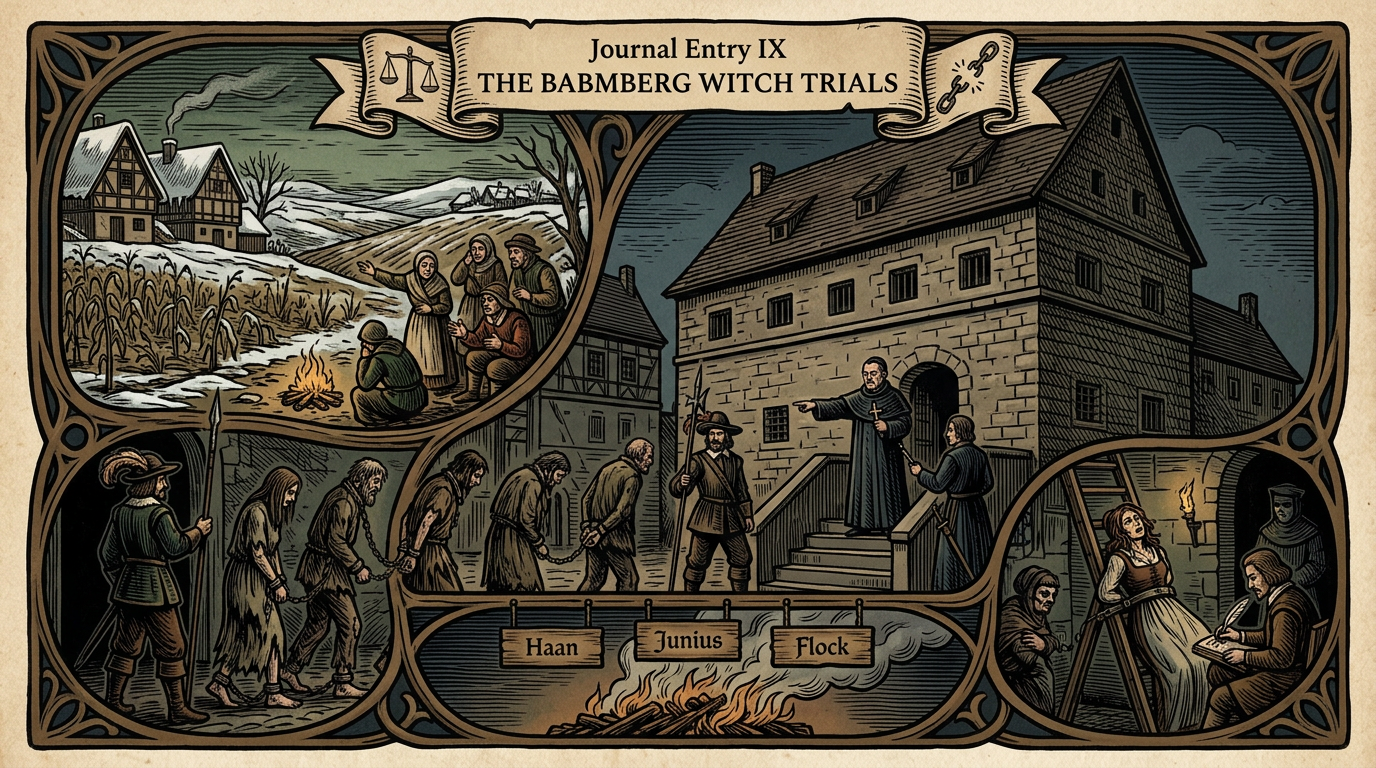
and the Order That Came Too Late

“Innocent have I come into prison, innocent have I been tortured, innocent must I die.” — Johannes Junius, burgomaster of Bamberg, in a letter smuggled to his daughter, 1628
An Archival Chronicle Prepared for the Discerning Collector
Compiled by the Archivist of the Unseen
Contents
I. The Seventeenth of May, 1630
II. A Note on This Study and Its Companion Entry
III. Bamberg Before the Burning
IV. The Frost
V. The Two Bishops
VI. Field Study — The Drudenhaus
VII. The Machinery of Accusation
VIII. Field Study — Three Lives
IX. The Empire Intervenes
X. Counting the Dead
XI. Field Study — The Ledger of Bamberg
XII. The Archivist’s Conclusion
Bibliography
I. The Seventeenth of May, 1630
Bamberg, in Franconia, a city of churches on seven hills, the seat of a prince-bishop. In the spring of 1630 a young woman named Dorothea Flock, twenty-two years old, born in Nuremberg and married to a member of Bamberg’s city council, has been in custody for months. She was first arrested on an anonymous accusation, escaped, was recaptured, and is now charged with witchcraft. She was pregnant when she was taken. Under torture, she has confessed.
Her family has not been idle. Her husband has fled to Protestant Nuremberg and petitioned everyone who might help. Her relatives have enlisted a cousin in the imperial army and a Capuchin friar in Würzburg. Three times, the Imperial Aulic Council in Vienna, the emperor’s own high court, has issued a mandate ordering the authorities in Bamberg to stop. The bishop’s men know that another order is on its way.
On the seventeenth of May, they hurry. Dorothea Flock is executed. By the usual account, the order that would have saved her arrives about half an hour later.
The Bamberg witch trials of 1626 to 1631 were among the most intense persecutions of the European witch hunts. In a single prince-bishopric, hundreds were executed in a few years, including the burgomaster, members of the city council, the bishop’s own officials, their wives, and their children. A purpose-built prison, the Drudenhaus, the house of the witches, was constructed to hold and torture them.
This field study sets out how that machinery was built, who built it, whom it consumed, and how it was finally stopped. It is prepared for the steadfast keeper of difficult records, who understands that the true horrors of history require no embellishment, and are diminished by it.
❧ ❧ ❧
II. A Note on This Study and Its Companion Entry
This field study accompanies Entry IX in the Journal of the Archivist of the Unseen, On the House Built for the Accused. In that entry, the Keeper moves the Bamberg file into the cellar beside the register of the Trier trials, the subject of Entry VIII, On the Fire That Fed on Names, and the Archivist spends the night pulling the two persecutions apart. The entry is a reflection; this study is the full record behind it.
The entry’s first purpose was to separate two persecutions that popular retellings often merge: the Trier trials of the 1580s and the Bamberg trials of the 1620s. This study begins where the entry began, by setting the two side by side, before following Bamberg on its own. Where the entry was necessarily brief, on the imperial courts, the release order for Dorothea Flock, and the number of the dead, this study gives the fuller record, and notes where the sources disagree.
❧ ❧ ❧
III. Bamberg Before the Burning
Not Trier
The persecution at Trier, in the Rhineland, belongs to an earlier generation. Under Johann von Schönenberg, archbishop-elector from 1581, a wave of trials swept the territory from the early 1580s to about 1593, fed by years of failed harvests and reaching the city of Trier in 1587. Its most famous victim was Dietrich Flade, a wealthy lawyer, city official, and judge who had himself presided over witch trials; he was accused, convicted, strangled, and burned in 1589. The scholar Cornelius Loos, who wrote against the trials, was forced to recant. The total number of victims is not known with certainty.
Bamberg lies nearly two hundred miles to the east, in Franconia, and its great persecution came more than thirty years later. Popular retellings often fasten Bamberg’s prince, his nickname of Witch Burner, and his purpose-built prison onto Trier, and run the two persecutions together. They were distinct: different rulers, different territories, different decades, and, in Bamberg’s case, a building constructed for the purpose that Trier never had. They belong to the same terrible age of the European witch hunts, but each deserves its own place on the shelf.
A State Ruled by a Bishop
Bamberg in the early seventeenth century was both a city and a state. Its ruler, the prince-bishop, was at once a spiritual lord and a secular prince of the Holy Roman Empire, with his own courts, officials, and executioners. The territory lay in Franconia, in a part of Germany torn by religious division between Catholic and Protestant states.
Witch persecutions in Bamberg did not begin in 1626. Earlier waves occurred under previous bishops, including a significant outbreak after crop failures in 1616. According to some accounts, a pause came in the early 1620s after Georg Haan, a senior official and later a victim himself, argued against further trials. The great persecution that followed was not a sudden eruption but the return, on an unprecedented scale, of a practice the territory already knew.
The context was the Thirty Years’ War, which had begun in 1618, and the Catholic Counter-Reformation, which sought to restore religious uniformity in the territories of Catholic rulers. For a reforming prince-bishop, the purification of his territory from heresy and from witchcraft could be understood as parts of the same godly task.
❧ ❧ ❧
IV. The Frost
On the twenty-seventh of May 1626, a severe frost struck the region. Johann Langhans, mayor of the nearby town of Zeil, recorded in his diary that the vines and the grain were destroyed. For a population that lived from its harvests and its vineyards, a killing frost in late May was a catastrophe that threatened hunger for the coming year.
Such disasters, in the mental world of the early seventeenth century, could be explained as the work of witches, who were believed to raise storms, blight crops, and harm livestock through their pact with the devil. After the frost, there were popular demands that the authorities act against those responsible. The trials that followed drew their first energy from this demand from below, but they were soon directed and expanded from above.
This pattern is found across Europe. Historians have linked the most severe witch hunts to the climatic deterioration of the period sometimes called the Little Ice Age, which brought cold summers, failed harvests, and famine. The frost of 1626 does not explain Bamberg by itself, but it provided the spark.
❧ ❧ ❧
V. The Two Bishops
Johann Georg Fuchs von Dornheim
Johann Georg Fuchs von Dornheim was born in 1586 at Wiesentheid in Franconia and became Prince-Bishop of Bamberg in 1623. He was committed to the Counter-Reformation and to the creation of a religiously uniform Catholic state. Under his rule, the witch trials reached a scale that earned him the names by which he is remembered: the Hexenbischof, the witch-bishop, and the Hexenbrenner, the witch burner.
Friedrich Förner
Fuchs von Dornheim’s suffragan, or assisting bishop, was the theologian Friedrich Förner, a learned and energetic preacher who was among the most important intellectual drivers of the persecution. In 1625 he published a collection of sermons, the Panoplia Armaturae Dei, the full armor of God, which presented witchcraft as an urgent spiritual danger and was recommended for use in sermons in the diocese. Förner died in 1630, before the trials ended.
The Apparatus
The bishop and his suffragan were supported by a commission of lawyers and officials who conducted the interrogations, by an executioner and his assistants, and by the prison system that was soon built for the purpose. The persecution was not a mob action. It was a bureaucratic enterprise conducted by an educated elite, with written procedures and records, under the authority of a sovereign prince.
❧ ❧ ❧
VI. Field Study — The Drudenhaus
The Name
In the dialect of Franconia, a Drude was a witch or a malevolent night spirit, the kind of being believed to press upon sleepers. The Drudenhaus was the house of the Druden, the witch house: a building constructed specifically to hold people accused of witchcraft.
The Building
The Drudenhaus was built in 1627 on the orders of Fuchs von Dornheim. It contained twenty-six single cells and two larger cells for groups of prisoners. Torture was conducted within the building. Its walls were inscribed with texts from the Bible, so that those imprisoned and tortured there were surrounded by scripture.
The Inscription
Over the entrance was a Latin line from the sixth book of Vergil’s Aeneid: Discite iustitiam moniti et non temnere divos, which may be translated as “Be warned: learn justice, and do not scorn the gods.” In the Aeneid, these words are cried out in Tartarus, the deepest region of the underworld, by Phlegyas, a king eternally punished for an act of sacrilege, as a warning to others.
The choice of the line is chilling, and it carries an irony that the builders may or may not have perceived. In Vergil, the words are spoken by one of the damned, from within his punishment. Placed above the door of the Drudenhaus, they addressed every person who entered as one already condemned. Whether the authorities intended the full force of the allusion cannot be known, and the Archivist does not claim that they did. But the line was well known to educated men, and its meaning in the poem would not have been lost on them.
The Use
The purpose of the building was efficiency. A persecution on the scale of Bamberg’s required somewhere to hold dozens of accused at once, isolated from one another and from their families, and to interrogate them under torture without interruption. The Drudenhaus was a machine for the production of confessions.
❧ ❧ ❧
VII. The Machinery of Accusation
The Bamberg trials grew as they did because of the way confessions were obtained and used.
Torture and Names
Under the procedures of the time, an accused witch was not only required to confess to a pact with the devil, but also to name accomplices: other people seen at the witches’ sabbath. Torture continued until names were given. Every confession therefore produced new accusations, and every new accusation, under torture, produced more. The persecution became self-sustaining. This is the same mechanism the Archive has recorded in an earlier case, the trial of Petronilla de Meath in fourteenth-century Kilkenny, where a confession extracted under torture implicated others.
Moving Upward
Because the accused named those they knew, and because the persecution was directed from the bishop’s court, the trials in Bamberg reached far up the social scale. Members of the city council, the burgomaster, officials of the bishop’s own government, and their families were accused and executed. At the height of the trials, it seemed that no one was safe.
Property
The property of executed witches could be confiscated, and the costs of imprisonment, torture, and execution could be charged to the accused or their heirs. Historians have debated how far financial motives drove the Bamberg trials. The evidence suggests that religious conviction and political control were the main drivers, but the confiscation of the estates of wealthy victims was a real feature of the persecution and a source of grievance in the appeals to the emperor.
Doubt
Even in the seventeenth century, there were those who saw what this machinery did. In 1631 the Jesuit Friedrich Spee, who had ministered to accused witches in Franconia, published anonymously the Cautio Criminalis, a devastating critique of witch trials, which argued that torture would make anyone confess to anything, and that the accused named others because they were made to. The book was written in the same region and at the same time as the Bamberg and Würzburg trials.
❧ ❧ ❧
VIII. Field Study — Three Lives
Georg Haan
Georg Haan was a doctor of law, a senior official of the prince-bishopric, and a member of Bamberg’s council, who had opposed the persecutions. In late December 1627 he left Bamberg for Speyer, the seat of the Imperial Chamber Court, to bring a legal complaint against the prince-bishop. While he was away, his wife, Katharina, was arrested and executed, and then their daughter, also named Katharina. When Haan returned, he too was arrested. According to the trial record, he had been denounced by his son, Adam. Under torture he confessed to sorcery, and he was executed on the fourteenth of July 1628. Adam Haan was burned the following year. The family was destroyed in the space of about eighteen months.
Johannes Junius
Johannes Junius was the burgomaster of Bamberg. Accused in 1628, he was tortured repeatedly, with thumbscrews, leg screws, and the strappado, in which a prisoner is hoisted by the wrists bound behind the back. In the summer of 1628, shortly before his execution, he wrote a letter to his daughter Veronica, which was smuggled out of prison. In it he declared that he was innocent, that he had been tortured until he confessed to things that were not true, and that he had been forced to name others he knew to be innocent. He told her that the executioner himself had urged him to confess anything, because he could not endure the torture otherwise. He asked her to keep the letter hidden. It survives, and it is one of the most powerful documents of the European witch hunts, a voice from inside the machine.
Dorothea Flock
Dorothea Flock was born in Nuremberg in 1608 and became the second wife of Georg Heinrich Flock, a member of Bamberg’s council. His first wife, Apolonia, had already been executed as a witch in 1628. Dorothea was arrested in December 1629, first on a charge of adultery and then of witchcraft. She was pregnant. Her husband fled to Nuremberg and petitioned the authorities in Bamberg and beyond, and her family mobilized every connection they had. Their appeals reached the Imperial Aulic Council in Vienna, which issued mandates in her favor in March and May of 1630; by the account the companion entry follows, these ordered that her treatment be eased and that she be allowed an advocate. She gave birth in custody to a daughter, and, by the same account, was returned to the Drudenhaus some six weeks later. She was sentenced to death on the fourteenth of May 1630 and executed on the seventeenth, the authorities having hastened the execution when they learned that a further order was coming. By the usual account, that order arrived about half an hour after her death.
❧ ❧ ❧
IX. The Empire Intervenes
The Bamberg trials were not stopped from within. They were stopped from outside, by the pressure of the empire and then by the arrival of war.
The Emperor and the Diet
The appeals of the families of the accused, including the Flocks, reached the imperial courts and the emperor, Ferdinand II, a devout Catholic who was no opponent of witch prosecution in principle. In the spring of 1630 he protested against the conduct of the Bamberg trials, and the matter was raised at the Imperial Diet of Regensburg in the autumn of that year. An investigation by the Aulic Council led to a halt in new trials. In July 1631 the emperor appointed Anton Winter, known as an opponent of the witch hunts, to head the Bamberg witch commission.
The Swedes
The final end came from the war. In 1631 and 1632, the Swedish army of Gustavus Adolphus advanced into Franconia. Fuchs von Dornheim fled. On the eleventh of February 1632, as the Swedish forces approached Bamberg, the authorities closed the Drudenhaus and released the remaining prisoners, on condition that they keep silent about what they had suffered.
The End of the House
Fuchs von Dornheim died in exile at Spital am Pyhrn in Austria on the twenty-ninth of March 1633. The Drudenhaus was demolished in 1635. Smaller witch trials continued in the region for decades, but nothing on the scale of 1626 to 1631 was seen in Bamberg again.
❧ ❧ ❧
X. Counting the Dead
How many people died in the Bamberg witch trials? The honest answer is that the number is not known precisely.
The records are incomplete. Some trial documents were lost or destroyed, and figures were compiled from different kinds of sources. Estimates in modern scholarship and reference works range from about three hundred to about one thousand executions across the period of persecution, with the most intense years between 1626 and 1631, and a peak in 1629. Some reckonings count only the city of Bamberg; others the whole prince-bishopric; others include earlier waves of trials.
The Archivist gives no single figure, because none can be given with confidence. What is certain is that the persecution killed hundreds of people in a few years, in a small territory, and that this places Bamberg, with neighboring Würzburg, among the most lethal witch hunts in European history.
❧ ❧ ❧
XI. Field Study — The Ledger of Bamberg
Established
The persecution of 1626 to 1631 under Prince-Bishop Johann Georg Fuchs von Dornheim, with the support of his suffragan Friedrich Förner; the frost of May 1626; the construction of the Drudenhaus in 1627, with its cells, its torture, its scriptural texts, and its Vergilian inscription; the execution of Georg Haan in July 1628 after the executions of his wife and daughter; the smuggled letter of Johannes Junius; the execution of Dorothea Flock on 17 May 1630 despite imperial mandates; the release of the prisoners in February 1632; the demolition of the Drudenhaus in 1635.
Reported, Not Precisely Verifiable
That Flock’s release order arrived half an hour after her death; the details of the imperial mandates in her case and the timing of her return to the Drudenhaus after childbirth; that Haan’s opposition halted the trials around 1622.
Uncertain
The total number of victims, with estimates from about three hundred to about one thousand; the relative weight of religious, political, and financial motives; whether the builders of the Drudenhaus intended the full meaning of the Vergil line above its door.
A Caution
Popular accounts of witch trials often mix documented horrors with invented ones: imaginary torture devices, fabricated quotations, and inflated numbers. The Archive’s study of the Iron Maiden showed how a device that never existed in the Middle Ages became a symbol of medieval cruelty. Bamberg needs no such additions. Its documents are terrible enough.
❧ ❧ ❧
XII. The Archivist’s Conclusion
The Bamberg witch trials were not the work of a superstitious mob, though popular fear helped start them. They were the work of a learned and pious prince, his theologian, his lawyers, and his officials, who built a house for the purpose, inscribed it with scripture and with Vergil, and processed hundreds of human beings through it according to rule.
The voices that survive from inside that house, above all the letter of Johannes Junius, tell us what the records do not: that the confessions were extracted, that the names were forced, that the accused knew themselves innocent and knew their accusers knew it too. The story of Dorothea Flock tells us that the empire, at its slowest and most reluctant, could still be moved to intervene, and that the men who ran the machine would race to finish their work before it could.
The lesson of Bamberg is not that the past was primitive. It is that a society with law, learning, and religion can build a system of judicial murder, and that such systems are stopped only when someone outside them, an appeal, a court, an army, forces them to stop. That is a lesson that requires no exaggeration. It requires only the record, kept faithfully, and read.
Not far to the west, in the prince-bishopric of Würzburg, another prince-bishop was lighting fires in the same years, and the surviving lists of the executed there include children. That file waits on the next shelf.
❧ ❧ ❧
This field study is preserved as one vestige among many within the haunted archive of Wicked Dual, an artisan boutique devoted to the reclamation of history’s clandestine and silenced corners. It is filed as the companion to Entry IX of the Journal of the Archivist, On the House Built for the Accused, and is kept in memory of those who passed through the Drudenhaus, innocent, as Johannes Junius wrote, of everything but their accusers’ fear.
Read the written chronicles on the blog, the Wicked Archive: www.wickeddualblog.com
Secure the physical artifacts drawn from these histories at the Wicked Dual boutique: https://www.etsy.com/shop/Wickeddual
We invite you to enter the haunted archive and secure a piece for your private collection; it is a necessary addition for those who curate the darker corners of human history.
— The Archivist of the Unseen

Bibliography
The following works include the principal modern studies of the Bamberg persecution, a contemporary critique of witch trials, and standard histories of the European witch hunts; translations of the Junius letter appear in both Burr and Kors and Peters; readers pursuing formal citation are advised to verify editions and pagination against a library catalog.
Behringer, W. (2004). Witches and witch-hunts: A global history. Polity Press.
Levack, B. P. (2016). The witch-hunt in early modern Europe (4th ed.). Routledge.
Roper, L. (2004). Witch craze: Terror and fantasy in baroque Germany. Yale University Press.
Related Chronicles in the Archive
Journal of the Archivist, Entry IX — On the House Built for the Accused
Journal of the Archivist, Entry VIII — On the Fire That Fed on Names
Field Study No. XII — The One Who Could Not Run: Petronilla de Meath
Field Study No. XXVII — The Maiden That Never Was: The Iron Maiden
Leave a Reply