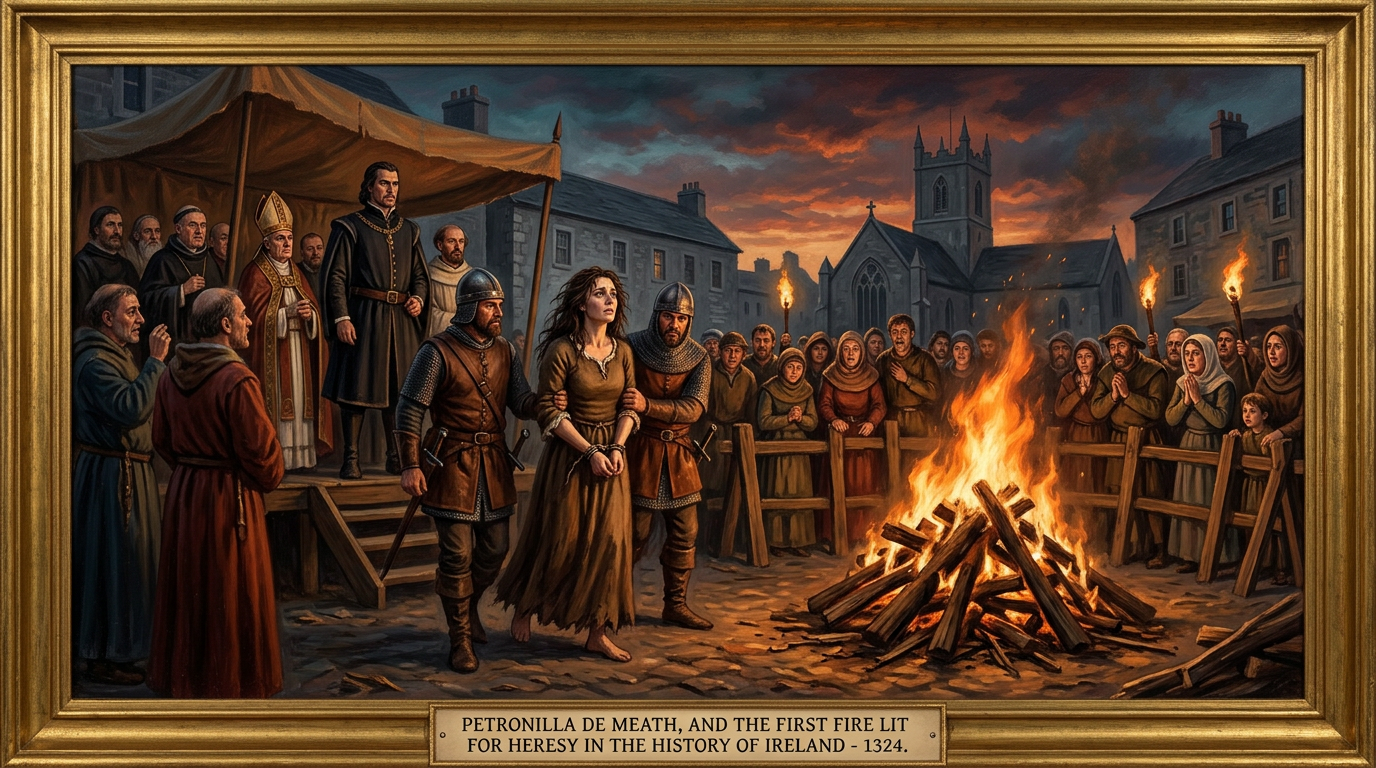
Petronilla de Meath, and the First Fire Lit for Heresy in the History of Ireland

“They burned the servant because the mistress could be replaced by no one and reached by nothing. The fire required a body. It took the only one that could not flee.”
An Archival Chronicle Prepared for the Discerning Collector
Compiled by the Archivist of the Unseen
Contents
I. The Fire That Was Meant for Another
II. The Problem of the Servant: A Life Known Only Through Her Destroyer
III. What Little the Record Grants Her
IV. The Household of Dame Alice Kyteler
V. Field Study — The Confession: A Text Composed in Pain
VI. The Machinery of Torture and the Manufacture of Truth
VII. An Archival Aside: On the Reclamation of the Silenced
VIII. Why the Servant and Not the Mistress: The Economics of the Fire
IX. The Flogging Through Six Parishes and the Stake
X. The Daughter Who Fled: Sarah, or Basilia
XI. The Chronicles That Recorded Her Burning
XII. The Long Afterlife: From the Ashes to The Dinner Party
XIII. The One Who Could Not Run
Bibliography
I. The Fire That Was Meant for Another
Consider the woman brought out to die in Kilkenny on the third of November, in the year 1324. She has already been flogged — driven, the record says, through six parishes under the whip. She has already confessed, though the confession was not hers in any sense that the word ought to carry; it was extracted from her body by torture and composed, in its damning particulars, by the men who held the instruments. She is, so far as anyone can determine, a servant — a woman of the laboring class, without fortune, without powerful kin, without the single thing that might have saved her: the means to be somewhere else.
For the fire she is about to enter was never meant for her. It had been built, across long and bitter months, for her mistress — a wealthy widow named Dame Alice Kyteler, four times married, connected by blood and marriage to the highest offices of the colony, and possessed of every resource a person could require to slip a noose. And slip it the mistress did. When the machinery of the trial had done its grinding work and the moment of sentence at last arrived, Alice Kyteler was gone, fled across the water into a silence that has never been broken. The stake stood ready. The crowd had gathered. The fire wanted a body.
It took hers. Her name was Petronilla de Meath, and she has the terrible distinction of being the first person in the recorded history of Ireland — and, by most reckonings, of the whole of the British Isles — to be burned to death for the crime of heresy. She was, in the most precise and unbearable sense, a substitute: consumed because the woman the fire was built for could not be reached, and she could not escape.
This chronicle is an act of reclamation. The Kyteler affair has been told and retold for seven centuries, and in nearly every telling Petronilla de Meath appears as a footnote — the servant who was tortured, whose confession damned her mistress, and who burned while the mistress escaped. She is the instrument of the story, rarely its subject. What follows attempts the opposite: to place at the center of the account the woman who was placed, in life, at its disposal; to gather the pitifully few facts the record grants her; to read her forced confession not as evidence of her guilt but as evidence of what was done to her; and to restore, so far as the sources permit, the human being who was burned so that a wealthier woman might live.
The pages that follow are prepared for the discerning collector of the silenced and the overwritten — the reader who understands that the true measure of a persecution is taken not among those who escaped it but among those who could not, and that the servant burned in the great one’s place is the figure history most consistently forgets and most urgently owes. Petronilla de Meath is owed. This is an attempt at partial payment.
❧ ❧ ❧
II. The Problem of the Servant: A Life Known Only Through Her Destroyer
Any honest study of Petronilla de Meath must begin with a confession of its own: that she is very nearly unknowable. The obstacle is not merely that the sources are thin — though they are desperately thin — but that the principal source is her executioner. Almost everything the record preserves of her issues from the pen of Richard de Ledrede, the Bishop of Ossory, the man who ordered her tortured and burned, writing an account whose entire purpose was to justify that torture and that burning. To reconstruct Petronilla from Ledrede’s narrative is to attempt to see a woman by the light of the fire that consumed her — to read her existence in the words of the one person in history most invested in her destruction.
This is the central methodological difficulty, and it must govern every sentence that follows. When the record says that Petronilla confessed to flying upon a greased beam, to sacrificing cocks at the crossroads, to witnessing her mistress lie with a demon — the record is not telling us what Petronilla did. It is telling us what her torturers required her to say, and what her chief torturer afterward chose to write down. The document is authentic; the confession within it is not. And so the historian is left in the strange position of possessing a relatively detailed text about a woman while being unable to trust a single one of its supernatural particulars — a text that is simultaneously the best evidence of her existence and worthless as evidence of her deeds.
What can be salvaged, then, is not Petronilla’s actions but the shape of her circumstances — the mundane and verifiable facts of her station, her relationship to Kyteler, her treatment, and her death — together with a disciplined reading of the confession as an artifact of coercion rather than a record of belief. This is a poorer harvest than one would wish, but it is not nothing. And it carries its own dark lesson, one that applies far beyond this single case: that the overwhelming majority of the people persecuted as witches across the following centuries are known to us, if at all, only through documents exactly like Ledrede’s — the words of their accusers, the confessions wrung from their bodies. Petronilla de Meath is not merely an individual to be recovered. She is the prototype of a whole category of the historically silenced, the first of a multitude who would be known to posterity only through the mouths of the men who killed them.
❧ ❧ ❧
III. What Little the Record Grants Her
Artifact: The Verifiable Facts
Stripped of the confession’s fantastical content, the securely knowable facts of Petronilla de Meath’s life can be stated in a short compass — and the brevity is itself a testimony to how completely the poor were erased from the medieval record even as they were consumed by its violence. She was born around the year 1300, which would have made her a young woman, scarcely more than twenty-four, at the time of her death in 1324. Her toponym — de Meath, or in the Latinized form de Midia — indicates an origin in Meath, the neighboring region to the north, marking her as a woman who had come from elsewhere into the Kilkenny household where she met her fate.
She was, the sources agree, an associate and servant of Dame Alice Kyteler, and among the most intimate of them — close enough to her mistress to be cast, in the prosecution’s narrative, as her chief accomplice and the medium between Kyteler and the demon she was said to serve. She was a mother: she had a daughter named Sarah, herself named among the accused, who is believed to have escaped in the company of Kyteler when the widow fled. And she was, by every indication, a woman of no independent means — possessed of neither the fortune nor the powerful kinship network that allowed her mistress and, apparently, her own daughter to escape. That single absence, the absence of the means of flight, is the most consequential fact of her life, for it is the reason she died.
Beyond these bare particulars, the record grants almost nothing. Her age is an estimate; her origins a single word; her inner life a blank. Even her name comes to us in variant forms — Petronilla de Meath, Petronilla de Midia — the spelling unstable because the recording hands did not consider a servant’s name worth fixing with care. This is the ordinary condition of the medieval poor, whose existences generated documentation only at the moments they collided with the machinery of the powerful: a tax, a court, a fire. Petronilla enters the record at the single point of her destruction and at no other. Before the accusation she is invisible; after the flames she is ash. The whole of her documented life is the record of her death — and it is precisely this, the near-total erasure of everything but her suffering, that makes the labour of her reclamation both so difficult and so necessary.
❧ ❧ ❧
IV. The Household of Dame Alice Kyteler
To situate Petronilla is to situate her within the household of the woman whose fate determined her own, and a word on that household — and on the affair that consumed it — is therefore necessary, though the fuller account of Dame Alice Kyteler belongs to a separate study within this archive. Kyteler was among the wealthiest figures of the Anglo-Norman colonial town of Kilkenny: a moneylender of Flemish merchant stock, four times married and four times widowed, each marriage having enlarged her fortune. Upon the death of her fourth husband, and amid the resentment of stepchildren who saw her wealth as the theft of their inheritance, an accusation arose that she had murdered her husbands by sorcery — and this ordinary accusation of domestic poisoning fell into the hands of a bishop freshly returned from the papal court at Avignon, who possessed both the learning and the zeal to transform it into something the historical record had not before seen: a full charge of diabolical, Satanic witchcraft.
Seven formal charges were assembled, and they named not Kyteler alone but a circle — an alleged coven of her servants, associates, and kin, of whom Petronilla was cast as the foremost. This collective conception was among the case’s grim innovations: the treatment of the accused not as an individual malefactor but as an organized society of heretics, a structure that would prove, across the centuries of witch-hunting to come, uniquely conducive to mass persecution, since the confession of one could be made to condemn many. Petronilla’s position within this constructed coven was the most exposed of all. She was intimate enough with Kyteler to be plausibly cast as her chief instrument, yet powerless enough to be broken without consequence. She occupied, in other words, the exact intersection of intimacy and vulnerability — close enough to the center of the accusation to be essential to it, and low enough in station to be expendable to it. It was the worst possible place to stand, and she had not chosen it; her service had placed her there, and her poverty ensured she could not leave.
❧ ❧ ❧
V. Field Study — The Confession: A Text Composed in Pain
Artifact: The Extracted Testimony
The confession attributed to Petronilla de Meath is the longest and most detailed thing the record preserves of her, and it must be approached as what it is: not a window into her mind but a wound in the shape of a text — a document composed under torture, its content dictated by the theology of her interrogators, its function to supply the supernatural proof that the prosecution of the well-defended Kyteler otherwise lacked. To read it is to read the anatomy of coercion, and the discerning reader should hold every particular of it at the arm’s length that its origin demands.
According to Ledrede’s own narrative, Petronilla confessed to a catalogue of the diabolical drawn directly from the developing European theology of witchcraft. She was made to say that she and her mistress had performed blasphemous rites — pronouncing sentences of excommunication against Kyteler’s own husband by the light of wax candles, with the ritual repetitions the “rules” of their supposed art required. She was made to declare herself an adept in the “accursed art,” while insisting she was as nothing beside her mistress, from whom she had learned it all, and than whom — the confession has her proclaim — there was no one more skilled in the whole realm of the King of England. She was made to affirm the most lurid of the charges against Kyteler: that the widow had permitted a demon to know her carnally, that she consulted devils, that she brewed potions, that she had denied the faith of Christ and His Church. And she was made to supply the detail that has attached itself to her memory ever since — that she and her mistress had applied a magical ointment to a wooden beam, and that by this means the two women flew.
The particulars deserve scrutiny, for they betray their own manufacture. Observe how perfectly the confession serves the prosecution’s needs: it confirms every one of the charges against Kyteler, it establishes Kyteler rather than Petronilla as the true adept and origin of the evil, and it supplies, in the flying ointment and the crossroads sacrifices, precisely the spectacular diabolical imagery that the new Avignon theology demanded and that no honest testimony could ever have produced. This is not the confession of a guilty woman. It is the confession of a theology, spoken through the broken body of a woman who had been given no choice but to speak it. The very fluency with which it echoes the formal charges is the proof of its falsity: a genuine account of folk practice would be idiosyncratic, local, strange; this account is simply the indictment played back, transposed into the first person and confirmed. Petronilla did not describe her life. She recited her torturers’ nightmare, because the alternative to reciting it was more pain.
There is, buried in the confession, a single detail that may carry a bitter authenticity — the note of the servant’s deference, the insistence that she was “nothing in comparison with her mistress.” Whether this reflects a genuine hierarchy within the household or merely the prosecution’s need to keep Kyteler as the primary target, it captures, perhaps unintentionally, the true relation between the two women: that even in the manufacture of their shared damnation, the servant was subordinate, the lesser figure, the one whose function was to point upward at her betters. She was made to confess her own inferiority even in the practice of the crime she had not committed. It is the logic of her whole life, preserved in the logic of her forced confession: always the instrument, never the principal; always the one who served, even in the fiction of her guilt.
❧ ❧ ❧
VI. The Machinery of Torture and the Manufacture of Truth
The confession cannot be understood apart from the means by which it was obtained, and here the record is at once revealing and evasive. Petronilla was tortured; this is not in doubt. What is instructive is the language with which her torture was described and justified, for it exposes the machinery by which the medieval prosecution converted violence into evidence and pain into proof.
The legal instrument that permitted the torture was the inquisitional procedure authorized by papal decree — the same apparatus, imported from the Continent, that Ledrede had learned to wield at Avignon. Under this procedure, confession was the queen of proofs, and torture the accepted means of obtaining it; a confession extracted under torment was held, by a monstrous circular logic, to be valid provided the accused affirmed it afterward, when the immediate agony had ceased. The system was designed to produce confession, and it produced it reliably, because the alternative to confession was the continuation of pain. What such a system cannot produce is truth, for a person in sufficient agony will affirm anything whatever, and the more elaborate and leading the questions, the more elaborate and confirmatory the answers. The confession of Petronilla de Meath is a textbook demonstration of the procedure’s actual function: not the discovery of what happened, but the manufacture of what the prosecutors already believed.
Ledrede’s own account contains a detail of chilling significance. He refers to the violence done to Petronilla not as torture but as flogging — presenting it as punishment rather than as interrogation. Scholars have observed the likely purpose of this framing: to lend her confession credibility. A confession extracted by torture was, even by the standards of the age, of questionable validity; but if the violence could be recast as the just chastisement of an already-guilty heretic rather than the means of establishing her guilt, then the confession it produced might stand unimpeached. In the slippage between torture and flogging one may read the prosecution covering its own tracks — disguising the manufacture of the evidence as the punishment of the crime, so that the circular engine of coerced confession might appear to turn on truth rather than on pain. It is among the earliest documented instances in these islands of a technique that the witch-hunts would perfect: the laundering of torture into testimony.
❧ ❧ ❧
VII. An Archival Aside: On the Reclamation of the Silenced
It is fitting to pause upon the peculiar nature of this particular act of remembrance. To write a field study of Petronilla de Meath is to attempt the reclamation of a person who left no voice of her own — no word she chose, no act she can be shown to have committed, nothing but the record of what was done to her and the false confession wrung from her. The ordinary materials of biography are absent. What remains is the outline of a woman visible only in the negative, defined entirely by the violence that ended her, and the labor of restoring her is the labor of insisting that a person existed where the record preserved only a victim.
This is among the oldest and most necessary functions of an archive of the unseen: to hold space for those whom the official record consigned to the margins, the footnotes, the ash. The powerful leave monuments; the wealthy leave wills and portraits and named tombs. The servant burned in her mistress’s place leaves a single hostile document and a variant spelling of her name. Wicked Dual exists as a repository for precisely this imbalance — for the conviction that the woman history reduced to an instrument of someone else’s story deserves to be recovered as a subject of her own, and that to keep a vestige of such a figure, to hold her memory deliberately against the current of a record that discarded her, is an act of reclamation and of justice. The great ones can defend their own memory; they have always been able to. It is the Petronillas who require the archive, because without it they vanish entirely, leaving only the fire.
This is the disposition the chronicle maintains: that the servant is not the footnote to the mistress’s escape but a subject in her own right, and that the true weight of the Kyteler affair is felt not in the widow’s clever vanishing but in the servant’s inability to vanish — in the body that could not be moved beyond the fire’s reach. The chronicle now turns to that terrible asymmetry, and to the question it forces: why the servant, and not the mistress?
❧ ❧ ❧
VIII. Why the Servant and Not the Mistress: The Economics of the Fire
The most important single fact about the death of Petronilla de Meath is comparative: she burned, and Alice Kyteler did not. The two women stood accused of the same crimes, named in the same indictment, condemned by the same confession. One died in agony; the other escaped so completely that her fate is unknown to this day. The difference between them was not guilt, not evidence, not the degree of their involvement in whatever had actually occurred within the Kyteler household. The difference was power — and in the precise anatomy of that difference lies the darkest lesson of the entire affair.
Alice Kyteler possessed everything required to escape the fire. She had wealth, and the mobility wealth confers. She had powerful kin — a relation by marriage who served as Chancellor of Ireland, the highest legal officer of the colony. She had a powerful son, and powerful allies among the secular magnates who at one point imprisoned the prosecuting bishop himself. And she had, in her Flemish mercantile background, the far-flung connections that could shelter a fugitive abroad. When the machinery of the trial finally overcame these defenses, they had bought her the one thing that mattered: the time and the means to flee. Petronilla possessed none of it. No fortune to fund a flight, no kin in high office to obstruct the prosecution, no allies to imprison the bishop, no foreign refuge prepared to receive her. When the machinery came for her, there was nothing to slow it and nowhere for her to go. She was, in the brutal economy of the affair, the accessible body — the one the fire could actually reach.
This asymmetry is not incidental to the history of witch-hunting; it is its essence, visible here at the very origin in unusually stark form. The persecutions that would sweep Europe across the following three centuries would fall, overwhelmingly, upon the poor, the isolated, the friendless, and the female — upon those who, like Petronilla, lacked the resources to defend themselves or to flee. The wealthy and well-connected were rarely burned; they could purchase legal defense, marshal powerful patrons, or simply remove themselves beyond reach, as Kyteler did. The fire was, from its first lighting in Kilkenny, an instrument that fell selectively upon the powerless. Petronilla de Meath is the founding demonstration of this principle: the first person burned for heresy in Ireland was burned not because she was the guiltiest but because she was the most reachable — because, alone among the accused of consequence, she could not run. The economics of the fire were established in her death, and they would not change for three hundred years.
❧ ❧ ❧
IX. The Flogging Through Six Parishes and the Stake
Artifact: The Public Death
The manner of Petronilla’s death was calculated, as such deaths always were, for its effect upon the living. She was not simply executed; she was made into a spectacle, a public instruction, her suffering deployed as a lesson to the watching town. The record preserves the essential particulars, and they repay a careful and unflinching attention, for they reveal the death of a heretic as the medieval Church understood it: not merely a punishment but a performance, a ritual of communal warning inscribed upon a human body.
Before the fire, she was flogged — whipped, in Ledrede’s own phrasing, through six parishes. The detail is precise and dreadful. She was not merely beaten in a single place but driven under the whip through parish after parish, her scourging carried from congregation to congregation so that the maximum number of the faithful might witness the chastisement of the heretic. The flogging was itself a procession, a moving sermon written in blood, and its purpose was as much didactic as punitive: to display the wages of heresy across the whole community before the final and irreversible display of the stake. By the time she reached the fire, she had already been made an example of, six times over.
And then, on the third of November 1324, she was burned. Death by fire was reserved, in the theology of the age, for the heretic specifically — for the one whose crime was against God and the Church rather than merely against the King’s peace — and its use here marked the case as ecclesiastical rather than criminal, a matter of heresy tried under Church law rather than sorcery tried under common law. The distinction was fatal. Under the English common law that governed ordinary sorcery, the offense was a comparatively minor one; under the ecclesiastical law of heresy that Ledrede invoked, it was a capital crime punishable by the flames. Petronilla de Meath died because her prosecutor chose the deadlier of two available legal frameworks — because he tried her not as a mere caster of spells but as a soldier in the Devil’s war against the Church. Her burning was the first of its kind in Ireland, and, by most reckonings, in the whole of the British Isles: the first time the specific penalty of death by fire for heresy was carried out in these islands. She is a grim milestone, the first name in a long and terrible ledger, and the ledger opens with a servant burned in the place of the mistress who got away.
❧ ❧ ❧
X. The Daughter Who Fled: Sarah, or Basilia
Artifact: The Surviving Child
Petronilla de Meath was a mother, and the fate of her daughter is among the few threads of the story that lead anywhere but the fire — though it leads, in the end, into the same silence that swallowed Alice Kyteler. The daughter was named Sarah, and she too was named among the accused; but unlike her mother, she escaped, and she is believed to have fled in the company of Kyteler when the widow made her own escape. The detail is small but it carries a terrible weight, for it means that the servant’s child survived by the same means the mistress did — by flight in the mistress’s protection — while the servant herself remained to burn.
The daughter’s name is itself unstable in the record, in a manner that illustrates the fragility of these lives in the documentation. She appears as Sarah in some accounts; but a fourteenth-century chronicler renders the name differently, and in a later history drawn from that source the fleeing daughter is called Basilia, the escape recorded in the terse phrase that “the Lady and Basil fled.” Whether Sarah and Basilia are the same person under variant names, as seems most probable, or whether the confusion reflects some deeper uncertainty in the sources, the essential fact survives: a daughter of Petronilla escaped the fate of her mother, carried to safety in the flight of the wealthy widow whose service had doomed the mother in the first place. There is a bitter symmetry in it. The mistress’s flight saved the mistress and the servant’s child, but not the servant. Petronilla remained the one fixed point in a story of escapes — the body that stayed while the others fled, the mother who could not save herself even as her daughter was saved beside her.
Of Sarah, or Basilia, nothing further is known. She vanishes into the same undocumented silence as Kyteler, and her later life — whether long or short, whether spent in England or Flanders or somewhere else entirely — is beyond recovery. But her survival, however shadowy, is one of the few consolations the record permits: that something of Petronilla de Meath escaped the fire after all, that the line did not end entirely in the flames of Kilkenny, and that a daughter carried out of that town whatever memory of her burned mother she was able to bear.
❧ ❧ ❧
XI. The Chronicles That Recorded Her Burning
Petronilla de Meath survives in more than the bishop’s self-justifying narrative; her death was noted, with varying degrees of horror and precision, by the chroniclers of her age, and these brief notices are worth gathering, for they establish the fact and the significance of her burning independently of the man who ordered it. In the terse Latin of the medieval annal, one may read the recognition, even among her contemporaries, that something new and terrible had occurred.
The most significant of these witnesses is John Clyn, a Franciscan friar of Kilkenny and one of the most important chroniclers of fourteenth-century Ireland — the same annalist who would later leave a famous and harrowing record of the arrival of the Black Death. Clyn recorded Petronilla’s death and, crucially, marked its unprecedented character. He noted that she was condemned for sorcery and for offering sacrifice to demons, consigned to the flames and burned; and then he added the observation that gives her death its place in history — that never before, in olden days, had it been seen or heard that anyone suffered the death penalty for heresy in Ireland. The chronicler recognized, in the moment, that a threshold had been crossed. Petronilla’s was not merely another execution. It was the first of a kind, and a contemporary understood it as such and set it down.
Other annals of the period preserve the affair as well, recording the charges, the flight of Kyteler, and the burning of the servant, sometimes with the variant details — the altered name of the fleeing daughter, the differing accounts of the associates’ fates — that mark the fragmentary and contested nature of the record. But it is Clyn’s notice that matters most, for it supplies the independent confirmation that Petronilla’s burning was genuinely the first of its kind, and the recognition, from within her own century, that a dark precedent had been established. The chroniclers did not remember Petronilla as a person; they remembered her as an event, a first, a milestone. It is left to the later archive to remember her as a woman.
❧ ❧ ❧
XII. The Long Afterlife: From the Ashes to The Dinner Party
For nearly seven centuries Petronilla de Meath remained what her chroniclers had made her: a footnote, an event, the servant burned in the Kyteler affair. But the later ages, and particularly the movements of recent decades that have sought to recover the silenced women of history, have begun at last to restore her as a subject — to lift her out of the margins of her mistress’s story and grant her a memory of her own. This afterlife is itself a significant artifact, for it demonstrates the slow work of historical reclamation across the centuries, the gradual turning of a forgotten victim into a remembered woman.
The most prominent act of this reclamation came from the feminist artist Judy Chicago, whose monumental installation The Dinner Party — completed in the latter half of the twentieth century and now permanently housed at the Brooklyn Museum — set a place for Petronilla de Meath among its company of mythical and historical women, inscribing her name upon the tiled floor of the great triangular table that honours the women written out of the historical record. To be named in that work is to be claimed for memory, lifted from the anonymity of the persecuted and set among the recognized. It is a fitting destination for a woman whose entire historical existence had been reduced to the manner of her death: to be remembered, at last, not as an instrument of someone else’s trial but as a person worthy of a place at the table.
More recently still, Petronilla has been restored to something even rarer — a voice. The Irish novelist Niamh Boyce, researching and writing in Kilkenny itself, published in 2019 a novel titled Her Kind, which retells the Kyteler affair through Petronilla’s own perspective — imagining the interior life the record so brutally denied her, and shining, as its admirers noted, a light upon the women whom history had silenced. That a servant burned as a footnote in 1324 should become, seven hundred years later, the narrating consciousness of a novel nominated for a major European literary prize is a reversal of historical fortune worth marking. The woman who was permitted, in life, only the words her torturers put in her mouth has been granted, in the long afterlife of memory, a voice imagined on her own behalf. It is not restitution — there can be no restitution for the fire — but it is remembrance, and remembrance is the one justice the dead can still receive.
These acts of reclamation matter because they reverse, however partially, the original erasure. The historical record preserved Petronilla only as her destroyer wished her preserved: as a confessed heretic, an instrument, an example. The later restorations insist upon what that record refused — that she was a person, a mother, a woman of no fortune caught in the machinery of the powerful, burned for the crime of being reachable. To set her a place at a table, to give her the narration of a novel, to write a field study that places her at the center rather than the margin of her own death: these are the small, late, necessary acts by which a silenced woman is at last permitted to be more than the fire that consumed her.
❧ ❧ ❧
XIII. The One Who Could Not Run
Seven hundred years after the fire, the essential facts of Petronilla de Meath’s life can still be counted on the fingers of a single hand. She was born around 1300, probably in Meath. She served in the household of Dame Alice Kyteler. She had a daughter named Sarah. She was tortured, made to confess to impossible crimes, flogged through six parishes, and burned at the stake on the third of November 1324, the first person put to death by fire for heresy in the recorded history of Ireland and the British Isles. Everything else — her face, her thoughts, her faith, her fears, the whole interior country of her life — is gone, burned away as thoroughly as her body, leaving only the outline that the flames threw upon the wall of the record.
And yet that outline is enough to indict an entire history. For Petronilla de Meath is the founding figure of a pattern that would repeat, with monstrous fidelity, for three centuries: the poor woman burned while the powerful one escaped; the confession manufactured by torture and laundered into evidence; the fire that fell not upon the guiltiest but upon the most reachable. She was first — the first name in the long ledger of the burned, the prototype of the multitude who would follow her into the flames across the whole of Europe, known to posterity, like her, only through the words of the men who killed them. To remember her rightly is to remember all of them: to understand that the witch-hunt was, from its very origin, an engine that ground the powerless while the powerful walked free, and that the servant burning in the mistress’s place was not an aberration of the system but its purest and most characteristic product.
The mistress vanished into a silence that reads, at this distance, almost like triumph — the clever woman who cheated the fire and was never found. But it is the servant who ought to hold the eye and the memory, precisely because she could not vanish, because she had nowhere to go and no one to hide her, because when the fire required a body hers was the one within reach. Alice Kyteler escaped; that is the story history has always told. Petronilla de Meath did not; that is the story history has always neglected, and it is the truer and the darker one. She was the one who could not run — and in her burning, the whole cruel logic of the persecutions to come was written, once and for all, in the ordinary daylight of a November afternoon in Kilkenny. She deserves to be remembered not for how she died but for who she was: a woman of no fortune and no power, caught in a machinery built by her betters, who paid with her body for a crime that no one committed because no such crime was ever possible. The fire took her. The archive, at least, may refuse to let it have the last word.
This field study is offered, then, as an act of remembrance for the one the record discarded — the servant burned in the great one’s place, restored so far as the sources permit from footnote to subject, from instrument to person, from ash to name. Petronilla de Meath. Died 3 November 1324. The first, and among the least remembered, and now, perhaps, a little less forgotten than before.
❧ ❧ ❧
This field study is preserved as one vestige among many within the haunted archive of Wicked Dual, an artisan boutique devoted to the reclamation of history’s clandestine and melancholy corners. Petronilla de Meath — the servant burned in her mistress’s place, the first put to the fire for heresy in these islands — is but one chronicle among the collection’s darker holdings.
We invite you to enter the haunted archive and secure a piece for your private collection; it is a necessary addition for those who curate the darker corners of human history.
The physical artifacts drawn from the histories chronicled here — the vestiges of the accused, the silenced, and the reclaimed — may be sought within the collection at www.wickeddualblog.com and in the associated ateliers, for those who would keep a fragment of this darkness near at hand.
— The Archivist of the Unseen

Bibliography
The following works constitute credible historical and scholarly literature underlying this field study; readers pursuing formal citation are advised to verify editions and pagination against a library catalog.
Boyce, N. (2019). Her kind. Penguin Ireland.
Chicago, J. (1979). The dinner party: A symbol of our heritage. Anchor Press/Doubleday.
Kieckhefer, R. (2000). Magic in the Middle Ages (2nd ed.). Cambridge University Press.
Seymour, St. J. D. (1913). Irish witchcraft and demonology. Hodges, Figgis & Co.
Leave a Reply