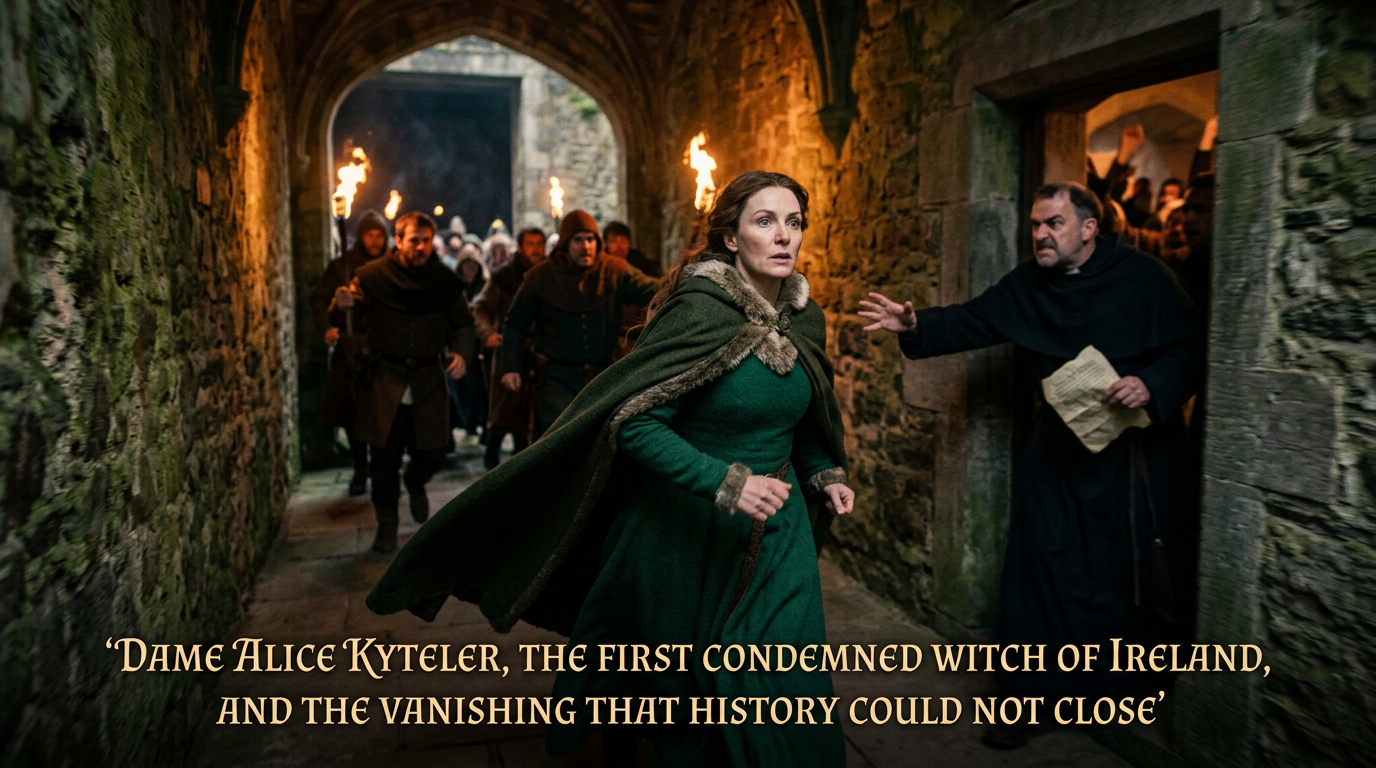
Dame Alice Kyteler, the First Condemned Witch of Ireland, and the Vanishing That History Could Not Close

“The fire was lit. The stake was raised. The record is precise on every particular but one — the woman it was built for was not there.”
Compiled by the Archivist of the Unseen
An Archival Chronicle Prepared for the Discerning Collector
Contents
I. The Empty Stake
II. The Tidy Story, and the Question It Refuses to Answer
III. The Woman: A Flemish Merchant’s Daughter in a Norman Town
IV. The Four Husbands and the Fortunes That Followed Them
V. Field Study — The Seven Charges: The Invention of an Irish Witch
VI. Petronilla de Meath: The Woman Who Burned in Her Place
VII. An Archival Aside: On the Reading of a Hostile Record
VIII. The Accusers and Their Motives: Who Wanted Her Destroyed
IX. Field Study — The Motives of Alice Herself: Money, Marriage, and the Constraints of a Woman’s Life
X. The Trial: A Bishop, a Chancellor, and a War of Jurisdictions
XI. The Escape: What the Record Actually Says
XII. Field Study — The Question of Survival: England, Flanders, and the Silence Beyond
XIII. The Weighing of the Evidence: Did She Live?
XIV. The Precedent: What Her Case Made Possible
XV. The Woman Who Was Never Burned
Bibliography
I. The Empty Stake
It is the third of November, in the year 1324, in the town of Kilkenny, and a fire is being prepared in the ordinary daylight. The record does not tell you the weather, but the season gives it to you: the low grey Irish sky of early November, the cold coming off the Nore, the smell of green wood and pitch. A crowd has gathered, because a crowd always gathers. A woman is brought out to the stake — flogged already, broken already, her confession already wrung from her by torture and read aloud in the elaborate Latin of a bishop who had learned his craft in Avignon.
She burns. She is the first person in the recorded history of Ireland to be put to death by fire for the crime of witchcraft, and she will not be the last. Her name is Petronilla de Meath, and she is a servant.
But the woman the fire was built for is not there. The elaborate machinery of the trial — the seven charges, the demon-lover, the coven, the potions brewed from the flesh of unbaptized children — had been assembled, over long and bitter months, around a different woman entirely: a wealthy widow, four times married, a moneylender of enormous fortune and formidable connections, the mistress of a fine hall on the high street. Her name was Dame Alice Kyteler, and when the fire was finally lit, she was already gone. She had slipped the net. And from the moment she slipped it, she vanishes out of the historical record so completely that seven centuries later no one can say with certainty where she went, how long she lived, or where her body lies.
This chronicle takes as its subject that vanishing. It will describe who Alice Kyteler was, in the fullness the sources permit; it will examine the motives — hers, and her accusers’ — that drove the affair toward the fire; and it will weigh, with the cold instruments of the historian, the single question that has hung over her case for seven hundred years: whether the first woman condemned as a witch in Ireland cheated the flames, escaped across the water, and lived out her days under another sky. The answer, the discerning collector should be warned at the outset, is not clean. The record that convicts her is precise. The record that might exonerate the fire — that might tell us she survived — is silence itself. And silence, as every archivist knows, is the most difficult document of all to read.
The pages that follow are prepared for the discerning collector of the buried and the unresolved — the reader who understands that the most compelling artifacts an archive can hold are not the settled cases but the open ones, the histories with a hole at their center where a body should be. Alice Kyteler is such a hole. To study her is to study not merely a medieval witch trial but the precise mechanism by which a wealthy woman was transformed, in the space of a single year, from a respected widow into the consort of demons — and then, at the last possible moment, out of the record altogether.
❧ ❧ ❧
II. The Tidy Story, and the Question It Refuses to Answer
The tidy version of the Kyteler affair, the one repeated in the popular histories and on the placards of the Kilkenny inn that still bears her name, runs as follows. A rich and much-married widow, resented for her wealth, was accused by her stepchildren of murdering her husbands by sorcery. A zealous foreign-trained bishop seized upon the accusation and inflated it into a full Satanic conspiracy — the first of its kind in Ireland. A servant was tortured and burned; the widow fled to England; and the case became the grim prototype of the great European witch-hunts that would follow two centuries later. It is a story that can be told in a paragraph, and like all such stories it is true in outline and treacherous in its confidence.
For beneath the tidy version lie several genuine and unresolved difficulties, and the honest chronicler is obliged to mark them. The trial records that survive are overwhelmingly hostile — the principal account descends from the very bishop who prosecuted her, a document composed to justify the prosecution rather than to record it impartially. Nearly everything alleged against Alice Kyteler reaches us through the mouth of her enemy. What she actually believed, actually did, actually was — as distinct from what she was accused of — must be reconstructed, cautiously, from a record designed to destroy her. And the central question of her fate is not answered by that record at all. It states that she escaped before sentencing. It does not say where she went. The words fled to England — so often repeated as fact — are, on close inspection, an inference, a reasonable guess that has hardened over centuries into a certainty the evidence never supported.
What follows, therefore, is not a single confident narrative but a careful weighing — of who this woman was, of why so many powerful people wished her destroyed, of what the surviving record genuinely establishes about her escape, and of what may, with appropriate caution, be inferred about the life she may or may not have lived beyond the reach of the fire. The discerning reader is asked to hold two things at once: the vivid specificity of the accusations, and the profound uncertainty of the outcome. Both are the artifact. Both must be preserved.
❧ ❧ ❧
III. The Woman: A Flemish Merchant’s Daughter in a Norman Town
Artifact: The Merchant Dynasty
To understand how Alice Kyteler came to stand accused of consorting with demons, one must first understand the world that produced her — the peculiar, layered, and deeply divided society of Anglo-Norman Ireland in the late thirteenth and early fourteenth centuries, and the specific position within it occupied by a wealthy woman of Flemish merchant stock. She was born, by the best reckoning, around 1260, the only child of a family of Flemish merchants who had settled in Ireland in the middle decades of the thirteenth century, part of the broad current of Continental and English settlement that followed the Anglo-Norman conquest of the island.
The distinction matters, for it placed her at once inside and outside the community that would eventually turn upon her. Kilkenny in this period was a town of the Anglo-Norman colony — a settlement of English and Continental families holding the land and the trade of a region whose native Gaelic Irish population remained, in law and in sentiment, a people apart. The Kytelers were of this colonial merchant class, and prosperous within it; the family name attached to a fine hall on the high street of Kilkenny, a building that survives, much altered, as an inn bearing her name to this day. But they were also, in origin, foreign even within the colony — Flemish rather than English or Norman — and a family of moneylenders besides, in an age when the lending of money at interest was both indispensable to commerce and morally suspect in the eyes of the Church. Alice Kyteler was born, in other words, into wealth and into a certain permanent marginality at once: rich enough to be envied, foreign enough to be resented, and engaged in a trade the age regarded as spiritually compromising. Every one of these facts would be turned against her.
It must be stated plainly that almost nothing survives of her inner life. No word she wrote, if she wrote any, has come down; no description of her appearance, no account of her character that does not issue from the mouth of an accuser. What can be reconstructed is a life measured in transactions — marriages, inheritances, lawsuits, loans — the documentary residue of a woman who moved through the property records of her age with unusual frequency and unusual success. From that residue emerges the outline not of a witch but of something the fourteenth century found nearly as troubling: a woman who accumulated, held, and defended wealth in her own right, across four marriages, with a competence that repeatedly bested the men who tried to take it from her. The witch was an invention of 1324. The formidable woman was the fact the invention was built upon.
❧ ❧ ❧
IV. The Four Husbands and the Fortunes That Followed Them
Artifact: The Marriages
The spine of Alice Kyteler’s worldly history is the sequence of her four marriages, and it is around this sequence that the accusation of murder-by-witchcraft would ultimately be built. Each marriage joined her to a man of substance; each ended in his death; and each death left her wealthier than before. To the modern eye this is a pattern susceptible to more than one reading; to her stepchildren and her bishop, it admitted only the darkest. The discerning collector should examine the sequence with care, for it is the ground of everything that followed.
Her first husband, married around 1280, was William Outlaw, a wealthy merchant and moneylender of Kilkenny — a man of her own class and trade. This marriage was the foundation of her fortune and, as importantly, of her connections, for it bound her to the powerful Outlaw family; her son by this marriage, also named William Outlaw, would become a man of consequence and serve as a magistrate of Kilkenny, and his kinsman Roger Outlaw would rise to become Chancellor of Ireland — a connection that would prove, at the critical hour, very nearly her salvation. Her second husband, married by 1302, was Adam le Blund of Callan, another moneylender, a man who brought children of his own from a previous marriage. Her third, married by 1309, was Richard de Valle, a wealthy landholder of County Tipperary.
It is with the death of this third husband, around 1316, that the machinery of resentment begins visibly to turn. Upon de Valle’s death, Alice took legal proceedings against one of her stepsons — also named Richard — to recover the widow’s dower owed to her from the estate. She won. And in winning, she took into her own hands money that her stepchildren regarded as rightfully theirs, kindling a resentment that would smolder for eight years and finally, in 1324, ignite. Her fourth and final husband, married around 1316, was Sir John le Poer, a knight, and it was his illness and death that would be cast as the immediate occasion of the whole affair — though, as will be seen, the record on this point is far muddier than the accusation required it to appear. The phrase the age reached for, again and again, was poisoner; and in the medieval mind the poisoner and the witch were near neighbors, bound together by the shared and suspect knowledge of herbs, of what the still-room and the garden could be made to yield. A woman who knew which plants healed was a woman who might know which plants killed, and from there it was a short and well-worn path to the woman who knew which words and powders could summon the Devil himself.
Four husbands; four fortunes; four deaths. Stated so baldly, the sequence carries an undeniable suggestive weight, and it would be dishonest to pretend otherwise — the question of whether Alice Kyteler was, in some ordinary and unsupernatural sense, guilty of hastening any of her husbands to the grave is one this chronicle will return to. But it must be set at once against the plain demographic reality of the fourteenth century, an age of appalling mortality in which men of middle years died routinely of causes no one could name, in which a woman might bury several husbands through no agency but the ordinary savagery of medieval life, and in which the remarriage of wealthy widows was not sinister but expected. The sequence that looks, to the hungry eye, like a pattern of murder looks, to the demographer, like the unremarkable arithmetic of a long life lived in a lethal century. Which of these the reader credits depends entirely upon what the reader has already decided about the woman — and that, precisely, was the mechanism by which she was destroyed.
❧ ❧ ❧
V. Field Study — The Seven Charges: The Invention of an Irish Witch
Artifact: The Indictment
The accusation that took shape against Alice Kyteler in 1324 was not a vague charge of malefice but a formal indictment of seven specific counts, and it is in the precise architecture of these charges that the historical significance of the case resides. For the seven charges are not the ordinary stuff of earlier medieval sorcery accusations, which tended to concern discrete acts of harmful magic. They constitute, rather, something new and terrible: the first full articulation, in the historical record of these islands, of the composite image of the Satanic witch that would come to define the great European witch-hunts of the sixteenth and seventeenth centuries. In the indictment of Alice Kyteler, assembled by a bishop trained at the papal court of Avignon, one may watch the modern idea of the witch being invented, charge by charge, before one’s eyes.
The first charge was the renunciation of Christ and of the Church — the foundational apostasy from which, in the developing theology, all the rest was held to flow, for to deny Christ was understood to be, of necessity, to turn one’s worship toward the Devil. The second was the sacrifice of animals to a demon: she was said to have offered creatures to a spirit she called Robert, or Robin, son of Art. The third was the seeking of counsel from demons in the practice of sorcery. The fourth — and this is the charge that gives the case its dark place in the history of witchcraft — was that she had carnal relations with a demon, an incubus named Robin Artisson, who was said to come to her in the shape of a cat, or a black dog, or a dark-skinned man. This is among the earliest instances in the records of these islands of the specific and lurid accusation of sexual congress between a witch and her demon-familiar — an accusation that would, in the centuries to come, sit at the very center of the witch-hunt’s obsessive imagination.
The fifth charge held that she led a group — named individuals, servants and associates and kin — in nocturnal rituals, gathering to work their sorcery and to hold unlawful ceremonies by candlelight. This is a matter of considerable significance to the historian, for it is among the earliest instances in which the accused were treated not as isolated practitioners but as an organized society, a coven — the collective conception of witchcraft that would prove, in later centuries, so uniquely conducive to mass persecution, since a single confession extracted under torture could be made to name a dozen others. The sixth charge concerned the manufacture of magical powders, ointments, and potions, brewed in the skull of a beheaded thief from a catalogue of horrors calculated to appall: the intestines of sacrificed cocks, spiders and black worms, herbs, and — the detail the age found most unbearable — the flesh and clothing of unbaptized children. The seventh and final charge returned to the worldly ground where the whole affair had begun: that by these arts she had bewitched and murdered her husbands, and stripped them of their wealth to enrich herself and her favored son.
The discerning reader will perceive the architecture at once. The seven charges rise, in a deliberate progression, from the worldly to the diabolical and back again — beginning with apostasy, ascending through the demon-lover and the coven to the unspeakable potions, and returning, at the last, to the money and the dead husbands that were the real and mundane engine of the whole affair. The genius of the indictment, if so dark a word may be used, was that it wrapped a perfectly ordinary case of family greed and financial resentment in the terrifying new theology of the Satanic conspiracy. The stepchildren wanted the money. The bishop supplied the Devil. And the fusion of the two produced something the historical record had not seen before: a witch in the fully developed, fully diabolical, fully modern sense, a full two centuries before that figure would become the terror of Europe. Alice Kyteler was, in this precise and terrible way, ahead of her time — not as a witch, but as a victim of a kind of accusation the world had not yet learned to make.
❧ ❧ ❧
VI. Petronilla de Meath: The Woman Who Burned in Her Place
Artifact: The Substitute
No account of Alice Kyteler can be honest that does not pause, at length and with gravity, upon the woman who died in her stead. For the fire of 3 November 1324 did not consume the wealthy widow who was its intended object. It consumed her servant — a woman of the labouring class named Petronilla de Meath — and the difference between the fates of the two women is the difference that runs through the entire history of the witch-hunts to come: the difference between those with power and connection enough to escape the fire, and those without.
Petronilla de Meath was, so far as the record permits us to know, a servant in Kyteler’s household, a woman of no fortune and no powerful kin. When the bishop’s prosecution stalled against the well-connected Kyteler — blocked at every turn by the widow’s formidable web of relations and allies — it was Petronilla upon whom the full weight of the interrogation fell. She was tortured. The record is euphemistic on this point in a manner the discerning reader should mark: the bishop’s own account refers to her being flogged, presenting the violence done to her as a punishment rather than as what it plainly was — a method of extracting the confession the prosecution required. Under that violence she confessed, and her confession, almost certainly dictated in its essentials by her tormentors, supplied the lurid particulars — the offerings at the crossroads, the potions boiled from horrors, the demon seen by daylight in the shape of dark-skinned men, the sight of the demon lying with her mistress — that the surviving account preserves in appalling detail.
Her confession damns Kyteler, and it is very nearly the only “evidence” of the supernatural charges that the record contains — which is to say that the entire diabolical edifice of the case rests upon the words of a servant broken by torture. The historian regards such testimony as worthless as to fact and invaluable as to process: it tells us nothing whatever about what Alice Kyteler did, and everything about how a confession was manufactured to fit a theology. And then, her usefulness exhausted, Petronilla was put to death. She was denied even the reformation and penance that the age routinely offered to repentant heretics — a mercy extended, tellingly, to Kyteler’s wealthy son, but withheld from the servant who had no one to speak for her. On the third of November she was flogged through the town and burned at the stake, the first person in Ireland to die by fire for witchcraft. She was, in every sense that mattered, a substitute — the body the fire received because the body it was built for had escaped. Her daughter, Sarah, is believed to have fled with Kyteler, if she fled at all; and so even the servant’s child vanishes into the same silence that swallowed the mistress. Petronilla de Meath deserves to be remembered by any serious student of this case not as a footnote to Kyteler’s escape but as its terrible cost — the one who could not run, and so burned in her place.
❧ ❧ ❧
VII. An Archival Aside: On the Reading of a Hostile Record
It is worth pausing to consider the peculiar difficulty that governs the entire study of the Kyteler affair, and indeed the study of nearly every accused witch in history: that the record was written by the accusers. The principal surviving account of the case descends from the circle of the very bishop who prosecuted it — a narrative composed not to preserve the truth but to justify a prosecution, to vindicate a controversial churchman, and to demonstrate the reality of the diabolical menace he claimed to have uncovered. Every fact it contains is a fact the prosecution wished preserved. Every silence within it is a silence the prosecution found convenient. To read such a document is to look at a woman through the eyes of the man who wished her dead, and to attempt, by an act of disciplined imagination, to reconstruct the figure standing just outside the frame of his hatred.
This is the essential labor of the archive of the unseen: the reclamation of the accused from the record of the accuser, the patient work of reading a hostile document against its own grain until the human being it was built to condemn becomes, however faintly, visible again. Wicked Dual exists as a repository for precisely this discipline — for the conviction that the women burned and vanished and slandered by the official record are not the monsters that record made of them, but people, whose true histories survive only in the negative space of the accusations against them, and who may be partially recovered by anyone willing to read with sufficient care and sufficient suspicion. To hold a vestige of such a history near at hand — an object that commemorates not the witch the bishop invented but the woman he destroyed — is to perform a small act of reclamation against the long tyranny of the victor’s record.
This is the disposition the chronicle maintains throughout: that a hostile source is not useless but must be read hostilely in its turn, interrogated for its motives, stripped of its theology, and mined for the mundane human facts it could not help but preserve even as it buried them. The chronicle now turns to those facts — and specifically to the question of who, beyond the bishop, wished Alice Kyteler destroyed, and why.
❧ ❧ ❧
VIII. The Accusers and Their Motives: Who Wanted Her Destroyed
A witch is never made by a single hand. The transformation of Alice Kyteler from wealthy widow into consort of demons required the convergence of several distinct interests, each with its own motive, each supplying a different element of the eventual catastrophe. The discerning collector who wishes to understand the case must understand this convergence, for it is the true anatomy of the affair — more revealing, in the end, than any of the supernatural charges.
The Stepchildren and the Money
The originating motive was greed, plain and unmysterious. The accusation began not with the bishop but with Kyteler’s stepchildren — the children of her deceased husbands, who saw in her accumulating fortune the steady erosion of their own inheritances. The proximate spark was her legal victory over her stepson Richard de Valle in the matter of the widow’s dower: money that would have flowed to the stepchildren had she not intervened flowed instead to her, and the resentment this bred was the seed of everything. It was the stepchildren who first brought the complaint that Alice had murdered her husbands by sorcery; it was they who carried that complaint to the bishop. Strip away the demon-lover and the potions and the coven, and at the bottom of the Kyteler affair lies the oldest motive in the world: an inheritance disputed, and a family willing to see a woman burned to recover it.
The Bishop and the Theology
But the stepchildren’s greed alone could not have produced a witch trial; it could have produced, at most, an ordinary suit over property or an ordinary charge of murder. The element that transformed a family quarrel into a landmark of European witchcraft was supplied by a single man: Richard de Ledrede, the Bishop of Ossory. Ledrede was an English Franciscan who had been trained at the papal court in Avignon — the very court where, under Pope John XXII, the theology of witchcraft as a diabolical heresy was then being actively formulated and codified. He arrived in his Irish diocese carrying the newest and most dangerous ideas in Christendom about the reality of the Satanic conspiracy, and in the stepchildren’s complaint he found the occasion to apply them. Where the family saw a murderess, Ledrede saw a Devil-worshipper, the local manifestation of a cosmic heresy; and he possessed both the learning to construct the charge and the zeal to press it past every obstacle. He was, in the most precise sense, the man who imported the European witch-hunt to Ireland — and Alice Kyteler was the vessel into which he poured it.
The evidence that personal will, and not merely doctrine, drove Ledrede is written across the trial’s conduct. When the wealthy son, William Outlaw, apologized to the bishop for his earlier resistance, he received leniency; when the servant Petronilla, who had no apology to offer and no power to make one matter, fell into the bishop’s hands, she received the fire. The differential treatment betrays the presence of wounded personal pride amid the theology: Ledrede punished those who had defied him and spared, at least somewhat, those who submitted. He was a man who had himself been imprisoned in the course of the affair — flung into Kilkenny Castle by Kyteler’s powerful allies — and a man who does not forget such an injury. The prosecution of Alice Kyteler was, among its other dimensions, an act of personal vindication by a churchman who had been humiliated and meant to be avenged.
The Undercurrents: Wealth, Foreignness, and the Woman Alone
Beneath the specific motives of stepchildren and bishop ran deeper currents of resentment that made the town receptive to the charge. Alice Kyteler was rich, and conspicuous in her wealth; she was a moneylender, in an age that regarded usury as sin and debtors as her natural enemies; she was of foreign, Flemish stock in a colonial society already riven by ethnic division; and she was, above all, a woman who had accumulated and defended great wealth in her own right, repeatedly besting men in the courts and the counting-house. Each of these facts generated its own quiet hostility, and the witchcraft accusation offered a vessel into which all of them could be poured at once. The woman who is envied, the creditor who is hated, the foreigner who is distrusted, and the woman who refuses the constraints of her sex — the accusation of witchcraft could hold all four resentments at a single time, which is precisely what made it, across the centuries to come, so uniquely serviceable a weapon against women of exactly her kind.
❧ ❧ ❧
IX. Field Study — The Motives of Alice Herself: Money, Marriage, and the Constraints of a Woman’s Life
Artifact: The Question of Guilt
Thus far this chronicle has concerned itself with the motives of those who destroyed Alice Kyteler. Intellectual honesty requires that it also confront the harder and more uncomfortable question: whether Alice Kyteler herself had motives — not for the impossible crime of consorting with demons, but for the mundane and entirely possible crime of hastening a husband, or several, toward the grave. The question cannot be answered. But it can be examined, and the examination reveals a great deal about the constraints that governed the life of even the wealthiest woman in her world.
The Motive of Wealth
The plainest possible motive is the one her accusers named: money. Each of her four husbands was a man of substance; each death enriched her; and the speed with which she moved from marriage to marriage, and the speed with which several of the marriages ended, admits — it must be conceded — of a sinister reading. A woman who wished to accumulate wealth in an age that barred women from most avenues of independent fortune had, in marriage and widowhood, one of the few paths available; and a woman ruthless enough to hasten the process would have found in the poisoner’s art, or simple neglect, a means the era was ill-equipped to detect. This is the reading her stepchildren and her bishop advanced, and it cannot be dismissed as impossible. But it cannot be established as fact, either. The pattern that looks like serial murder looks equally like the ordinary widowhood of a long-lived woman in a lethal age, and no evidence beyond the suggestive sequence itself was ever produced. The honest verdict is the unsatisfying one: it is possible, and it is unproven, and it will remain both forever.
The Constraints of Marriage and the Female Body
A subtler line of speculation concerns the constraints under which a woman of her time and place actually lived, and whether those constraints might have driven a woman toward desperate remedies. Marriage in Anglo-Norman Ireland was, for a woman, very nearly indissoluble; the grounds on which a union might be annulled or dissolved were narrow and difficult — the prolonged absence of a spouse, the breach of a pre-marital contract, impotence, and a few others — and a woman who simply wished to be free of a husband she had come to loathe possessed, in law, almost no means of achieving it. It has been suggested, cautiously, that a woman thus trapped, and possessed of both the means and the temperament to act, might have resorted to the one dissolution the law could not prevent. This is speculation, and must be labeled as such; but it illuminates a genuine truth about her world, which is that the very absence of a woman’s lawful power to end a marriage was itself a structural incitement to the darker remedies the age then turned around and blamed upon female wickedness.
There is, too, a fragment of the record that gestures toward a woman unusually unwilling to be bound by the constraints her age placed upon female desire. Among the objects the investigators claimed to have found in her chamber was a pipe or tube containing ointment — cited, in the indictment, as evidence of her potion-making, but interpreted by some modern scholars as very probably an object of an entirely different and more intimate purpose. If that interpretation is correct — and it must be held as interpretation, not fact — then the object testifies not to sorcery but to a woman comfortable transgressing the ferociously restrictive sexual codes of medieval Ireland, a society in which open expressions of sexuality, and female sexuality above all, were regarded as gravely sinful. Whether or not the reading is right, the accusation of the demon-lover itself — the charge that she took carnal pleasure with an incubus — suggests that her prosecutors perceived in her, or wished to construct around her, the figure of a sexually transgressive woman, and that this perceived transgression was among the things for which she was truly being punished. The witch, here as so often, was partly a name the age gave to the woman who would not be governed — in her wealth, in her marriages, or in her body.
None of this establishes guilt, and none of it is meant to. The purpose of the examination is the opposite: to demonstrate that the question of Alice Kyteler’s actual conduct is irrecoverable, buried beneath a hostile record and the impossibility of the crimes she was charged with, and that what remains legible is not her guilt or innocence but the shape of the constraints that hemmed her life — the narrow channels through which a woman’s ambition, desire, and will were forced to run, and the ease with which any woman who overflowed those channels could be named a servant of the Devil.
❧ ❧ ❧
X. The Trial: A Bishop, a Chancellor, and a War of Jurisdictions
The proceeding that unfolded in Kilkenny across 1324 was not, in the main, a trial about witchcraft at all. It was a war between two powers — the Church and the secular authority of the Anglo-Norman colony — fought over the body of a wealthy woman, and the supernatural charges were, in large part, the weapons with which that deeper war was waged. To understand the trial is to understand that Alice Kyteler’s survival, and Petronilla de Meath’s death, were determined less by anything either woman had done than by the shifting balance of a jurisdictional struggle between a foreign bishop and a native colonial establishment that had every reason to resent him.
Ledrede opened the affair by seeking Kyteler’s arrest, invoking the authority of the Church over matters of heresy. But Kyteler was not without defenses; she was, on the contrary, one of the best-connected women in the colony. Her late first husband’s kinsman, Roger Outlaw, was Chancellor of Ireland — the highest legal officer of the colonial administration — and to him she turned. The Chancellor sought to have the case dropped; when that failed, the machinery of delay and counter-maneuver engaged. The bishop demanded the secular arm arrest an excommunicate; the secular authorities demanded the bishop observe the proper forms and delays; and in the resulting confusion Kyteler was able repeatedly to remove herself beyond his reach. When Ledrede pressed too hard, her son’s powerful ally, Sir Arnold le Poer — the seneschal of Kilkenny, a senior secular official — had the bishop himself arrested and flung into Kilkenny Castle, where he languished for some seventeen days.
The spectacle is worth pausing upon: the prosecutor of the first Irish witch trial spent part of that trial in prison, jailed by the secular allies of the woman he was prosecuting. It is a vivid illustration of how little the affair resembled the later witch-hunts, in which the machinery of Church and state moved in grim concert against the powerless. Here the machinery was divided against itself, and the accused very nearly commanded more of it than the accuser did. Ledrede, released at last, retaliated with the one weapon a bishop always held: he placed his diocese under interdict, suspending all religious rites — no Mass, no burial in consecrated ground, no sacrament — until his authority was respected. In a profoundly Catholic society, this was a weapon of enormous power, a collective spiritual punishment visited upon the whole population to break the resistance of the powerful few, and it worked. The pressure of the interdict, and the wider political currents then running against Kyteler’s faction, gradually shifted the balance. The bishop regained his footing. The prosecution resumed. And the well-connected widow, sensing at last that the protection of her allies was failing, chose the one course that remained to her.
She fled. Before the sentence could be pronounced — before the fire could be lit for her — Alice Kyteler removed herself from Kilkenny, from Ireland, and, so far as the surviving record is concerned, from history itself. The trial that had been built around her was left with an empty center, and it closed upon the bodies it could still reach: the servant Petronilla, burned; the son William, made to do penance and briefly imprisoned; the lesser associates, scattered, punished, or fled. The principal object of the entire vast machinery had simply walked out of its reach, and the machinery, unable to bear an empty stake, consumed her servant instead.
❧ ❧ ❧
XI. The Escape: What the Record Actually Says
Artifact: The Vanishing Point
Here the chronicle arrives at the central question, and here it must proceed with the greatest possible care, for it is precisely at this point that popular history has substituted confidence for evidence. The question is simple to state: what became of Alice Kyteler? And the honest answer begins with a strict accounting of what the surviving record actually establishes, as distinct from what has been inferred, assumed, and repeated until the inference acquired the appearance of fact.
What the record establishes is this, and only this: that before her sentence was pronounced, Alice Kyteler escaped, and that she does not appear again in any contemporary record. That is the whole of the documented fact. She was to be tried; she fled before the verdict; and the pen of history, having recorded her flight, records nothing further. There is no account of her arrival anywhere. There is no notice of her death. There is no record of a burial, no will, no property transaction, no lawsuit, no mention in the rolls of any other jurisdiction that can be securely identified as hers. The woman who had moved through the property records of Ireland with such frequency for four decades simply stops — as though she had walked out of Kilkenny and off the edge of the documented world.
The familiar claim — that she “fled to England,” or in some tellings to Flanders — must be understood for what it is: not a documented destination but a reasonable inference, and one that has hardened, through centuries of repetition, into a false appearance of certainty. The inference rests on plausible grounds. England was the natural refuge for a member of the Anglo-Norman colonial class, bound to England by law, language, and kinship; a wealthy woman with powerful connections would have had both the means to reach it and allies to receive her there. Flanders is proposed on the different ground of her ancestry — the Kytelers were of Flemish merchant stock, and a return to the ancestral country of a still-mercantile family is not implausible. Both destinations are reasonable. Neither is documented. The sources that state them state them as conjecture, or state them baldly without any source at all, and the discerning collector should treat the confident assertion that Alice Kyteler “fled to England” with the same measured suspicion one brings to any claim that has been repeated more often than it has been verified.
The precise historical position, then, is one of documented flight followed by total silence. She escaped; that is certain. She went somewhere; that is necessary. Where she went, how long she lived, and where she died are unknown, and — barring some extraordinary future discovery in an unexamined archive — are likely to remain unknown forever. This is the vanishing point of the case, the hole at its center, and it is around this hole that the question of her survival must be constructed entirely from inference, probability, and the disciplined imagination of the historian.
❧ ❧ ❧
XII. Field Study — The Question of Survival: England, Flanders, and the Silence Beyond
Artifact: The Possible Lives
If the record falls silent at the moment of her escape, the question of what followed can nonetheless be approached through the disciplined weighing of probabilities — not to manufacture a certainty the evidence cannot support, but to establish which of the possible fates is the most consistent with what is known of the woman, her resources, and her world. The discerning reader is asked to receive what follows explicitly as reasoned conjecture, offered in the spirit of the historical imagination rather than the assertion of fact.
The Case for Survival
The strongest argument that Alice Kyteler survived her escape — that she was not, say, killed on the road, or quietly captured and disposed of without record — is the argument from her resources. She was not a powerless fugitive but one of the wealthiest and best-connected women in the colony. She had money, or access to it; she had kin in high office, including a Chancellor of Ireland; she had a powerful son who survived the affair and remained a man of consequence in Kilkenny; and she had, in her Flemish mercantile background, the kind of far-flung commercial connections that could shelter a fugitive abroad. A woman so resourced does not flee at random into the dark. She flees along prepared channels, toward known refuges, with the means to sustain herself once arrived. Every material fact about Alice Kyteler suggests a woman entirely capable of engineering not merely an escape but a durable disappearance — of reaching safety, and then of remaining, deliberately and successfully, lost.
The very completeness of her vanishing may itself be read, paradoxically, as evidence of a successful survival rather than a quiet death. Consider: had she been captured and executed, the bishop who had pursued her with such relentless personal zeal would surely have recorded the fact, for it would have been the triumphant vindication of his entire prosecution. Had she died on the road, some notice — of a body, of an estate, of a son’s inheritance — might reasonably be expected to survive. The absence of any such record is at least consistent with, and arguably suggestive of, a woman who got clean away and lived out her life under conditions of deliberate obscurity, in a place where the arm of the Bishop of Ossory could not reach and the name Kyteler meant nothing. Silence is not proof of survival. But in this particular configuration — a relentless pursuer who never claimed his prize, a wealthy fugitive with every means of escape — the silence leans, if it leans anywhere, toward the woman who lived.
The Case for Doubt
Against this must be set the sober recognition that silence is, in the end, only silence, and that it is consistent with fates far darker than a comfortable exile. A woman of sixty-odd years — for Alice Kyteler, born around 1260, would have been in her mid-sixties in 1324, an advanced age for the era — fleeing in haste across a lethal medieval landscape, might have died of the ordinary hazards of such a journey and left no more record in death than she did in her vanished later life. The absence of a death notice proves nothing; the vast majority of medieval deaths generated no surviving record whatever, and a fugitive traveling under an assumed identity, or none, would generate less than most. The argument from her wealth and connection is powerful, but it is not decisive; fortunes could be seized, allies could fail, and a woman under sentence of the Church was a woman whose protections were precarious in the extreme. The honest historian must concede that Alice Kyteler may have reached a safe old age in England or Flanders — and may equally have died, unrecorded, within months of her flight, in a ditch or a strange town, as anonymous in death as the record has made her.
❧ ❧ ❧
XIII. The Weighing of the Evidence: Did She Live?
The chronicle now gathers its findings and renders, as any rigorous inquiry must, its judgment — not a verdict, for the evidence permits none, but a considered weighing of the probabilities, offered with all the caution the thinness of the record demands. The question posed at the outset was whether Dame Alice Kyteler, the first person condemned for witchcraft in Ireland, survived and fled to another country. The answer, assembled from everything the record permits, may be stated in three parts, in descending order of certainty.
First, and with near-certainty: she escaped the fire. On this the record is clear and undisputed. Whatever became of her afterward, Alice Kyteler was not the woman who burned at Kilkenny on 3 November 1324; she had removed herself beyond the reach of the sentence before it fell. The first person condemned as a witch in Ireland was never, so far as any evidence shows, executed. That grim distinction fell to her servant. Second, and with strong probability: she left Ireland. A woman under sentence of the Church, her local protections failing, her name notorious across the colony, had no safe refuge on the island; flight abroad was the only durable escape, and every material circumstance — her wealth, her connections, her mercantile background — made such a flight feasible. That she crossed the water, most probably to England and conceivably to Flanders, is not documented but is strongly consistent with all that is known. Third, and with genuine and irreducible uncertainty: whether she lived long, and where she died. Here the evidence simply fails. The most that can be said is that a woman of her resources was well equipped to survive, that her relentless pursuer never recorded capturing her, and that the total silence of the record is at least as consistent with a successful disappearance as with an unrecorded death.
The considered judgment of this chronicle, offered as probability and not as fact, is therefore as follows: that Alice Kyteler very likely escaped Ireland alive, most probably to England; that she possessed every means required to survive and to remain hidden; and that whether she achieved a long exile or perished soon after her flight is, and will almost certainly remain, unknowable. She is neither confirmed survivor nor confirmed casualty but something rarer and, to the archival temperament, more compelling: a genuine open case, a woman who stepped out of the documented world at a precise and datable moment and was never securely seen again. The fire was cheated of her. What claimed her in the end — old age in a foreign city, or the hazards of the road, or some fate no record preserved — is a secret the centuries have kept, and seem disposed to keep. She remains, seven hundred years on, the woman who was never burned — and never found.
❧ ❧ ❧
XIV. The Precedent: What Her Case Made Possible
Whatever became of the woman, the case bearing her name did not vanish; it endured, and its endurance is the darkest part of the whole history. For the prosecution of Alice Kyteler was not merely the first recorded witchcraft condemnation in Ireland but a template — an early and remarkably complete model of the fully diabolical witch trial that Europe would adopt, elaborate, and turn into an instrument of mass death across the sixteenth and seventeenth centuries. In Kilkenny in 1324, the elements were already assembled that would later consume tens of thousands: the pact with the Devil, the demon-lover, the organized coven, the confession extracted by torture, the theology imported from the highest levels of the Church, and the fusion of mundane local resentment with cosmic diabolical dread.
The case was, in this sense, prophetic — a full two centuries ahead of the great persecutions it anticipated. It marked the first appearance in these islands of the witch conceived not as an isolated worker of harmful magic, the sort of figure earlier ages had always known and half-tolerated, but as a member of a Satanic conspiracy, a soldier in the Devil’s war against the Church, whose destruction was therefore not merely permitted but demanded. It was among the first cases to treat the accused as an organized group rather than as individuals — the coven, that uniquely lethal conception, since it allowed a single tortured confession to metastasize into a dozen further accusations. It was the first in Ireland in which the charge of heresy led to death. And it demonstrated, with terrible clarity, the mechanism by which the new theology could be married to old greed — how a dispute over an inheritance could be transmuted, by a learned and determined churchman, into a matter of demons and fire. Every witch-hunt that followed, across the centuries and across the water, would run upon machinery whose essential design was already visible, fully formed, in the prosecution of a wealthy widow in a small Irish town.
It is one of the bleak ironies of the case that the woman who occasioned this dark precedent was herself the one participant to escape its consequences. Alice Kyteler, who gave her name to the first Irish witch trial, was the one who got away; the template was completed upon the body of her servant, and upon the many thousands of the poor and the friendless who, in the centuries to come, would have no Chancellor for a kinsman and no ship waiting to carry them beyond the reach of the fire. In this, too, the case was prophetic. The witch-hunts of Europe would fall, overwhelmingly, upon women like Petronilla de Meath — the poor, the powerless, the friendless — and only rarely upon women like Alice Kyteler, who possessed the means to purchase, or to flee toward, their own survival. The first Irish witch trial established not only the theology of the persecution but its terrible economics: that the fire was for those who could not afford to escape it.
❧ ❧ ❧
XV. The Woman Who Was Never Burned
Seven hundred years after the fire was lit in Kilkenny, the essential facts of the Kyteler affair remain fixed and its central mystery remains open, and it is precisely this combination — the vivid, documented specificity of the persecution and the total, unbreachable silence of its aftermath — that gives the case its enduring hold upon the historical imagination. Nearly everything about how Alice Kyteler was destroyed is known, in detail sometimes almost unbearable. Nearly nothing about what became of her is known at all. The record is a brilliantly lit room with one door standing open onto absolute darkness, and through that door the woman walked, and the darkness closed behind her, and it has never opened again.
What can be reclaimed from that darkness is not a fate but a figure — the outline, read against the grain of a hostile record, of a woman who was in life none of the things her accusers made of her. Not a consort of demons but a merchant’s daughter of formidable competence; not a poisoner of husbands, on any evidence that survives, but a widow who had the misfortune to outlive four wealthy men in a lethal age and the audacity to defend her fortune against those who would have taken it; not a servant of the Devil but a woman whose wealth, whose foreignness, whose independence, and whose refusal to be governed made her the perfect vessel for every resentment her town could not otherwise express. The witch was the invention. The woman was the fact — and the woman, at the last, proved cleverer or luckier or better-connected than the machinery built to destroy her, and walked out of its reach forever.
That she escaped is the one certainty, and it is a strange and quietly satisfying one. In a history so thick with the burning of the innocent — a history her own case did so much to inaugurate — here is the founding figure, the first condemned witch of an entire nation, and she is the one who got away. The fire that bears her name in the popular memory never touched her. It touched Petronilla de Meath, whom no one remembers to fear and everyone ought to remember to mourn. Alice Kyteler herself passed through the one door the record could not follow her through, and became, in the passing, something the witch-hunters could never abide and the archive most treasures: a case left open, a fate unresolved, a woman who refused the ending that had been written for her. She is out there still, somewhere in the undocumented dark of the fourteenth century — in an English town, in a Flemish city, in a grave no one marked or a life no one recorded — the woman who was condemned to the fire, and was never burned.
This field study is offered, then, not as the solution to a mystery but as its faithful preservation — the careful setting-down of everything the record permits and the honest marking of the vast territory it does not. The discerning collector who has followed the case to its vanishing point holds now what the archive can offer: not the answer to where Alice Kyteler went, but the fully assembled shape of the question, and the reclaimed figure of the woman at its heart. The rest is silence — and silence, in the end, is the medium in which the most haunting histories are kept.
❧ ❧ ❧
This field study is preserved as one vestige among many within the haunted archive of Wicked Dual, an artisan boutique devoted to the reclamation of history’s clandestine and melancholy corners. Dame Alice Kyteler — the first condemned witch of Ireland, and the one who was never burned — is but one chronicle among the collection’s darker holdings.
We invite you to enter the haunted archive and secure a piece for your private collection; it is a necessary addition for those who curate the darker corners of human history.
The physical artifacts drawn from the histories chronicled here — the vestiges of the accused, the vanished, and the reclaimed — may be sought within the collection at http://www.wickeddualblog.com and in the associated ateliers, for those who would keep a fragment of this darkness near at hand.
— The Archivist of the Unseen

Bibliography
The following works constitute credible historical and scholarly literature underlying this field study; readers pursuing formal citation are advised to verify editions and pagination against a library catalog.
Kieckhefer, R. (2000). Magic in the Middle Ages (2nd ed.). Cambridge University Press.
Seymour, St. J. D. (1913). Irish witchcraft and demonology. Hodges, Figgis & Co.
Leave a Reply