THE ORDERING OF THE BLOOD

“To order a mythology by its own inner time is to walk its history from the first blood to the last — and to discover that the two rivers were always running toward the same sea.”
An Archival Register Prepared for the Discerning Collector
Compiled by the Archivist of the Unseen
Contents
I. On the Two Ways of Reading a Mythology
II. The Internal Chronology: The History as It Unfolds Within the Fiction
III. The Talamasca: The Thread Through Every Century
IV. The Order of Publication: The History as It Was Written
V. A Note on Numbering and the Firmness of the Record
Bibliography
I. On the Two Ways of Reading a Mythology
A mythology of sufficient scale may be entered by two doors, and the discerning collector should understand at the outset that they lead into different rooms. The first door is the door of internal time — the history as it unfolds within the fiction itself, from the most ancient event to the most recent, in the order the invented world would record its own past. The second door is the door of composition — the order in which the author actually set the works down, which follows not the logic of the story but the logic of a life spent building it across four and a half decades.
For the interwoven cosmos of Anne Rice — the twin dynasties of the undead and the witch-blooded, examined in full in the field study this register accompanies — the two orders diverge sharply, and each reveals something the other conceals. Read by internal chronology, the mythology becomes a single unbroken history stretching from ancient Egypt to the turn of the millennium, and the eventual convergence of the vampires and the witches appears as the destined confluence of two rivers that were always flowing toward one sea. Read by order of publication, the same body of work reveals its true architecture as a constructed thing — two separate mythologies begun years apart and only later, deliberately, drawn together. What follows presents both orderings, that the collector may possess the cosmos by either door.
❧ ❧ ❧
II. The Internal Chronology
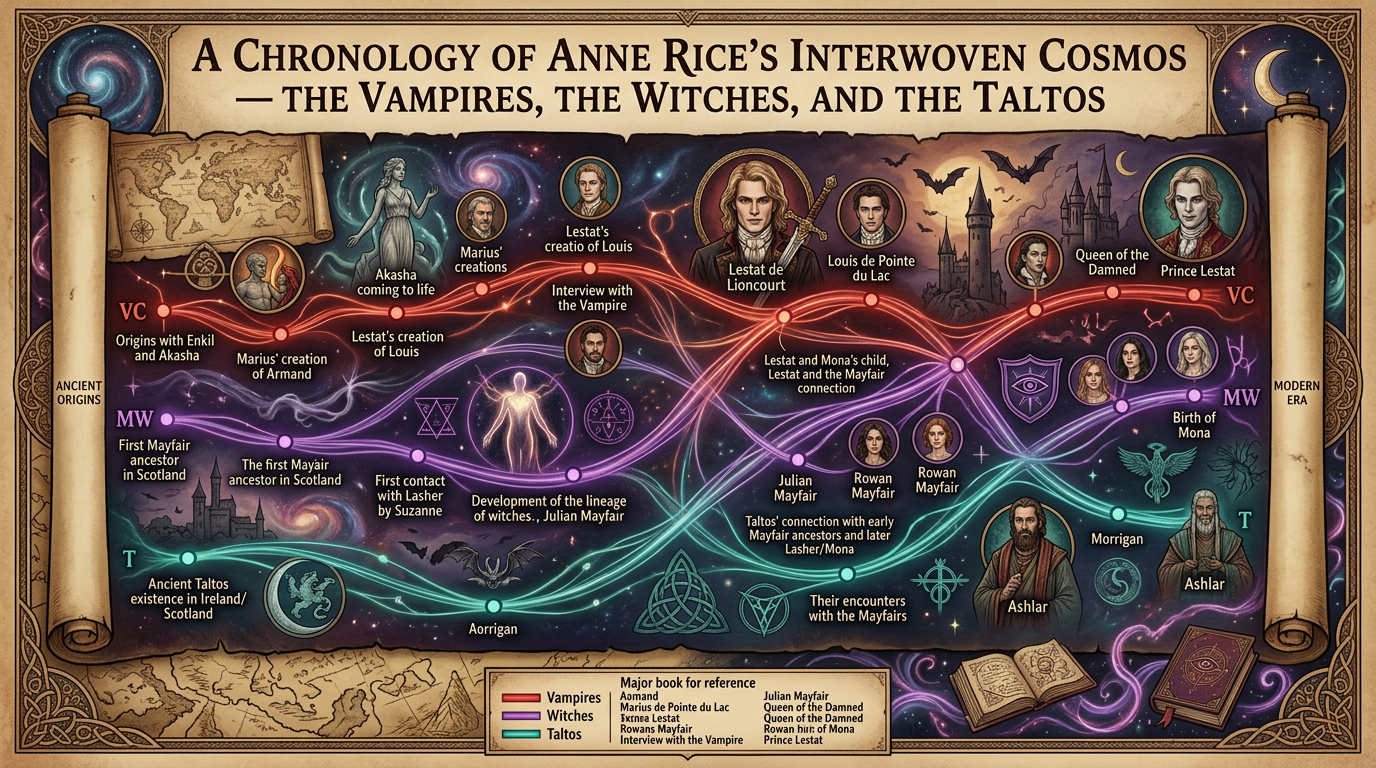
Ordered as the history unfolds within the fiction, from the first blood to the last reckoning. The entries below trace the invented world’s own account of its past — the deep antiquity of the vampire race, the parallel prehistory of the witch line and the Taltos, and the long migration of both toward the single ground of New Orleans, where at last they meet.
c. 4000 BCE — Ancient Egypt (Kemet)
The origin of the blood. The spirit Amel enters the Egyptian queen Akasha and her consort Enkil, and the first vampires are made. From this single fusion the entire race descends; Akasha becomes the root and fountainhead of all who will ever drink blood to live. Here the pantheon begins, in the oldest dark the mythology admits.
Antiquity — The Taltos and Early Britain
In the ancient world flourishes the near-human race of the Taltos, bound to the folklore of the British Isles. Their long decline toward near-extinction lays down the deep prehistory from which the spirit Lasher will one day emerge — the buried root of the witch saga’s central mystery.
17th Century — Scotland and the Continent
The Mayfair witch line takes shape. Suzanne Mayfair summons the spirit Lasher, and with that summoning begins the family’s thirteen-generation bond and its inherited curse. The line migrates across the world — through the Caribbean, through Saint-Domingue — carrying its spirit and its doom slowly toward Louisiana.
18th Century — France and Colonial New Orleans
Lestat de Lioncourt is born in the rural Auvergne, travels to Paris, and is made a vampire by the ancient Magnus. In time he encounters Marius and, through him, the Divine Parents — the still and silent Akasha and Enkil. In the same era the Mayfairs establish themselves in the New World, the two bloodlines now converging, unknowing, upon a single city.
Late 18th–19th Century — New Orleans
Louis de Pointe du Lac is made a vampire by Lestat, and the vampire child Claudia is brought across — the events later recounted in the work that first opened this mythology to the world. In the same decades the Mayfair dynasty settles into the First Street house in the Garden District, the great decaying mansion that will hold three centuries of inheritance within its walls.
1985 — The Modern Awakening
Akasha wakes. She rises as the Queen of the Damned, and the vampire race is thrown into crisis as the ancients — Maharet, Mekare, Marius, and the rest — converge against the peril of the risen mother. This is the great turning point of the vampire mythology, the moment the deep past erupts into the present.
1990s — The Mayfair Reckoning (New Orleans)
Rowan Mayfair and Michael Curry confront the full weight of the family’s inheritance. The spirit Lasher achieves incarnation, is revealed at last as a Taltos, and the scholarly Talamasca closes in. Rowan later bears Morrigan, another Taltos, deepening rather than resolving the curse. Here the witch saga reaches its central crisis.
Turn of the Millennium — The Confluence (New Orleans)
The two mythologies formally merge upon the shared ground of New Orleans. The witch Merrick Mayfair joins the vampires and retains her powers; Quinn Blackwood, haunted by the spirit Goblin, is drawn into both worlds and falls in love with Mona Mayfair; Mona is brought across; and Rowan and Michael return to the center of the conflict. The vampire and the Taltos storylines are at last woven into one.
Across All Eras — The Talamasca
Beneath and through every century runs the secret order of scholars, watching and recording. Present in the deep past and the living present alike, the Talamasca is the connective tissue that binds the vampires, the witches, and the Taltos into a single archived history — the fictional embodiment of the archival temperament itself.
❧ ❧ ❧
III. The Talamasca: The Thread Through Every Century
The discerning collector will have observed that a single institution appears at every stratum of the chronology above, from the deep antiquity of the Taltos to the millennial confluence of the bloodlines. This is by design. The order of scholarly watchers — secular, ancient, dedicated to the observation and archiving of the supernatural — is the mechanism by which the entire cosmos is revealed to be a single reality rather than a set of separate ones. It investigates the vampires; it investigates the witches; its files contain the histories of both, and of the Taltos besides. In tracing the chronology by internal time, one traces, in effect, the growth of the Talamasca’s own archive — the accumulating record of a single institution that has watched the whole of this history unfold. That the connective tissue of the cosmos should itself be an archive is a matter of no small resonance for any repository of the unseen.
❧ ❧ ❧
IV. The Order of Publication: The History as It Was Written
Ordered as the works were actually composed and released, across the four and a half decades of the author’s career. Read in this order, the mythology reveals its true construction: two distinct sagas, begun fourteen years apart, running in parallel before their deliberate convergence at the turn of the millennium. The publication years are firm; it is the numbering alone, as the closing note observes, that varies between sources.
The Vampire Chronicles
1976 · Interview with the Vampire
1985 · The Vampire Lestat
1988 · The Queen of the Damned
1992 · The Tale of the Body Thief
1995 · Memnoch the Devil
1998 · The Vampire Armand
2000 · Merrick — Mayfair crossover
2001 · Blood and Gold
2002 · Blackwood Farm — Mayfair crossover
2003 · Blood Canticle — Mayfair crossover
2014 · Prince Lestat
2016 · Prince Lestat and the Realms of Atlantis
2018 · Blood Communion: A Tale of Prince Lestat
New Tales of the Vampires
Companion titles set within the same world, standing apart from the main sequence.
1998 · Pandora
1999 · Vittorio the Vampire
Lives of the Mayfair Witches
1990 · The Witching Hour
1993 · Lasher
1994 · Taltos
The Points of Convergence
Three novels — Merrick (2000), Blackwood Farm (2002), and Blood Canticle (2003) — are numbered within the Vampire Chronicles yet continue the Mayfair characters and storylines. These are the works in which the two archives formally converge, the vampire sequence reaching across to gather the witch saga into a single unified narrative. The discerning collector who wishes to witness the exact moment of the confluence will find it here, in this trio of crossover volumes at the turn of the millennium.
❧ ❧ ❧
V. A Note on Numbering and the Firmness of the Record
A single caution attends any attempt to number these works in sequence, and the honest register must record it plainly. The count of the Vampire Chronicles varies between sources depending upon whether the two New Tales of the Vampires — Pandora and Vittorio the Vampire — are folded into the main sequence or held apart from it as companion volumes. A collector consulting several references will therefore find the same novel assigned different ordinal positions, and should not be troubled by the discrepancy; it reflects a genuine ambiguity in how the corpus is grouped, not an error in the record.
The publication years themselves, however, are firm, and it is upon them rather than upon any contested numbering that this register is built. Between the internal chronology and the order of composition, the discerning collector now holds both doors into the cosmos — the history as the fiction remembers it, and the history as the author made it — and may enter by whichever door the hour and the temperament prefer.
❧ ❧ ❧
This companion register is preserved alongside its parent field study within the haunted archive of Wicked Dual, an artisan boutique devoted to the reclamation of history’s clandestine and melancholy corners. The ordered cosmos of the undead and the witch-blooded is but one chronicle among the collection’s darker holdings.
We invite you to enter the haunted archive and secure a piece for your private collection; it is a necessary addition for those who curate the darker corners of human history.
The physical artifacts drawn from the histories chronicled here — the vestiges of the Southern Gothic dark — may be sought within the collection at http://www.wickeddualblog.com and in the associated ateliers, for those who would keep a fragment of this atmosphere near at hand.
— The Archivist of the Unseen

Bibliography
The following works constitute credible reference and scholarly literature supporting this register; readers pursuing formal citation are advised to verify editions and pagination against a library catalog.
Ramsland, K. (1991). Prism of the night: A biography of Anne Rice. Dutton.
Roberts, B. B. (1994). Anne Rice. Twayne Publishers.
Smith, J. B. (1996). Anne Rice: A critical companion. Greenwood Press.
Leave a Reply