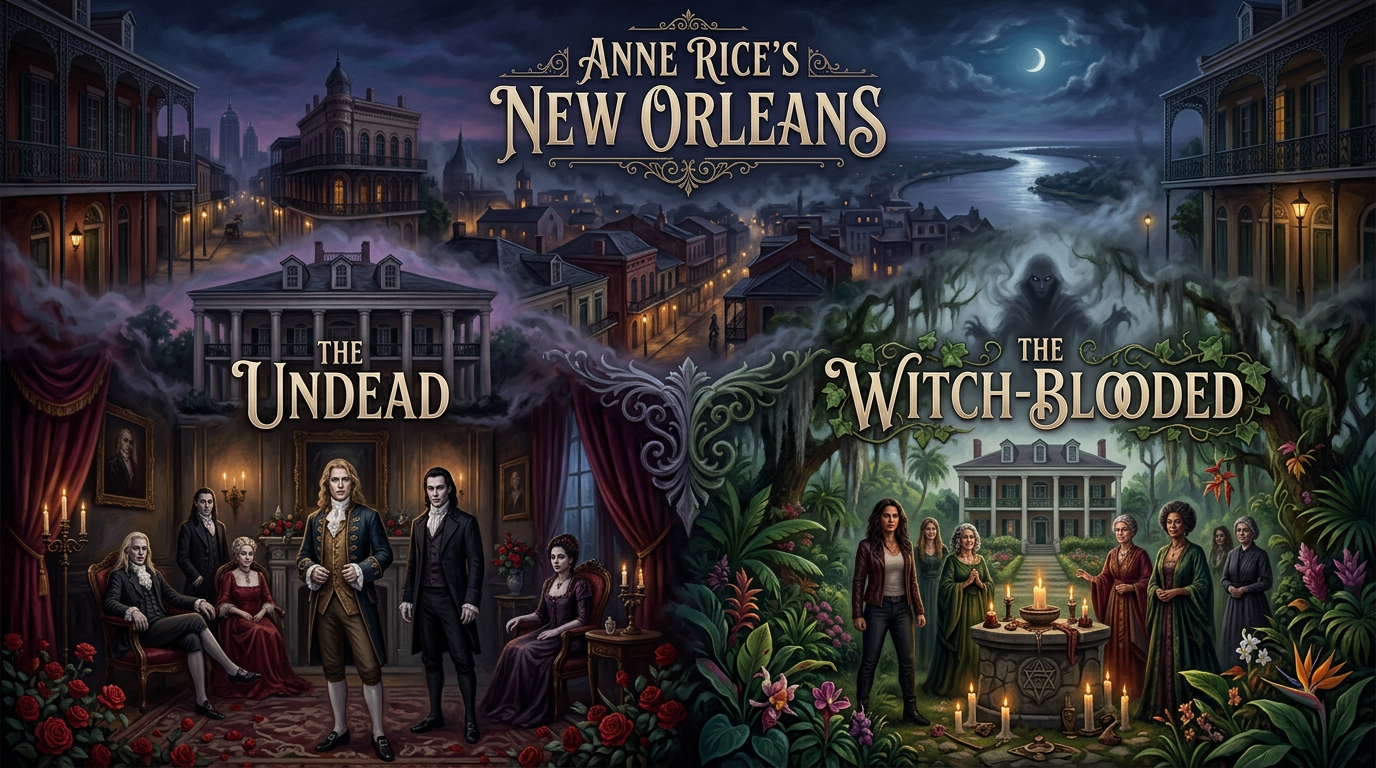
Anne Rice’s New Orleans, and the Twin Dynasties of the
Undead and the Witch-Blooded

“A city built below the level of the river learns early that the dead do not stay where they are put.”
An Archival Chronicle Prepared for the Discerning Collector
Compiled by the Archivist of the Unseen
I. The City That Buries Its Dead Above the Ground
You have come to New Orleans in the wet heat of late summer, when the air itself seems to have weight and memory, and you have wandered, as every visitor eventually does, into one of the old cemeteries. The tombs here do not lie in the earth. They stand above it, in rows, white and crumbling, little houses of stone crowded street upon street, because the water table lies so near the surface that a body committed to the ground will not stay buried — it will rise, in time, with the rains.
You walk among these cities of the dead as the light fails, and you begin to understand something that no history book quite prepared you for: that in this place, the boundary between the living and the dead was never firmly drawn. The dead are housed here as neighbors, their addresses known, their doors sealed but not sunk. And it occurs to you, standing among the whitewashed vaults, that a place like this does not merely tolerate ghost stories. It generates them, the way marshland generates fog — continuously, inevitably, out of its own saturated ground.
It was into precisely this atmosphere — this literal and spiritual waterlogging of the line between the quick and the dead — that a writer named Anne Rice released, across four decades, two of the most elaborate mythologies ever constructed by a single American author: the sequence of novels concerning her vampires, and the sequence concerning her witches. This chronicle takes as its subject not the stories themselves, which the discerning reader may seek out and possess in their own editions, but the deeper matter beneath them: the historical and regional and spiritual ground from which they were drawn, the genuine architecture that binds the two invented dynasties together, and the real Louisiana whose atmosphere of beautiful decay made both of them not merely possible but, in a sense, inevitable.
The pages that follow are prepared for the discerning collector of literary and regional dark — the reader who understands that a body of fiction, when it is deeply enough rooted in a real place and a real history, becomes itself a kind of historical artifact, a record of how a particular city dreamed about its own dead. Anne Rice’s two great sagas are such a record. To study them as cultural objects — to trace their bloodlines to their sources in Catholic New Orleans, in the folklore of the Louisiana Gothic, in the author’s own grief-haunted life — is to perform upon a modern mythology the same patient work the folklorist performs upon an ancient one.
II. The Author as Archivist: A Life Written Into Two Dynasties
No account of these two mythologies can proceed without first situating the woman who built them, for her sagas are among the most nakedly autobiographical in modern popular fiction — not in event, but in grief, in geography, and in the peculiar theology that runs beneath both. Howard Allen O’Brien was born in New Orleans in 1941, into an Irish Catholic family of that city’s Garden District and Faubourg neighborhoods, and given a masculine first name that she discarded on her first day of school, renaming herself Anne. The self-rechristening is worth noting at the outset, for the woman who would spend her career writing about beings who shed one identity for another began by shedding her own.
She was raised in the dense sensory world of mid-century Catholic New Orleans — a world of incense and Latin liturgy, of saints and relics and the veneration of the dead, of a religious imagination steeped in blood and sacrifice and bodily resurrection. This Catholic substrate is the single most important key to both sagas, and the discerning reader should hold it firmly, for it explains what mere Gothic convention cannot. Rice’s vampires are not simply monsters; they are damned souls in a specifically Catholic sense, obsessed with the questions of a lapsed communicant — whether God exists, whether evil is punished, whether an immortal soul can be lost, whether the body and the blood are sacred or profane. Her fiction is the work of a mind formed by the Mass and later estranged from it, pouring the imagery of the Eucharist — the drinking of blood as a route to eternal life — into a secular and Gothic vessel.
And then there is the grief, which cannot be separated from the work and which the author herself never tried to separate from it. In 1972, Rice’s young daughter, Michele, died of leukemia — a disease of the blood — at the age of five. It was in the aftermath of this loss, working through the night in a state the author later described as a kind of possession by the material, that Rice expanded a short story into the first and most famous of her vampire novels, published in 1976. The connection is not a matter of speculation; Rice discussed it openly throughout her life. The figure at the emotional center of that first novel is a child who can never grow up, a little girl locked forever in a body that cannot age while her mind matures into something monstrous and despairing — a vision of a dead child granted a terrible immortality, written by a mother who had just watched her own daughter fail to survive childhood. The vampire, in Rice’s hands, was from the very first a way of writing about grief that would not die, about love that outlasts the body, about the unbearable wish that the dead might simply refuse to go. This is the emotional engine beneath the entire Vampire Chronicles, and it is the same engine, transposed into a different key, that drives the saga of the witches.
Rice would return to New Orleans repeatedly across her life, most significantly in the late 1980s, buying a house in the Garden District — the very neighborhood in which she would site the ancestral home of her witch dynasty. She would undergo a religious return to Catholicism, and later a public departure from organized religion while retaining her faith, and these spiritual convulsions are legible throughout the later work. She died in 2021, having produced across her career a body of interlinked mythology unusual in modern letters for its scale, its theological seriousness, and its rootedness in a single, specific, saturated place. The two sagas are the twin pillars of that achievement, and they were built, quite literally, on the same ground.
III. The Vampiric Pantheon: A Genealogy of the Blood
Artifact: The Lineage of the Undead
The vampire sequence, composed across roughly three and a half decades beginning in 1976, is not a series of monster stories but the construction of an entire secret history of the world — a genealogy of the blood, a pantheon in the strict sense, complete with an origin myth, a theology, a hierarchy of elders and fledglings, and a metaphysics of what the vampire condition actually is. The discerning collector will recognize in this ambition something older than the horror genre: the impulse of the myth-maker to explain the whole of a supernatural order, to answer not merely what the monster does but where it came from and what it means.
At the center of Rice’s vampire mythology stands a genuine invented cosmogony. The vampire condition is traced, across the sequence, not to folklore’s plague-spirits or revenants but to a single originating event in the ancient world — a fusion of a spirit with human flesh, producing the first of the blood-drinkers, from whom all subsequent vampires descend in an unbroken line. This is the crucial structural fact: Rice’s vampires are a lineage, a family, connected by the literal transmission of blood from maker to made, so that the entire population of the undead constitutes a single vast bloodline reaching back to one ancient source. The vampire is made, never born, and the making is an act of terrible intimacy — the exchange of blood that binds maker and fledgling forever in a relationship that is part parenthood, part seduction, part damnation. The pantheon is thus a family tree, and the horror and the pathos alike flow from the fact that these immortals are bound to one another by bonds of blood they can neither honor nor escape.
The genius of the sequence — and the reason it transformed the vampire in popular culture — lay in its point of view. Where earlier vampire fiction had watched the monster from outside, through the eyes of its human hunters, Rice moved the perspective inside the grave. Her vampires narrate their own condition, in the first person, at exhausting and beautiful length, and what they narrate is not appetite but consciousness — the interior experience of a being who must kill to live, who possesses heightened senses and centuries of memory, who is beautiful and damned and articulate and utterly alone. The vampire becomes, in Rice’s hands, a figure for every form of alienation the modern reader might recognize: the outsider, the addict, the aesthete, the mourner, the one who loves against the grain of the world, the immortal soul uncertain whether it is watched by God or by nothing at all. This interiority is the sequence’s true innovation, and it is inseparable from the Catholic sensibility described above, for a vampire who agonizes over his own damnation is a vampire imagined by a lapsed Catholic and not by a folklorist.
The pantheon is populated by figures who recur and interweave across the novels — the brooding, guilt-ridden narrator of the first volume; the flamboyant, amoral, magnetic elder who becomes the sequence’s central and most beloved figure; the doomed vampire child; the ancient progenitors who wake from millennia of stillness. But this chronicle will not recount their individual stories, which belong to the novels and to the reader who acquires them. What matters for the present study is the structure: a single bloodline, a made rather than born immortality, a first-person theology of damnation, and a mythology that treats the vampire not as an intruder from outside the human world but as a tragic extension of it — the human soul, its longings and terrors, granted the terrible gift of never ending.
IV. The Witch-Blooded: The Mayfair Dynasty and the Man Called Lasher
Artifact: The Thirteen Generations
The second of Rice’s great sagas, the sequence concerning the Mayfair witches, was inaugurated in 1990 and constitutes a mythology structured on entirely different principles from the vampire pantheon — and it is precisely in this difference that the deepest connection between the two bodies of work is to be found. Where the vampires are a lineage of the made, the Mayfairs are a lineage of the born. Theirs is not a contagion transmitted by blood-exchange but an inheritance transmitted by descent: a family, traced across some thirteen generations from the seventeenth century into the twentieth, whose women carry a hereditary power and a hereditary curse down the bloodline from mother to daughter.
The structural inversion is exact and, the discerning reader will note, almost certainly deliberate. The vampire saga is a genealogy of blood transmitted horizontally, by the vampiric act, across a family of the chosen and the damned. The witch saga is a genealogy of blood transmitted vertically, by ordinary human generation, down a family of the inheriting. The one is a chosen family bound by the exchanged blood of the undead; the other is a born family bound by the inherited blood of the living. Both are dynasties; both are cursed; both are organized around the transmission of a supernatural condition through blood. Rice, having built one mythology upon made immortality, built its companion upon inherited power — the two halves of a single preoccupation with what passes, and what cannot help but pass, through the blood of a family.
At the heart of the Mayfair saga stands a presence that has no true equivalent in the vampire books: a powerful spirit, bound to the family across all its generations, which attaches itself to the designated witch of each generation — the inheritor of the family’s power and its legacy — and works its will through and upon the bloodline across three centuries. This entity is the engine of the saga’s dread, and it transforms the Mayfair chronicle from a mere family melodrama into something closer to a haunting extended across history itself: a single malevolent and yearning intelligence patiently shaping a human family, generation upon generation, toward an end of its own design. The horror of the witch saga is not the horror of the predator in the night but the subtler horror of inheritance itself — the recognition that one is not free, that the blood carries something that chose its course long before one was born, that the family is less a refuge than a trap laid by the dead for the unborn.
The Mayfair saga is also, more explicitly than the vampire books, a story of place and property — centered upon a specific house, a great decaying mansion in the Garden District of New Orleans, which functions as the physical vessel of the family’s power and memory, the architectural body in which three centuries of inheritance are stored. Here the connection to the real city becomes literal, for Rice modeled the fictional ancestral home upon a genuine Garden District mansion, and the saga’s obsession with the decaying great house, the family seat that outlives its family, is among the purest expressions of the Southern Gothic tradition to be examined later in this chronicle. The witch saga is, in the end, a story about a house and a bloodline and the thing that haunts them both — a ghost story in the oldest and most architectural sense, in which the haunted thing is not a person but a lineage, and the haunted place is not a room but a dynasty.
V. The Shared Soil: New Orleans as the Ground of Both Sagas
If the vampires are a family of the made and the Mayfairs a family of the born, the two dynasties nonetheless share one parent between them, and it is not a person but a place. New Orleans is the true progenitor of both sagas — the ground from which both were drawn, the atmosphere that made both plausible, the single most important character in the whole of Rice’s interlinked work. To understand why the two mythologies feel like kin even where their plots do not touch, one must understand the city that fathered them both.
New Orleans is unlike any other city in the United States, and its difference is precisely the difference that Gothic fiction requires. Founded by the French, ceded to the Spanish, retaken by the French, and sold to the young American republic in the Louisiana Purchase of 1803, it is a Catholic and Latin city set in a Protestant and Anglo nation — a place whose culture, architecture, law, and spiritual life descend from a European and Caribbean inheritance profoundly foreign to the country that surrounds it. Its dead are entombed above the ground. Its calendar is organized around Carnival and Lent, around masking and penitence, around the ritual inversion of the ordinary order. Its religious life fused Catholic practice with the traditions carried by enslaved Africans and free people of color into forms of folk belief and spiritual practice found nowhere else in the nation. It is a city of above-ground tombs, of decaying grandeur, of heat and rot and flowering excess, of masks and secrets and old families guarding old sins. It is, in short, a city that was Gothic before any novelist arrived to describe it.
Both of Rice’s sagas draw their fundamental atmosphere from this real inheritance. The vampires haunt the French Quarter and the Garden District, moving through a city whose beauty is inseparable from its decay, whose warmth conceals corruption, whose very architecture — the wrought-iron balconies, the shuttered townhouses, the overgrown courtyards — speaks of a European past preserved in tropical amber. The witches inhabit the same streets, the same Garden District, the same atmosphere of old wealth and older secrets. Both sagas understand New Orleans as a place where the past does not pass, where the dead remain present, where grand families rot slowly in beautiful houses, and where the boundary between the natural and the supernatural was worn thin long before any vampire or witch was invented to cross it. The city is the shared soil, and everything Rice planted in it — the undead and the witch-blooded alike — grew from the same saturated ground.
It is worth observing, too, that both sagas are preoccupied with the specific temporality of the American South, and of New Orleans above all: the sense of a place living perpetually in the shadow of its own vanished grandeur, haunted by a past that was itself morally compromised, unable either to forget its history or to redeem it. The vampire, immortal and backward-looking, forever mourning the centuries he has outlived, is a perfect figure for this Southern relationship to time. So is the Mayfair dynasty, chained to a three-hundred-year inheritance it can neither escape nor fulfill. Both are studies in the Southern condition of being possessed by the past — and both could only have been written about this particular city, by an author who carried its saturated atmosphere in her own blood.
VI. An Archival Aside: On the Keeping of Invented Histories
It is worth pausing here to consider a question the discerning collector may already have raised: by what right does an archive of the historical and the folkloric concern itself with invented fiction — with vampires and witches who never walked, and a secret history no scholar could confirm? The answer lies in the nature of the artifact under study. A mythology deliberately constructed by a modern author, and rooted so deeply in a real city and a real spiritual tradition, becomes over time a genuine cultural document — a record not of events that occurred, but of how a place and an era imagined their own darkness. The folklorist who studies a ghost story does not ask whether the ghost was real. The folklorist asks what the story reveals about the people who told it, feared it, and could not stop repeating it.
By that standard, Rice’s sagas are among the richest folk-documents modern America has produced, precisely because they are so saturated with the real. They preserve, in fictional amber, the specific spiritual atmosphere of Catholic New Orleans; the architecture and decay of a genuine district; the Southern relationship to a haunted past; the imagery of a religion of blood and resurrection turned to secular and Gothic ends. A house in the Garden District that inspired a fictional witches’ mansion now draws visitors who come to stand before a real building made resonant by an invented history — the fiction and the fact grown so entangled that the one has become a lens for seeing the other. This is the temperament to which Wicked Dual addresses itself: the conviction that the objects and atmospheres a culture uses to dream about its own dead — whether ancient relic or modern mythology — are all of them worth the keeping, and that a well-made vessel for the dark, however recently made, participates in a tradition of the macabre as old as the first story told against the night.
This is the disposition the chronicle maintains throughout: that invented histories, when they are made with sufficient seriousness and rooted in sufficient truth, become real objects of study — not because they record what happened, but because they record what was feared, mourned, and desired. The chronicle now returns to the specific matter of how Rice’s two dynasties, drawn from the same soil, are actually joined.
VII. The True Connections: Where the Two Bloodlines Actually Touch
Artifact: The Points of Contact
Here the chronicle must proceed with particular precision, for the relationship between the two sagas is widely misunderstood, and the misunderstanding runs in both directions. Some readers assume the vampires and the witches inhabit entirely separate fictional universes; others imagine them densely interwoven, their casts freely mingling. The truth lies between, and it is more interesting than either error. For most of their length the two sagas run in parallel rather than in contact — two distinct mythologies, sharing a city and an atmosphere and an author, but pursuing their separate stories without crossing. And yet they are not sealed from one another. There are genuine points of contact, deliberately placed, and understanding them precisely is essential to grasping what Rice was building.
The first and most important connection is thematic and structural rather than a matter of shared characters, and it has already been established in these pages: both sagas are genealogies of the blood. Each is organized around the transmission of a supernatural condition through a bloodline — the vampires by the horizontal exchange of blood that makes an immortal, the Mayfairs by the vertical inheritance of power that descends through the generations. This shared obsession with blood, lineage, inheritance, and the family as the vessel of a curse is the deepest bond between the two bodies of work, deeper than any shared character could be. Rice was, across both sagas, writing a single extended meditation on the same theme: that the most intimate and inescapable bond, the bond of blood, is also the vehicle of the most terrible inheritances, and that to be bound to a family — whether the chosen family of the undead or the born family of the witches — is to be bound to a curse one did not choose.
The second connection is a shared institution, and it is the most concrete link between the two fictional worlds: a secret order of scholars, examined in its own section below, that appears in both sagas as the observer and chronicler of the supernatural. This order investigates both the vampires and the witches; its archives contain the files of both; and its presence in both sequences establishes, unmistakably, that the two mythologies occupy a single shared fictional reality — one world, containing both the undead and the witch-blooded, watched over by a single ancient institution. It is chiefly through this order that the two sagas are formally united, and it is the strongest textual evidence that Rice conceived of her creations as a single interconnected cosmos rather than two separate ones.
The third connection emerges only in the later phase of Rice’s career, when — in novels published from the late 1990s onward, and in the final books of her life — the author began deliberately to draw her separate creations together, allowing figures and elements from the vampire sequence and the witch sequence and her other supernatural mythologies to appear within shared narratives, converging her lifelong body of work toward a single unified mythology. This late convergence is real, and it confirms the underlying unity, but it should not be read backward into the earlier books, which were largely self-contained. The precise account is this: the two sagas began as parallel mythologies sharing a city, an atmosphere, a thematic obsession with blood, and a single watching institution; and only in their author’s later years were they consciously merged into the explicitly unified cosmos that her most devoted readers now regard as a single vast creation.
VIII. The Talamasca: The Order That Watches Both
Artifact: The Watchers
The single most important bridge between Rice’s two sagas is an invented institution that has, in its own right, become one of her most enduring creations: a secret order of scholars and investigators, ancient and secular, dedicated to the study of the supernatural. The order describes itself, in the fiction, as a body of watchers — observers who record and archive the paranormal without, in principle, interfering in it. Its motto declares that its members watch, and are always there. Its members are not hunters in the manner of the vampire-slayers of older fiction; they are scholars, archivists, keepers of files, an academic body whose relationship to the supernatural is precisely that of the researcher to the object of study.
The discerning collector will immediately perceive why this order is the perfect hinge between the two sagas, and why it resonates so powerfully with the very enterprise of an archive of the unseen. The order is itself an archive — a repository of the documented supernatural, a library of the paranormal maintained across centuries. It investigates the vampires; it investigates the witches; its files contain the histories of both bloodlines; its scholars move through both sagas as the recurring observers who connect the undead and the witch-blooded within a single documented reality. In making this order the chief link between her mythologies, Rice placed at the center of her connected cosmos not a monster and not a hero but an archive — an institution devoted to watching, recording, and preserving the very darkness the novels explore. The order is the reader’s surrogate, the scholarly intelligence that treats the supernatural as an object of patient study rather than mere terror, and it is, in a sense, the fictional embodiment of the archival temperament itself.
The order’s deep history, as Rice constructed it across the sagas, reaches back many centuries, and its European origins and vast documented holdings lend the connected cosmos a sense of institutional weight, of a bureaucracy of the uncanny operating quietly beneath recorded history. It is through this order that a reader of the witch saga encounters the machinery that also tracks the vampires, and through it that the two mythologies are revealed to share a single reality. That Rice chose a body of scholarly watchers — rather than warriors or priests — as the connective tissue of her cosmos is itself significant, and it speaks to the fundamentally contemplative character of her horror: a horror concerned less with the destruction of the monster than with the understanding of it, less with the stake and the fire than with the file and the archive.
IX. The Historical Substrate: Real Louisiana Beneath the Fiction
Artifact: The Ground Truth
Beneath the invented mythologies lies a genuine historical and cultural substrate, and it is this real Louisiana — its history, its peoples, its folk traditions — that lends both sagas their extraordinary density and conviction. The discerning reader who wishes to understand the fiction as a cultural artifact must understand the reality it drew upon, for Rice was not inventing an atmosphere from nothing but distilling one that genuinely existed, and continues to exist, in the ground she wrote from.
Consider first the colonial history. Louisiana’s layered French, Spanish, African, Caribbean, and Anglo-American inheritances produced a society of extraordinary cultural complexity, and one marked, at its foundation, by the brutal institution of slavery and by the distinctive social order of colonial and antebellum New Orleans — including the substantial community of free people of color, the intricate and now-notorious systems of racial caste, and the plantation economy whose wealth and cruelty built the great houses that still stand. The decaying grandeur that saturates both of Rice’s sagas is not an invention; it is the real afterglow of a genuine and morally compromised prosperity, the beauty of houses built on suffering, and the Southern Gothic tradition to which Rice belongs has always understood that this specific beauty — grand, decaying, and guilty — is among the most powerful atmospheres in American letters.
Consider next the spiritual inheritance. The folk-religious traditions of Louisiana — the fusion of Catholic practice with West and Central African spiritual systems carried by the enslaved, developed among the enslaved and free Black communities of the region into the practice widely known as Louisiana Voodoo — form part of the real spiritual atmosphere from which Rice’s fiction draws its sense of a city where the supernatural is woven into daily life. The discerning reader should note, with care, that this is a genuine and living religious tradition of a real community, historically maligned and sensationalized by outsiders, and not merely a Gothic prop; the responsible study of Rice’s fiction acknowledges that her atmospheric New Orleans borrows from real traditions that deserve to be understood on their own terms and not reduced to horror-scenery. What can be said accurately is that the mere existence of such syncretic folk-spiritual traditions in New Orleans — the public knowledge that this was a city where African, Caribbean, and Catholic spiritual currents had genuinely mingled — contributed to the wider cultural image of New Orleans as a place of the uncanny, an image Rice inherited and elaborated.
Consider finally the physical and temporal atmosphere: the above-ground cemeteries with their cities of tombs; the subtropical climate of heat, rot, and relentless growth; the annual ritual of Carnival with its masking and inversion; the persistence of old French and Spanish and Creole families with long memories and longer secrets; the pervasive Catholic sensibility with its veneration of relics, saints, and the dead. Every one of these is real, and every one of them appears, transmuted, in the sagas. Rice’s achievement was not to invent a Gothic New Orleans but to perceive, with great clarity, that the real New Orleans was already Gothic — already a city of the beautiful dead, already saturated with the atmosphere her fiction would require — and to build her mythologies directly upon that existing foundation. The fiction is dense and convincing precisely because so little of its atmosphere is invented. The ground was already haunted. Rice merely named the hauntings.
X. The Southern Gothic Inheritance and the Catholic Dark
Rice’s two sagas belong to, and substantially transformed, a literary tradition older than either of them: the Southern Gothic, that distinctively American strain of the Gothic mode which relocated the crumbling castles and haunted lineages of the European original to the decaying plantations and haunted families of the American South. To situate Rice within this tradition is to understand both what she inherited and what she made new, and it is essential to any serious account of her work as a cultural artifact.
The Southern Gothic, as developed across the twentieth century by the great writers of the American South, took as its characteristic materials the decaying great house, the family cursed or degenerating across generations, the weight of a guilty regional past, the grotesque, the haunted, and the morally compromised grandeur of a society built upon slavery and living perpetually in the shadow of its own defeat and its own sin. The mode is preoccupied with inheritance in every sense — the inheritance of property, of guilt, of madness, of blood — and with the past’s refusal to remain past. The discerning reader will recognize at once how perfectly Rice’s witch saga, in particular, fulfills this tradition: a great decaying house, a family cursed across generations, a hereditary taint carried in the blood, a past that will not release its grip upon the present. The Mayfair chronicle is Southern Gothic in its purest and most concentrated form, the tradition’s obsessions rendered supernaturally literal — the family curse made an actual curse, the haunted house made an actually haunted house, the taint in the blood made a genuine hereditary power.
To this inherited tradition Rice added two elements that were substantially her own. The first was the specifically Catholic dimension already described — the theology of blood, sacrifice, damnation, and resurrection that runs beneath both sagas and gives her horror a metaphysical seriousness rare in the genre. Much of the classic Southern Gothic was Protestant in its spiritual furniture, haunted by sin and judgment in a Calvinist key; Rice’s New Orleans Gothic is Catholic, haunted by the Mass, by the literal blood of the sacrament, by the possibility of damnation and the ache for a grace that may not come. This Catholic inflection is her signal contribution to the regional tradition, and it is inseparable from the specific city she wrote from, the one genuinely Catholic city in the Protestant South.
The second element was the radical interiority described in the discussion of the vampire pantheon — the decision to narrate the supernatural condition from within, to make the monster the conscious and articulate center of its own story. This move, applied to the Southern Gothic’s traditional materials, produced something genuinely new: a Southern Gothic told not by the horrified observer of the decaying family but by the cursed thing itself, the vampire narrating his own damnation, the family confronting its own haunting from the inside. Rice took the oldest materials of the regional tradition — the house, the bloodline, the curse, the guilty past — and turned them inside out, so that the reader no longer watches the Gothic family from the safety of the road but is trapped inside the house, inside the bloodline, inside the cursed and conscious body itself. This is her enduring achievement, and it is why her fiction, for all its supernatural furniture, belongs to the serious study of the Southern literary imagination.
XI. The Question of the Crossover: Fact, Rumor, and the Later Novels
Because the relationship between the two sagas is so often misrepresented, this chronicle will address the question of the crossover directly and precisely, separating what the novels actually establish from what enthusiasm has embroidered. The matter deserves care, for it is the single point on which casual accounts of Rice’s work most often err, and the discerning collector values accuracy above the pleasures of a tidier story.
The accurate account is as follows. The two sagas were conceived and, for years, written as distinct mythologies. The vampire sequence began in 1976 and had grown into a substantial body of work before the first witch novel appeared in 1990. For a considerable period the two ran in parallel, sharing the city of New Orleans and a common atmosphere and a common authorial sensibility, but not sharing plots or casts. The bridge between them was established chiefly through the order of scholarly watchers described above, whose presence in both sequences placed them, retroactively, within a single fictional reality. Then, in the later phase of her career — across novels published from the late 1990s onward — Rice deliberately began to converge her separate creations, drawing the vampires, the witches, and elements of her other supernatural mythologies together into shared narratives, until her body of work came to constitute, by her own late design, a single unified cosmos. This convergence is genuine and authorially intended; it is not the invention of fans.
What must be resisted, however, is the temptation to overstate the density of the connection. The two sagas are joined, but they are not fused into a single continuous narrative; each retains its own distinct character, its own concerns, its own tone. The vampire books remain, at their core, a first-person theology of made immortality and damnation; the witch books remain, at their core, a Southern Gothic of inherited power and the haunted house. The connection is real but selective — a shared world, a shared institution, a shared thematic preoccupation with blood and inheritance, and a late and deliberate convergence — rather than a seamless merger. The discerning reader who approaches the two sagas expecting a single interwoven epic will misread both; the reader who approaches them as two distinct mythologies, drawn from one soil and joined at specific and identifiable points, will grasp precisely what Rice built.
It should be noted, finally, that Rice’s connected cosmos has in recent years been extended beyond the page, adapted for television in a body of screen work that has drawn the vampire and witch mythologies into a shared adaptation, and that this adaptation — developed after the author’s involvement and, in its later seasons, after her death in 2021 — has made the kinship of the two sagas more explicit and more prominent than it ever was on the page. The discerning collector should understand that these adaptations are their own artifacts, distinct from the novels, and that they represent a further stage in the long convergence of Rice’s mythologies — the twin dynasties of the undead and the witch-blooded drawn at last, on the screen, into a single visible cosmos. The details of these ongoing adaptations lie beyond the settled historical record this chronicle prefers to keep, and belong to the living present rather than the archive; but their existence confirms the essential point, that the two bloodlines Rice drew from the single soil of New Orleans were always, at root, kin.
XII. The Blood That Does Not Dry
It is tempting to regard a body of popular fiction as a lesser object of study than the ancient legends and folk traditions that fill the rest of this archive — to suppose that a mythology with a known author and a copyright date cannot carry the weight of the genuinely old. The supposition does not survive examination. For what Anne Rice accomplished, across her two great sagas and the four decades she spent building them, was the construction of a modern mythology so deeply rooted in a real place and a real spiritual tradition that it has begun to function as folklore functions — shaping how a city is seen, drawing pilgrims to its houses and tombs, teaching two generations of readers to imagine the dark in a particular and enduring way.
The two dynasties she built — the made family of the undead and the born family of the witch-blooded — are, in the end, a single meditation wearing two faces. Both are studies in blood: in what it carries, in what it curses, in what it cannot help but transmit from the dead to the living and the living to the unborn. Both are studies in New Orleans: in a city where the dead are housed above the ground, where the past refuses to pass, where beauty and decay and guilt and grace are so thoroughly intermingled that no boundary between them can be maintained. And both are studies in grief — in the refusal of love to accept the finality of death, in the terrible wish that the lost might be granted an immortality, in the recognition that such a wish, if granted, would be a curse. The mother who lost a daughter to a disease of the blood spent the rest of her life writing about blood that would not stop, about families that could not die, about the dead who would not go. The whole of her interlinked work is, at its deepest level, an elegy that refused to end.
And so the two bloodlines run on, parallel and joined, through the saturated ground of a city that was Gothic before any novelist arrived to name it. The vampire narrates his damnation in the first person; the witch inherits her curse down thirteen generations; the order of scholarly watchers records them both in its endless archive; and above them all stands the real city, with its above-ground tombs and its flowering rot, its Catholic dark and its guilty grandeur, generating ghost stories the way its marshes generate fog — continuously, inevitably, out of its own saturated ground. Rice did not invent that atmosphere. She inherited it, as the Mayfairs inherit their curse, in the blood; and she transmitted it, as the vampire transmits his condition, to everyone who has read her. The blood, in her work and in the city that produced it, does not dry. It only passes on.
This field study is offered, then, not as a summary of stories that the discerning collector should seek out and possess entire in their own editions, but as a chronicle of the ground beneath them — the real history, the real city, the real spiritual tradition, and the real grief from which two of the most elaborate mythologies in modern American letters were drawn. The stories themselves await, as all the best dark things do, those with the temperament to seek them. And the atmosphere from which they came awaits as well, in a city that has never stopped being what Rice understood it to be: a place where the blood does not dry, and the dead do not stay where they are put.
This field study is preserved as one vestige among many within the haunted archive of Wicked Dual, an artisan boutique devoted to the reclamation of history’s clandestine and melancholy corners. The twin dynasties of the undead and the witch-blooded, and the saturated New Orleans ground that produced them, are but one chronicle among the collection’s darker holdings.
We invite you to enter the haunted archive and secure a piece for your private collection; it is a necessary addition for those who curate the darker corners of human history.
The physical artifacts drawn from the histories chronicled here — the vestiges of the Southern Gothic dark — may be sought within the collection at http://www.wickeddualblog.com and in the associated ateliers, for those who would keep a fragment of this atmosphere near at hand.
— The Archivist of the Unseen

Crow, C. L. (2009). History of the Gothic: American Gothic. University of Wales Press.
Goddu, T. A. (1997). Gothic America: Narrative, history, and nation. Columbia University Press.
Ramsland, K. (1991). Prism of the night: A biography of Anne Rice. Dutton.
Rice, A. (2008). Called out of darkness: A spiritual confession. Alfred A. Knopf.
Roberts, B. B. (1994). Anne Rice. Twayne Publishers.
Smith, J. B. (1996). Anne Rice: A critical companion. Greenwood Press.
Tucker, S. (2017). New Orleans cuisine and culture: The city’s Creole and Catholic inheritance.
Leave a Reply