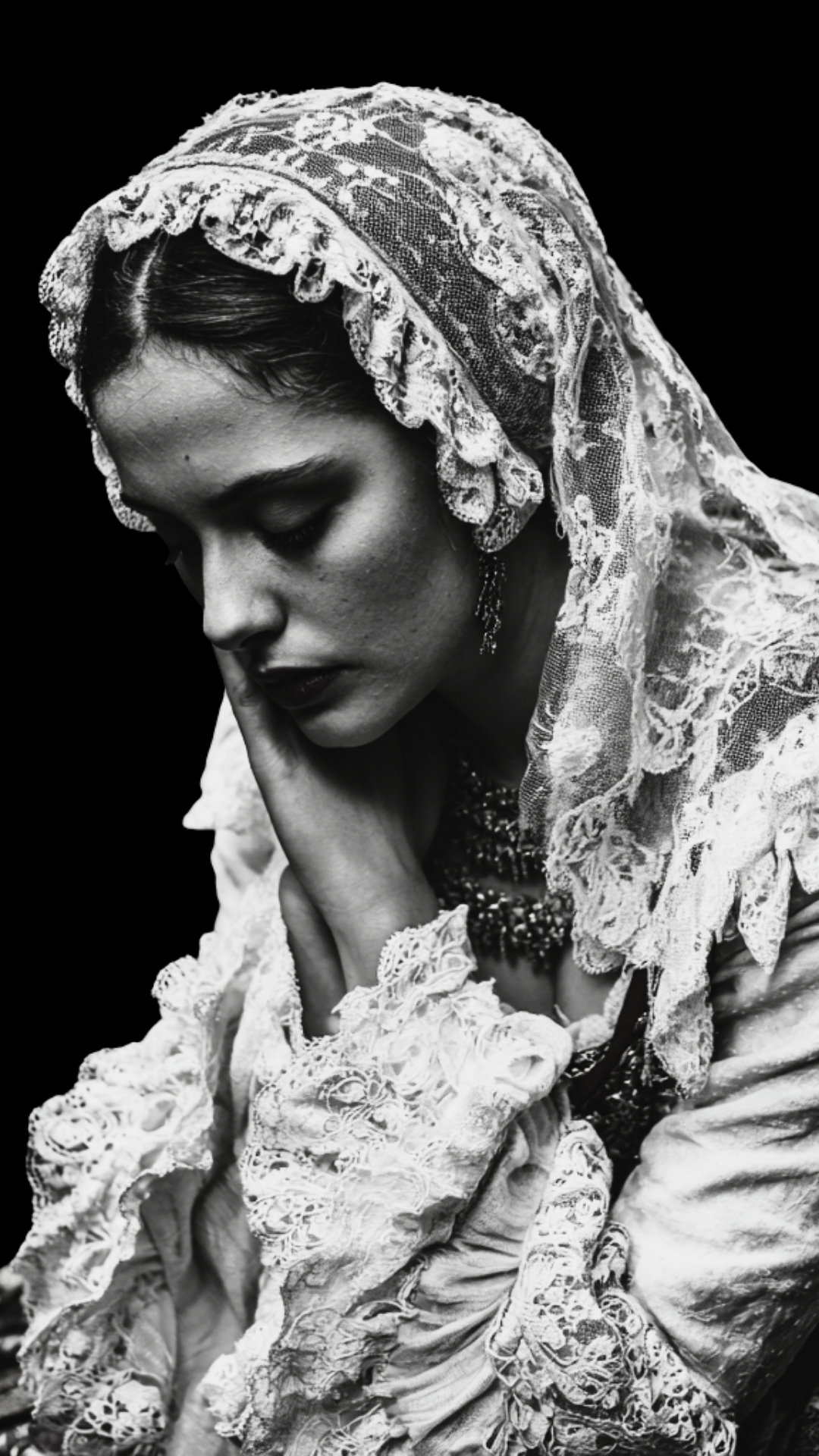
The Weeping Woman and the Architecture of a Borderland Grief

“Grief, given long enough, does not fade. It calcifies into geography.”
I. The Sound Before the Shape
It reaches you first as water. Not the crash of it, but the low, patient movement of a river at night, and threaded through that sound, so faint you might mistake it for wind in the reeds, a woman weeping.
You walk near the water because the evening is warm, the town behind you has grown loud, and the path along the bank promises quiet. The weeping does not frighten you at first. It is a human sound, and human sounds invite sympathy. Someone is in distress. Someone has lost something. You slow your steps. You listen for a direction.
She is downstream, upstream, or across the water—the sound will not hold still. When you move toward it, it retreats; when you stop, it circles back and settles close, so close you feel you could reach into the dark and touch the shoulder shaking with sorrow. And there she is at last, at the very edge of the current, a figure in white with her back turned, her long hair hanging wet, her whole body bent around a loss you have not yet named.
Something in you wants to comfort her. That is the trap. That has always been the trap.
She turns. And the face is not a face — it is absence wearing the shape of one, and the words come out of it in a voice worn smooth by centuries of repetition: ¡Ay, mis hijos! Oh, my children. She is not asking for your pity. She is looking for hers, and at this hour, on this bank, in this light, you will do.
This is not the grieving mother the sympathetic ear was promised. What follows is the anatomy of that betrayal — an examination, conducted with the cold instruments of the historian and the patient attention of the folklorist, of the single most durable ghost in the Americas.
The audience for the pages that follow is the discerning collector of the darker chronicles — the reader who understands that a legend is not a superstition to be dismissed but an artifact to be cataloged, dated, and held to the light. La Llorona, the Weeping Woman, is such an artifact. She has been carried across four centuries and countless borders, and she has never once stopped weeping. To study her is to study the machinery by which a culture stores its grief, its guilt, and its warnings in the durable amber of a story told after dark.
❧ ❧ ❧
II. The Tidy Story, and Why It Will Not Hold
Every enduring legend arrives first in its most portable form — the version compact enough to be passed from a grandmother to a frightened child in the space of a single evening. The tidy story of La Llorona is this: a beautiful woman, betrayed or abandoned by the man she loved, drowns her own children in a river in a paroxysm of rage or despair. Realizing too late the enormity of what she has done, she takes her own life, or dies of grief, and is refused entry into the afterlife until she recovers the children she destroyed. And so she walks the waterways forever, weeping, searching, and — in the versions meant to keep children indoors after dark — seizing any child she finds as a substitute for the ones she lost.
It is a story with the symmetry of a folk ballad. Beauty, betrayal, murder, remorse, eternal punishment. It can be told in ninety seconds. It requires no scholarship to understand and no context to land. This is precisely why it has survived, and precisely why it should be regarded with suspicion by anyone who wishes to understand it. A story this clean has been polished by many hands, and polishing removes as much as it reveals.
For the tidy story conceals a genuine scholarly disagreement — several of them, in fact — that have never been settled and likely never will be. Where did she come from? Is she a genuinely pre-Columbian figure wearing colonial dress, or a European import wearing an Indigenous face? Is she one legend or a dozen legends that drifted together under a single name, the way separate streams braid into one river and lose their individual sources? And what, precisely, is she for — a warning to children, a warning to women, a lament for a conquered people, or something older and stranger than any of these?
The honest answer, the answer a rigorous chronicle is obligated to give, is that scholars do not agree, and that the disagreement is itself the most interesting artifact in the collection. What follows is not a single account but a field study of competing accounts, each dated and situated, laid side by side so that the discerning reader may judge the evidence without the comfort of a settled verdict.
❧ ❧ ❧
III. Field Study — The Deep Origin: A Goddess Who Wept Before the Ships
Artifact: The Sixth Omen
The most seductive origin story places La Llorona in the world before the conquest, and it rests upon a genuinely remarkable document. In the years after the fall of Tenochtitlan in 1521, Spanish friars — chief among them the Franciscan Bernardino de Sahagún — set about recording the beliefs and histories of the Mexica people, partly to understand them and partly to dismantle them more efficiently. The result, the vast compendium now called the Florentine Codex, preserves, among much else, a catalog of omens said to have appeared in the decade before Cortés arrived, portents that the empire was doomed.
Among these omens is a voice. At night, the chroniclers recorded, a woman was heard weeping and crying out, wandering the streets and causeways of the city, lamenting for her children. Her cry, as it has been transmitted, is a lament that the people must flee, that the children are lost, that there is nowhere left to go. To an empire on the edge of annihilation, a weeping woman in white passing through the streets by night was not a ghost story. It was a prophecy delivered in advance, and the advance was terrifyingly short.
This weeping omen is frequently identified with a specific deity of the Mexica pantheon: Cihuacóatl, the Snake Woman, a goddess associated with motherhood, midwifery, and the mortal dangers of childbirth. Cihuacóatl was numbered among the mother goddesses, but she was no gentle nurse. She was fierce, dangerous, associated with warfare and with the women who died in labor — the Cihuateteo, spirits of mothers dead in childbirth who were believed to haunt the crossroads at night and to snatch living children. She was said to appear dressed in white, to weep and wail through the darkness, and to leave behind, on occasion, the cradle-board of an infant that, when examined, held a sacrificial knife instead.
The correspondences are difficult to dismiss. A goddess of motherhood and its terrors. A figure in white. A woman weeping through the night for lost children. Spirits of dead mothers who prey upon the living young at the crossroads. Assemble these vestiges, and the outline of La Llorona seems to rise from the pre-Columbian dark already substantially formed, awaiting only a Spanish name and a colonial love story to become the figure known today.
There is a second candidate as well, invoked less often but with its own gravity: Coatlicue, the great earth mother of the serpent skirt, devourer and bringer-forth of life; and beyond her, the broader complex of feminine divinities in whom creation and destruction were never separated into tidy opposites but held together in a single terrible embrace. In the Mexica cosmos, the mother who gives life is inseparable from the mother who takes it, because life itself was understood to be borrowed and repayable. A weeping woman who both mourns children and endangers them is not a contradiction within that worldview. She is its perfect expression.
The Case for Caution
And yet the rigorous collector must handle this artifact with gloves. The identification of La Llorona with Cihuacóatl is powerful, but it is a reconstruction, assembled centuries later by folklorists and nationalists who had their own reasons for wanting the Weeping Woman to be authentically, defiantly Indigenous. The documents describing the weeping omen were written by Spanish friars steeped in European traditions of the wailing spirit and the female ghost, and they may have heard, or shaped, Indigenous accounts through that lens. The very act of recording an Aztec omen in a Franciscan codex is an act of translation, and translation is never innocent.
To claim a clean, unbroken line from Cihuacóatl to the modern Llorona is to claim more than the surviving evidence can bear. What can be said with confidence is narrower and, in its way, more interesting: that the conquest-era sources record a genuine tradition of a weeping female figure associated with maternal loss and civilizational catastrophe, and that this tradition supplied a ready vessel into which later meanings could be poured. The goddess did not simply become the ghost. But the goddess left a shape in the cultural memory, and grief, seeking a form, found that shape waiting.
❧ ❧ ❧
IV. Field Study — The Conquest Wound: The Woman at the Center of a Nation
Artifact: The Betrayer, the Betrayed
If the goddess supplies the oldest layer, a historical woman supplies the deepest wound. To understand why La Llorona weeps with such specifically Mexican grief, one must consider the figure of La Malinche — the Nahua woman, also called Malintzin or Doña Marina, who served Hernán Cortés as interpreter, guide, cultural intermediary, and mother of one of his children. She stands at the exact hinge of the conquest, the point where two worlds were forced into a single sentence, and she has been, ever since, one of the most contested figures in the history of the Americas.
In one reading, sustained for centuries, she is the great traitor — the woman whose fluency and intelligence made the Spanish victory possible, who sold her people to the invaders, and whose very name became a word for betrayal. In another, more recent reading, she is herself a victim — a woman given as tribute, enslaved, deprived of any true choice, surviving by the only means available to a woman in her position, and unfairly made to carry the guilt of an entire catastrophe she did not author. Both readings agree on one point: she is the mother of a symbolic new people, the mestizo nation born of the collision, and she is a mother whose children were, in the deepest cultural sense, taken from her — absorbed into a world that would spend centuries deciding whether to revere or revile her.
The folk imagination did what the folk imagination always does. It fused the two figures. La Malinche, the mother of a conquered and transformed people, and La Llorona, the mother weeping eternally for children she has lost, became, in the popular current, difficult to separate. The Weeping Woman’s cry — ¡Ay, mis hijos! — acquires, in this reading, a meaning far larger than any single drowning. She weeps for a whole lineage. She weeps for the children of the conquest, for a world that ended in the space of a single generation, for an entire people delivered into an afterlife of neither one thing nor the other. Her homelessness — the refusal of the beyond to receive her — becomes the homelessness of the colonized soul itself.
This interpretation, championed by twentieth-century writers and thinkers who sought in the old legends the buried psychology of a nation, transforms La Llorona from a cautionary tale into a national elegy. She is no longer merely a hazard to disobedient children. She is the grief of the conquest given a body and a voice, condemned to walk the rivers of the New World because the wound she embodies was never permitted to close.
The Case for Caution
Here too the archivist must resist the pull of a story too satisfying to be trusted. The fusion of La Malinche and La Llorona is real and culturally potent, but it is largely a modern interpretive achievement, articulated most forcefully in the twentieth century by intellectuals reading the past through the lens of national identity. The peasants and townspeople who told Llorona stories in the seventeenth, eighteenth, and nineteenth centuries were, for the most part, not consciously narrating the trauma of the conquest. They were frightening their children away from the river and warning young women against the ruin that followed seduction and abandonment.
The elegiac reading is not false. It is true in the way that all deep interpretations are true — it reveals a meaning genuinely latent in the material. But it is a meaning that later generations found and named, not necessarily one the earliest tellers intended. The collector who wishes to hold the whole artifact must hold both: the small, sharp domestic warning and the vast national lament, folded into the same white dress.
❧ ❧ ❧
V. Field Study — The European Inheritance: The Ghost That Crossed the Ocean
Artifact: The White Lady and the Wronged Wife
No honest chronicle of La Llorona can pretend she is purely a product of the Americas, for the ships that carried the conquest also carried a cargo of ghosts. Medieval and early modern Europe had a rich and ancient tradition of the female revenant—the woman returned from death, usually to lament, to warn, or to avenge. To read the Weeping Woman only against her Indigenous background is to see half the artifact and call it the whole.
Consider first the White Lady, the Weiße Frau of Germanic tradition and her cousins across the continent — the spectral woman in pale garments who appears at castles, crossroads, and bodies of water, often associated with a family’s misfortune or a violent death, frequently connected to the loss of children or to a marriage betrayed. The White Lady weeps. She appears near water. She portends death. She is a woman whose sorrow has outlasted her body. The parallels to the Llorona are not incidental; they are structural.
Next, consider the deep classical inheritance Europe carried in its own bones. The figure of Medea, who slew her children to punish the husband who betrayed her, was known to every educated colonist through the Greek and Roman canon; the tale of a mother’s infanticidal revenge was not an American invention but a Mediterranean inheritance thousands of years old. Consider the lamia and the strix of antiquity — female monsters who preyed upon infants in the night. Consider the banshee of the Irish and the bean nighe of the Scottish Gael, the washerwoman at the ford whose keening announced a coming death. Everywhere the Europeans came from, a woman was already weeping by the water.
The uncomfortable possibility — uncomfortable, at least, for those invested in a purely Indigenous origin — is that La Llorona is a convergence, a figure in whom two vast traditions of the weeping female spirit recognized one another and merged. The Spanish arrived carrying the White Lady, Medea, and the lamia in their cultural baggage. They encountered Cihuacóatl and the Cihuateteo already resident in the land. The two did not compete so much as fuse, each confirming and reinforcing the other, until the resulting figure was so thoroughly hybrid that arguing for a single origin became a kind of category error.
This is, in the end, the most defensible position the evidence supports. La Llorona is neither purely Aztec nor purely European but genuinely mestiza — a creature of the border in the most literal sense, born of the same violent fusion that produced the culture that tells her story. Her hybridity is not a flaw in the record. It is the record. She is what a legend looks like when two worlds are forced to become one.
❧ ❧ ❧
VI. The Anatomy of a Haunting: The Fixed Points of a Shifting Tale
A legend that has traveled as far and lived as long as La Llorona necessarily changes in the telling. The details shift from village to village, from generation to generation, from the mountains of central Mexico to the irrigation ditches of the American Southwest. And yet, beneath the variation, certain elements recur with such persistence that they may be regarded as the load-bearing structure of the legend — the fixed points around which everything else is free to move. The systematic reader will find it useful to catalog them.
The Water
She is never far from water. A river, a lake, an irrigation canal, a well, a flooded ditch after a storm — the setting changes but the element does not. Water is the site of the original drowning and the medium of her eternal search; it is also, in the practical wisdom the legend encodes, the most genuine danger a child in a rural or frontier community could encounter. The Weeping Woman haunts precisely the places where children actually drowned. In this sense the legend is a map of real hazard drawn in the ink of the supernatural, a means by which a community taught its young, through terror rather than instruction, to keep away from the deep and the fast-moving dark.
The White Dress
She appears in white — the color of the bridal gown and the burial shroud alike, the color of purity and of the corpse. The whiteness links her to the White Lady of Europe and to the white-clad goddess of the Mexica, and it performs, in the encounter, a specific and cruel deception: from behind, from a distance, in the dark, she reads as a woman in distress, perhaps a bride, perhaps a mourner, an object of sympathy rather than fear. The horror of the classic encounter lies in the reversal, the moment the sympathetic figure turns, and the face is revealed to be something other than human. The white dress is the bait.
The Long Wet Hair and the Absent Face
Her hair hangs long and often wet, veiling the face until the last possible moment. And the face, when it is finally seen, is the point at which the accounts grow most varied and most dreadful: sometimes a skull, sometimes a blank absence, sometimes the face of a horse, sometimes simply a countenance so contorted by grief and rage that it can no longer be read as belonging to the living. Withholding the face is the legend’s central mechanism of dread. Sympathy requires a face; horror arrives through its removal or transformation.
The Cry
Above all, there is the cry. ¡Ay, mis hijos! — Oh, my children. It is the single most stable element in the entire tradition, the detail that survives every translation and every migration. The cry does two kinds of work at once. It is the sound of the lure, drawing the sympathetic listener toward the water; and it is the substance of the curse, the endless repetition of a grief that can never be resolved because the object of the search can never be found. She is defined by a sound, and the sound is a question that has no answer.
The Ambiguity of Threat
Finally, and most interestingly, the persistent uncertainty remains about what she actually does. In the sternest versions, told to keep children from wandering, she drowns the young she encounters, mistaking them for her own or seizing them as replacements. In gentler or more melancholy versions, she is simply a sorrowing presence, dangerous chiefly to the foolish and the cruel, harmless or even piteous to those who show her no disrespect. In still others, she is a moral instrument, appearing to unfaithful husbands and wayward men as a specifically feminine vengeance. This instability of threat is not a defect in the legend. It is the source of its longevity. A ghost who might harm you is more useful, and more frightening, than a ghost who certainly will.
❧ ❧ ❧
VII. An Archival Aside: On the Keeping of Dangerous Things
It is worth pausing, midway through this field study, to reflect upon the peculiar labor of the archive itself — for the collector who has read this far is, whether they intended it or not, already engaged in that labor. To keep a legend is not the same as to believe it. The archivist does not leave offerings at the river; the archivist catalogs the offerings others have left, and dates them, and asks what fear or hope compelled them. The Weeping Woman survives not because she is believed but because she is remembered, and remembrance is a discipline with its own instruments and its own melancholy.
There is a particular temperament — the collector will recognize it in themselves — that is drawn not to the bright and comforting narratives a culture tells about itself, but to the ones it whispers after dark and half-wishes to forget. Wicked Dual exists as a repository for precisely this temperament: a haunted archive assembled for those who understand that a legend of infanticide and eternal wandering is not merely something to be shuddered at and dismissed, but a genuine artifact of the human interior, as worthy of preservation as any painting or any coin. To hold such a thing — to keep a vestige of the Weeping Woman near at hand — is to keep faith with the parts of history that the daylight would prefer to leave uncurated.
This is the disposition the pages assume throughout: that the dark is not to be exorcised but understood, and that understanding requires proximity. One does not learn the shape of a ghost by fleeing the water. One learns it by returning, again and again, with a lamp and a ledger, to the place where she was last heard. The chronicle now returns to that place.
❧ ❧ ❧
VIII. The Geography of Grief: A Ghost With No Fixed Border
Few legends have proven so portable. La Llorona is not the possession of a single nation or a single river; she is a phenomenon of an entire cultural region, and her range has expanded rather than contracted with the passage of centuries. To trace her geography is to trace the movement of a people, for the ghost travels wherever her tellers travel, taking up residence in whatever water she finds.
In central and southern Mexico, she is oldest and most varied, her story braided together with the pre-Columbian traditions and the conquest narrative examined above. In the northern states and across the frontier, she becomes increasingly a creature of the specific landscape — the acequia, the arroyo, the flood-prone ditch — and increasingly a disciplinarian of children, her national and mythological resonances quieting into a sharp, local, practical dread. She crosses into the American Southwest with the communities who have lived on both sides of that shifting line for longer than the line has existed, and there she takes root in New Mexico, Texas, Arizona, and California with such firmness that generations of children in those places have grown up genuinely afraid of the ditch behind the house.
This northward migration carries a poignancy the collector should not overlook. The border La Llorona crosses is, in one sense, the very border her legend is partly about — the line between worlds, between the receiving afterlife and the refusing one, between the mother and the children taken from her. A ghost of the frontier haunting the frontier; a legend of separation carried by the separated. Her homelessness is her mobility. She belongs everywhere because she belongs nowhere, and the waters of a canal in the American desert weep with the same voice as the causeways of a drowned Aztec capital.
This portability has ensured her survival into an age that, in theory, has no room for her. The rivers have been dammed and the ditches lined with concrete, and still she is reported — not because the modern world believes in ghosts but because the modern world, like every world before it, must find somewhere to store its grief and its guilt about the children it fails to protect. The vessel endures because the need it serves endures. As long as children drown, the Weeping Woman will have a river to walk.
❧ ❧ ❧
IX. The Uses of Terror: What the Legend Is For
A legend that survives four centuries does not survive by accident. It survives because it works—because it serves functions a community needs and cannot easily accomplish by other means. The Weeping Woman is not merely believed or disbelieved; people use her. The rigorous student of the legend must therefore ask, of each version, the plain and unsentimental question: what is this telling of the story attempting to accomplish?
The Discipline of Children
The most obvious function, and the one most parents will readily admit, is controlling the young. In communities where a wandering child might drown in an unfenced canal or vanish into the dark beyond the firelight, the threat of a supernatural predator who seizes children near water is a device of terrifying efficiency. It requires no supervision to enforce. It reaches the child even when the parent is absent. It turns an abstract, invisible danger—the depth of the water, the speed of the current—into something concrete and memorable. At this level, the Weeping Woman is a safety fence built of fear, and she has kept more children from the water than any fence of wood or wire.
The Discipline of Women
A subtler and more troubling function attends the versions that emphasize the woman’s own transgression — her vanity, her pride, her willingness to abandon her children for the love of a man, or her descent into a rage that destroys everything she was meant to protect. In these tellings, the legend becomes a warning aimed at women themselves, dramatizing the catastrophe that supposedly follows female desire, ambition, or deviation from the maternal role. The Weeping Woman’s eternal punishment is, in this reading, the punishment threatened against any woman who places her own longing above her children. That such a message was carried inside a ghost story does not make it less a message. The archivist notes it without endorsing it, as one notes the composition of a poison.
The Discipline of Men
Less often remarked, but genuinely present in the tradition, is the version in which La Llorona is a hazard specifically to unfaithful men, drunkards, and those who mistreat women — appearing to the philandering husband on his way home from another woman’s bed, luring the cruel and the faithless to their deaths in the water. Here the legend inverts its own misogyny and becomes a feminine vengeance, the wronged woman returned to collect from the men who wrong her kind. This version circulates alongside the others without any apparent sense of contradiction, because a legend is not a doctrine and need not be consistent. It is a tool, and a tool may serve more than one use.
The Mourning of a People
And above all these local disciplines stands the great function examined earlier: the storage of collective grief. In her fusion with the conquest, with La Malinche, with the mother goddesses of the vanished world, La Llorona becomes the vessel in which an entire culture holds a sorrow too large for any individual to carry. She weeps so that the culture need not weep continuously; she carries the wound so that daily life may proceed around it. This is perhaps the oldest and most sacred function of the ghost in every tradition — not to frighten, but to remember on our behalf, to hold the grief in trust so that the living are free to forget it most of the time and to visit it only when they choose to walk near the water at night.
❧ ❧ ❧
X. The Legend in the Modern Archive: Persistence in an Age of Concrete
It has become fashionable to assume that legends of this kind belong to a vanished world of firelight and superstition, and that the electric century has no room for a ghost by the river. The evidence contradicts the assumption. La Llorona has not merely survived the modern age; she has flourished in it, migrating from oral tradition into literature, drama, cinema, and the vast informal folklore of the schoolyard and the campfire, and acquiring new vestiges in the process without shedding the old.
Writers seeking the buried psychology of a nation and artists seeking an image of feminine power and feminine grief have claimed her. She has been reclaimed, in particular, by generations of women who have turned the legend inside out — refusing the version that makes her a warning against female desire and recovering the version that makes her a figure of rage against betrayal, a mother destroyed by a world that gave her no good choices, an accusation rather than a caution. This reclamation is itself a significant artifact: the same figure that was once used to discipline women has become, in other hands, an emblem of resistance to that very discipline. A legend is a contested inheritance, and each generation fights over what it will mean.
She has entered the machinery of popular entertainment, where she is flattened, sensationalized, and sold — rendered into a jump-scare, a monster in a film, a costume, a plastic figure. The concluding sections of this chronicle will have something to say about that flattening, for it is a phenomenon worth examining in its own right. But it is enough to note here that even the crudest commercial rendering carries, however faintly, the ancient charge; even the child who knows her only as a movie monster inherits, without knowing it, the whole freighted lineage of the goddess, the conquest, and the drowned world.
For the discerning keeper of such things, this modern proliferation is not a debasement to be lamented but a demonstration of the artifact’s durability. A legend that can survive its own commodification, that can be sold as a plastic figure and still retain the capacity to frighten a child who encounters her name in the dark, is a legend of extraordinary structural integrity. The Weeping Woman has been diluted a thousand ways and has not disappeared. She is, in the truest sense, collectible — not because she can be reduced to a commodity, but because she cannot be. Something in her always escapes the transaction and returns to the water.
❧ ❧ ❧
XI. Field Study — The Named Variants: A Legend Under Many Roofs
Artifact: The Regional Chronicles
A legend of this magnitude does not remain a single, uniform tale as it travels; it splinters into local versions, each community attaching the wandering framework to its own particular river, its own particular scandal, its own remembered drowning. The systematic archivist, confronted with the sheer proliferation of regional Lloronas, must resist the impulse to declare any one of them authentic and the rest corrupt. There is no original from which the others descend. There is only the pattern, and the pattern’s endless local incarnations, each as genuine as any other. A survey of the principal variant strains reveals the mechanism of the legend’s survival more clearly than any single telling could.
In the most widely disseminated strain — the one most often reproduced in printed collections and repeated to children across the whole cultural region — the woman bears a name, most commonly María, and possesses a beauty so remarkable that it becomes the engine of her ruin. She is poor, or of humble station, and her beauty draws the attention of a man above her: a wealthy ranchero, a nobleman, a soldier, a gentleman of the town. He courts her, marries her or does not, fathers her children, and then — as such men in such tales invariably do — tires of her, or is called away, or takes another woman of his own class. It is in the extremity of her abandonment and jealous rage that she turns upon the children, seeing in them the living image of the man who betrayed her, and drowns them in the river. Only afterward does the full horror of the deed reach her, and she dies in her grief, or takes her own life at the water’s edge, and is condemned to her eternal search.
This strain is the most morally legible and, not coincidentally, the most widely propagated, for it carries the clearest cautionary freight: it warns against pride and vanity, against desire that reaches above its station, against the surrender of maternal duty to romantic passion. It is a story a community can use, and used stories survive. But the collector will note the significant local variations even within this strain. In some tellings the man is entirely to blame, and the woman is a figure of tragic sympathy; in others she is monstrous from the outset, her beauty a mask for a cruel and vain interior. The same skeleton wears entirely different flesh depending upon what the teller wishes the tale to teach, and about whom the teller wishes it understood.
A second, older strain dispenses with the elaborate romance and roots the legend directly in the pre-Columbian and conquest-era material examined in the earlier field studies. Here the woman is less an individual than an embodiment — the weeping goddess, the mother of the conquered, the omen in the streets of the doomed city. This strain is less commonly told to children, for it lacks the sharp domestic warning, and it survives chiefly in the more reflective and literary channels of the tradition, tended by those interested in the legend’s deepest meanings rather than its disciplinary uses. It is the strain from which the elegiac interpretation draws its authority, and it is, in all probability, the older of the two, though the archivist notes that antiquity in folklore is notoriously difficult to establish and that a story’s apparent age is often itself a later embellishment.
A third strain, more diffuse and harder to isolate, comprises the countless purely local hauntings — the Weeping Woman of this particular bridge, that particular hacienda, the specific canal where a specific child was genuinely lost within living memory. In these tellings the grand mythological and national resonances fall away almost entirely, and the legend becomes a container for a community’s actual, remembered grief: a real drowning, transfigured by the passage of a generation or two into an encounter with the eternal Weeping Woman. This strain is, in a sense, the legend caught in the act of being made — the process by which particular sorrows are fed into the general vessel and preserved there, their specificity gradually dissolving into the archetype. To observe it is to watch the machinery of legend at work in real time.
The Instructive Impossibility of a Definitive Text
The multiplicity of variants poses a genuine methodological problem for anyone who wishes to speak of “the” legend of La Llorona, and the honest chronicler must acknowledge it rather than paper over it. There is no authoritative version. There is no urtext, no original manuscript, no single fixed narrative against which the variants may be measured and judged. The legend exists only in its tellings, and the tellings contradict one another on nearly every point of detail: her name, her nation, her era, her motive, the fate of her children, the nature of her threat, the means of escaping her. What survives across all of them is only the irreducible core — a woman, weeping, near water, for children she has lost — and everything else is negotiable, local, and provisional.
For the collector, this impossibility is not a frustration but a feature, and indeed the very source of the legend’s value as an artifact. A story with a single fixed text is dead, embalmed and finished. A story that exists only in a thousand living contradictions is an organism, adapting continuously to the needs of those who carry it. La Llorona has survived four centuries precisely because she has no definitive form to disprove, no single version to grow stale, no fixed doctrine to abandon when the world changes. She is a shape that accepts content, and a shape that accepts content is very nearly immortal. The archive does not seek to resolve her contradictions. It preserves them, for the contradictions are the legend.
❧ ❧ ❧
XII. The Sisters of the Weeping Woman: A Comparative Register
No artifact is fully understood in isolation. To grasp the particular character of La Llorona, the comparative method requires that she be set beside her kindred — the other female spirits of grief, vengeance, and water who populate the folklore of the world. The resemblances illuminate what she shares with the universal human imagination; the differences illuminate what makes her distinctly herself, a creature of a specific soil and a specific wound.
Her nearest European relations have already been noted — the White Lady, the banshee, the classical figures of Medea and the lamia — and the depth of these resemblances forms much of the case for her hybrid origin. But the comparison may be extended further, and profitably so. The weeping female water-spirit is very nearly a human universal. The Slavic rusalka, the drowned or wronged woman who haunts the rivers and lures the unwary to their deaths beneath the water, shares with the Llorona the fatal association of feminine sorrow with the drowning element. The various water-women of Germanic and Scandinavian tradition, luring listeners with their song, share her acoustic method of predation — the beautiful or pitiable sound that draws the victim toward the fatal water. Across cultures with no possibility of contact, the same figure recurs: the woman, the water, the sorrow, the lure, the death.
This near-universality suggests that La Llorona answers to something deeper than any single history — that she is a local incarnation of an archetype the human mind seems compelled to produce wherever there is water deep enough to drown a child and grief large enough to outlast a life. But the archetype alone does not account for her. What distinguishes La Llorona from her sisters is the specific moral and historical charge she carries: her fusion with conquest, her association with a particular betrayed and betraying mother, her disciplinary function within a particular kind of community, and her freighting with the grief of a particular colonial catastrophe. The rusalka is a nature-spirit; La Llorona is a history-spirit. She is what the universal figure becomes when it is made to carry the weight of an actual, datable historical wound.
There is instruction, too, in what she is not. She is not, in most tellings, a seductress in the manner of the water-women who lure men with the promise of love; her lure is pity, not desire, and this distinction matters. Where the seductive water-spirit exploits the appetite, La Llorona exploits the conscience — the impulse to comfort, the reflex of compassion. This is a subtler and, in its way, a more disquieting predation, for it turns not our vices against us but our virtues. The listener drawn to the rusalka is punished for wanting; the listener drawn to La Llorona is punished for caring. Of all the world’s weeping women, she may be the one whose method most precisely inverts the moral order, making of kindness itself the fatal flaw.
The comparative register thus returns the chronicle to its central and recurring finding. La Llorona is at once utterly universal and utterly specific — an ancient archetype and a modern history, a figure who could arise anywhere and yet could only have become precisely what she is in the particular crucible of the colonial Americas. She is the meeting-point of the deepest human patterns and the sharpest local pain, and it is this doubleness, more than any single quality, that accounts for both her breadth and her endurance. She belongs to everyone because she belongs to the human condition, and she belongs to her own people because she carries their particular sorrow. The archive holds her under both headings at once.
❧ ❧ ❧
XIII. A Taxonomy of the Encounter: How She Is Met
The chronicler who assembles enough Llorona narratives begins to see that the encounters themselves fall into recognizable types—recurring architectures of the meeting between the living and the Weeping Woman. To catalog them is to understand the legend as its tellers understood it: not as a fixed text but as a scenario, endlessly re-performed with variation. Three principal forms recur across the tradition and deserve separate entry in the archive.
Encounter of the First Kind: The Mistaken Sympathy
The classic and most fully developed form is the encounter examined in the opening of this chronicle: the traveler, alone near water at night, hears weeping, mistakes the Weeping Woman for a living person in distress, and approaches to offer aid. The horror is delivered by the reversal — the moment the object of sympathy is revealed to be an object of terror. This form encodes a precise and unsettling moral instruction: one’s own compassion can be the instrument of one’s destruction; the impulse to help is precisely the vulnerability the predator exploits. It is a lesson in the danger of the open heart, and it is delivered without mercy.
Encounter of the Second Kind: The Pursuit
In the second form, there is no deception and no sympathy — only flight. The witness recognizes the Weeping Woman immediately and tries to escape, and the narrative becomes a chase: the white figure pursuing across fields and along banks, sometimes appearing impossibly ahead of the fleeing witness no matter how fast they run. This form is the purest distillation of the legend’s disciplinary function: the story told to the child out too late, the drunk staggering home, the transgressor caught where they should not be. The pursuit is a punishment, and the survivor survives, typically, only by reaching consecrated ground, by prayer, or by the fortunate arrival of the dawn.
Encounter of the Third Kind: The Melancholy Witness
The third and least sensational form is, to the reflective reader, perhaps the most affecting. Here the Weeping Woman does not pursue and does not deceive; she is simply seen, at a distance, weeping by the water, engaged in her endless and hopeless search, entirely indifferent to the witness who observes her. No harm is done. The encounter is one of pity rather than terror — the living granted a glimpse of a grief so vast and so permanent that it no longer even registers the presence of the living. This is the Llorona of the elegiac tradition, the figure who mourns the conquest and the lost world, and her power lies not in threat but in the unbearable spectacle of a sorrow that will never end and can never be consoled.
The existence of all three forms within a single tradition is the strongest possible evidence for the thesis advanced throughout this chronicle: that La Llorona is not one legend but a confluence, a figure capacious enough to serve as predator, as punishment, and as pure lament, depending upon the need of the teller and the fear of the hour. She is a mirror held up to the dark, and each community, each generation, each frightened traveler sees in her the particular shape of what they have most reason to dread or to mourn.
❧ ❧ ❧
XIV. The Question of Belief: On Ghosts That Do Not Require Believing
A chronicle of this kind must eventually confront the question that hovers over all such material: the question of belief. Does anyone truly believe in the Weeping Woman? Did they ever? And if belief has faded, why does the legend persist with such vigor? The question is more subtle than it first appears, and its answer reveals something essential about the nature of the artifact under examination.
For the legend has never depended on belief the way a doctrine does. A child frightened of the ditch behind the house need not hold a theological conviction about the survival of the soul; the fear operates regardless. An adult who would deny, in daylight and in company, any belief in ghosts may nonetheless quicken their step past the canal at night, or feel the hair rise at a sound from the water, or hesitate to speak the name aloud. The legend works on a stratum beneath belief—on the older, pre-rational apparatus of fear and grief that no amount of education has ever fully dismantled.
This is why the modern insistence that we have outgrown such things rings hollow to the careful observer. We have not outgrown La Llorona; we have merely learned to be embarrassed by her. The belief has gone underground, as beliefs do when a culture decides they are no longer respectable, and now operates in the register of the involuntary—the shudder, the quickened pulse, the reluctance. The rational mind disavows her; the body, near water and after dark, is less certain. She persists in the gap between what we claim to know and what we cannot help but feel, and that gap has not narrowed in four hundred years.
The discerning collector understands this gap intimately, for it is the very space in which the value of such artifacts resides. One does not preserve a legend because one believes it literally true. One preserves it because it is true in the deeper sense — true to the fear it encodes, true to the grief it carries, true to the enduring human predicament it dramatizes. The Weeping Woman is a fact about the human interior, and facts about the human interior do not become false simply because we have grown too sophisticated to admit them aloud.
❧ ❧ ❧
XV. On the Diminishment of Monsters
There is a temptation, characteristic of the age, to render the old terrors harmless — to explain them, to sell them, to shrink them until they fit comfortably in the palm of a hand. The Weeping Woman has not escaped this treatment. She has been made into a figure on a screen, a mask for a single night of the year, a name attached to attractions and merchandise, a monster domesticated for consumption and sold back to the descendants of the very people who first whispered her into being.
It is easy to lament this as a loss, and in one sense it is a loss — the flattening of a figure of genuine terror and genuine grief into a product. But the reflective chronicler will resist too simple a mourning. For the impulse to diminish the monster is itself an ancient and revealing one, older than the marketplace that now profits from it. We shrink our terrors because we cannot bear them at full size. We make them small so that we may look at them at all. The plastic figure on the shelf is not merely a debasement; it is also a talisman, a way of keeping the dangerous thing near enough to reckon with while stripping it of the power to destroy. The child who owns a small effigy of the Weeping Woman has, in a sense, performed the same operation the ancients performed when they carved the fearful goddess into a form small enough to hold.
And yet the diminishment is never complete, and this is the crucial observation. The modern world flattened the ghost into an acorn cup and pinned her to the page, and still she does not stay pinned. The name spoken in a dark room still empties the room of children. The sound of weeping heard genuinely, near real water, at a real hour of the night, still raises the hair on end, no matter how many plastic figures line the shelf. The monster made small retains, in her smallness, the memory of her largeness. She is compressed, not destroyed — folded down to a size we can bear, but with every fold of her original terror still present, awaiting only the right darkness to unfold again.
It is precisely this quality — the terror that survives its own domestication — that distinguishes the genuine artifact from the merely decorative. A legend worth keeping cannot be fully tamed by the keeping. The Weeping Woman submits to the shelf and the frame and the transaction, and something in her declines to submit, and it is that ungovernable remainder that the true collector seeks. Anyone may own an image of a monster. The rarer thing is to keep near you a monster who, despite everything, is still a little bit real.
❧ ❧ ❧
XVI. The Water That Was Never Empty
It is comforting to believe that the problem was solved by changing the story. A world was built of concrete and steel and mapped from orbit; the rivers were dammed, the ditches lined, the wild water fenced and channeled and made obedient. The old fears were cataloged as folklore and shelved, and a civilization persuaded itself that anything it could not measure had ceased to exist. The Weeping Woman was shrunk until she fit inside a film, pinned to the page with the scholar’s neat annotations, and sold back to the children of her tellers as a mask and a plastic figure. She was made small because she could not be lived with at full size.
But the old landscape never cared for the books, the theories, the annotations. The rivers still run at night, and the irrigation ditches still fill after a storm, and children still, with terrible regularity, are lost to the water that the concrete was supposed to have tamed. The vessel endures because the grief it carries endures, and the grief endures because the world has never yet been built in which children do not drown, and mothers do not weep, and the space between the receiving afterlife and the refusing one is not crowded with those who cannot be consoled.
She is four hundred years old, and older. She was a goddess weeping through a doomed city; she was the mother of a conquered people; she was the White Lady carried across an ocean; she was the safety fence built of fear around a village well. She is all of these at once, folded into a single figure in a white dress, and she has never once stopped weeping, because the thing she weeps for has never once been recovered. To study her is to be reminded that the dark we imagine we have banished was never truly banished — only lined with concrete, and given a schedule, and told to keep to the ditches. It waits there still. It has always waited.
And should the reader find themselves, some warm evening, walking alone along the bank of a river or the edge of a canal, and should they hear, threaded through the movement of the water, a sound almost like weeping — the chronicle offers no instruction. It offers only the observation, dated and cataloged and set before the discerning collector for their own consideration, that in four hundred years no one has ever improved upon the oldest advice, which is simply this: do not go toward the water to comfort what is weeping there.
❧ ❧ ❧
This field study is preserved as one vestige among many in the haunted archive of Wicked Dual, an artisan boutique devoted to reclaiming history’s clandestine and melancholy corners. The Weeping Woman is but one chronicle among the collection’s darker holdings.
We invite you to enter the haunted archive and secure a piece for your private collection; it is a necessary addition for those who curate the darker corners of human history.
— The Archivist of the Unseen

Anzaldúa, G. (1987). Borderlands / La frontera: The new mestiza. Aunt Lute Books.
West, J. O. (1988). Mexican-American folklore. August House.
Leave a Reply