The Journal of the Archivist of the Unseen

Written at Faulkenmire, in the east reading room, the first frost of November, by a lamp that was burning before I came down.
The clippings have lain on the long table since I last wrote of them, their corners weighted with a brass inkwell and a cold candlestick. Tonight I came down to find the lamp already lit and the box squared to the table’s edge, as if someone had wished me to stop circling it. There is frost at the windows of the east reading room for the first time this year. Newsprint of the 1890s has a particular frailty in cold air; it is cheap wood-pulp paper, and it browns and cracks at the folds. I handled the Rhode Island pages as one handles dried flowers.
The facts, as far as they can be fixed, are these. Exeter, in western Rhode Island, was a farming town of thin soil and abandoned fields by the late nineteenth century. George Brown, a farmer there, lost his wife, Mary Eliza, to consumption in December 1883, and his eldest daughter, Mary Olive, to the same disease in 1888. His son Edwin sickened next and went west to Colorado Springs in search of dry air, as consumptives then did; he came home worse. In January 1892 his daughter Mercy Lena died at nineteen. The ground was frozen, and her coffin was placed in a stone vault at the Chestnut Hill cemetery to wait for spring.
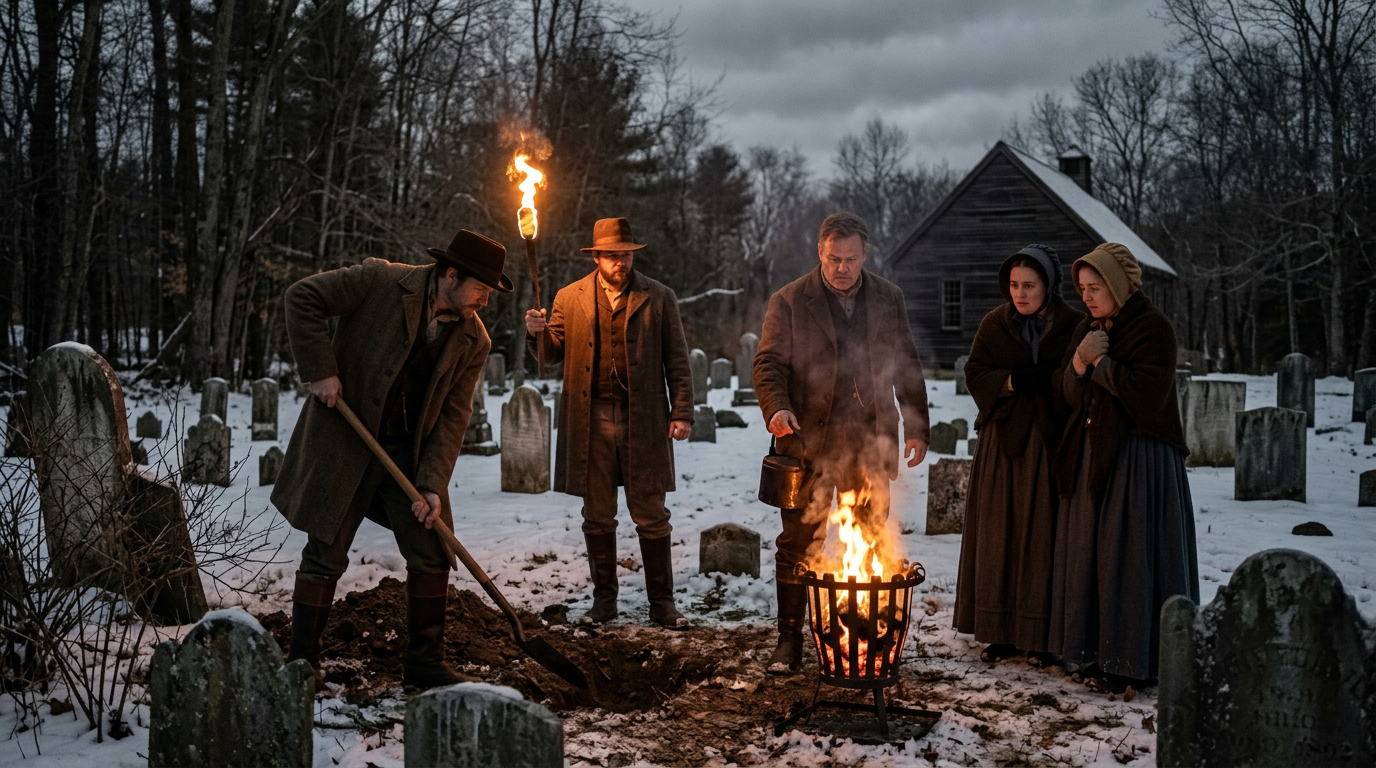
On 17 March 1892 a party of men opened the graves, with the district medical examiner, Dr. Harold Metcalf, in attendance. The mother and the elder sister, years buried, were bone. Mercy, two months in a cold vault, was not; her heart and liver still held blood. Metcalf, by the accounts I trust, found nothing that ordinary decay and a Rhode Island winter could not explain, and her lungs bore the marks of the disease that killed her. The heart and liver were burned on a nearby rock, and the ashes, mixed into a draught, were given to Edwin. He died on 2 May.
It would be easy, careful reader, to file this under superstition and close the drawer. I cannot. Consumption, which we now call pulmonary tuberculosis, was the great killer of nineteenth-century New England, responsible by many estimates for something near a quarter of all deaths in the region. Robert Koch had identified the bacillus in 1882, ten years before the Exeter exhumations, but identification is not cure; no effective drug existed until streptomycin in the 1940s. What a farm family saw was a slow wasting that passed from one member of a household to the next, as though the first dead were drawing the living after them. The remedy followed that logic with terrible exactness: stop the drawing at its source.
Nor was Exeter alone. The folklorist Michael Bell has traced some eighty such cases across New England, from the late eighteenth century to the 1890s. Henry David Thoreau noted in his journal in 1859 that he had heard of a family who burned the vitals of a dead relative to save the living. In 1990, at a family burial ground in Griswold, Connecticut, archaeologists found a coffin whose occupant, marked only by the brass-tack initials “JB 55,” had been disturbed after death, his skull and thighbones rearranged on his chest; his bones showed signs consistent with tuberculosis. Genetic and genealogical work published in 2019 suggested the name John Barber. Exeter was not an aberration. It was the last well-documented instance of a long practice.
One detail troubles me more than the rest. The families themselves seem not to have used the word vampire. It arrives in the reporting, in the copy of journalists who came from outside and needed a word their readers would know. This is where the clippings brush against my old study of Anne Rice. Her vampires speak at length; they confess, mourn, and choose. Mercy Brown said nothing at all. She was given the name of a literary monster by men who never met her, and the name has outlived nearly everything else about her. It is sometimes claimed that Bram Stoker kept an account of the Rhode Island affair among his notes for Dracula. I have not found that claim securely documented, and I file it as rumor rather than history.
I keep returning, too, to my study of the far bank: the river, the ferryman, the old conviction across many cultures that the dead belong on the other side of the water and must be helped to stay there. The men at Chestnut Hill were not hunting a monster so much as trying to close a door that grief and disease had left open. George Brown, by the accounts, consented rather than led. I find I cannot judge him. I can only note how small the gap is between mourning and dread, and how quickly a frightened community will cross it.
Before I put the lamp out I refolded the clippings along their old creases and laid them in a fresh folder. The frost had thickened on the glass. On the shelf nearest the door, where I am certain I did not leave it, the box tied with black ribbon was waiting.
— A.U., Faulkenmire
Catalogue References
Field Study No. X — The Blood and the Bloodline: Anne Rice
Field Study No. VIII — The Other Side: The Otherworld, the Ferryman, and the River
Further Studies
Barber, P. (1988). Vampires, burial, and death: Folklore and reality. Yale University Press.
Bell, M. E. (2001). Food for the dead: On the trail of New England’s vampires. Carroll & Graf.
Dubos, R., & Dubos, J. (1952). The white plague: Tuberculosis, man, and society. Little, Brown.
Editions and reprints vary; verify details against a library catalogue.
Uncatalogued
The box tied with black ribbon has moved to the shelf beside the door, and I begin to suspect it is not waiting to be opened so much as waiting to be carried somewhere.
This entry is preserved within the haunted archive of Wicked Dual, among the private papers of the Archivist of the Unseen.
Read the written chronicles on the blog, the Wicked Archive: www.wickeddualblog.com
Secure the physical artifacts drawn from these histories at the Wicked Dual boutique: https://www.etsy.com/shop/Wickeddual
We invite you to enter the haunted archive and secure a piece for your private collection; it is a necessary addition for those who curate the darker corners of human history.


Leave a Reply