The Journal of the Archivist of the Unseen

Written at Faulkenmire, in the pigment room off the west stair, the second night of rain, by a light that turned every blue to black.
Tonight there was a ledger open on the long table that I did not open: a nineteenth-century register of pigments, each entry a smear of color beside a name in brown ink. Lamp black. Vermilion. Azure. Verdigris. Someone had set a pressed sheet of blue paper across the page like a bookmark. The rain has kept on since noon, and in that light the blue looked almost black, which I have come to think was the point. I have been asked, in letters and in the margins of my own notes, why the Devil was once painted blue, and when he turned red. The answer is less tidy than the question, and I will try to give it honestly.
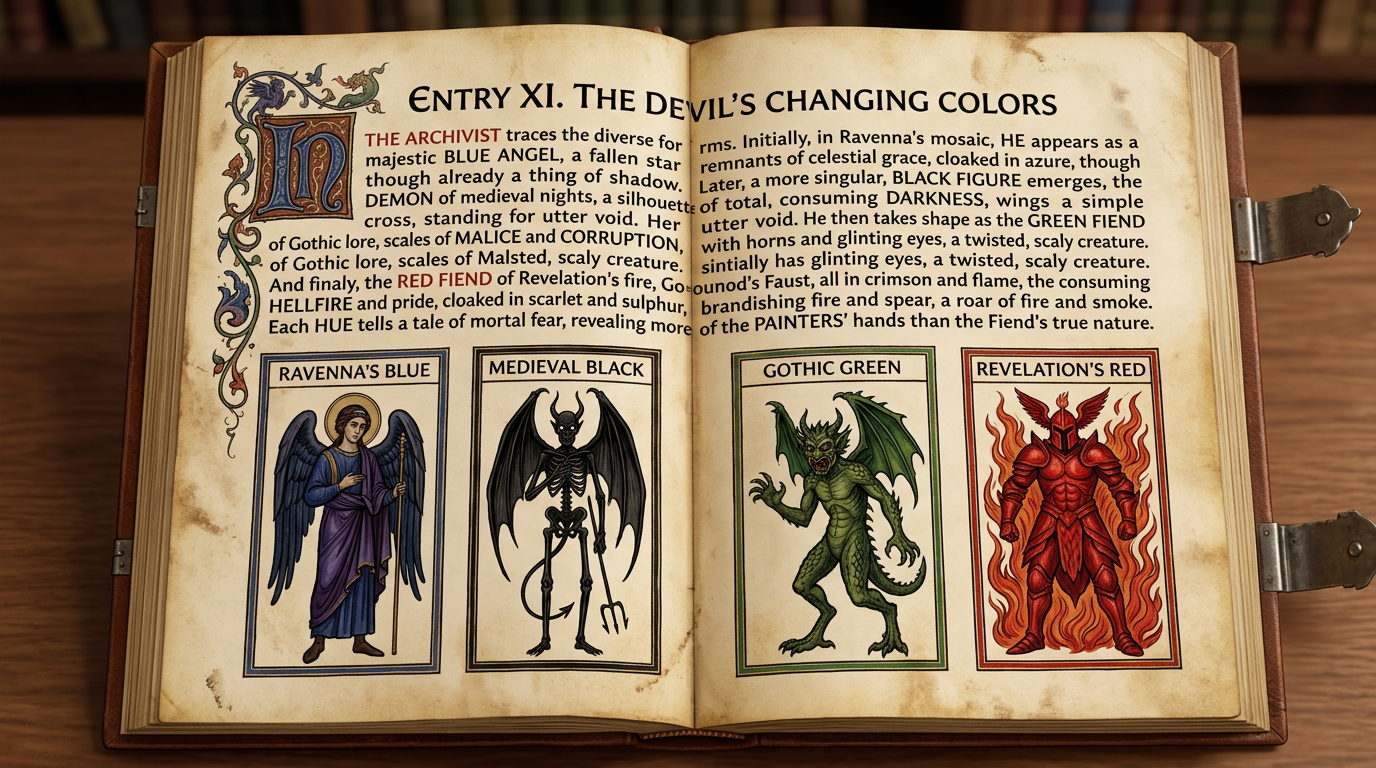
Begin in Ravenna, in the basilica of Sant’Apollinare Nuovo, among the mosaics made under the Ostrogothic king Theodoric in the early sixth century. One small panel illustrates the parable in Matthew 25: Christ, enthroned, separates the sheep from the goats. On his right stands an angel in red beside the sheep; on his left, an angel in blue beside the goats. Some art historians read that blue angel as Satan, which would make him one of the earliest images of the Devil in Western art. Others are more cautious, and so am I. He is not labeled. He has no horns, no tail, nothing monstrous. He is simply an angel on the wrong side, and his color is the only sign that something is amiss.
Why blue? Here, patient reader, we must set aside our own eyes. For us blue is the color of the sky, of calm, of loyalty. It did not carry those meanings in the ancient Mediterranean. The historian Michel Pastoureau has shown that the Romans thought little of blue. It was the color of barbarians: Caesar wrote that the Britons stained themselves with woad. Blue eyes were thought unlovely, and dark blue was linked with mourning and the night. In Byzantine pictorial convention, deep blue could also stand for darkness itself, the absence of light. Some scholars add a scriptural reading. The Epistle to the Ephesians calls Satan “the prince of the power of the air,” and early Christian writers placed the fallen angels in the dim air below heaven. A blue-violet angel may be an angel of that lower air: fallen, but not yet hideous. I cannot say which reading the Ravenna mosaicists intended. Perhaps they intended all of them.
Through most of the Middle Ages, however, the Devil’s true color was neither blue nor red. It was black. Black was the color of the darkness he had chosen, of the smoke of the pit, of a light deliberately put out. Saints’ lives describe demons as black men, black dogs, black birds. This is where the pigment ledger brushes against my study of Dame Alice Kyteler. The Irish accusations of 1324 said her familiar, Robin son of Art, came to her as a cat, a shaggy black dog, or a black man. In the visual language of the age, such darkness was a moral sign, and it is a cruel inheritance; the habit of reading darkness as evil fell on real human beings for centuries afterward.
Blue, meanwhile, was undergoing a revolution. In the twelfth and thirteenth centuries, Pastoureau argues, it rose from neglect to prestige. Glassmakers at Saint-Denis and Chartres filled windows with it. Painters gave it to the mantle of the Virgin Mary, sometimes in costly ultramarine ground from Afghan lapis lazuli. The kings of France took it for their arms. A color given to the Queen of Heaven could hardly remain the Devil’s. Yet the old association lingered in places. In Giotto’s Last Judgment in the Scrovegni Chapel at Padua, painted around 1305, a vast dark, bluish Satan sits in hell devouring the damned. Late medieval painters, freed from any single rule, gave demons whatever color best suggested corruption. Michael Pacher’s panel of Saint Augustine and the Devil, from the 1470s, shows a green fiend with a second face on his hindquarters. Green, in that age, meant the unstable, the poisonous, the rotting, and the serpent.
Red had always been near at hand. The Book of Revelation gave the Devil a color in so many words: “a great red dragon, having seven heads and ten horns.” Isaiah wrote that sins were “as scarlet.” Red was the color of hellfire and of blood, and in medieval art hell is very often red and black together. Yet red was double-edged. It was also the blood of Christ and of the martyrs, the robes of cardinals, the color of divine love. A red Devil is a parody of that sacred red: fire that burns without giving light, blood that is shed and not offered. Pastoureau notes, too, that painters gave red hair to Judas and other figures marked as traitors or outsiders. Red was the color of the one who betrays from within.
When, then, did the Devil become red in the popular mind? Later than we imagine. Red demons appear in late medieval and early modern art, but the fully red Devil, in his tights and pointed beard, is largely a nineteenth-century figure. Charles Gounod’s opera Faust, first staged in Paris in 1859, dressed Mephistopheles as a red-clad gentleman, and the costume spread through the theaters of Europe and America. From the stage he passed to cartoons, advertisements, and tins of deviled ham; the Underwood company registered its little red devil as a trademark in 1870. By the twentieth century he had become what he is now: less a terror than a mascot. I will say plainly that this sequence is the general shape of the evidence and not a single dated turning; the colors overlapped for centuries.
So the Devil was painted in turn in the dark of the air, the black of the void, the green of rot, and finally the red of fire and the playhouse. His names were borrowed as freely as his colors; as I wrote in my study of Baal, Beelzebub preserves Baal-zebub, the god of Ekron in the Book of Kings, a god known to us chiefly through his enemies. Every color was a judgment, and every judgment said more about the painters than about him. Before I closed the ledger I lifted away the blue sheet. Beneath it, against the entry for azure, someone had pressed a single strand of black ribbon.
— A.U., Faulkenmire
Catalogue References
Field Study No. XI — The Woman Who Was Never Burned: Dame Alice Kyteler
Field Study No. XXVI — The Lord of the Storm: Baal
Further Studies
Russell, J. B. (1984). Lucifer: The Devil in the Middle Ages. Cornell University Press.
Editions and reprints vary; verify details against a library catalogue.
Uncatalogued
The empty box marked “Mortlake” has acquired a smell of burnt wax, and I have begun to read about a black obsidian mirror that Dr. John Dee is said to have used to speak with angels.
This entry is preserved within the haunted archive of Wicked Dual, among the private papers of the Archivist of the Unseen.
Read the written chronicles on the blog, the Wicked Archive: www.wickeddualblog.com
Secure the physical artifacts drawn from these histories at the Wicked Dual boutique: https://www.etsy.com/shop/Wickeddual
We invite you to enter the haunted archive and secure a piece for your private collection; it is a necessary addition for those who curate the darker corners of human history.


Leave a Reply