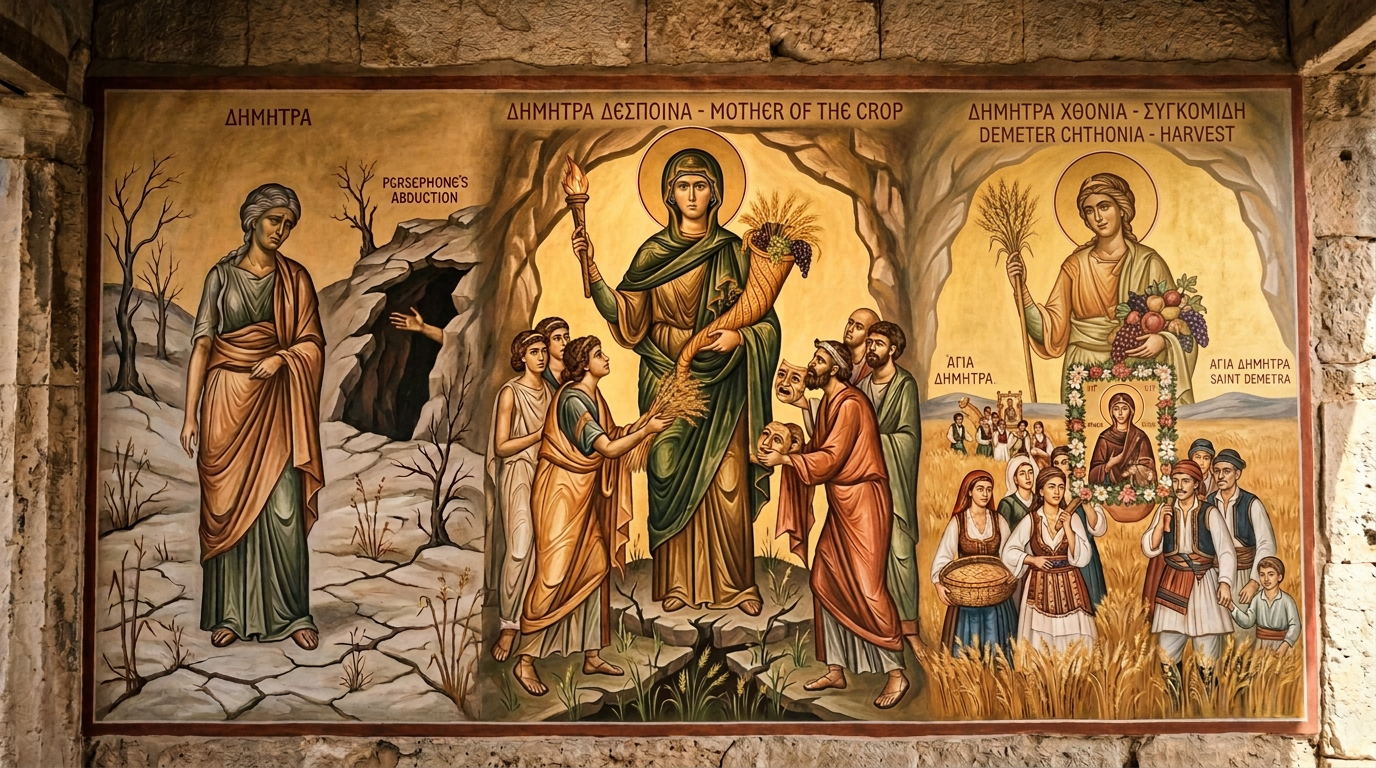
That Gave the Turning Year Its Meaning

“A mother lost her daughter to the lord of the dead, and in her grief she let the whole earth die. This is not merely a story of the seasons. It is the story of why the seasons were ever felt to matter.”
An Archival Chronicle Prepared for the Discerning Collector
Compiled by the Archivist of the Unseen
Contents
I. The Day the Grain Refused to Grow
II. A Living Inheritance: A Note on a Continuing Tradition
III. Who Demeter Was: The Grain-Mother of the Olympians
IV. The Name and Its Contested Roots
V. Field Study — The Abduction of Persephone: The Central Tale
VI. The Bargain of the Pomegranate and the Birth of the Seasons
VII. An Archival Aside: On the Grief That Became a Calendar
VIII. The Eleusinian Mysteries: The Secret at the Heart of the Cult
IX. The Harvest Goddess and the Feast of the Second Gathering
X. Field Study — The Darker Demeter: The Black Mare of Arcadia
XI. The Many Names: Ceres, Isis, and the Great Mother
XII. Saint Demetra: The Goddess Who Outlived Her Own Religion
XIII. The Mother Who Let the World Die
Bibliography
I. The Day the Grain Refused to Grow
Imagine the year the world nearly ended — not by flood or fire, but by grief. A goddess had lost her daughter, and in the depth of her mourning she withdrew her gift from the earth, and the earth obeyed her sorrow. The seed lay dead in the furrow and did not sprout. The green blade did not rise. The grain did not ripen, the fruit did not set, and across the whole face of the world the fields lay barren and black under a sun that could no longer quicken them. Mortals began to starve. The smoke of sacrifice thinned upon the altars as there was less and less to burn, until the very gods grew alarmed — for a world of the starving dead is a world with no one left to worship.
The goddess did not care. She wandered the earth in the black robes of her mourning, a torch in either hand, searching, refusing to eat or bathe or rest, indifferent to the famine she had loosed, indifferent to the dying, indifferent to everything but the single unbearable fact at the center of her: that her daughter was gone, taken down into the kingdom of the dead, and that no power in heaven or earth had troubled to prevent it. She would let the whole living world follow her daughter into death before she would relent. And she very nearly did.
The goddess was Demeter, the grain-mother of the Greeks, and the tale of her grief and her daughter’s abduction is among the most profound the ancient world produced — for it is at once the myth that explained the turning of the seasons and something far deeper: a meditation on grief, on the bond of mother and child, on the necessity of loss, and on the strange truth that death and life are bound together in a single cycle that cannot have the one without the other. This field study takes as its subject Demeter herself — who she was, the harvest she governed, the darker faces she wore — and above all the great tale of the abduction of Persephone, which gave the ancient world its account of why the year must die each autumn and be reborn each spring.
The pages that follow are prepared for the discerning collector of the sorrowful and the sacred — the reader who understands that behind the tidy schoolbook formula, in which Persephone’s months underground simply “explain” the winter, there lies one of humanity’s deepest reckonings with loss and return. Demeter’s grief did not merely account for the seasons. It gave them their meaning — taught a whole civilization to feel, in the dying of the year and its rebirth, the vast rhythm of loss and recovery that governs every mortal life.
❧ ❧ ❧
II. A Living Inheritance: A Note on a Continuing Tradition
Before the tale is told, a note on the living dimension of this material is owed, for the worship of Demeter, though its ancient public form was suppressed sixteen centuries ago, has proven remarkably resistant to complete extinction, and threads of it survive and revive into the present day.
The public cult of Demeter was formally ended when the Christian emperors of Rome outlawed the old religion in the late fourth century, and the great sanctuary at Eleusis, where her mysteries had been celebrated for the better part of two thousand years, fell at last into ruin. And yet the goddess did not entirely die with her temples. As a later section of this study will detail, the people of the region around Eleusis continued, astonishingly, to venerate a figure they called “Saint Demetra” — a Christian-tinged survival of the grain-goddess — into the early nineteenth century, praying to her for the fertility of their fields more than a thousand years after her official abolition. And in the present day, the broader revival of Hellenic polytheism — the reconstructed worship of the ancient Greek gods, practiced by communities in Greece and around the world, and recognized in Greece as a religion — has restored the honoring of Demeter to a genuine, if modest, living practice. The concept of the agricultural year she governed, and the profound meditation on death and rebirth encoded in her mysteries, remain living currents in the Western imagination.
This matters for the treatment of the material. Where this study touches upon the modern survival and revival of Demeter’s worship, it does so with the respect owed to living or recently-living practice, not as the description of a wholly dead curiosity. The ancient religion is, in its public form, long ended; but the figure of Demeter, the meaning of her mysteries, and the reverence for the turning agricultural year have proven among the most durable inheritances of the classical world, surviving suppression, transformation, and the passage of sixteen centuries. The archive records the ancient cult with historical rigor and marks its afterlives with care. With that understanding fixed, the chronicle proceeds to the goddess herself.
❧ ❧ ❧
III. Who Demeter Was: The Grain-Mother of the Olympians
Artifact: The Second-Born of the Titans
Demeter stands among the twelve great Olympian gods of the Greek pantheon, but her origins reach back before the Olympians to the generation of the Titans, and her nature is older still — rooted in the agrarian earth-cults of the Greek world long before the classical gods received their familiar forms. To understand her is to understand a goddess who is at once a member of the shining Olympian family and something far more ancient and more chthonic: the grain-mother, the earth-mother, the giver and withholder of the food on which all mortal life depends.
In the genealogy set down by Hesiod, Demeter is the daughter of the Titans Cronus and Rhea, and thus the sister of Hestia, Hera, Hades, Poseidon, and Zeus. She shared the terrible infancy of her siblings: Cronus, fearing the prophecy that his own children would overthrow him, swallowed each of them at birth, and Demeter, like the others save Zeus, spent her first existence within her father’s body until Zeus forced his disgorging and freed them all. In the great war that followed — the Olympians against the Titans — Demeter took her place among the victors, and became one of the new rulers of the cosmos. Through her brother Zeus she became the mother of Persephone, the daughter whose loss would define her greatest myth; and through other unions she was mother to a range of further figures, among them, in various traditions, the wealth-god Plutus, the horse-god Arion, the Arcadian mistress Despoina, and others.
But genealogy is the least of her. Demeter’s true nature is functional and elemental: she is the goddess of the grain, and thereby of the very possibility of settled human life. Her many cult-titles read like a hymn to the harvest — Sito, “she of the grain”; Chloe, “the green shoot”; Haloas, “of the threshing floor”; Karpophoros, “bringer of fruits”; Chrysaoros, “lady of the golden blade” of the wheat. She was the goddess who taught humankind the cultivation of cereals, and in doing so, the ancient Greeks held, taught them civilization itself — for agriculture was understood to be the foundation of settled, lawful, civilized life, as distinct from the wandering existence that preceded it. Her epithet Thesmophoros, “the law-giver” or “bringer of custom,” binds these two gifts together: Demeter gave both the grain and the law, both the harvest and the ordered civilization the harvest made possible. She was, in the fullest sense, the goddess who made human life as the Greeks knew it possible — and who, in her grief, could unmake it.
❧ ❧ ❧
IV. The Name and Its Contested Roots
Artifact: The Disputed Mother
The very name Demeter has been a subject of scholarly dispute since antiquity, and the debate turns upon a single question of great resonance: is she the Earth-Mother, or the Grain-Mother? The answer, or the failure to settle upon one, illuminates the double nature of the goddess herself.
The second element of the name is not in serious doubt: -meter derives from the Proto-Indo-European root for “mother,” the same root that yields “mother” across the whole Indo-European family of languages. Demeter is, beyond question, a divine mother. It is the first element, De- or Da-, that has generated the debate. One ancient and long-favored theory held that Da was a Doric form of a word for “earth” — making Demeter “Earth-Mother,” the divine earth itself, sister-in-nature to Gaia. This reading has an intuitive power, for Demeter is indeed deeply identified with the earth and its fertility. Yet modern philologists have grown skeptical: several leading scholars find no secure evidence that the element da actually means “earth,” and the “Earth-Mother” etymology, for all its appeal, rests on shakier ground than its popularity suggests.
A rival theory, championed by the scholar Jane Ellen Harrison among others, holds that the first element relates instead to a word for grain or cereals — connecting Demeter to deai or zeia, Cretan and Ionic words for grain — making her not “Earth-Mother” but “Grain-Mother,” the mother and giver of food specifically. This reading accords with her overwhelmingly agricultural character and with the great majority of her cult-titles, which concern grain and harvest rather than the earth in the abstract. Further theories abound: one connects the first element to a Proto-Indo-European root for “house,” making her “mother of the house”; the scholar M. L. West proposed a borrowing from a non-Greek Illyrian or Messapic goddess, Damatura, combining “earth” and “mother” from roots outside Greek altogether. The honest position is that the name’s first element remains genuinely uncertain, and that the uncertainty is itself meaningful: Demeter hovers, at the very level of her name, between the earth and the grain, between the mother of all growing things and the mother of the harvest specifically — a doubleness that runs through the whole of her worship.
There is, too, the tantalizing possibility of very deep antiquity. The name may appear in the undeciphered Linear A script of Bronze Age Crete as da-ma-te, and a Mycenaean Linear B inscription preserves a “Potnia of the Grain” — a “Mistress of the Grain” — who is widely regarded as Demeter’s Bronze Age predecessor. If these identifications hold, then the grain-mother’s worship reaches back well over three thousand years, into the Minoan and Mycenaean world before the Greeks as we know them, making Demeter among the oldest continuously-worshipped deities of the entire European tradition — a goddess whose cult may have run unbroken from the Bronze Age palaces of Crete to the Christian-tinged “Saint Demetra” of the nineteenth century, a span of more than three millennia.
❧ ❧ ❧
V. Field Study — The Abduction of Persephone: The Central Tale
Artifact: The Homeric Hymn to Demeter
The central myth of Demeter — the abduction of her daughter Persephone and the grieving search that followed — is preserved in its fullest and most beautiful ancient form in the Homeric Hymn to Demeter, a poem composed perhaps in the seventh century before the common era, and among the greatest religious poems of the ancient world. It is the foundational text of Demeter’s worship, the myth behind her mysteries, and one of the most profound explorations of grief and loss that antiquity produced. The tale must be told in full, for every element of it carries weight.
The daughter was Persephone — also called Kore, “the Maiden” — the child of Demeter and Zeus, a young goddess of surpassing beauty. She was gathering flowers in a meadow, in the company of other maidens, when the earth split open before her. For Hades, the grim lord of the underworld and Demeter’s own brother, had conceived a desire to make Persephone his wife and queen — and, crucially, he had obtained the consent of Zeus, the girl’s own father, who had granted his brother the maiden without her knowledge or her mother’s. As Persephone reached for a particularly beautiful narcissus — a flower set there, the hymn tells, as a snare — the ground opened and Hades burst forth in his chariot, seized her, and carried her down screaming into the kingdom of the dead, the earth closing over them as though they had never been.
Demeter heard her daughter’s cry echoing from the mountains and the depths of the sea, and a terrible grief seized her. She cast off her divine serenity; she took up two flaming torches and, refusing food and drink and the bath and all comfort, she wandered the whole earth for nine days and nine nights, searching for her lost child, finding nothing. On the tenth day the goddess Hecate, who had heard but not seen the abduction, joined her, and together they went to Helios, the all-seeing sun, who alone had witnessed the deed. Helios told her the truth: that Hades had taken Persephone, and that Zeus himself had permitted it. It is difficult to overstate the bitterness of this revelation — that the girl’s own father had given her away to the lord of the dead, bargaining his daughter into the underworld without a word to the mother who bore her. Demeter’s grief now hardened into rage, and into a terrible resolve.
In her wrath and sorrow, Demeter withdrew entirely from the company of the gods and wandered the earth in disguise, coming at last to the town of Eleusis, where — in the guise of an old woman — she was received with kindness by the royal household and became nurse to the queen’s infant son. Here the hymn tells a tender and strange episode: Demeter, grateful for the kindness shown her, sought to make the child immortal by anointing him with ambrosia and placing him in the fire by night to burn away his mortality — until the horrified queen, seeing her infant in the flames, cried out and broke the spell, and the goddess, revealing herself at last in her full and terrible divinity, rebuked the mortals for their folly and commanded that a great temple be built for her at Eleusis. It was there, in that temple, withdrawn in her grief, that Demeter loosed the full weight of her mourning upon the world.
For she now enacted the famine. As goddess of the grain, she simply withdrew her gift: she made the seed barren in the ground, and across the whole earth nothing grew. The hymn describes it with stark power — the oxen dragging the plough in vain, the white barley falling uselessly upon the soil, the whole race of mortals threatened with death by famine, and the gods threatened with the loss of the honors and sacrifices that mortals alone could give. Demeter would not relent. She would see the entire living world die before she would restore its fertility while her daughter remained in the dark. It was the ultimate maternal refusal: the mother who would let the cosmos itself starve rather than accept the theft of her child.
❧ ❧ ❧
VI. The Bargain of the Pomegranate and the Birth of the Seasons
Artifact: The Seeds of Return
Faced with the death of all mortal life and the collapse of the divine order that depended upon mortal worship, Zeus was at last compelled to act. He sent the gods, one after another, to Demeter with gifts and honors, begging her to relent and restore the earth’s fertility. She refused them all. She would not set foot on Olympus, she declared, nor allow the earth to bear fruit, until she saw her daughter again with her own eyes. And so Zeus was forced to concede: he sent Hermes, the messenger, down into the underworld to bring Persephone back to her mother.
But the lord of the dead was cunning, and before he released his queen, he did a fateful thing. He gave Persephone — or in some tellings tricked her into eating — a few seeds of the pomegranate, the fruit of the underworld. And this small act bound her forever, for it was a law older than the gods that whoever tasted the food of the dead could not wholly return to the living. Persephone had eaten — a few seeds only, in most tellings, three or four — and so she could not be given back to her mother entirely and forever. A compromise was struck, and it is this compromise that gave the ancient world its seasons: Persephone would spend a portion of each year — corresponding to the number of seeds she had eaten — in the underworld with her husband Hades, and the remainder of the year above, in the light, with her mother Demeter.
And here the myth reveals its deepest function, for it binds the drama of the divine family directly to the turning of the agricultural year. When Persephone is below, in the months of her absence, Demeter mourns anew, and in her grief she withholds her gift, and the earth grows cold and barren — this is the autumn and the winter, the season of death, when the fields lie empty and the year descends into darkness. And when Persephone returns to the light, ascending from the underworld to her mother’s arms, Demeter rejoices, and in her joy the earth bursts once more into fertility — this is the spring and the summer, the season of life, when the seed sprouts and the grain ripens and the world is green again. The seasons, in this vision, are the outward expression of a mother’s grief and a mother’s joy: the winter is Demeter mourning her absent daughter, and the spring is her rejoicing at the daughter’s return. The turning of the year is the beating of a divine mother’s heart between loss and recovery, enacted upon the whole face of the earth.
The discerning reader should mark how much richer this is than the schoolbook formula that reduces it to a mere explanation of the seasons. The myth is not primarily a proto-scientific account of why winter comes; it is a meditation on the necessity of loss, on the way that life and death are bound inseparably together, on the truth that the seed must go down into the dark of the earth — must, in a sense, die — before it can rise again as the living grain. Persephone’s descent and return is the seed’s descent and return; the grain buried in the autumn furrow and sprouting in the spring is Persephone going down into the dark and rising again into the light. And the promise buried within the grief — that what descends will return, that the loss is not final, that the dark is a season and not an ending — is the promise that lay at the very heart of Demeter’s mysteries, and that offered her initiates, as the next sections will explore, a hope that reached beyond the harvest and into the question of death itself.
❧ ❧ ❧
VII. An Archival Aside: On the Grief That Became a Calendar
It is worth pausing upon the extraordinary nature of what this myth accomplishes, for it represents one of the great achievements of the human religious imagination: the transformation of grief into meaning, of loss into calendar, of a mother’s sorrow into the very rhythm by which a civilization understood its year. The discerning collector who contemplates the tale of Demeter is contemplating not merely a story but a mechanism — the means by which an agricultural people took the most universal of human experiences, the loss of a beloved, and wrote it into the sky and the soil, so that every autumn and every spring re-enacted it, and every harvest and every dearth was felt as an episode in a divine grief and a divine joy.
This is what myth does at its most powerful: it does not merely explain the world but invests it with feeling, so that the turning of the seasons is no longer a blank astronomical fact but a story one lives inside, charged with the emotions of loss and return. The ancient Greek who watched the fields go barren in the autumn was not merely observing the agricultural year; he was witnessing Demeter’s grief, participating in a cosmic mourning, and holding — through the promise of the mysteries — to the certainty that the daughter would return and the grief would turn to joy. Wicked Dual exists as a repository for precisely this order of artifact: the recognition that the deepest myths are the ones by which humanity made its world bearable and meaningful, encoding its griefs and its hopes into the very structure of time, and that to preserve such a myth is to preserve a record of how the human heart once met the great facts of loss and death and the turning year. To hold a vestige of Demeter’s story is to hold the shape of humanity’s oldest consolation: that what goes down into the dark may rise again.
This is the disposition the chronicle maintains: that the myth of Demeter and Persephone is not a quaint prescientific error to be smiled at but a profound and durable structure of meaning, one that spoke to the deepest human experiences and that has never entirely lost its power to do so. The chronicle now turns to the secret rites in which this meaning was most intensely enacted — the Eleusinian Mysteries, the great initiation at the heart of Demeter’s cult, which promised those who underwent it a hope that reached beyond the grave.
❧ ❧ ❧
VIII. The Eleusinian Mysteries: The Secret at the Heart of the Cult
Artifact: The Unspoken Rite
Of all the religious institutions of the ancient world, few were more revered, more secret, or more enduring than the Eleusinian Mysteries — the great initiation rites of Demeter and Persephone, celebrated at Eleusis near Athens for nearly two thousand years, from the archaic period until their suppression by the Christian emperors. They were the spiritual summit of Demeter’s worship, and they promised their initiates something no other Greek cult offered so clearly: a happier fate beyond death.
The Mysteries were built directly upon the myth of Persephone’s descent and return. Their central drama re-enacted, in ways that remain largely unknown to us, the loss of Persephone, Demeter’s grieving search, and the joyful reunion of mother and daughter — and in that reunion, the initiates found a promise for themselves. For if Persephone could descend into the kingdom of death and yet return to the light, then perhaps the human soul, too, might hope for something beyond the grave; and if the seed buried in the dark earth rose again as the living grain, then perhaps the human being buried in the dark earth might rise again as well. The Mysteries took the agricultural cycle of death and rebirth, embodied in Persephone and the grain, and extended it into a promise about the human soul — offering initiates, in the words the ancient sources allow us, a “sweeter hope” concerning the end of life. The poet Pindar wrote that blessed is the one who has seen the Mysteries before going under the earth, for he knows the end of life and knows also its divine beginning.
What actually happened within the Mysteries — the specific rites, the things shown, the words spoken at the climax — remains, remarkably, one of the best-kept secrets in human history. The initiates were sworn to absolute silence, and they kept it: across two thousand years, through all the vast literature of the ancient world, not one of the many thousands who were initiated ever revealed the central secret of what was shown in the innermost sanctuary, the Telesterion, at the culminating moment of the rite. We know the outward structure — the procession from Athens to Eleusis along the Sacred Way, the fasting, the drinking of the kykeon (a mixed drink of barley and water and pennyroyal), the entry into the great hall of initiation — but the core revelation, the thing that gave the Mysteries their transformative power, was carried to the grave by every initiate who ever experienced it. It is among the most tantalizing silences in the entire record of antiquity: a secret held perfectly by a whole civilization, a mystery that remains, genuinely and permanently, a mystery.
The endurance and prestige of the Eleusinian Mysteries testify to the depth of the human need they answered. For nearly two millennia, the greatest figures of the Greek and Roman world — statesmen, philosophers, emperors — traveled to Eleusis to be initiated, seeking the hope the Mysteries offered in the face of death. They were among the last of the old rites to fall, surviving until the very end of the ancient world, suppressed only when the Christian empire finally closed the sanctuary in the late fourth century. That so many, for so long, sought out this initiation is the clearest possible evidence of what Demeter’s cult offered beyond the harvest: not merely bread for the body, but hope for the soul — the promise, drawn from the grain and the returning daughter, that death might not be the end.
❧ ❧ ❧
IX. The Harvest Goddess and the Feast of the Second Gathering
Demeter’s primary and most universal function was as the goddess of the harvest, and it is in this aspect that she connects most directly to the great human tradition of the autumn harvest festival — the season of gathering-in, gratitude, and preparation for winter that agricultural peoples across the world have marked, and that the modern neopagan calendar observes at the autumn equinox under the borrowed name Mabon. To understand Demeter as harvest goddess is to understand the sacred dimension the ancient Greeks found in the labor on which their survival depended.
The Greeks marked the agricultural year with festivals to Demeter at every crucial juncture. The Thalysia was a harvest festival of first-fruits, offered to Demeter in thanksgiving for the gathered grain — the bread baked from the first harvest was called thalysian bread in her honor. The Thesmophoria, her great and secret women-only festival celebrated across the Greek world in the autumn, was bound up with the sowing of the new crop and with a form of agrarian magic intended to secure the fertility of the coming year — a festival in which the death and return embodied in Persephone were ritually enacted to ensure that the buried seed would rise. The Chloeia celebrated the first green shoots of spring. Across the whole turning year, Demeter was honored at each threshold of the agricultural cycle, her festivals marking the sowing, the sprouting, the ripening, and the gathering-in.
The connection to the modern autumn harvest festival is direct and genuine, and the discerning reader who has encountered the neopagan festival of Mabon — the celebration of the autumn equinox and the second harvest — will recognize in Demeter one of its principal invoked deities. This is entirely fitting, for Demeter is, of all the classical gods, the one most purely bound to the harvest and its meaning: the gratitude for the gathered abundance, the recognition of the earth’s generosity, and — crucially — the shadow of the coming dark, the knowledge that the harvest is also a farewell, that the gathering-in precedes the barren months, that Persephone is about to descend once more. The autumn harvest, in the Demetrian understanding, is a moment poised exactly between abundance and loss: the fields are full, and the fields are about to die, and the goddess who gave the grain is about to begin her mourning. It is this doubleness — the feast held in the shadow of the winter, the gratitude shadowed by the coming grief — that Demeter brings to the harvest festival, and that makes her its most profound presiding figure. She is not merely the goddess of the abundance; she is the goddess who knows what the abundance costs, and what follows it.
It should be noted, for the sake of accuracy, that the ancient Greeks did not celebrate a festival called Mabon — that name, as a separate field study in this archive details, is a modern coinage of the twentieth-century neopagan revival, drawn from Welsh rather than Greek tradition. But the modern festival’s invocation of Demeter is no error; it reaches, across the borrowed name, toward a genuine and ancient truth, for Demeter is the authentic harvest-mother of the classical world, and the autumn gathering she presided over carried, three thousand years ago, the same charge of gratitude and coming loss that the modern festival seeks to honor. The name is modern; the harvest-mother is as old as agriculture itself.
❧ ❧ ❧
X. Field Study — The Darker Demeter: The Black Mare of Arcadia
Artifact: Demeter Melaina
The gentle grain-mother of the popular imagination is only one face of Demeter, and the discerning collector should not mistake the part for the whole. In the older and more chthonic cults, particularly in the remote and archaic region of Arcadia, Demeter wore a far darker aspect — a goddess of rage, of the underworld, of violation and vengeance, black-robed and horse-headed, as terrible as she was nurturing. This darker Demeter is essential to a true understanding of her, for she reveals the goddess’s deep connection to death as well as to life, to the underworld as well as to the fertile field.
The most striking of these dark traditions is that of Demeter Melaina — “Black Demeter” — worshipped in Arcadia, and the myth attached to her is one of violation and grief. During Demeter’s desperate wandering in search of Persephone, the tradition holds, her own brother Poseidon conceived a lust for her and pursued her. To escape him, Demeter transformed herself into a mare and hid among the horses of a mortal king — but Poseidon, seeing through the disguise, transformed himself into a stallion and violated her despite her transformation. From this dark union were born the divine horse Arion and a daughter whose name was so sacred it could not be spoken to the uninitiated. In her grief and rage at this second violation — first the theft of her daughter, now her own violation by her brother — Demeter clothed herself entirely in black and withdrew into a cave to mourn and to purify herself, and while she hid there, the earth again grew barren. She was depicted, in this Arcadian cult, with the head of a horse, snake-haired, holding a dove and a dolphin — a genuinely monstrous and chthonic image, as far from the serene grain-mother as can be imagined.
This darker Demeter bore fitting epithets. In Arcadia she was called Erinys — “Fury” — the same word used for the terrible avenging spirits of Greek myth, marking her as a goddess of vengeance and wrath. She was Melaina, “the Black.” In Sparta and elsewhere she was Chthonia, “of the underworld,” honored with rites for the dead. The Athenians, tellingly, called the dead themselves Demetrioi — “Demeter’s people” — reflecting a deep and ancient association between the grain-goddess and the realm of death, rooted in the agrarian intuition that the dead, like the buried seed, go down into the earth from which new life springs. This is the profound logic beneath Demeter’s underworld aspect: that the same earth which receives the seed receives the corpse, that the goddess of the buried grain is necessarily also a goddess of the buried dead, and that fertility and death are not opposites but the two faces of the single earth she governs. The grain-mother and the death-goddess are one, because the field and the grave are the same ground.
The darker Demeter thus completes the portrait and deepens it immeasurably. She is not merely the kindly giver of bread but the terrible mother who let the world starve, the violated goddess who withdrew in black rage, the chthonic power to whom the dead belonged. Her gentleness and her terror are inseparable, for they spring from the same source: her absolute bond with the earth, which gives all life and receives all death, which nourishes and which buries, which is the mother of the grain and the keeper of the corpse alike. To honor Demeter only as the smiling harvest-goddess is to honor half of her. The whole goddess holds the field and the grave together in a single dark embrace — and it is this wholeness, this refusal to separate life from death, that makes her one of the most profound figures in all of ancient religion.
❧ ❧ ❧
XI. The Many Names: Ceres, Isis, and the Great Mother
Demeter’s worship did not remain confined to Greece, nor her identity to a single name. As the ancient Mediterranean world grew interconnected, Demeter was identified and merged with the great goddesses of other peoples, until she became one face of a vast, syncretic mother-goddess worshipped across the classical world under many names. This process of identification illuminates both Demeter’s particular character and the deep human tendency to perceive, behind the many goddesses of many peoples, a single great mother.
The most important of these identifications was with the Roman goddess Ceres, with whom Demeter was formally merged around the end of the third century before the common era, when a Greek-style cult of Demeter and Persephone — rendered in Latin as Ceres and Proserpina — was officially installed at Rome. From Ceres, the goddess of grain, descends the very word cereal, a linguistic monument to Demeter’s agricultural function surviving in every modern breakfast table. The Roman cult preserved the essential myth — the search of the mother for the daughter stolen into the underworld — and the essential meaning, binding the goddess to the harvest and to the mysteries of death and rebirth.
Beyond Ceres, Demeter was identified with a whole constellation of great goddesses. She was equated with the Phrygian Great Mother, Cybele, the mountain-mother of Asia Minor worshipped with wild and ecstatic rites, for both were mother-goddesses of fertility and both bound up with the cycle of death and return. In the syncretic religious world of late antiquity, she was merged with the Egyptian Isis — the great goddess who, in one famous ancient text, declares herself the single deity worshipped throughout the world under a thousand names, naming Demeter’s Eleusinian form among them. She was even identified, in her aspect as the mother whose gifts sustain life, with the universal earth-mother, the source of all fertility. Through these identifications Demeter became more than a Greek goddess: she became one name, one face, of the great mother-goddess whom the ancient world increasingly perceived behind all its particular deities — the single divine mother worshipped, as the text has Isis say, “in a thousand shapes, with divers rites, and under many a different name.”
These identifications should not be mistaken for mere confusion; they express a genuine religious perception, deepening across the centuries of antiquity, that the many mother-goddesses of the many peoples were reflexes of a single great reality — the divine feminine, the source of life and fertility, the mother of gods and mortals alike. Demeter, with her profound myth of loss and return and her mysteries that promised hope beyond death, was among the most compelling faces this great mother wore, and her identification with Ceres, Cybele, Isis, and the earth-mother herself carried her worship and her meaning across the whole of the ancient Mediterranean and down into the syncretic spirituality of late antiquity, from which it would pass, transformed, into the imagery of the age that followed.
❧ ❧ ❧
XII. Saint Demetra: The Goddess Who Outlived Her Own Religion
Artifact: The Christian Survival
Perhaps the most remarkable chapter in the whole long history of Demeter is its ending — or rather its refusal to end. For when the ancient religion was suppressed and the sanctuary at Eleusis fell to ruin, the grain-mother did not entirely die. She survived, in disguise, in the folk-devotion of the very region that had been the center of her cult, for well over a thousand years after her official abolition, as a figure the local people called “Saint Demetra.” It is one of the most extraordinary survivals in the history of religion, and it deserves to be recorded in full.
After the Christian emperor Theodosius banned the old religion throughout the Roman Empire in the late fourth century, the public cult of Demeter ended and Eleusis declined into ruin. But the people of the Eleusis region, generation after generation, continued to venerate a figure they called Hagia Demetra — “Saint Demetra” — a Christian-tinged folk-saint whose story preserved, in altered form, the ancient myth. In the local folklore, Saint Demetra was associated with the protection and fertility of the crops, exactly as the ancient goddess had been; and her legend told of a daughter who had been abducted — though in the Christianized version the daughter had been taken by the Turks rather than by Hades. At the center of this folk-devotion stood an actual ancient statue — a great carved caryatid that still stood among the ruins of Eleusis — which the local people regarded as sacred, believing that it protected the fertility of their fields. They covered it with flowers to ensure a good harvest, and honored it as the guardian of their crops.
This astonishing survival endured into the early nineteenth century. When European antiquarians visited Eleusis in the seventeenth and eighteenth centuries, they recorded the folk-veneration of “Saint Demetra” and the flower-covered statue, and marveled at how closely the local legend still echoed the ancient myth of Demeter and Persephone — more than fourteen hundred years after the goddess had supposedly been abolished. The devotion continued until 1801, when the antiquarian Edward Daniel Clarke removed the ancient statue and carried it away to England, where it was eventually given to the University of Cambridge, in whose museum it remains to this day. The local people, it was recorded, lamented the loss of their “Saint Demetra” bitterly, believing that the removal of the statue would harm the fertility of their fields — a last echo, in the nineteenth century, of a devotion to the grain-mother that reached back, unbroken in some form, across more than three thousand years.
The tale of Saint Demetra is the perfect emblem of everything this chronicle has traced: the extraordinary durability of the grain-mother, the way she survived every attempt to end her, transforming from Bronze Age Mistress of the Grain to Olympian goddess to Christian folk-saint, always bound to the same essential function — the protection of the harvest, the fertility of the fields, the survival of the people who depended on her. She outlived her temples, her priesthood, her very religion, persisting in the folk-devotion of the people whose fields she had always guarded. The public cult could be abolished by imperial edict; the grain-mother herself, it seems, could not be. She simply changed her name to Saint Demetra and went on protecting the crops, as she had done since before the Greeks had a name for her at all.
❧ ❧ ❧
XIII. The Mother Who Let the World Die
At the center of Demeter’s myth stands an image of almost unbearable power: a mother so consumed by grief at the loss of her daughter that she was willing to let the entire living world die rather than accept it. This is the deepest and most human truth the tale preserves, and it is what has kept it alive across three thousand years and more. Demeter is not a remote and serene divinity presiding calmly over the harvest. She is a mother who lost her child, and whose grief was so absolute that it stopped the world — who withdrew her gift of life from the whole earth because the one life she loved most had been taken from her. Every parent who has feared for a child, every person who has lost a beloved, can recognize the terrible truth at the heart of her story: that grief on this scale does not care about the world, that a great enough loss can make the whole of existence seem worth sacrificing, that the bond of love and the wound of its severing are among the most powerful forces the human heart contains.
And yet the myth does not end in the endless winter of Demeter’s grief. It ends in the compromise of the pomegranate, in the daughter’s partial return, in the turning of the year between loss and recovery — and this is its deepest wisdom. For the tale acknowledges that the loss cannot be wholly undone: Persephone has eaten the food of the dead, and she can never again be simply and entirely her mother’s child; she must spend her portion of the year in the kingdom of death, and Demeter must, each year, grieve her going. But it insists, with equal force, that the loss is not final either — that the daughter returns, that the grief turns to joy, that the dead season gives way to the living one, that the seed buried in the dark rises again into the light. Demeter’s myth holds these two truths together in a way that few human stories manage: that loss is real and irreversible, and that return is real and certain; that the winter comes, and that the spring comes after it; that we lose what we love to the dark, and that what we lose to the dark comes back. This is the consolation the Mysteries offered, drawn from the grain and the returning daughter: not that we do not die, but that death is a season, and that beyond it lies return.
She endures, this grain-mother, because the truths she carries are the ones that do not change. As long as the seasons turn, as long as the seed goes down into the earth and rises again, as long as mothers love children and human beings lose what they love and hope against hope for its return, the myth of Demeter and Persephone will retain its power — for it is, beneath its agricultural surface, the story of every loss and every longed-for return, written into the turning of the year itself. She let the world die for grief, and she let it live again for joy, and in the endless alternation of her sorrow and her gladness the ancient world found the meaning of its seasons and a hope to carry into the dark. The grain still ripens and falls; the year still dies and returns; and the mother still grieves and rejoices, as she has done since before there were Greeks to tell her story — the goddess who loved her daughter enough to stop the world, and who, each spring, receives her back from the dead.
❧ ❧ ❧
This field study is preserved as one vestige among many within the haunted archive of Wicked Dual, an artisan boutique devoted to the reclamation of history’s clandestine and enduring corners. Demeter and the abduction of Persephone — the grief that stopped the world, the bargain of the pomegranate, the mysteries that promised hope beyond the grave — are but one chronicle among the collection’s deeper holdings.
Read the written chronicles on the blog, the Wicked Archive: http://www.wickeddualblog.com
Secure the physical artifacts drawn from these histories at the Wicked Dual boutique: https://www.etsy.com/shop/Wickeddual
We invite you to enter the haunted archive and secure a piece for your private collection; it is a necessary addition for those who curate the darker corners of human history.
— The Archivist of the Unseen

Bibliography
The following works constitute credible historical, literary, and archaeological literature underlying this field study; readers pursuing formal citation are advised to verify editions and pagination against a library catalog.
Burkert, W. (1985). Greek religion (J. Raffan, Trans.). Harvard University Press.
Cashford, J. (Trans.). (2003). The Homeric hymns. Penguin Classics.
Mylonas, G. E. (1961). Eleusis and the Eleusinian mysteries. Princeton University Press.
Leave a Reply