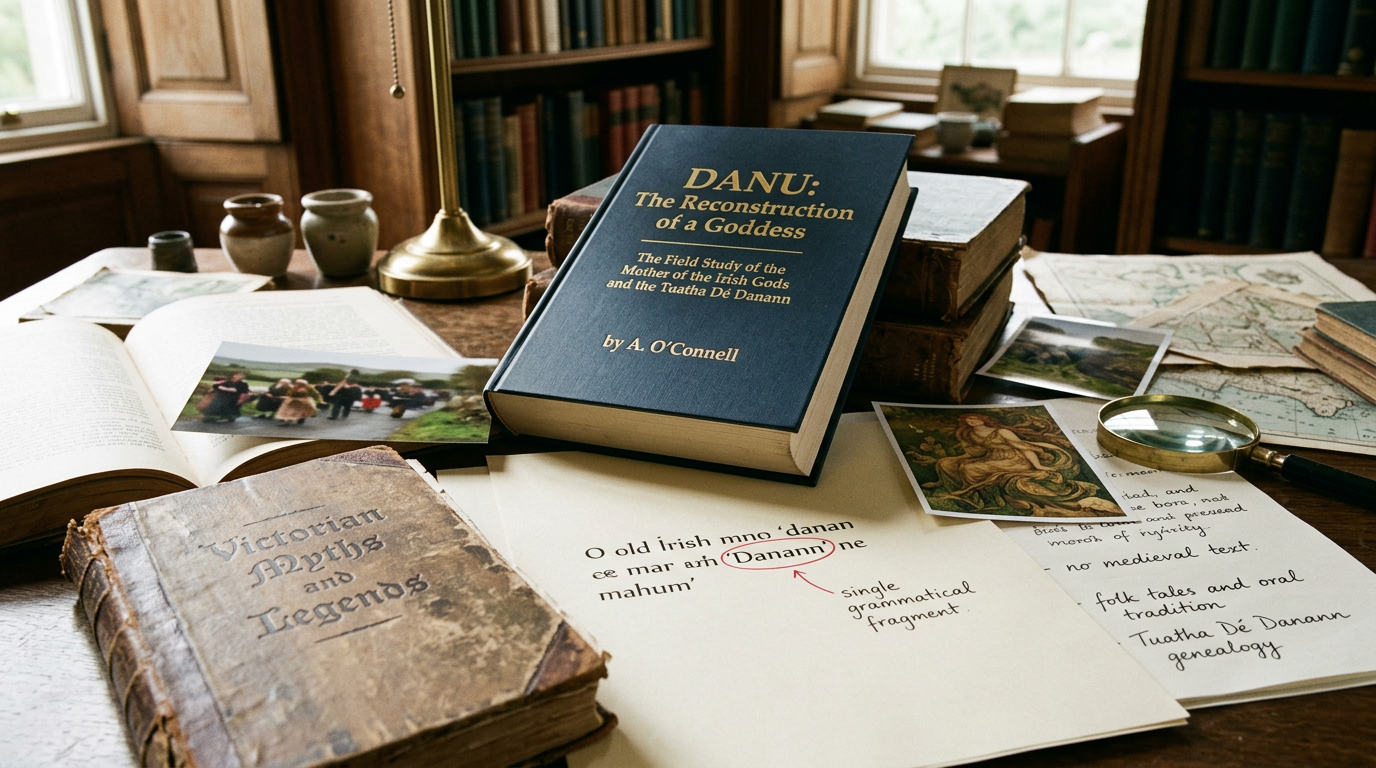
Reconstructed From a Single Word

“An entire people were named for her — the folk of the goddess Danu. And yet in all the medieval books of Ireland, she herself never once appears. She is a mother known only by her children, a name surviving only in the possessive.”
An Archival Chronicle Prepared for the Discerning Collector
Compiled by the Archivist of the Unseen
Contents
I. The Mother No One Wrote Down
II. A Living Inheritance: A Note on Irish Tradition
III. The Problem of Danu: A Goddess Reconstructed From Grammar
IV. The Etymology and Its Warring Theories
V. Field Study — The Tuatha Dé Danann: The Folk She Named
VI. The Candidates: Anu, Danand, and the Search for the Real Danu
VII. An Archival Aside: On the Reconstruction of the Vanished
VIII. Field Study — The Notable Tales: The Deeds of Her Attributed Children
IX. The Welsh Shadow: Dôn and the Question of the River-Mother
X. The Victorian Invention: How Danu Became an Earth Goddess
XI. The Indo-European Temptation: Danu, the Danube, and the Waters
XII. The Goddess Known Only by Her Children
Bibliography
I. The Mother No One Wrote Down
Consider a strange and haunting circumstance. There exists a goddess whose name was given to an entire race of divine beings — the most celebrated supernatural people in all of Irish legend, the gods of pre-Christian Ireland themselves. They are called, in the medieval texts, the Tuatha Dé Danann, and the phrase is universally rendered “the folk of the goddess Danu.” An entire pantheon bears her name. An entire people are, by their very title, hers.
And yet, if you open the great medieval books of Ireland — the manuscripts that preserve the whole vast mythology of that island, the wars of the gods and the takings of the land and the deeds of every named divinity — and search them for this goddess, for Danu herself, for a single story in which she acts, a single scene in which she speaks, a single myth that is hers, you will find nothing. Nothing at all. She has no tale. She has no deed. She does not appear. The mother of the gods, whose name a whole pantheon carries, is entirely absent from the literature of her own children.
Stranger still: the very form of her name, the nominative “Danu” by which she is universally known, appears in no medieval Irish text whatsoever. It is a reconstruction — a form built by modern scholars out of the possessive ending that survives in the name of her folk. She exists, in the primary record, only in the genitive case, only as a possessive, only as the “of-whom” in the name of her children. Danu is a goddess who survives solely in the grammar of belonging — a mother known only by the fact that others were said to be hers.
This field study takes as its subject that absence — the most famous mystery in Celtic mythology, the goddess who may never have existed as her modern admirers imagine her, reconstructed from a single grammatical fragment and clothed, over the past two centuries, in attributes the ancient sources never granted her. It will trace what the primary texts actually say, which is almost nothing; it will examine the candidates scholars have proposed for the “real” Danu; it will recount the notable tales of the divine folk who bear her name, since she has no tales of her own; and it will chronicle the extraordinary process by which Victorian folklorists built a full earth-mother goddess out of a possessive ending. The result is not the biography of a goddess but something rarer and more instructive: the anatomy of how a goddess is made.
The pages that follow are prepared for the discerning collector of the absent and the reconstructed — the reader who understands that the most fascinating figure in a mythology is sometimes the one who left no trace, and that the study of how later ages fill a silence with a goddess reveals as much about those ages as about the silence itself. Danu is the great absence at the heart of the Irish pantheon. This is the chronicle of her missing.
❧ ❧ ❧
II. A Living Inheritance: A Note on Irish Tradition
Before proceeding, a matter of importance must be set down, for it governs the treatment of all that follows and distinguishes this study from the chronicles of wholly extinct beliefs held elsewhere in this archive. The mythology to which Danu and the Tuatha Dé Danann belong is the cultural heritage of a living people, and it is to be approached with the respect that living heritage demands.
Irish — Gaeilge — is a living language, an official language of Ireland, taught, spoken, broadcast, and written today, one of the oldest vernacular literatures in Europe. The mythology preserved in the medieval Irish manuscripts is not the property of a vanished civilization but the foundational literary and cultural inheritance of the modern Irish nation and of the broader Gaelic world, a living tradition studied, celebrated, retold, and drawn upon continuously down to the present day. The Tuatha Dé Danann in particular occupy a vivid and continuing place in Irish cultural memory, bound up with the folklore of the sídhe — the fairy folk of later Irish tradition, into whom the old gods were said to have transformed — and with the very landscape of Ireland, its ancient mounds and hills and rivers, many of which still bear the names of the old divinities. This is not a dead pantheon exhumed for curiosity; it is a living heritage still woven into the identity, the landscape, and the imagination of a present people.
This matters for how the subject must be handled. The scholarly caution this study brings to the figure of Danu — the insistence that her earth-mother attributes are a modern reconstruction rather than an ancient attestation — is offered not to diminish the tradition but to honor it with accuracy, to distinguish what the medieval Irish actually recorded from what later outsiders added. The mythology deserves to be understood as it truly is, in its genuine depth and its genuine gaps alike, rather than flattened into the vague and romanticized “Celtic spirituality” that has too often been imposed upon it from without. Where this study questions the popular image of Danu, it does so in the service of the real tradition, not against it — for the real tradition, with its strange absences and its scholarly mysteries, is far more interesting than the invented one. The archive records what is genuinely there, and marks honestly what is not. With that understanding fixed, the chronicle proceeds.
❧ ❧ ❧
III. The Problem of Danu: A Goddess Reconstructed From Grammar
Artifact: The Missing Nominative
The central fact of any honest study of Danu must be stated at the outset and held firmly throughout, for nearly every popular account obscures it: Danu, as a named and described goddess, does not appear in the medieval Irish sources at all. This is not a matter of scholarly caution or interpretive dispute; it is a plain feature of the textual record. The discerning reader who wishes to understand Danu must first understand precisely what does and does not survive.
What survives is a single grammatical form, and it is not even the form by which she is known. The name “Danu” that appears in every modern retelling is a nominative — the case a name takes as the subject of a sentence, the form one would use to say “Danu did this” or “Danu was that.” But this nominative form, *Danu — conventionally marked with an asterisk precisely to signal that it is a reconstruction — is found in no medieval Irish text whatsoever. What is actually attested is the genitive: Danann (also spelled Donand or Danand), the possessive form meaning “of Danu,” and it survives essentially in one place — the collective name of the Irish gods, the Tuatha Dé Danann, “the folk of the goddess Danu.” The goddess exists, in the primary record, only as the possessive ending of her children’s name. She is grammatically present and personally absent — a genitive without a nominative, a possession without a possessor, a mother attested only in the phrase that says her children are hers.
From this single genitive form, modern scholars reconstructed the nominative *Danu, and from that reconstructed name, generations of folklorists and popularizers built an entire goddess — a mother of the gods, an earth deity, a goddess of fertility and rivers and prosperity, complete with attributes and associations and a personality. Not one of these attributes is found in a medieval Irish text describing Danu. They were inferred, proposed, borrowed from other figures, or simply invented, and then attached to the reconstructed name until the invented goddess acquired, through sheer repetition, the appearance of an ancient one. This is the problem of Danu, and it is also, for the historian, her fascination: she is a rare and unusually clear case of a deity assembled almost entirely after the fact, a goddess built backward from a grammatical fragment, and the study of her is less the study of an ancient belief than the study of how ancient belief is imagined, reconstructed, and, where the record falls silent, invented outright.
❧ ❧ ❧
IV. The Etymology and Its Warring Theories
Artifact: The Disputed Root
Since the very name is nearly all that survives, the etymology of that name has borne an enormous interpretive weight, and it has been a matter of vigorous scholarly dispute since the nineteenth century. What the name Danu means, if it can be determined, is very nearly the only evidence available for what kind of goddess she might have been — and so the competing etymologies are, in effect, competing goddesses, each theory of the root implying a different deity. The discerning reader should weigh them with care, for a great deal has been built upon each.
The most famous and most seductive theory, favored by many earlier scholars, links the name to water. On this reading, *Danu derives from a Proto-Indo-European root, *dʰenh₂-, meaning “to run” or “to flow” — the root of flowing water — and is connected to a whole family of river-names across the Indo-European world. It is compared, most strikingly, to the Vedic water goddess Danu of ancient India, whose name derives from the same root, and to the ancient name of the river Danube, Danuuius, along with other great river-names of Europe. On this theory Danu is a river-goddess, or a goddess of flowing waters, part of a vast and ancient Indo-European complex of divine rivers — a genuinely tantalizing possibility that would root the Irish goddess in a mythological inheritance thousands of years old and a continent wide. But the discerning reader should note the caution the theory requires: the connection is philologically attractive but not proven, and the very river-name Danube, though possibly Celtic, may instead be an early Scythian loanword, complicating the neat Indo-European picture.
A second theory, advanced by the scholar Mary MacLeod, turns from water to art. It connects Danu to the Old Irish word dán, meaning an artistic skill or craft — the word from which the aes dána, the “people of skill,” the artisans and poets and craftsmen of early Ireland, took their name. On this reading Danu is bound not to rivers but to skill and craft, a goddess of the arts, and the theory gains support, as a later section will detail, from the identification of her attributed sons with the great craftsman-gods of the pantheon. A third and more recent theory, from the linguist Eric Hamp, rejects both of these traditional derivations entirely and proposes that *Danu derives from the same root as the Latin bonus (in its old form duenos), from a Proto-Indo-European root meaning “good,” via a Proto-Celtic form meaning something like “aristocrat” or “noble one.” On this reading Danu is neither river nor craft but nobility itself — the noble one, the aristocrat among the gods.
River-goddess, craft-goddess, or noble one: the three etymologies sketch three entirely different deities, and the honest position is that the question remains unresolved. Each theory has its scholarly advocates and its philological difficulties; none commands consensus. And this irresolution is itself significant, for it means that even the single surviving fragment of Danu — her name — does not yield a stable meaning, and that the goddess reconstructed from it will differ depending on which theory of the root one adopts. The water-goddess of the popular imagination, so often asserted as fact, rests upon one contested theory among several. The discerning collector is advised to hold all three in view, and to grant none of them the certainty that popular retellings so freely bestow.
❧ ❧ ❧
V. Field Study — The Tuatha Dé Danann: The Folk She Named
Artifact: The Divine Race
If Danu herself is absent from the record, the folk who bear her name are anything but — for the Tuatha Dé Danann are the central supernatural race of Irish mythology, the gods of pre-Christian Ireland as the medieval Christian scribes preserved and reframed them, and their deeds fill the great mythological texts. To understand Danu at all, one must understand the folk she named, for they are, in the most literal sense, all that survives of her: her children, her people, the only evidence that she was ever conceived to exist.
The name Tuatha Dé Danann is usually rendered “the folk of the goddess Danu,” though the phrase repays closer attention. Tuatha means “peoples” or “tribes”; Dé means “gods” or “of the goddess”; Danann is the genitive that carries her name. So: the tribes of the gods of Danu, the divine people who belong to her. They are, in the mythological history of Ireland preserved in the Lebor Gabála Érenn — the “Book of the Taking of Ireland,” the great medieval compilation of Ireland’s legendary prehistory — one of a succession of peoples who invaded and held Ireland in the ages before the coming of the Gaels. They arrived, the tradition holds, from four legendary northern cities, bringing with them their druidry and their skill and four great treasures; they descended, in some accounts, in a mist or a cloud; and they wrested the land from the peoples who held it before them.
The Tuatha Dé Danann are portrayed as masters of skill, magic, and craft — a people of surpassing artistry and supernatural power, and this characterization, the discerning reader will note, lends real weight to the theory that connects Danu’s name to dán, skill or craft, for a goddess of skill would be a fitting mother for a race defined by their mastery of it. Among their number are the greatest gods of the Irish pantheon: the Dagda, the vast and benevolent father-figure with his cauldron of plenty and his great club; Lugh, the shining, many-skilled god of light and mastery; Nuada of the Silver Arm, their king; Brigid, the goddess of poetry, healing, and smithcraft; Dian Cécht, the god of medicine; the craftsman-gods Goibniu, Luchta, and Creidhne; the Morrígan, the fierce goddess of war and sovereignty; and many more. These are the children of Danu, the folk who carry her name, and their collective identity as a people of divine skill is the closest thing the record offers to a portrait of the mother who named them.
Their ultimate fate, in the mythological history, carries a particular poignancy and connects directly to the living tradition noted above. When the Gaels — the Milesians, the ancestors of the historical Irish — came at last to Ireland and defeated the Tuatha Dé Danann in their turn, the old gods did not simply vanish. They withdrew, the tradition holds, into the mounds and hills of the land.
They became the people of the sídhe — the ancient burial mounds and hills that dot the Irish landscape — the Aos Sí, the fairy folk of later Irish tradition, the people of the mounds who dwell beneath the visible land and emerge, in folklore, to touch the world of mortals. This is the great transformation by which the gods of pagan Ireland became the fairies of Christian Ireland — driven underground, in the most literal sense, into the hollow hills, where the folk imagination kept them alive for a thousand years after the coming of the new religion. The children of Danu, in other words, never quite died; they went into the earth, and into the folklore, and into the landscape itself, where they endure in the living tradition to this day. The mother is absent from the record, but her folk are woven into the very ground of Ireland.
❧ ❧ ❧
VI. The Candidates: Anu, Danand, and the Search for the Real Danu
Artifact: The Possible Goddesses
If Danu herself does not appear in the texts, scholars seeking the goddess behind the name have proposed several attested figures who might be her, might be confused with her, or might be the reality of which “Danu” is a distortion. Each candidate illuminates a different facet of the problem, and the survey of them is essential to any honest account, for it reveals that “Danu” may be less a single lost goddess than a tangle of several partially-attested ones, knotted together by scribes and scholars alike.
The foremost candidate is Anu (also declined as Anann or Anand). Anu is a genuinely attested Irish goddess — she appears in Cormac’s Glossary, an early text that predates the Lebor Gabála, where she is named as the mother of the Irish gods. A mother of the gods, actually attested in an early source: this is precisely what “Danu” is supposed to be, and so many scholars have proposed that Danu and Anu are the same goddess, or that Danu is a conflation of Anu, or even that “Danu” arose as a contraction of a phrase meaning “goddess Anu” — *d[ia] Anu. Anu carries her own genuine associations with fertility and the land, most vividly in the pair of mountains in County Kerry known as the Paps of Anu — Dá Chích Anann, “the two breasts of Anu” — twin rounded peaks named for the goddess’s body, a striking survival of a fertility-goddess associated directly with the shape of the Irish land itself. If Danu is Anu, then the mother of the gods is genuinely attested after all, under a different name — and the fertility and earth-mother attributes so often ascribed to Danu would have a real, if displaced, ancient foundation.
A second candidate is Danand, daughter of Delbáeth, who appears in the Lebor Gabála Érenn itself. This Danand is the closest match in name to the reconstructed Danu, and the text notes that the Tuatha Dé Danann take their name from the three sons of Danand and Delbáeth — Brian, Iuchar, and Iucharba, who are called the “gods of Danann.” Here, seemingly, is the goddess herself, named in the primary text as the source of the folk’s name. But the matter is complicated, for the scholar MacLeod has observed that these three sons — Brian, Iuchar, and Iucharba — fit less naturally as “the gods of Danann” than another famous trio would: the craftsman-gods Goibniu, Luchta, and Creidhne, the smith, the wright, and the metalworker, whose mastery of skill would accord with the dán etymology. The identity of the “gods of Danu” is thus itself contested, tangled between two different trios of divine sons.
Further candidates and complications abound. Some scholars connect Anu — and thus possibly Danu — to the Morrígan, the fierce goddess of war and sovereignty, of whom “Anu” may be an epithet, which would pull Danu away from the gentle earth-mother of the popular image and toward something far darker and more martial. A poem in the Dindshenchas — the great body of Irish place-name lore — mentions a Danainn, wife of Ganaan and mother of a daughter named Gorn, possibly another reflex of the name. The picture that emerges is not of a single clearly-lost goddess but of a scatter of partially-attested figures — Anu, Danand, Danainn, perhaps the Morrígan — whose names and functions overlap and blur, and out of whose tangle the modern “Danu” was assembled. She may be one of these; she may be a conflation of several; she may be a scholarly ghost conjured from the confusion between them. The honest verdict is that the “real Danu” cannot be securely identified, and may never have been a single figure at all.
❧ ❧ ❧
VII. An Archival Aside: On the Reconstruction of the Vanished
It is worth pausing upon the peculiar nature of this artifact, for Danu presents the archivist with a challenge unlike any other in this collection: how to keep the record of a figure who may not have existed, whose entire substance is an absence, whose every attribute is a reconstruction. The ordinary work of the archive is the preservation of what survives. But what does one preserve of a goddess who survives only as a possessive ending — whose whole documented existence is the fact that others were said to belong to her?
The answer is that one preserves the reconstruction itself, honestly labeled as such — that the process of imagining Danu, the two centuries of scholarly debate and folkloric invention that built a goddess from a genitive, is itself a genuine and fascinating artifact, worthy of the archive precisely because it reveals so much about the human hunger to fill a silence. The absence of Danu from the medieval texts did not produce an absence in the modern imagination; it produced, on the contrary, an unusually vivid and detailed goddess, because a blank is an invitation, and the human mind cannot bear to leave the mother of the gods unimagined. Wicked Dual exists as a repository for exactly this order of truth: the recognition that what a culture invents to fill its silences is as revealing as what it genuinely remembers, and that a reconstructed goddess — a deity assembled from a fragment by the longing of later ages — is a real object of study, a real vestige of the human need for the divine mother, even if she is not a real object of ancient worship. To keep Danu is to keep the shape of a longing.
This is the disposition the chronicle maintains: that the honest study of Danu means neither asserting the invented goddess as ancient fact nor dismissing her as mere error, but seeing clearly what is genuinely attested, what is reasonably inferred, and what is frankly invented — and finding the whole layered structure more interesting than any single confident answer. The chronicle now turns to the tales that the tradition does preserve — not of Danu, who has none, but of the divine children who carry her name, for it is in their deeds that whatever she was must be sought.
❧ ❧ ❧
VIII. Field Study — The Notable Tales: The Deeds of Her Attributed Children
Artifact: The Stories She Left to Others
Danu has no tale of her own; this has been established. But the request for her “most notable tales” can be honored in the only way the record permits — by recounting the great stories of the Tuatha Dé Danann, the folk who bear her name, for these are, in the fullest sense available, her tales: the deeds of her children, the myths of the people she named, the only narrative substance attached, however indirectly, to the goddess in the genitive. Three cycles of story loom largest, and each is central to the mythology she anchors.
The Coming and the Battles of Mag Tuired
The foundational tales of the Tuatha Dé Danann concern their arrival in Ireland and the two great battles they fought to win and hold it, both fought at a place called Mag Tuired. In the first battle, the Tuatha Dé Danann wrested Ireland from the Fir Bolg, the people who held it before them; and in this battle their king, Nuada, lost his arm, and with it — by the rule that a king of the Tuatha Dé must be physically unblemished — his kingship, until the physician-god Dian Cécht fashioned him a working arm of silver, earning him the name Nuada Airgetlam, Nuada of the Silver Arm. The second battle of Mag Tuired, the greater and more famous, was fought against the Fomorians — a monstrous, oppressive supernatural race, the enemies and dark counterparts of the Tuatha Dé — and it is one of the central texts of all Irish mythology. It is in this tale that Lugh, the shining many-skilled god, comes to the fore, gaining entry to the royal hall by demonstrating that he alone possesses every art and skill, and leads the Tuatha Dé to victory against the Fomorian king Balor of the baleful eye — his own grandfather — whom he slays with a sling-stone through that death-dealing eye, fulfilling a prophecy. These battles are the great war-epics of the pantheon, and they define the character of Danu’s folk as a people of skill triumphing over the forces of chaos and blight.
The Children of Lir and the Sorrows of the Gods
Among the most beloved and most sorrowful of the tales associated with the Tuatha Dé Danann is the Fate of the Children of Lir — one of the “Three Sorrows of Storytelling” of Irish tradition. Lir, a figure of the Tuatha Dé, had four beloved children; their jealous stepmother, Aoife, used magic to transform them into swans, condemning them to spend nine hundred years upon the cold waters of Ireland — on a lake, on a strait, and on the wild northern sea — retaining their human minds and voices and their gift of song, but locked in the bodies of birds. The tale of their long exile, their endurance, and their final release into aged human form at the coming of Christianity is among the most haunting in the tradition, a story of transformation, loss, and the melancholy of the old gods’ passing world. It carries, too, the theme of the Tuatha Dé as a people touched by sorrow and enchantment, their power shadowed always by grief.
The Wooing, the Dagda, and the Dwellings in the Mounds
A further body of tales concerns the Tuatha Dé in their aspect as the people of the sídhe, the dwellers in the great mounds, and the loves and dwellings of the gods. The Dagda — the “good god,” not good in the moral sense but good at all things, the vast father-figure of the pantheon with his cauldron that never empties and his club that both slays and restores — figures in many of these, including the tale of how the great mound of Newgrange, Brú na Bóinne, came to be occupied by his son Aengus, the youthful god of love, through a clever trick of words. The tale of Aengus and his own wooing — Aislinge Óenguso, “The Dream of Aengus” — in which the love-god pines for a maiden seen only in dreams, who proves to be a swan-maiden he must identify among a hundred and fifty others, is among the tenderest of the cycle. These tales bind the Tuatha Dé to the actual monuments of the Irish landscape — the real Neolithic passage-tomb of Newgrange, thousands of years old, reimagined in the mythology as the dwelling of the gods — and to the living folklore of the mounds, connecting the ancient pantheon directly to the visible, visitable land of Ireland and to the fairy-faith that survived into modern times.
These are the notable tales that the tradition preserves — and the discerning reader will observe that in none of them does Danu appear. The battles are fought by Nuada and Lugh; the sorrows are borne by the children of Lir; the mounds are dwelt in by the Dagda and Aengus. The mother in whose name the whole race is called stands entirely outside her children’s stories, present only in the collective title they all bear. It is the final and most eloquent testimony to her strange condition: that she named a people whose every deed is recorded and whose every great tale survives, and that she herself acts in none of them. She is the silence at the center of a mythology full of voices — the unstoried mother of a thousand stories.
❧ ❧ ❧
IX. The Welsh Shadow: Dôn and the Question of the River-Mother
Ireland is not the only Celtic land to preserve a shadowy divine mother whose name may echo Danu’s, and the comparison with the Welsh tradition has been central to scholarly attempts to recover her. For in the medieval Welsh tales of the Mabinogion there appears a figure named Dôn, the parent of a family of divine or semi-divine children, and many scholars have seen in Dôn a Welsh parallel or cognate to the Irish Danu — the same lost mother-goddess, surviving in two related traditions.
The parallels are genuine and suggestive. Like Danu, Dôn is known chiefly as the parent of a divine family — the “children of Dôn,” a group of figures in the Fourth Branch of the Mabinogion who function much as the Tuatha Dé Danann do, as a race of magical, skilled, and powerful beings. Like Danu, Dôn has little narrative of her own, appearing mainly as the ancestress whose name defines the family. And most tantalizingly, the theory that connects Danu’s name to a root meaning “to flow” or to rivers has been applied to Dôn as well, whose name some have likewise traced to a river-root — which would make both the Irish and the Welsh mothers reflexes of a single ancient Celtic river-goddess, a divine mother of flowing waters standing behind both traditions. This connection gains further support from a striking correspondence among their children: one of Dôn’s offspring is Gofannon, a smith-god, who is the exact Welsh equivalent of the Irish smith-god Goibniu — one of the very craftsman-gods proposed as a “god of Danu.” The matching smith-sons on both sides strengthen the case that Dôn and Danu are two faces of one inherited figure.
Yet here too the honest chronicler must sound a caution, for the Welsh evidence is scarcely less problematic than the Irish. Dôn’s own gender is not actually specified in the Mabinogion, and some medieval Welsh antiquarians presumed Dôn to be male rather than female — a striking uncertainty at the very heart of the supposed mother-goddess parallel. The identification of Dôn as a mother goddess is, like so much concerning Danu, a modern scholarly reconstruction rather than a medieval certainty, resting on inference and comparison rather than on any text that plainly describes Dôn as a divine mother. The Welsh shadow, then, does not resolve the Irish mystery so much as double it: two traditions, each preserving a shadowy parent of a divine family, each lacking the clear attestation that would settle what that parent was, each reconstructed by modern scholars into a mother-goddess whom the medieval sources decline to describe. The parallel is real and important, but it illuminates a shared uncertainty rather than dispelling it — two silences echoing one another across the Irish Sea.
❧ ❧ ❧
X. The Victorian Invention: How Danu Became an Earth Goddess
Artifact: The Manufactured Mother
The popular Danu of the present day — the serene earth-mother, the goddess of fertility and agricultural abundance, the primordial mother of the gods comparable to the Greek Demeter — is very largely the creation of a specific period and a specific enterprise: the Victorian and post-Victorian folklore revival, and the romantic reconstruction of “Celtic” religion that flourished from the late nineteenth century onward. The discerning collector who wishes to understand how a goddess absent from every medieval text became one of the most famous deities of the Celtic world must understand this modern manufacture, for it is the true origin of the Danu most people believe they know.
The pattern is exemplified in the work of writers such as Charles Squire, whose influential popular treatments of Celtic myth around the turn of the twentieth century confidently ascribed to Danu attributes the sources never granted her. Squire wrote, in a representative passage, that “Danu herself probably represented the earth and its fruitfulness, and one might compare her with the Greek Demeter. All the other gods are, at least by title, her children.” The discerning reader should attend to the machinery of that sentence: the word probably doing enormous work, the comparison to Demeter importing a whole set of associations from an entirely different mythology, the confident assertion of earth-and-fruitfulness attributes for which no Irish source offers the slightest warrant. This is reconstruction presented as knowledge — informed guesswork, shaped by the expectations of the age, hardening through confident repetition into apparent fact. Squire and his contemporaries did not lie; they inferred, and filled the silence with the kind of goddess their romantic conception of Celtic religion led them to expect — a gentle, primal, Demeter-like earth-mother, presiding over a vaguely conceived nature-spirituality.
Why did the Victorian imagination reach for precisely this figure? Because the age was hungry for exactly such a goddess. The nineteenth century’s romantic reaction against industrialism, its idealization of a lost rural and spiritual past, its fascination with comparative mythology and the search for universal mother-goddesses, and its sentimental conception of the “Celtic” as a realm of misty spirituality all conspired to make an earth-mother goddess of fertility and abundance the most desirable possible thing to find at the root of the Irish pantheon — and so, finding a convenient blank where such a goddess might be, they filled it with one. The reconstructed Danu is thus a genuine artifact, but an artifact of the nineteenth and twentieth centuries rather than of ancient Ireland — a mirror in which the modern age, gazing into the silence of the medieval record, saw reflected the goddess it wished to find. She tells us a great deal, this manufactured mother; but what she tells us is about her makers, not about the beliefs of pre-Christian Ireland, which on the subject of Danu remain, as they have always been, silent.
❧ ❧ ❧
XI. The Indo-European Temptation: Danu, the Danube, and the Waters
There remains one further dimension of the Danu question that deserves its own consideration, for it is at once the most intellectually seductive and the most cautionary: the possibility that Danu, whatever her status in Ireland specifically, is a reflex of a genuinely ancient and vastly widespread Indo-European divine figure — a river-mother whose traces are scattered across half the world. This is the grandest of all the theories about her, and the discerning reader should weigh both its allure and its dangers.
The case rests upon the water-etymology examined earlier and the remarkable family of names it gathers. If *Danu derives from the Proto-Indo-European root meaning “to flow,” then she stands in the company of a striking array of divine and geographical names across the Indo-European world: the Vedic water-goddess Danu of ancient India, mother of a race of chaos-demons in the Rigveda; the great European rivers whose names may share the root — the Danube above all (Danuuius), but also, some have argued, the Don, the Dnieper, and the Dniester, the great rivers of the Scythian steppe. On this grand theory, a primordial Indo-European goddess of flowing waters, worshipped by the ancestral people before their dispersal, left her name upon the rivers of the lands her descendants settled and upon the divine mothers of their pantheons — from the Ganges-world of the Vedas to the Danube-world of Central Europe to the Ireland of the Tuatha Dé Danann. It is a vision of breathtaking scope: a single goddess flowing, quite literally, across the whole Indo-European world, surviving in the names of its greatest rivers.
The temptation of this theory is precisely its grandeur, and the caution it requires is precisely proportional. The connections are philologically possible but far from proven; the shared root is attractive but the derivations are disputed at every point; the Danube’s name may be Scythian rather than Celtic; and the leap from a shared linguistic root to a single shared goddess, consciously worshipped across millennia and continents, is a leap the evidence cannot securely support. The comparative method, applied with discipline, can suggest that the name Danu may belong to an ancient Indo-European family of river-words; it cannot establish that a coherent goddess named Danu was carried, as a living cult, from the Proto-Indo-European homeland to the shores of Ireland. The honest position holds the possibility open while refusing it the certainty its romance invites. Danu may be the Irish reflex of a vast and ancient river-mother; or the resemblance to the Vedic Danu and the European rivers may be the deep coincidence of a shared root that never carried a shared goddess. The waters, here as everywhere in her story, do not hold still long enough to be certain of their source.
❧ ❧ ❧
XII. The Goddess Known Only by Her Children
At the end of every path of inquiry into Danu, the same silence waits. The etymology yields three warring meanings and no certainty; the candidates — Anu, Danand, the Morrígan — dissolve into one another without resolving; the Welsh parallel doubles the mystery rather than solving it; the Indo-European theory offers a grandeur it cannot prove; and the popular earth-mother turns out to be a Victorian manufacture. What remains, when all the reconstructions are stripped away, is exactly what was there at the beginning: a single genitive form in the name of a divine race, a mother attested only in the possessive, a goddess known solely by the fact that a whole people were said to be hers.
And yet — and this is the final turn the honest chronicle must make — that absence is itself a kind of presence, and a haunting one. For consider what it means that an entire pantheon should be named for a goddess who appears in none of its stories. It means that at some point, in the deep and unrecorded past before the medieval scribes set down what survived, there was something — some figure, some conception, some divine mother important enough that the gods themselves were called her folk — and that this something was so thoroughly lost, so completely worn away by the centuries and the coming of Christianity and the accidents of what got written down and what did not, that only her name’s shadow survived, caught in the grammar of her children’s title. Danu is not the absence of a goddess. She is the trace of one — the last worn footprint of a figure who must once have mattered enormously, preserved by pure linguistic accident in the one place a name can hide most durably: inside the name of someone else.
She is, in the end, the perfect emblem of everything this archive exists to keep: the figure at the vanishing point of memory, present and absent at once, real enough to have named a pantheon and lost enough to have no story of her own. The mother of the gods of Ireland survives as a possessive ending and a scholarly reconstruction and a Victorian dream and an Indo-European possibility — as everything, that is, except a goddess anyone can securely describe. And perhaps that is the truest thing that can be said of her, and the most fitting note on which to close: that Danu is known only by her children, remembered only in the belonging of others, a mother whose entire surviving reality is the love and the lineage of those who called themselves, across all the centuries and all the silence, the folk of the goddess Danu. The children remember the mother. The mother herself has gone into the same mounds as her folk — down into the dark beneath the record, lit and waiting, and never quite surfacing into the light of a story that is hers alone.
❧ ❧ ❧
This field study is preserved as one vestige among many within the haunted archive of Wicked Dual, an artisan boutique devoted to the reclamation of history’s clandestine and vanished corners. Danu — the mother reconstructed from a single word, the goddess known only by her children, the trace of a divinity worn almost entirely away — is but one chronicle among the collection’s deeper holdings, kept with reverence for the living Irish tradition from which she springs.
We invite you to enter the haunted archive and secure a piece for your private collection; it is a necessary addition for those who curate the darker corners of human history.
The physical artifacts drawn from the histories chronicled here — the vestiges of the old gods and the mounds that kept them — may be sought within the collection at http://www.wickeddualblog.com and at the Wicked Dual boutique on Etsy, for those who would keep a fragment of this mystery near at hand.
— The Archivist of the Unseen

Bibliography
The following works constitute credible historical, literary, and folkloric literature underlying this field study; readers pursuing formal citation are advised to verify editions and pagination against a library catalogue.
Carey, J. (1993). A new introduction to Lebor Gabála Érenn. Irish Texts Society.
Koch, J. T. (Ed.). (2006). Celtic culture: A historical encyclopedia. ABC-CLIO.
MacKillop, J. (1998). Dictionary of Celtic mythology. Oxford University Press.
MacLeod, S. P. (2018). Celtic myth and religion: A study of traditional belief. McFarland.
Squire, C. (1905). The mythology of the British Islands. Blackie & Son.
Leave a Reply