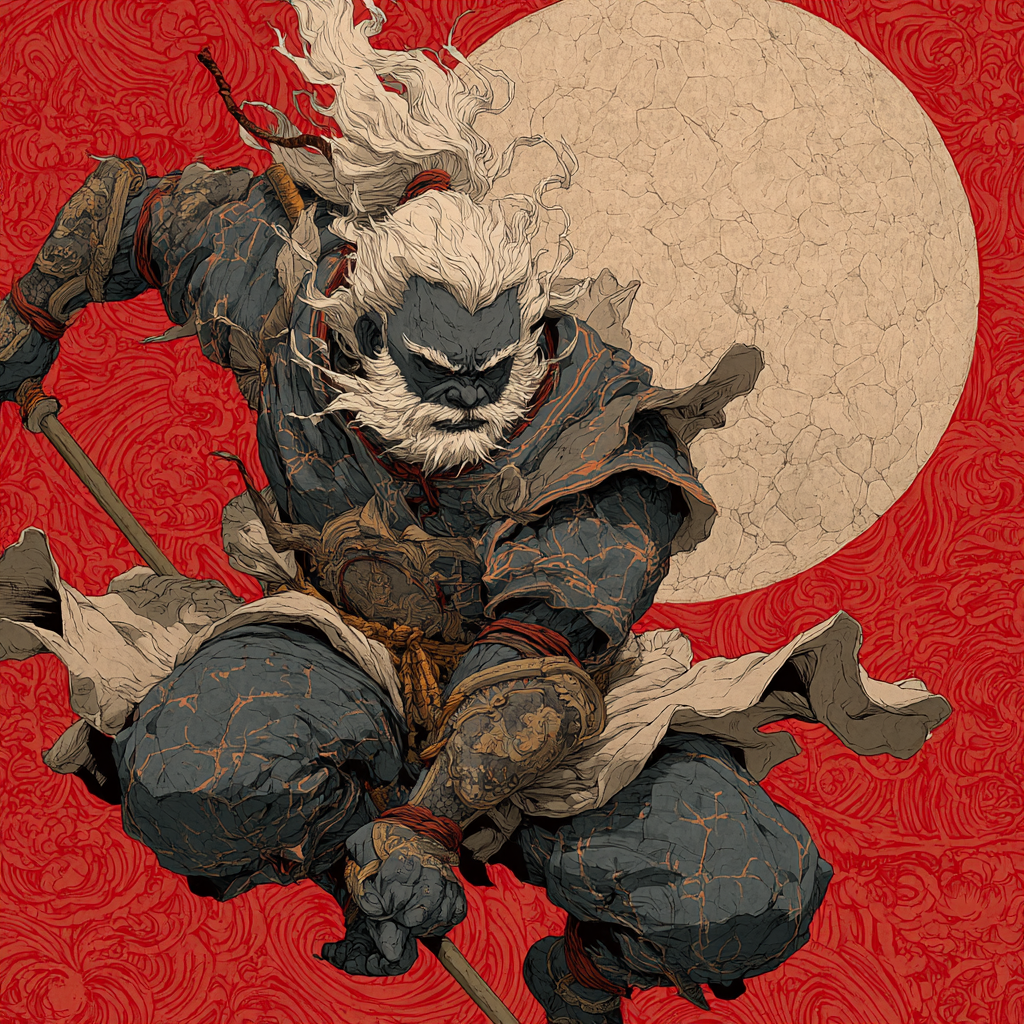
Introduction: A Solitary Silhouette in the Starry Sky
Look up on a clear night. The moon, a serene, solitary traveler, is a fixture of our shared human experience. But in the Shinto tradition of Japan, that pale orb is more than a celestial body; it is the realm of Tsukuyomi-no-Mikoto, the enigmatic and often misunderstood Moon God. More than just a personification, Tsukuyomi’s story is a foundational myth explaining the very fabric of the universe—why day is separate from night, why the sun and moon never meet, and how the world of the gods is one of passion, transgression, and eternal consequence. This is the story of the divine who dwells in the quiet, a deity born of purity, stained by violence, and destined for eternal, solitary rule over the night.
The Birth of the Celestial Trio: A Purity Born of Purification
To understand Tsukuyomi, we must begin at his genesis. In the foundational myths of the Kojiki (712 CE) and Nihon Shoki (720 CE), the creator deities, Izanagi and Izanami, gave birth to the Japanese islands and a pantheon of kami (spirits). However, Tsukuyomi’s own birth is a story of ritual purification.
After a harrowing escape from the land of the dead, the deity Izanagi performed misogi, a purification ritual. As he washed the impurity (kegare) from his body, new deities were born from the act of cleansing. From washing his left eye, the Sun Goddess, Amaterasu-Ōmikami, was born. From his right eye was born Tsukuyomi-no-Mikoto. From his nose was born the impetuous storm god, Susanoo-no-Mikoto.
This trio, known as the Mihashira-no-Uzu-no-Miko (The Three Noble Children), was the “three noble children” destined for greatness. Tsukuyomi was thus born not of a biological union, but from a divine act of ritual cleansing, linking him intrinsically to concepts of purity and order.
The Divine Family: A Celestial, Yet Divided, Household
In the divine genealogy (Kami no Keifu), Tsukuyomi occupies a critical, if often understated, position.
* Divine Parents: He is the direct offspring of Izanagi, the male creator god. His mother, depending on the textual variant, is either not explicitly named (born from Izanagi’s eye) or is Izanami, though his birth from Izanagi’s purification is the more canonical and symbolically potent origin.
* Siblings of Light and Storm: His siblings define his cosmic role.
* Amaterasu, born from the left eye, is his elder sister and the uncontested sovereign of the sun, day, and the celestial plain of Takamagahara. She is order, life, and the ultimate source of imperial authority.
* Susanoo, born from the nose, is the storm god, a being of untamed nature, tempestuous seas, and raw emotion. He is Tsukuyomi’s younger brother, representing the chaotic counterpoint to Tsukuyomi’s more measured, if severe, nature.
* Consort and Conflict: The Nihon Shoki provides a crucial, tragic detail often overlooked. Tsukuyomi is described as the husband of his sister, Amaterasu. This divine union, a common motif in mythology to explain cosmic phenomena, is the key to understanding the central myth of their separation.
The Fateful Banquet: The Origin of Day and Night
The most defining myth of Tsukuyomi is found in the Nihon Shoki (Chronicles of Japan, 720 CE). It explains not just the god’s nature, but the very separation of day and night.
The sun goddess, Amaterasu, sent her husband-brother, Tsukuyomi, as her representative to a banquet offered by the food goddess, Ukemochi-no-Kami. The goddess of plenty produced a lavish feast by facing the ocean and spewing fish, facing the forest and spewing game, and facing a rice paddy to cough up a bowl of rice.
However, Tsukuyomi, the Moon God, was not merely a passive observer. His reaction is critical. In the Nihon Shoki (Book V, Alternate 11), it is recorded: “He was filled with wrath, and said: ‘Filthy! The food which is to be eaten by the Deities is actually vomit from the mouth of a filthy being.’ So he drew his sword and slew Ukemochi-no-Kami.”
This act of divine violence, a response to the “impure” method of the food’s creation, is the catalyst for the cosmic schism. When Tsukuyomi returned and reported his actions to Amaterasu, she was not just angry; she was horrified and enraged. She declared him an “evil deity” (ashiki kami) and proclaimed, “I will not look upon you face to face!”
This decree is the mythological explanation for the eternal dance of the sun and moon. The Sun Goddess, in her wrath, declared they should never meet again, thus forever separating day from night, sun from moon.
The Many Faces of the Moon God: Ambiguity in the Texts
Tsukuyomi’s character is not monolithic across ancient texts, reflecting his complexity.
* In the Kojiki: He is a relatively minor figure. The tale of Ukemochi’s slaying is instead attributed to the storm god, Susanoo, with a different food goddess, Ōgetsuhime. This suggests competing or regional myths that were later standardized.
* In the Nihon Shoki: Tsukuyomi’s role is more prominent. Here, the story of Ukemochi’s slaying is his defining myth. The text offers multiple “alternate writing” versions (kana), a sign of the tale’s complexity. One variant even states he was born not from Izanagi’s eye, but from a white-copper mirror held in Izanagi’s right hand, linking him to the moon’s reflective nature.
* Meaning of the Name: The etymology is debated. The most accepted interpretation is “Tsuku” (moon) + “Yomi” (reading, counting, or reading the phases). Thus, Tsukuyomi is “He Who Reads/Counts the Moon,” the celestial timekeeper. This links him directly to the lunar calendar, agriculture, and the measurement of time—a far cry from the impulsive storm god Susanoo.
The Etymology of “Tsukuyomi”: The Reader of the Moon
The name itself is a key to his essence. The most widely accepted etymology breaks it down as:
* Tsuku (月) meaning “moon” or “month.”
* Yomi (読み or 讀み) meaning “reading” or “counting.”
Thus, Tsukuyomi translates as “Reading the Moon” or “The Moon-Reader.” This is not a simple name but a job description. As the one who “reads” the moon’s phases, Tsukuyomi is the divine keeper of the lunar calendar, the rhythm of the seasons, and the cycles of time. This role as a divine timekeeper and celestial scribe is central to his identity, framing his violent act against Ukemochi not just as an outburst but as a transgression of the natural and divine order that demanded cosmic recompense.
Living Worship: Shrines and Modern Veneration
Unlike the widely venerated Amaterasu, Tsukuyomi has a more subtle but enduring presence in Shinto.
* Lunar Shrines: He is enshrined in several locations. The Tsukiyomi Shrine in Kyoto’s Fushimi Inari complex is dedicated to him. He is also the central deity (shintai) of the Gassan Shrine on Mount Gassan in Yamagata, where he is venerated as a mountain god. His worship is often tied to lunar and agricultural cycles.
* In Tenrikyo: In the modern Japanese New Religion of Tenrikyo, Tsukiyomi-no-Mikoto is revered as one of the Ten Aspects of God’s Providence, representing the divine function that “sweeps away” spiritual impurities, a direct conceptual link to his purifying, severe nature.
* Cultural Legacy: Beyond shrines, Tsukuyomi’s influence is subtle. He is the solitary, stoic, and sometimes tragic figure in the shadow of his radiant sister. He represents the quiet, introspective, and sometimes harsh aspects of nature—the cold of the night, the silent passage of time, and the necessary counterpart to the sun’s life-giving, but sometimes scorching, light.
Conclusion: The Lonely Guardian of the Night
Tsukuyomi is far more than a simple lunar deity. He is a complex figure of cosmic order and divine transgression. Born from the purest ritual cleansing, he became the keeper of time and the night. Yet, his story is a tragedy of divine law: his act of righteous (in his view) violence, though perhaps justified in his eyes, shattered the divine household and cleaved the celestial sphere in two.
He is not a god of vengeance, but a deity of consequence. His eternal, self-imposed exile in the night sky is a constant reminder in Japanese myth that actions have cosmic repercussions and that even among the gods, a single act of violence can alter the very structure of the cosmos, separating day from night for all time. He remains, forever, the lonely god who reads the moon, a celestial scribe of the silent, silvered night.

Chamberlain, B. H. (Trans.). (1981). Kojiki: Records of Ancient Matters. Tuttle Publishing.
Philippi, D. L. (Trans.). (1969). Kojiki. Princeton University Press.
Leave a Reply