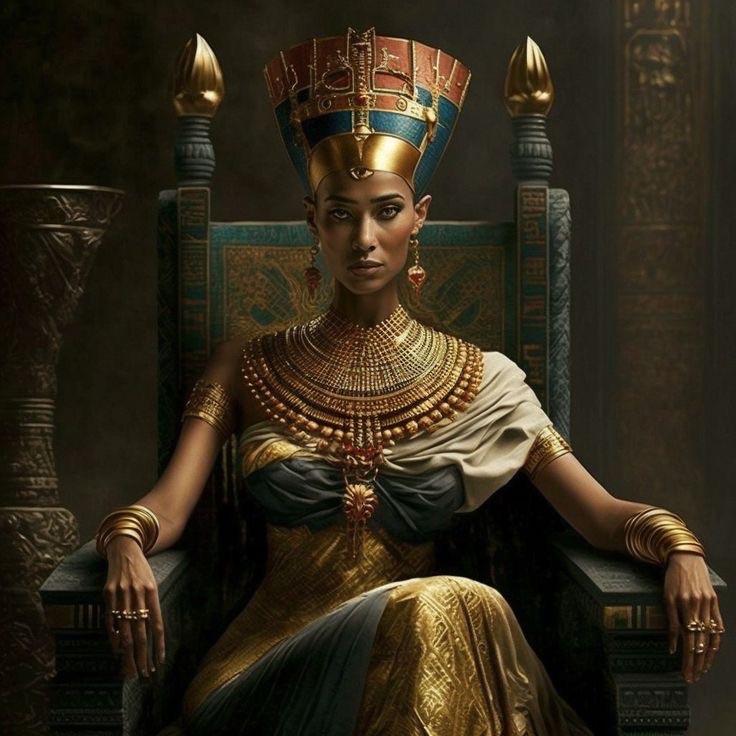
In the land of ancient Egypt, a woman emerged from the shadows, destined to become one of the most enigmatic and powerful figures in history. Her name was Nefertiti, and her story is one of tragedy, ambition, and untold secrets.
Born in the city of Thebes during the 14th century BCE, Nefertiti was the daughter of a high-ranking nobleman. From a young age, she possessed an otherworldly beauty that captivated all who beheld her. Her almond-shaped eyes, high cheekbones, and graceful figure made her the epitome of feminine allure.
As Nefertiti grew older, her beauty became a weapon she wielded with cunning precision. She caught the attention of the young Pharaoh Amenhotep IV, who was immediately smitten by her radiant charm. In a bold move, he made her his Great Royal Wife, a position of immense power and influence.
With her newfound status, Nefertiti set out to reshape the religious and political landscape of Egypt. Together with Amenhotep IV, she embarked on a radical religious revolution, abandoning the traditional worship of multiple gods in favor of a monotheistic cult centered around the sun god Aten. This new faith, known as Atenism, aimed to consolidate power and control under the Pharaoh’s rule.
Nefertiti’s influence over Amenhotep IV was unparalleled. She became his trusted advisor, guiding him in matters of state and religion. Together, they changed their names to Akhenaten and Neferneferuaten-Nefertiti, symbolizing their devotion to the Aten. Yet to not create any confusion I will continue calling her Nefertiti in this story. The couple eventually moved the capital of Egypt to a new city, Amarna, where they could build a utopian society dedicated to their radical beliefs.
However, their reign was not without opposition. The powerful priesthood, threatened by the abandonment of their gods, conspired against Akhenaten and Nefertiti. The people, too, grew restless under the weight of their new religious practices and the burdensome taxes imposed to fund the construction of Amarna.
As the years passed, tragedy struck the royal couple. Their eldest daughter, Meritaten, died in infancy, followed by the deaths of their other children. The loss of their beloved offspring plunged Nefertiti into a deep despair, shrouding her in a veil of grief that never lifted.
Amidst the turmoil, whispers of Nefertiti’s own ambitions began to circulate. During the reign of Akhenaten, and perhaps even after, Nefertiti wielded an unprecedented power. By the twelfth year of his rule, evidence emerged suggesting that she may have ascended to the status of co-regent, standing as an equal to the pharaoh himself. This potential elevation is depicted on the mysterious Coregency Stela, a testament to Nefertiti’s influence and authority.
Some theorists dare to imagine that Nefertiti may have assumed the identity of Neferneferuaten, a ruler whose name echoes through the annals of history. They believe that she remained alive, exerting her influence over the younger members of the royal family. If this conjecture holds true, Nefertiti’s power and existence would have come to an end during the third year of Tutankhaten’s reign, marked by his transformation into Tutankhamun. This symbolic change signified his return to the official worship of Amun and the abandonment of Amarna, as the capital was relocated back to Thebes.
But amidst the enigmatic tapestry of history, new theories emerged, casting a flickering light on the mysteries of Nefertiti’s fate. In 2012, an inscription was unearthed, dated to the sixteenth year of Akhenaten’s reign. Etched in red ochre within Quarry 320, was this five-line inscription:”Great Royal Wife, His Beloved, Mistress of the Two Lands, Neferneferuaten Nefertiti.” The final line spoke of ongoing construction under the watchful eye of the king’s scribe Penthu, as the Small Aten Temple in Amarna took shape.
This discovery shattered the veil of uncertainty, providing undeniable evidence that both Akhenaten and Nefertiti were alive in the sixteenth year of his reign. It also confirmed that they still held the same positions of power they had assumed at the beginning of their rule. This revelation demanded a reevaluation of the final years of the Amarna Period, forcing scholars to reconsider the intricate puzzle of Nefertiti’s existence.
Thus, it is now believed that Nefertiti was alive during the penultimate year of Akhenaten’s reign, standing faithfully by his side as he ruled alone. The reign of the enigmatic female pharaoh known as Neferneferuaten must be situated between the death of Akhenaten and the ascension of Tutankhamun. This powerful ruler, adorned with the epithet “Effective for her husband” in one of her cartouches, could only be Nefertiti herself or her daughter Meritaten, who was wedded to King Smenkhkare.
In the depths of the ancient world, a veil of secrecy shrouds the truth, beckoning only the brave to venture forth. Within the enigmatic realm of ancient Egypt, where whispers dance with shadows, the enigma of Nefertiti’s reign lingers, tantalizingly out of reach. Her legacy, a testament to a woman who defied the norms and etched her mark upon the shifting sands of time, stands as an enduring enigma. Was she cast out from the court, banished to the abyss? Did she fade into obscurity, her existence swallowed by the sands? Or did a more tragic fate befall her? The answers, concealed beneath the weight of Egypt’s ancient dunes, remain forever entwined with the annals of history.
Nefertiti, a woman who dared to challenge the very fabric of tradition, remains a riddle wrapped in a mystery. Her poignant tale serves as a haunting reminder of the ephemeral nature of power and the delicate fragility of human ambition.
 Wicked Dual Blog