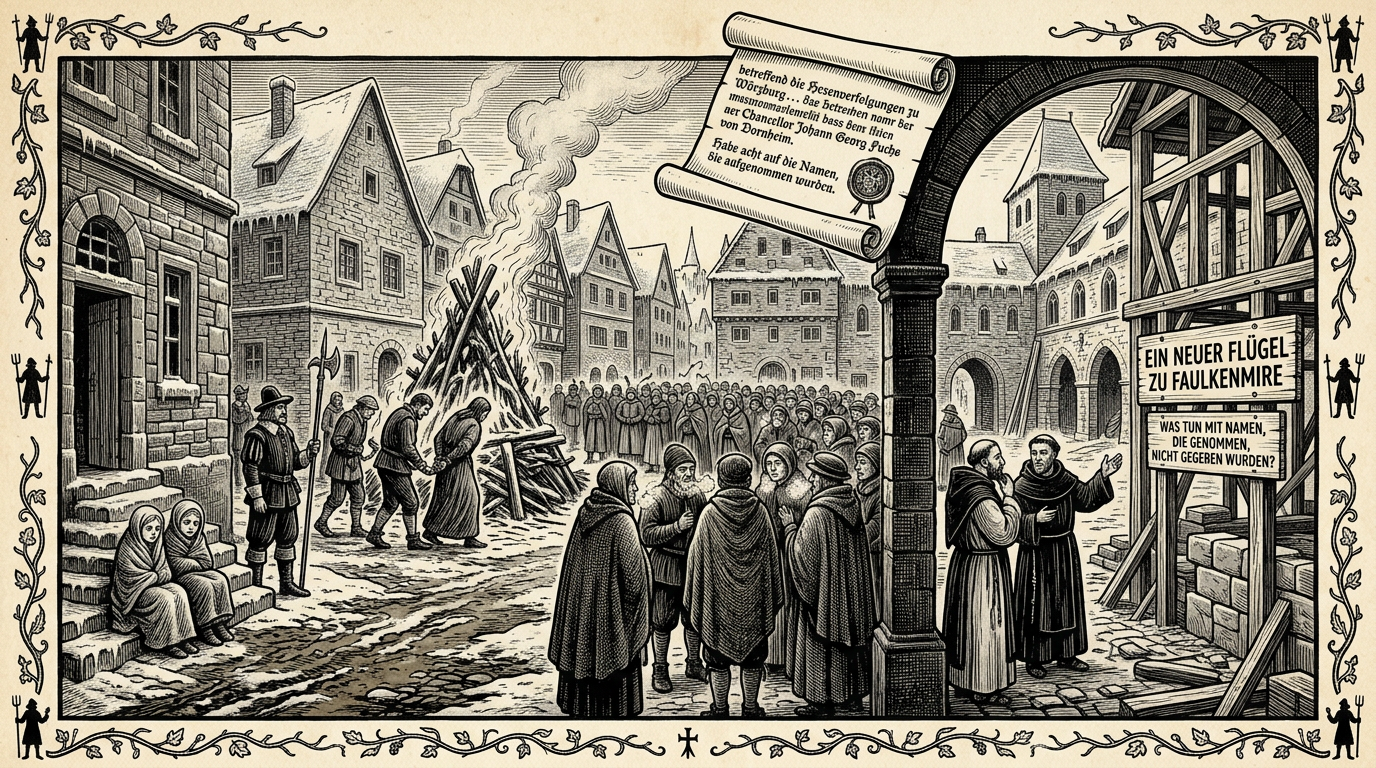
and What Faulkenmire Will Not Keep

“I have seen put to death children of seven, promising students of ten, twelve, fourteen, and fifteen.” — The chancellor of the Prince-Bishop of Würzburg, in a letter of August 1629 (trans. G. L. Burr)
An Archival Chronicle Prepared for the Discerning Collector
Compiled by the Archivist of the Unseen
Contents
I. The Wing That Grew in the Night
II. A Note on This Study and the Rules of the House
III. The Prince-Bishop and the Frost
IV. Field Study — The Engine
V. Field Study — The List and the Unnamed
VI. Field Study — The Chancellor’s Letter
VII. When the Engine Reached the Palace
VIII. Kilkenny, Three Centuries On
IX. How the Fires Were Put Out
X. Field Study — The Jesuit Who Walked Them to the Fire
XI. Field Study — The Ledger of Würzburg
XII. What Faulkenmire Will Not Keep
Bibliography
I. The Wing That Grew in the Night
Faulkenmire grows a new wing whenever it must hold a kind of secret it has not held before, and every wing is built in the style of the people whose sins it keeps. I have walked the Tidewater wing with its salt-damp brick, and the clapboard room of jars, and the hemlock wing where the coal smoke never quite clears. I did not know, until this autumn, that the house had grown a wing for Franconia.
I know it now. Beyond the German stacks, where I went on the night I wrote the thirteenth entry of my journal, there is a passage I am certain was not there in the spring. It runs under a steep roof of slate, between walls of dark timber framing filled with plaster the color of old bread, the way the houses of Würzburg were built along the Main. Bundles of vine stakes lean in the corners. The air smells of crushed grapes gone over, of wet stone, and, under everything, of woodsmoke, although there is no hearth in the wing and never has been.
The shelves along the passage are empty. Every one of them carries a paper tag, as everything in this house does, but the tags are blank. At the far end stands a reading desk, and on it, the sheet of paper I found on the night of the entry: ruled into columns for names, and every column empty.
I have spent the weeks since then working out why the house built a wing and filled it with nothing. This field study is the record of that work. It sets out what happened at Würzburg between 1625 and 1631, with all the care I owe the dead, and it sets out, as plainly as I am able, what the house has asked of me in return.
❧ ❧ ❧
II. A Note on This Study and the Rules of the House
This field study accompanies Entry XIII of my journal, On the Fires of Würzburg. Unlike most of the studies in this archive, I have written it in my own voice, because what I have to report about the house cannot be separated from what I have to report about the trials.
The reader should know where the line falls. Everything I say about Würzburg, its prince-bishop, its commission, its victims, its chancellor, and its end, is drawn from the historical record and the scholars named in the bibliography, and where the record is uncertain I say so. What I say about Faulkenmire is the record of this house, which the reader may take as the reader pleases.
The house has rules. I have written them down elsewhere, and I set them out again here, because one of them matters to everything that follows. Things are given to Faulkenmire freely: a family surrenders a grief, a sin, or a name of its own will. Every surrender is paid, and a receipt is left behind. Nothing leaves without an equal weight left in its place. The archive writes you before you arrive. The seeker finishes the sentence. And what is surrendered is unremembered.
The first rule is the one that Würzburg breaks.
❧ ❧ ❧
III. The Prince-Bishop and the Frost
Würzburg, in Franconia, was a prince-bishopric of the Holy Roman Empire: a state whose ruler was both its bishop and its sovereign prince. From 1623 that ruler was Philipp Adolf von Ehrenberg. He was the nephew of his celebrated predecessor, Julius Echter von Mespelbrunn, who had driven the Counter-Reformation through the territory and founded both its university and its great charitable hospital, the Juliusspital. Ehrenberg intended, as historians describe it, to make Würzburg a godly and obedient Catholic state.
The prince-bishopric stood on a confessional frontier, in a region where Catholic and Protestant territories pressed against one another, and in the middle of the Thirty Years’ War. A single witch trial took place in 1625 and appears to have been an isolated case. Then, in 1626, a frost destroyed the vine harvest on which the region lived. Wine was the wealth of the Main valley; the loss of the vintage meant hardship for the whole territory. Rumors spread that the frost had been raised by sorcery. Suspects were arrested and tortured, and they confessed to it.
I note, because I have filed the two side by side, that the neighboring prince-bishopric of Bamberg suffered the same frost in the same year and began its own great persecution in its wake. The two fires burned at once, some fifty miles apart, under two bishops pursuing the same godly state.
❧ ❧ ❧
IV. Field Study — The Engine
What frightens me about Würzburg is not the cruelty of any one person. It is the simplicity of the machine.
The Commission
The trials were conducted by a special witch commission. The imperial criminal code of 1532, the Constitutio Criminalis Carolina, permitted torture but placed limits on it, requiring, among other things, sufficient grounds for its use. The Würzburg commission set those limits aside. Torture could be applied without restraint and repeated until the accused confessed.
The Names
A confession was not enough. The accused were required to name their accomplices, the others they had seen at the witches’ sabbath. Those named were arrested and tortured in turn, and they named others. Each confession produced new names, and each name a new confession. The commission accepted names without regard to rank. A process fed by names cannot respect rank, and in time it did not.
The First and the Last
The first arrested were mostly poor women, as in so many persecutions. But the names spread through every level of the city. By the end, the dead included canons and vicars of the cathedral, councilors, physicians, students, nobles, and children. Historians estimate that between nineteen and forty-three priests were among the victims.
I have studied the same engine before, at Kilkenny, at Trier, and at Bamberg. Würzburg is where it ran fastest.
❧ ❧ ❧
V. Field Study — The List and the Unnamed
The best-known record of the Würzburg trials is a list, preserved in an eighteenth-century compilation, of those executed in the city in twenty-nine burnings between 1627 and early 1629. It records one hundred and fifty-seven people. It says of itself that it is incomplete: there were more burnings than it records.
Described, Not Named
What strikes every reader of the list is that most of the dead are not named. They are described. A strange man. A wandering boy, twelve years of age. A wife, a daughter, a student, a vicar, identified by their household or their office or their age. A few names survive; one young woman is remembered in the list, as it is usually translated, only as the most beautiful girl in Würzburg. The clerks who kept the record knew how many they had burned. They did not always trouble to know who.
The Children
Among the confirmed dead are at least forty-nine children under the age of twelve. Many of them came from the orphanage and school of the Juliusspital, the hospital founded by the prince-bishop’s own uncle as a place of charity. I record a detail that I cannot read without stopping: the Juliusspital was endowed with vineyards and remains one of the great wine estates of Franconia today, so that the charity which sheltered these children drew its living from the same vines the frost of 1626 had killed.
The Count
Historians estimate some two hundred and nineteen executions in the city of Würzburg, and around nine hundred across the whole prince-bishopric during Ehrenberg’s reign. These figures are estimates, and I set them down with their uncertainty. The list is incomplete; other records are lost. The true number may be higher.
❧ ❧ ❧
VI. Field Study — The Chancellor’s Letter
The document I read on the night of the entry is a letter written in August 1629 by the chancellor of the Prince-Bishop of Würzburg to a friend. It survives in a manuscript in Munich, and it was translated into English by the historian George Lincoln Burr in 1896. I give its words in his translation.
The chancellor writes first that the persecution, which had seemed to slacken, has begun again:
“… has started up afresh, and no words can do justice to it.”
The chancellor of Würzburg, August 1629 (trans. G. L. Burr, 1896)
He reports the scale of the suspicion that remains, and the rank of those already dead:
“… there are still four hundred in the city, high and low, of every rank and sex …”
The chancellor of Würzburg, August 1629 (trans. G. L. Burr, 1896)
“The richest, most attractive, most prominent, of the clergy are already executed.”
The chancellor of Würzburg, August 1629 (trans. G. L. Burr, 1896)
He writes of children, and of what he has seen with his own eyes:
“… of three and four years, to the number of three hundred, who are said to have had intercourse with the Devil.”
The chancellor of Würzburg, August 1629 (trans. G. L. Burr, 1896)
“I have seen put to death children of seven, promising students of ten, twelve, fourteen, and fifteen.”
The chancellor of Würzburg, August 1629 (trans. G. L. Burr, 1896)
And in a postscript he adds, as plain report, that on a hill near the city the Devil in person,
“… with eight thousand of his followers, held an assembly and celebrated mass …”
The chancellor of Würzburg, August 1629 (trans. G. L. Burr, 1896)
I wrote in my journal that what chills me is not his credulity but his tone, and I hold to it. He writes as a busy official writes to a friend about a crisis at work. He is distressed, but he is not ashamed. He believes, and he reports. A machine of that kind does not need monsters to run it. It needs only men like this one, who see children burned and write it down between the other business of the day.
❧ ❧ ❧
VII. When the Engine Reached the Palace
The names reached, in the end, into the prince-bishop’s own house.
Among the accused was Ernst von Ehrenberg, the prince-bishop’s nephew, a young man of his court. He was condemned, beheaded, and his body burned. Records also mention a noble page among the dead. The persecution that Ehrenberg had begun to make his territory godly consumed his own blood.
It is sometimes suggested that the death of his nephew shook Ehrenberg, and that the trials slackened afterward; the evidence for his state of mind is thin, and I do not press it. What is clear is the lesson the episode teaches, the same lesson Trier taught with the fall of Dietrich Flade: a procedure that accepts any name extracted under torture will, sooner or later, extract the names of those who built it.
❧ ❧ ❧
VIII. Kilkenny, Three Centuries On
In my first studies of witchcraft in this archive, I followed two women of Kilkenny. In 1324 Dame Alice Kyteler was accused of keeping a demon and holding night meetings with her accomplices, and when the case grew dangerous she had the wealth and connections to flee to England. Her maidservant, Petronilla de Meath, did not. She was flogged until she confessed, named her mistress and others, and was burned.
Three centuries later, in Franconia, the same logic ran at a scale Kilkenny could not have imagined: confession under pain, the naming of others, and fire for those who could not run. At Kilkenny the rich escaped and the servant died. At Würzburg, in the end, no one could run, not the poor, not the clergy, not the bishop’s own nephew. The machine had grown large enough to take everyone.
❧ ❧ ❧
IX. How the Fires Were Put Out
The Würzburg trials were not ended from within. They were ended from outside.
The Courts and the Emperor
When the persecution began to consume the wealthy and well connected, their families had the means to resist. Relatives of the accused brought complaints before the Imperial Chamber Court at Speyer and appealed to the Emperor, Ferdinand II. In 1630 the Emperor publicly condemned the proceedings. The same pressure from the empire was bearing on Bamberg in the same months.
The Death of the Prince-Bishop
Philipp Adolf von Ehrenberg died on July 16, 1631.
The Swedes
That autumn, the Swedish army of Gustavus Adolphus, advancing into Franconia in the Thirty Years’ War, took Würzburg. The burnings stopped. As at Bamberg, it was an invading Protestant army, not any change of heart among the persecutors, that finally ended the fires.
❧ ❧ ❧
X. Field Study — The Jesuit Who Walked Them to the Fire
In 1631, the year the trials ended, a book appeared without its author’s name: the Cautio Criminalis, a caution concerning criminal procedure against witches. Its author was the Jesuit priest and poet Friedrich Spee.
Spee argued that confessions obtained under torture are worthless, because torture will make anyone confess to anything; and that the requirement to name accomplices multiplies suspicion without limit, so that, if the process continued, no one would be safe. It was an exact description of what had happened at Würzburg and Bamberg, written by a man who had seen it.
Tradition holds that Spee heard the confessions of the condemned at Würzburg, and many modern accounts say so as fact. In his own book, however, he said only that he had accompanied women to the fire in various places. I treat his presence at Würzburg as probable, not proven, as I did in my journal. What is certain is that he had walked beside the condemned somewhere in that terrible country, that he had come to believe them innocent, and that he wrote the most powerful argument against the trials of his age.
❧ ❧ ❧
XI. Field Study — The Ledger of Würzburg
Established
The persecution in the prince-bishopric of Würzburg from 1625 to 1631 under Philipp Adolf von Ehrenberg; the frost of 1626 that destroyed the vine harvest; the special commission and its abandonment of the Carolina’s limits on torture; the forced naming of accomplices; the list of 157 executed in twenty-nine burnings from 1627 to early 1629, incomplete by its own account; at least forty-nine children under twelve among the dead, many from the Juliusspital; the execution of Ernst von Ehrenberg; the chancellor’s letter of August 1629; the imperial condemnation of 1630; Ehrenberg’s death on July 16, 1631; the Swedish capture of the city that autumn; the publication of the Cautio Criminalis in 1631.
Estimated
Some 219 executions in the city and around 900 in the whole territory; between 19 and 43 priests among the dead.
Probable, Not Proven
That Friedrich Spee heard the confessions of the condemned at Würzburg; that the death of his nephew affected Ehrenberg’s conduct.
Lost
The names of most of the dead.
❧ ❧ ❧
XII. What Faulkenmire Will Not Keep
I understand the empty wing now, or I believe I do.
Faulkenmire keeps what is given to it freely. A mother in a hill hollow surrenders the name of a drowned child so that she may forget, and the house receives it, writes it in a ledger, and leaves a receipt. That is the bargain the house was built on, and it has held for longer than anyone living can say.
The names of Würzburg were never given. They were taken: torn out of the accused under torture, written down by clerks, and fed back into the fire. A name taken that way is not a surrender. There is no receipt for it. The house, which can hold every grief that is freely laid down, cannot hold a name that was extracted. And so it grew a wing in the style of the people whose sins it keeps, timber and plaster and vine stakes and slate, and left every shelf empty, because the thing it was built to receive was never offered.
The commission at Würzburg did the opposite of what this house does. Faulkenmire takes a name so that a grieving family may forget. The commission took names so that more people could be burned, and then did not trouble to remember most of them at all. The list calls them a strange man, a wandering boy. The clerks unremembered them without being asked.
The sheet with its empty columns is not a demand that I invent what is lost. I will not do that, and I believe the house does not want it. I think it is asking for the only thing that can be given freely in this case: the record, kept honestly, with every gap left visible, so that the gaps themselves can be counted. One hundred and fifty-seven on a list that admits it is incomplete. Two hundred and nineteen in the city, by estimate. Nine hundred in the territory. Forty-nine children under twelve. Names where they survive; descriptions where they do not; and blank lines, honestly drawn, for the rest.
Last night I went down to the wing again. The smell of woodsmoke was gone. On the reading desk, beside the ruled sheet, the house’s ledger lay open, and the newest line was already written, as the lines always are, and it stopped where they always stop.
Würzburg. The Archivist comes by lamplight to the wing that grew in the night, and is shown the empty columns. The Archivist is told what every asker is told: that nothing leaves Faulkenmire unless something of equal weight is left in its place. The Archivist
The ledger at Faulkenmire, the newest line
I picked up the pen. It was warm, as it always is. I finished the sentence: will leave the record, and nothing invented, and the blanks drawn honestly, for whoever comes after to count.
Then I wrote, in the first column of the sheet, the only names I am certain of, and below them the descriptions the clerks left, a strange man, a wandering boy, twelve years of age, and below those I ruled the blank lines, one for each of the dead the record admits it lost, until my hand ached and the lamp burned low. When I looked up, the first shelf in the wing had a tag on it that was no longer blank.
In another hand, written in the margin:
Received: what was taken, returned as record. Nothing further is owed. The blank lines are to be kept as they are.
The hand in the margin was not the old looping hand of the front house, nor the upright one of the deeper stacks. It was narrow and slanted, a hill-country hand, still learning the weight of the pen. In neighboring Bamberg, some fifty miles to the east, a burgomaster wrote a letter to his daughter from his cell in the summer of 1628. I have filed his story already, in its own place. Tonight I think I will read it again.
❧ ❧ ❧
This field study is preserved as one vestige among many within the haunted archive of Wicked Dual, an artisan boutique devoted to the reclamation of history’s clandestine and silenced corners. It is filed as the companion to Entry XIII of the Journal of the Archivist, On the Fires of Würzburg, in the wing that grew in the night, and is kept in memory of the dead of Würzburg, named and unnamed.
Read the written chronicles on the blog, the Wicked Archive: www.wickeddualblog.com
Secure the physical artifacts drawn from these histories at the Wicked Dual boutique: https://www.etsy.com/shop/Wickeddual
We invite you to enter the haunted archive and secure a piece for your private collection; it is a necessary addition for those who curate the darker corners of human history.
— The Archivist of the Unseen

Bibliography
The following works include the further studies named in the companion entry and the public-domain translation of the chancellor’s letter from which this study’s excerpts are drawn; readers pursuing formal citation are advised to verify editions and pagination against a library catalog.
Behringer, W. (2004). Witches and witch-hunts: A global history. Polity Press.
Levack, B. P. (2016). The witch-hunt in early modern Europe (4th ed.). Routledge.
Roper, L. (2004). Witch craze: Terror and fantasy in Baroque Germany. Yale University Press.
Related Chronicles in the Archive
Journal of the Archivist, Entry XIII — On the Fires of Würzburg
Field Study No. XI — The Woman Who Was Never Burned: Dame Alice Kyteler
Field Study No. XII — The One Who Could Not Run: Petronilla de Meath
Field Study No. XLII — The House of the Druden: The Bamberg Witch Trials
Field Study No. XLVI — The Register and the Rector: The Trier Witch Trials
Leave a Reply