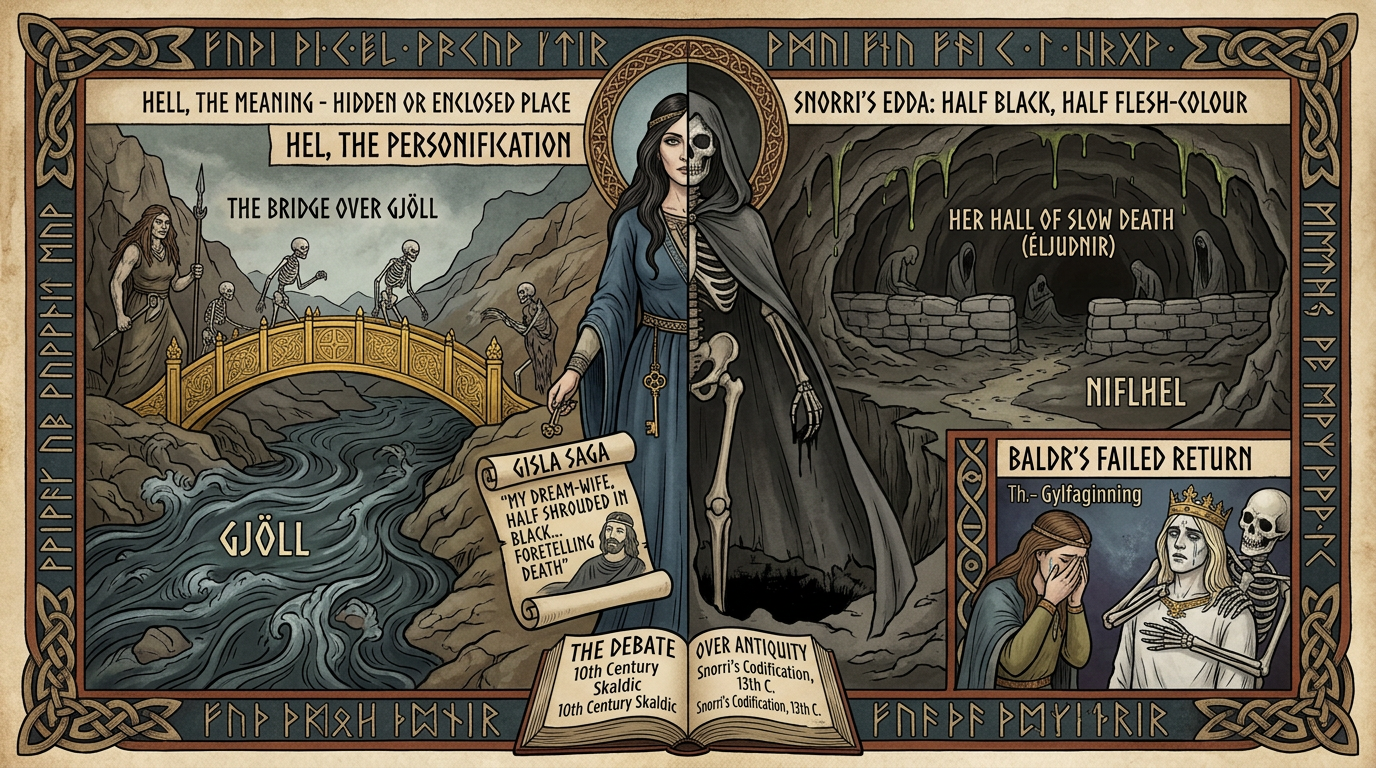
and the Road the Dead Must Walk

“The day before there had ridden over the bridge five companies of dead men; but the bridge thunders no less under thee alone, and thou hast not the color of dead men.” — Snorri Sturluson, Gylfaginning (trans. A. G. Brodeur, 1916)
An Archival Chronicle Prepared for the Discerning Collector
Compiled by the Archivist of the Unseen
Contents
I. Sleet in the North Stacks
II. A Note on This Study and Its Companion Entry
III. The Word That Covers
IV. The Place Before the Person
V. Field Study — The Daughter of Loki
VI. Field Study — An Inventory of Slow Death
VII. Ancient Goddess or Medieval Invention?
VIII. The Road and the Shoes
IX. Field Study — The Bridge over Gjöll
X. Field Study — The Weeping of the World
XI. Field Study — The Ledger of Hel
XII. The Archivist’s Conclusion
Bibliography
I. Sleet in the North Stacks
At Faulkenmire, the cold came into the house before the weather did. It waited in the north stacks, where the Scandinavian volumes are shelved, beside a single book drawn half out of its row: a nineteenth-century edition of Snorri Sturluson’s Edda, its spine split, open at the passage on the children of Loki. The lamp above it would not burn steady.
Outside, sleet ticked at the glass. The hall of the queen of the dead, the Edda says, is called Sleet-Cold.
Hel is one of the most haunting figures of Norse tradition: the name of the realm of the dead, and, in some sources, the name of the being who rules it, a daughter of Loki whose body is half the color of living flesh and half dark as a corpse. She receives those who die of sickness and old age. She holds the god Baldr after his death and sets the terrible condition for his return. Her name, through Old English, gave the English language its word for hell.
This field study, prepared for the keeper of cold roads and far crossings, sets out what the Norse sources actually say about Hel, with excerpts from the old texts where they speak best for themselves, and weighs the long scholarly argument over whether the goddess is ancient or the creation of a learned medieval Christian.
❧ ❧ ❧
II. A Note on This Study and Its Companion Entry
This field study accompanies Entry XII in the Journal of the Archivist of the Unseen, On Hel, and the Hall That Hides. That entry followed Hel through Snorri’s Edda: the meaning of her name, her half-dark body, her hall of Hunger and Sickbed, the hel-shoes of the sagas, the golden bridge over the river Gjöll, and her condition for Baldr’s return. It was careful, as this study is, about how much of that portrait comes through Christian hands.
The excerpts quoted here are drawn from public-domain translations: Arthur Gilchrist Brodeur’s English Prose Edda of 1916, and George Webbe Dasent’s translation of Gisli the Outlaw of 1866. Their language is old-fashioned, and their wording sometimes differs from modern translations such as those listed in the companion entry. Readers who wish to quote the texts are encouraged to compare a modern edition.
One detail in the companion entry is refined here. The entry cites the hel-shoes of Gisla saga as evidence that the dead were thought to walk the road to Hel. In the saga’s own words, as Dasent translated them, the shoes were tied so that the dead might walk on them to Valhalla. The custom and its name still connect the dead to a long road; but the destination named in that passage is Odin’s hall. Section VIII sets out the passage in full.
❧ ❧ ❧
III. The Word That Covers
Hel begins as a word, and the word tells a story of its own.
The Old Norse hel derives from a Proto-Germanic word usually reconstructed as haljō, which in turn is traced to an ancient root meaning to cover or to conceal. The same root gave English words for things that cover and enclose: hall, helmet, and, through related forms, hull and husk. Hel was, at its root, the hidden place, the place under cover, the grave beneath the earth.
Cognate words appear across the Germanic languages: Old English hel, Old High German hella, Gothic halja. When the Anglo-Saxons became Christians, they used their word hel for the Christian place of damnation, and through them it became the English hell. A word that once meant simply the covered place of the dead came to mean the place of eternal punishment, a shift that the companion entry noted and that this study returns to below.
❧ ❧ ❧
IV. The Place Before the Person
In much of the older poetry, Hel is a place before she is a person.
In the Eddic poems, to die is often to go to Hel, or to Hel’s realm. The dead travel the hel-road, helvegr. The poems speak of Niflhel, Misty Hel, a lower depth beneath Hel itself. In the opening of Snorri’s own account, before the goddess appears, Hel is simply a destination:
“… evil men go to Hel and thence down to the Misty Hel; and that is down in the ninth world.”
Gylfaginning, ch. 3 (trans. Brodeur, 1916)
Here Hel is a region with depths, and its moral coloring, evil men going down, may itself show the influence of Christian ideas of judgment. In much other material, as the companion entry observed, Hel is not a place of punishment at all, but the ordinary destination of the dead who did not die in battle. Whether a given reference means the place or the person who rules it is often unclear, and that uncertainty lies at the heart of the scholarly debate.
❧ ❧ ❧
V. Field Study — The Daughter of Loki
The fullest portrait of Hel as a person comes from Snorri Sturluson, the Icelandic chieftain, lawspeaker, and scholar who wrote his Edda around 1220, more than two centuries after Iceland’s conversion to Christianity.
The Children of Loki
In the section of the Edda called Gylfaginning, the Deluding of Gylfi, Snorri tells how the god Loki fathered three children with the giantess Angrboða: the wolf Fenrir, the World Serpent Jörmungandr, and Hel. The gods, warned by prophecy that these children would bring great harm, seized them. The serpent was thrown into the sea, the wolf was bound, and Hel was sent below:
“Hel he cast into Niflheim, and gave to her power over nine worlds …”
Gylfaginning, ch. 34 (trans. Brodeur, 1916)
Her charge was to receive those sent to her: in Brodeur’s words, “men dead of sickness or of old age.” The warriors who died in battle went to Odin in Valhalla, or, as other sources say, to the goddess Freyja; most others went to Hel.
Her Appearance
“She is half blue-black and half flesh-color (by which she is easily recognized), and very lowering and fierce.”
Gylfaginning, ch. 34 (trans. Brodeur, 1916)
The Old Norse word Snorri uses for her dark half is blár, which covered a range of colors from dark blue to black. As the companion entry observed, it is the color of a bruise, of cold, of a body some days dead. In the Archive’s preceding study of the Devil’s colors, blue and black were the colors of darkness and the lower air; here, the same darkness is written on a single body, half alive and half dead, the very image of the boundary between them.
❧ ❧ ❧
VI. Field Study — An Inventory of Slow Death
Snorri gives Hel a hall, and he furnishes it with a list of objects, each bearing a name.
“Her hall is called Sleet-Cold; her dish, Hunger; Famine is her knife; Idler, her thrall; Sloven, her maidservant; Pit of Stumbling, her threshold, by which one enters; Disease, her bed; Gleaming Bale, her bed-hangings.”
Gylfaginning, ch. 34 (trans. Brodeur, 1916)
Reading the Inventory
The Old Norse names have been translated in different ways. The hall, Éljúðnir, is often rendered as sleet-damp or damp with storm. Brodeur’s Gleaming Bale is the bed-hangings that the companion entry, following another translation, called Gleaming Misfortune. However they are translated, the names share a pattern. The hall is a portrait not of torture but of decline: cold, hunger, want, slowness, the stumble at the threshold, the sickbed, and the bright misery that hangs over it.
As the companion entry put it, it is less a palace of torment than a portrait of a slow death, the death of the fevered and the old, drawn room by room. It is exactly the realm one would expect for those who died, in Snorri’s phrase, of sickness or of old age.
A Learned Allegory?
The list has a markedly literary character. Personified abstractions, Hunger as a dish and Famine as a knife, are a familiar device of medieval Latin learning, which Snorri, a highly educated Christian, knew well. Many scholars therefore suspect that the inventory is Snorri’s own composition, or a learned elaboration of older materials, rather than a direct record of pagan belief. The companion entry rightly declined to settle the question.
❧ ❧ ❧
VII. Ancient Goddess or Medieval Invention?
Was Hel, the person, a goddess of pre-Christian Scandinavia, or largely a creation of Snorri and his age?
The Case for Invention
All of the fullest descriptions of Hel come from Christian Iceland, written centuries after the conversion. Snorri organized the old myths into a system, explaining them for a Christian audience, and he was capable of filling gaps with his own learning. The Danish historian Saxo Grammaticus, writing at about the same time, retells the story of Baldr very differently, and gives the role of the queen of the dead not to Hel but to a figure he calls by the classical name Proserpina, who appears to Balder in a dream to foretell his death. The variety of the medieval accounts suggests how freely learned writers reshaped the material.
The Case for Antiquity
On the other hand, Hel appears personified in skaldic poetry that is generally dated earlier than Snorri, some of it to the pagan period. The poem Ynglingatal, a genealogy of Swedish and Norwegian kings usually dated to the ninth or tenth century, describes the death of a king in terms that refer to Loki’s daughter possessing him, a phrase widely read as a reference to Hel. Egil Skallagrímsson, in his great poem of grief Sonatorrek, composed in the tenth century, closes by saying that he will wait for Hel gladly and without sorrow, a line that may refer either to the place or to its ruler. Such passages suggest that the idea of Hel as a female being associated with Loki was older than Snorri.
The Archivist’s Position
Scholars such as John Lindow and Christopher Abram, whose works are listed in the bibliography, have weighed this evidence with care. The most balanced conclusion, and the one the companion entry reached, is that the idea of Hel as a place is old and certain; that some idea of a female being connected with that place is probably older than Snorri; and that the detailed portrait, the half-dark body, the furnished hall, owes much to Snorri’s learning. The goddess is neither wholly ancient nor wholly invented.
❧ ❧ ❧
VIII. The Road and the Shoes
If Hel was a place, the dead had to travel there, and the sagas show the living preparing them for the journey.
The Hel-Shoes
In Gisla saga, one of the most celebrated of the Icelandic family sagas, the young man Vésteinn is murdered and buried in a mound. As the mound is being closed, the chieftain Thorgrim, who is himself suspected of the killing, steps forward to perform a custom:
“’Tis the custom, brother-in-law, to bind the hellshoe on men, so that they may walk on them to Valhalla, and I will now do that by Vestein.”
The Story of Gisli the Outlaw (trans. G. W. Dasent, 1866)
Thorgrim adds that he does not know how to bind them if these come loose, words that carry a menacing irony from a man who is probably the murderer. The passage shows that the custom of hel-shoes, helskór, was remembered in Iceland: footwear tied onto the dead to help them on a long road.
Hel or Valhalla?
As noted above, the saga names Valhalla as the destination. The name of the shoes nonetheless preserves the older word for the realm of the dead, and the custom fits the wider idea, found across the sources, that death was a journey on foot along the hel-road. It is possible that the saga writer, or the tradition he followed, applied an old custom with an older name to the more glamorous destination. The companion entry’s central point stands: the road was long, and the dead were thought to walk it.
❧ ❧ ❧
IX. Field Study — The Bridge over Gjöll
The most vivid account of the road to Hel comes in Snorri’s telling of the death of Baldr.
The Ride
When Baldr, the beloved son of Odin, is killed by the blind god Höðr, guided by Loki, the gods are overwhelmed with grief. Baldr’s brother Hermóðr volunteers to ride to Hel to ask for his return. He takes Sleipnir, Odin’s eight-legged horse, and rides for nine nights through dark and deep valleys until he comes to the river Gjöll and its bridge, Gjallarbrú, which Brodeur describes as a bridge “thatched with glittering gold.”
The Maiden at the Bridge
The bridge is guarded by a maiden named Móðguðr. She asks the rider his name and kin, and tells him:
“… the day before there had ridden over the bridge five companies of dead men; but the bridge thunders no less under thee alone, and thou hast not the color of dead men.”
Gylfaginning, ch. 49 (trans. Brodeur, 1916)
The bridge knows the weight of the living. Five whole companies of the dead crossed it quietly; one living man makes it ring. Móðguðr sees at once that Hermóðr does not have the color of the dead, a detail that recalls Hel’s own half-dark body. As the companion entry observed, this is the river that divides the living from the dead, and the keeper at the crossing who knows the difference, a figure the Archive has met before, in its study of the far bank and in its study of the conductors of souls.
❧ ❧ ❧
X. Field Study — The Weeping of the World
The Condition
Hermóðr reaches Hel’s hall and finds Baldr seated in a place of honor. He begs Hel to let Baldr return, telling her of the great grief among the gods. Hel answers that she will put the love of the world for Baldr to the test:
“… if all things in the world, quick and dead, weep for him, then he shall go back to the Æsir …”
Gylfaginning, ch. 49 (trans. Brodeur, 1916)
Everything Weeps
The gods send messengers throughout the world, asking all things to weep Baldr out of Hel. And all things do weep: people and animals, the earth, stones, trees, and every metal. Snorri’s narrator explains the image:
“… even as thou must have seen that these things weep when they come out of frost and into the heat.”
Gylfaginning, ch. 49 (trans. Brodeur, 1916)
It is one of the most beautiful images in Norse literature: the thaw of spring, when water runs from stones and trees, imagined as the whole world weeping for a dead god.
The One Who Would Not Weep
But the messengers find a giantess sitting in a cave, who calls herself Thökk. She refuses to weep, saying, in effect, that Baldr was nothing to her and that Hel should keep what she holds. Snorri adds:
“And men deem that she who was there was Loki Laufeyarson …”
Gylfaginning, ch. 49 (trans. Brodeur, 1916)
Because one being would not weep, Baldr remains with Hel until after the end of the world. As the companion entry observed, the story recalls Demeter, who also bargained with the lord of the dead for the return of a beloved child and won only a partial victory. Hel’s terms are harder still. She asks not for a season but for unanimity, and the world cannot give it. The story suggests a hard wisdom: that grief, however universal, can always be refused by someone, and that one refusal is enough.
❧ ❧ ❧
XI. Field Study — The Ledger of Hel
Established in the Sources
Hel as the Norse name for the realm of the dead, from a Germanic root meaning to cover or conceal; its passage into English as hell; Snorri’s account, around 1220, of Hel as Loki’s daughter, cast into Niflheim with power over nine worlds and receiving those who died of sickness and old age; her half-dark body; her hall and its named furnishings; Hermóðr’s ride to the bridge over Gjöll; Móðguðr’s words; Hel’s condition for Baldr’s return; the refusal of Thökk; the hel-shoes of Gisla saga, tied for the walk to Valhalla.
Probable
That some idea of Hel as a female being connected with Loki predates Snorri, on the evidence of skaldic poetry such as Ynglingatal; that the idea of the dead walking a long road was widespread.
Disputed
How much of Hel’s personality and hall is Snorri’s learned invention; whether particular early references mean the place or the person; how far Christian ideas shaped the moral coloring of Hel.
A Living Tradition
As the companion entry noted, the Norse gods are honored today by living communities of Heathen practice, including the Ásatrúarfélagið in Iceland, recognized by the state as a religious organization since 1973. For these communities, Hel is part of a living religious life. This study, like the entry, concerns texts and scholarship, and does not speak for those who keep her name in a living way.
❧ ❧ ❧
XII. The Archivist’s Conclusion
Hel began as a word for a covered place: the grave, the earth’s hidden interior, the destination of the ordinary dead. Over centuries it gathered a mistress, half alive and half dead, a hall furnished with slow death, a road that the dead must walk, and a bridge that rang for the living. Then the word itself traveled into English and was given to the Christian place of damnation, and its old meaning was almost forgotten.
The Hel of the Norse sources is not the hell of later Christianity. She does not punish the wicked; she receives the many who died in their beds of fever and age. Her hall is cold, hungry, and slow, but it is the common destination, not a place of torment. Her strictest act is not cruelty but a test of love: let the whole world weep, and the dead god may go home. The world nearly passes the test.
Much of her portrait, as the companion entry concluded, comes to us through Christian hands, and some of it may be the invention of a brilliant medieval scholar. But beneath Snorri’s learned furnishings, the oldest idea remains: that the dead go down a long road to a hidden place, across water, past a keeper who can tell the living from the dead by the sound of their footsteps on the bridge.
In the north stacks at Faulkenmire, the Archivist marked the passage on the bridge with a slip of paper. When the Archivist looked again, the slip had moved to the line where the maiden says the bridge rang louder under one living rider than under five companies of the dead. The black-ribboned box still bears the name of a river, which no one in the house has ever heard spoken aloud.
❧ ❧ ❧
This field study is preserved as one vestige among many within the haunted archive of Wicked Dual, an artisan boutique devoted to the reclamation of history’s clandestine and silenced corners. It is filed as the companion to Entry XII of the Journal of the Archivist, On Hel, and the Hall That Hides, beside the Edda that was drawn half out of its row on a night of sleet.
Read the written chronicles on the blog, the Wicked Archive: www.wickeddualblog.com
Secure the physical artifacts drawn from these histories at the Wicked Dual boutique: https://www.etsy.com/shop/Wickeddual
We invite you to enter the haunted archive and secure a piece for your private collection; it is a necessary addition for those who curate the darker corners of human history.
— The Archivist of the Unseen

Bibliography
The following works include the further studies named in the companion entry and the public-domain translations from which this study’s excerpts are drawn; readers pursuing formal citation are advised to verify editions and pagination against a library catalog.
Abram, C. (2011). Myths of the pagan North: The gods of the Norsemen. Continuum.
Dasent, G. W. (Trans.). (1866). The story of Gisli the outlaw. Edmonston and Douglas.
Larrington, C. (Trans.). (2014). The Poetic Edda (Rev. ed.). Oxford University Press.
Sturluson, S. (1916). The Prose Edda (A. G. Brodeur, Trans.). American-Scandinavian Foundation.
Sturluson, S. (2005). The Prose Edda: Norse mythology (J. L. Byock, Trans.). Penguin Classics.
Related Chronicles in the Archive
Journal of the Archivist, Entry XII — On Hel, and the Hall That Hides
Field Study No. VIII — The Other Side: The Otherworld, the Ferryman, and the River
Field Study No. XVI — The Grief That Stopped the World: Demeter
Field Study No. XLIII — The Conductors of Souls: Psychopomps
Leave a Reply