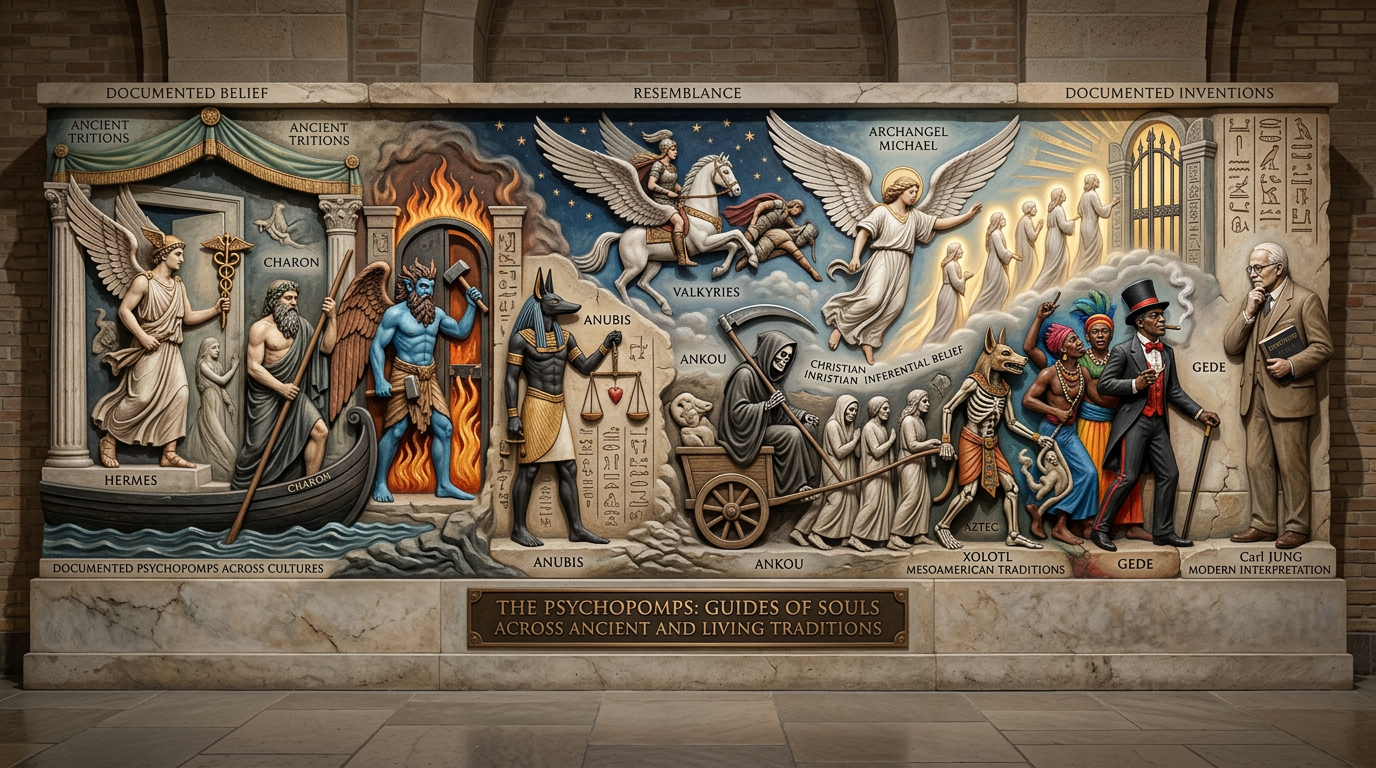
Refusal to Let the Dead Walk Alone

“Hermes of Cyllene summoned forth the spirits of the suitors, and they followed, gibbering, down the dank ways, past the streams of Ocean and the White Rock, to the meadow of asphodel, where the spirits dwell.” — after Homer, Odyssey 24
An Archival Chronicle Prepared for the Discerning Collector
Compiled by the Archivist of the Unseen
Contents
I. The Lamp No One Lit
II. A Note on This Study and Its Companion Entry
III. What a Psychopomp Is, and What It Is Not
IV. The Greek Road: Hermes, Thanatos, and Charon
V. Etruria: The Hammer and the Wings
VI. Egypt: The Jackal and the Ferryman Who Looks Behind
VII. The North: The Choosers of the Slain
VIII. The Angels: Michael and the Angel of Death
IX. Field Study — The Ankou
X. Other Roads: The Dog, the Baron, the Messengers of Yama, and a Modern God of Death
XI. Field Study — The Ledger of Guides
XII. The Road Turned Inward
Bibliography
I. The Lamp No One Lit
In the archive at Faulkenmire, by the door of the east corridor, there is a box tied with black ribbon and labeled with the name of a river. For a long time it sat on a high shelf in the reading room. Then, one night, it was moved. Now it rests beside a lamp that no one remembers lighting, and the ribbon has not been untied.
The Archivist, writing in the journal, understood the gesture. The box had been moved so that, when the time came, it would not have to be carried alone. The keeping of records, like the guiding of souls, is work that is better done in company.
Almost every human culture that has left a record of its beliefs about death has imagined that the dead do not make their final journey alone. Someone comes for them: a god, an angel, a ferryman, a dog, a winged woman, a skeletal man with a cart. The Greeks gave this figure a name, psychopompos, the conductor of souls, and the word psychopomp is now used for all of them.
This field study, prepared for the reader who keeps watch at the threshold, follows the conductors of souls across the ancient and modern world, examines what the evidence actually shows about each, and asks why this figure has proved so persistent.
❧ ❧ ❧
II. A Note on This Study and Its Companion Entry
This field study accompanies Entry V in the Journal of the Archivist of the Unseen, On Those Who Walk Beside the Dead. That entry traced the psychopomp from Hermes in the Odyssey to Carl Jung, and set a rule that this study follows: to separate documented history from mere resemblance. As the Archivist wrote of the boatmen of Mesopotamia and Greece, it records a resemblance, not a lineage.
The entry introduced Hermes, Charon, Urshanabi, Anubis, Hekate, the Valkyries, the archangel Michael, the Breton Ankou, and the dog of the Nahua road to Mictlan. This study expands on several of those figures and adds others the entry did not have room for: the Greek twins Sleep and Death, the Etruscan Charun and Vanth, the Egyptian ferryman, Freyja, the Islamic Angel of Death, the Nahua god Xolotl, the Gede of Haitian Vodou, the messengers of Yama, and the Japanese shinigami.
Several of these figures belong to living religions and living cultures. Where that is so, it is noted, and the study describes rather than judges.
❧ ❧ ❧
III. What a Psychopomp Is, and What It Is Not
The word psychopomp is used loosely, and it helps to distinguish four kinds of figures that are often grouped together.
The Guide
The psychopomp proper is a guide: a being who accompanies or leads the soul from the world of the living to the world of the dead. Hermes is the classic example. He does not kill, and he does not judge. He shows the way.
The Ferryman
The ferryman carries the dead across a boundary of water. Charon is the best-known example. He is a kind of psychopomp, but his role is narrower: he controls a crossing, often for a fee, rather than guiding the whole journey.
The Personification of Death
Some figures are Death itself: Thanatos in Greece, the Grim Reaper in later European art. They bring death but do not always guide the soul afterward.
The Judge
Some figures preside over the judgment of the dead, such as Osiris in Egypt or the judges Minos, Rhadamanthys, and Aeacus in Greek tradition. They are not guides at all. The psychopomp brings the soul to the judge.
Many figures combine several of these roles, and traditions changed over time. But the distinctions matter, because popular accounts often blur them, calling every death figure a psychopomp and every psychopomp a version of the same ancient original.
❧ ❧ ❧
IV. The Greek Road: Hermes, Thanatos, and Charon
Hermes
Hermes was the god of boundaries, roads, travelers, messengers, and thieves, the one god who could pass freely between Olympus, the earth, and the underworld. It was natural that he should guide the dead. The opening of the final book of the Odyssey, as the companion entry describes, shows him leading the ghosts of Penelope’s slain suitors down to the meadow of asphodel with his golden wand, the spirits following him and gibbering like bats. In Greek art he appears as a guide of souls on funerary vases. His epithet psychopompos gave the concept its name. In Roman religion his counterpart Mercury inherited the role.
Sleep and Death
In the sixteenth book of the Iliad, when the hero Sarpedon, a son of Zeus, is killed at Troy, Zeus sends Hypnos and Thanatos, the twin brothers Sleep and Death, to carry his body home to Lycia for burial. The scene is painted on one of the most famous of all Greek vases, the calyx krater signed by the painter Euphronios around 515 BCE, which shows the two winged brothers lifting the bleeding body while Hermes stands behind them. The vase, long displayed at the Metropolitan Museum of Art in New York, was returned to Italy in 2008 after it was shown to have been looted. It is among the clearest images of death as a gentle, winged conveyance.
Charon
Charon, the ferryman of the dead across the river or lake of the underworld, is not mentioned by Homer. As the companion entry notes, the second-century writer Pausanias reports that the painter Polygnotus took Charon from a lost epic, the Minyas. Charon appears on Athenian white-ground lekythoi, funerary oil jars, from the later fifth century BCE, a rough, bearded figure in a small boat, waiting for the dead who approach him, often led by Hermes.
Charon’s Obol
The best-known detail of the Charon story is the coin placed in the mouth of the dead to pay the ferryman’s fee. The archaeological evidence is more complicated than the legend. As the numismatist Susan Stevens showed in a 1991 study, coins appear in a minority of Greek and Roman burials, and they are found in many positions, in the hand, on the chest, near the body, not only in the mouth. The custom was real, but it was neither universal nor uniform, and its meaning may have varied. The Archive’s earlier field study on the Otherworld and the ferryman traced this thread in more detail.
❧ ❧ ❧
V. Etruria: The Hammer and the Wings
The Etruscans, the people of central Italy before the rise of Rome, imagined the passage to the underworld vividly, and their tomb paintings and carved sarcophagi preserve two remarkable demons of the dead.
Charun
Charun, whose name is related to the Greek Charon, is a very different figure. In Etruscan art he is often blue-skinned or gray, with a hooked nose, pointed ears, and sometimes snakes in his hair, and he carries a heavy hammer or mallet. He appears at the doors of tombs and in scenes of death and departure, a fearsome guardian of the threshold. Whether the hammer was used to strike the dying or to guard the gates is debated.
Vanth
Beside Charun often stands Vanth, a winged female demon, sometimes carrying a torch, a key, or a scroll. Unlike Charun, she is usually depicted calmly, even protectively, accompanying the dead on their journey. Both appear together in famous tomb paintings such as those of the François Tomb at Vulci.
The Etruscan demons show that a figure with a Greek name could be transformed entirely in another culture. Charun is not Charon in Etruscan dress. He is a separate being, shaped by Etruscan beliefs about death, who shares a name and a role with his Greek counterpart. It is a reminder, again, of the difference between resemblance and identity.
❧ ❧ ❧
VI. Egypt: The Jackal and the Ferryman Who Looks Behind
Anubis
Anubis, the jackal-headed god, was the patron of embalming and the guardian of the necropolis. Jackals scavenged at the edges of the desert where the dead were buried, and the Egyptians may have made the jackal a protector of the dead to turn a threat into a guardian. In the vignettes of the Book of the Dead, Anubis leads the deceased into the hall of judgment and attends the weighing of the heart against the feather of Maat. As the companion entry notes, in the Greco-Roman period he was fused with Hermes into Hermanubis, a deliberate merging of two guides of souls by people who recognized their kinship.
The Ferryman
Egypt also had a ferryman of the dead, though he is less famous than Charon. In the Pyramid Texts, the oldest religious writings of Egypt, the dead king must persuade a ferryman to carry him across the waters of the sky. The ferryman is sometimes called Mahaf, a name often translated as “he who looks behind,” because his face was turned backward. The image of the dead needing a boatman to cross water appears independently in Egypt, Mesopotamia, and Greece, which is exactly why the companion entry was careful to call it a resemblance and not a lineage.
❧ ❧ ❧
VII. The North: The Choosers of the Slain
In Norse tradition, the dead were not all guided to the same place, and some of them were chosen.
The Valkyries
The valkyries, from Old Norse valkyrja, the chooser of the slain, were female spirits who decided who would die in battle and brought the chosen warriors to Valhalla, the hall of Odin, where they would feast and fight until the end of the world. As the companion entry notes, the poems that describe them were written down in Christian centuries, in Iceland in the thirteenth century, long after the end of Norse paganism, so they cannot be taken as a straightforward record of earlier belief. Earlier evidence, such as small figures of women offering drinking horns, may represent valkyries, but the identification is uncertain.
Freyja
The Eddic poem Grímnismál states that the goddess Freyja chooses half of the slain each day for her own hall, Fólkvangr, while Odin receives the other half. Freyja’s role as a receiver of the dead is often forgotten in popular accounts, which give Odin all the warriors.
Hel
Those who died of sickness or old age went, in some accounts, to the realm of Hel, ruled by a goddess of the same name. Hel is a ruler rather than a guide. The Norse picture of the afterlife, as preserved, is varied and probably reflects many local traditions brought together by later writers.
❧ ❧ ❧
VIII. The Angels: Michael and the Angel of Death
Michael
In Christian tradition, the archangel Michael became the great guide and guardian of souls. Medieval painters showed him holding the scales at the Last Judgment, weighing souls while demons tried to tip the balance. The Offertory of the old Latin Requiem Mass asks that Saint Michael, the standard-bearer, bring the souls of the faithful into the holy light. Here the Christian psychopomp is not a neutral guide but a protector, defending the soul against the powers that would seize it.
The Angel of Death in Islamic Tradition
In Islamic tradition, the Qur’an refers to the Angel of Death, malak al-mawt, who takes the souls of the dying at the appointed time. The name by which this angel is widely known, Azrael, or Izra’il, does not appear in the Qur’an. It comes from later Islamic tradition and from related Jewish and Christian sources. In Islamic belief, the angel acts by God’s command, and accounts describe the soul of the righteous being drawn out gently and that of the wicked with difficulty. This is a living faith, and the Archive records these beliefs with the respect owed to the beliefs of more than a billion people.
❧ ❧ ❧
IX. Field Study — The Ankou
The companion entry closed with a glimpse of Brittany: an axle creaking in a lane at night, and the year’s last dead waiting to take up the reins. The Ankou deserves particular attention, because it is one of the best-documented folk psychopomps of Europe, and because it belongs to a living culture.
The Record
The Ankou was recorded in detail by the Breton folklorist Anatole Le Braz in his book La Légende de la mort chez les Bretons armoricains, first published in 1893, which gathered the death lore of Lower Brittany from oral informants. According to the traditions Le Braz recorded, the Ankou is the servant of death in each parish. The last person to die in the parish in a given year becomes the Ankou for the following year, gathering the souls of all who die.
The Cart
The Ankou is usually imagined as a tall, thin figure, sometimes a skeleton, wearing a wide hat, carrying a scythe, and driving a creaking cart, the karrigell an Ankou, drawn by a gaunt horse. Two companions walk beside the cart and throw the bodies of the dead into it. To hear the creak of the cart’s axle at night was a sign that someone nearby would soon die.
In Stone and Wood
The Ankou appears in the religious art of Brittany. A carved figure of the Ankou on the ossuary at La Roche-Maurice, dating from the seventeenth century, bears the inscription Je vous tue tous, “I kill you all.” A wooden statue of the Ankou is preserved in the church at Ploumilliau. These images show the Ankou not as a pagan survival hidden from the church but as a figure the church itself displayed, as a reminder of mortality.
Guide or Death?
The Ankou blurs the categories set out at the start of this study. It is a personification of death, a collector of the dead, and a guide. Its most distinctive feature is that it is drawn from the community itself. The Ankou is one of the parish’s own dead, serving a year before passing the duty on. This makes it unlike any of the gods and angels described above. The dead, in Breton tradition, are guided by their neighbors.
❧ ❧ ❧
X. Other Roads: The Dog, the Baron, the Messengers of Yama, and a Modern God of Death
The Dog and Xolotl
The companion entry recorded the account, preserved by the sixteenth-century friar Bernardino de Sahagún, that among the Nahua of central Mexico a dog carried the dead across a river on the long journey to Mictlan, the realm of the dead. Sahagún’s informants said that a dog was sometimes killed and buried with the dead for this purpose, and that only a dog of a certain color would agree to carry its master. The dog is associated with Xolotl, a dog-headed god connected with twins, transformation, and the underworld, who in Mexica myth accompanied the sun through the land of the dead each night. The hairless Mexican dog, the xoloitzcuintli, takes its name from him. As the companion entry rightly observed, Sahagún wrote as a Spanish missionary, and Nahua communities living today are the proper authorities on their own traditions.
The Gede of Haitian Vodou
In Haitian Vodou, a living religion, the Gede are the spirits, or lwa, of the dead, led by Baron Samedi, often depicted in a top hat and black tailcoat, with dark glasses. The Gede preside over cemeteries and the boundary between life and death, and are honored especially at the beginning of November. They are guardians and gatekeepers of the dead rather than guides in the Greek sense, and they are known for their humor and irreverence. They should not be confused with the sensational images of popular culture.
The Messengers of Yama
In Hindu tradition, also a living faith, Yama is the lord of death and of the realm of the dead, and his messengers, the Yamadūtas, come to take the souls of the dying, gently or harshly according to their deeds. Texts such as the Garuda Purāṇa describe the journey of the soul after death in detail. Yama himself, in the oldest texts of the Rigveda, is described as the first mortal to die, who found the path for those who came after.
The Shinigami
The Japanese shinigami, the god of death, is widely known through modern fiction. It is worth noting that the shinigami as a personified figure of death is largely a modern development. One influential source is a rakugo comic story called Shinigami by the Meiji-era storyteller San’yūtei Enchō, which adapted the European folktale of Godfather Death, collected by the Brothers Grimm. Older Japanese traditions had many beliefs about the dead and their journey, but the shinigami as a reaper-like figure owes a significant debt to European influence. It is an example of how a guide of the dead can travel between cultures in the modern era.
❧ ❧ ❧
XI. Field Study — The Ledger of Guides
Documented in Ancient Texts and Art
Hermes as psychopompos in the Odyssey and in vase painting; Hypnos and Thanatos carrying Sarpedon in the Iliad and on the Euphronios krater; Charon in art from the later fifth century BCE; the uneven evidence for Charon’s obol; Charun and Vanth in Etruscan tombs; Anubis in the Book of the Dead and as Hermanubis; the ferryman of the Pyramid Texts; the valkyries and Freyja in thirteenth-century Icelandic texts; Michael in Christian liturgy and art; the Angel of Death in the Qur’an.
Documented in Folklore and Ethnography
The Ankou as recorded by Le Braz in 1893, and in Breton church art; the Nahua dog and the road to Mictlan as recorded by Sahagún; the Gede of Haitian Vodou; the Yamadūtas of Hindu tradition.
Resemblance, Not Lineage
The parallels between the ferrymen of Egypt, Mesopotamia, and Greece; between Hermes, Anubis, and Michael; and between the Ankou and other European figures of death. The Hermes-Anubis fusion is the rare case where people of the time deliberately joined two figures.
Modern Developments
The name Azrael, from later tradition rather than the Qur’an; the Grim Reaper as a standard image; the shinigami as a personified god of death; Jung’s psychological psychopomp.
❧ ❧ ❧
XII. The Road Turned Inward
The companion entry ended its survey with the Swiss psychiatrist Carl Gustav Jung, who carried the word psychopomp indoors. In Jung’s psychology, the psychopomp became a figure within the psyche, a guide that mediates between the conscious mind and the unconscious, appearing in dreams as a wise old man, an animal, or a figure of the opposite sex, leading the dreamer into the unknown parts of the self. As the Archivist wrote, the road had moved inward. It had not disappeared.
In the twenty-first century, the word has moved again. People who sit with the dying, hospice workers, chaplains, and the end-of-life companions sometimes called death doulas, occasionally describe their work as that of a psychopomp: not leading souls to an underworld, but accompanying the dying so that they do not face the end alone.
This, in the end, is what unites the figures in this study, across thousands of years and very different beliefs. Whether the guide is a god with a golden wand, a ferryman with a pole, a jackal-headed embalmer, a winged woman, an archangel with scales, a dog at the edge of a river, or the last neighbor to die in a Breton parish, the conviction behind each one is the same. The dead should not walk alone. Someone must go with them, at least as far as the water.
The box by the east corridor door is still tied with its black ribbon. The lamp beside it is still burning. The Archive keeps watch, as the guides have always kept watch, at the threshold.
❧ ❧ ❧
This field study is preserved as one vestige among many within the haunted archive of Wicked Dual, an artisan boutique devoted to the reclamation of history’s clandestine and silenced corners. It is filed as the companion to Entry V of the Journal of the Archivist, On Those Who Walk Beside the Dead, and is kept with respect for the living traditions that still send guides with their dead.
Read the written chronicles on the blog, the Wicked Archive: www.wickeddualblog.com
Secure the physical artifacts drawn from these histories at the Wicked Dual boutique: https://www.etsy.com/shop/Wickedhttps://www.etsy.com/shop/Wickeddualdual
We invite you to enter the haunted archive and secure a piece for your private collection; it is a necessary addition for those who curate the darker corners of human history.
— The Archivist of the Unseen

Bibliography
The following works include the further studies named in the companion entry, the principal record of the Breton Ankou, a standard translation of Sahagún, and studies of Etruscan religion and Jungian psychology; readers pursuing formal citation are advised to verify editions and pagination against a library catalog.
Bremmer, J. N. (2002). The rise and fall of the afterlife. Routledge.
Le Braz, A. (1893). La légende de la mort chez les Bretons armoricains. Honoré Champion.
Vermeule, E. (1979). Aspects of death in early Greek art and poetry. University of California Press.
Related Chronicles in the Archive
Journal of the Archivist, Entry V — On Those Who Walk Beside the Dead
Field Study No. VIII — The Other Side: The Otherworld, the Ferryman, and the River
Field Study No. XVI — The Grief That Stopped the World: Demeter
Field Study No. XXV — Three Faces of the Moon: Selene, Artemis, and Hekate
Leave a Reply