THE JOURNAL OF THE ARCHIVIST OF THE UNSEEN

Written at Faulkenmire, at the mouth of the east corridor, the first cold night of autumn, by a lamp I did not light.
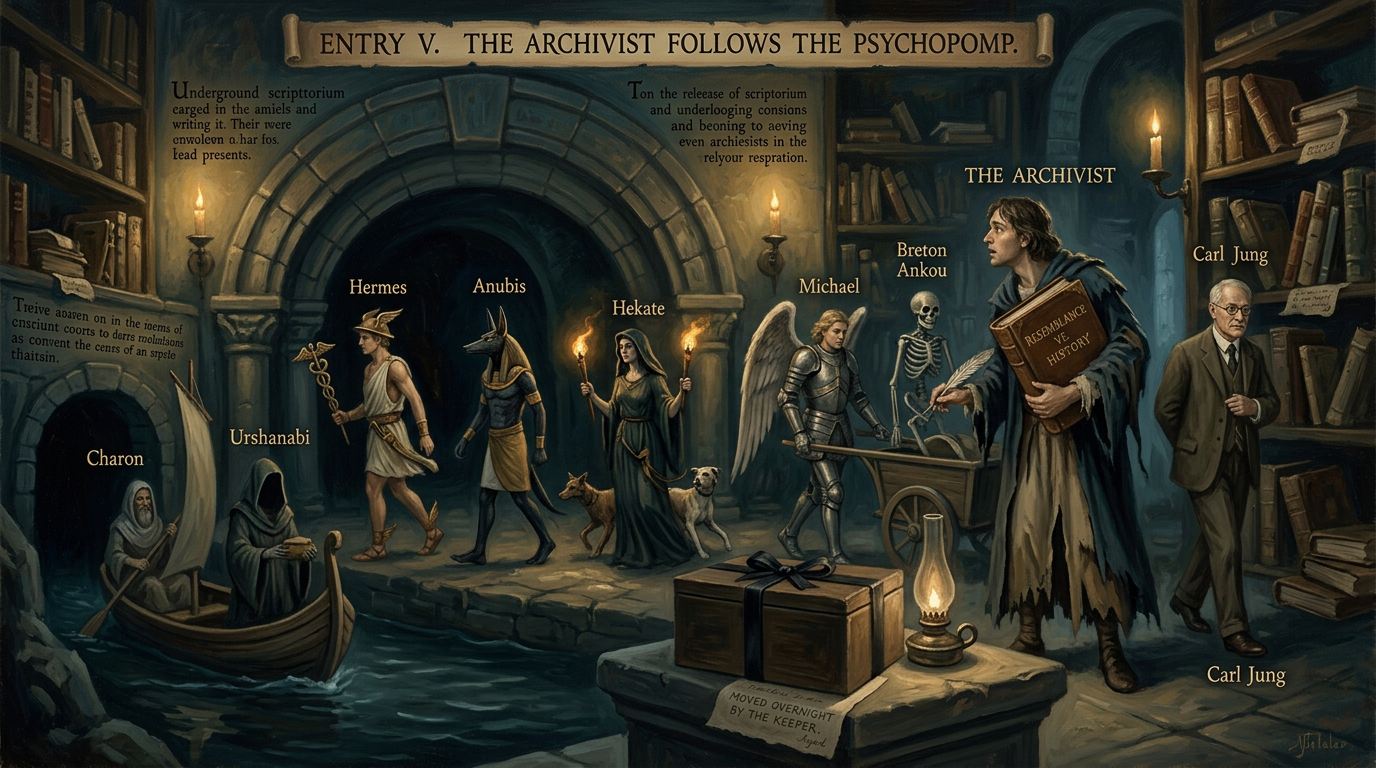
The lamp was already burning when I came down the east corridor tonight. It had been set on the floorboards beside the box tied with black ribbon, the one labeled with the name of a river. I left that box on a high shelf in the reading room in my first week here. It now waits by the corridor door, as though it means to go somewhere and would rather not go alone. I have not untied the ribbon. I have, instead, spent the evening with the question the box seems to pose, which is among the oldest the dead have left us: who walks beside them on the way?
The Greeks had a word for such a figure, psychopompos, the conductor of souls, and they gave it most often to Hermes. The earliest scene I know comes at the opening of the final book of the Odyssey. Hermes rouses the ghosts of the slain suitors with his golden wand, and they follow him, gibbering like bats, past the streams of Ocean and the land of dreams to the meadow of asphodel. Notice, careful reader, what the poet chose to show. There is no tribunal here and no sentence, only a road, and a god patient enough to lead strangers down it.
The ferryman arrives later than one might expect. Homer never names Charon. Pausanias, describing the great painting of the underworld that Polygnotus made at Delphi in the fifth century BCE, says the painter took Charon from a lost epic called the Minyas. By the later fifth century the ferryman had become a familiar figure on white-ground lekythoi, the slender oil flasks Athenians placed in graves, where he stands in his skiff and waits. The coin said to pay his fare is a harder matter. Excavation confirms that the dead were sometimes buried with a coin, but never universally, and not always in the mouth; the custom and the story told about it may not have travelled together. It is the thread I first followed in Field Study No. VIII, and it has not grown simpler.
Older waters lie behind his. In the Epic of Gilgamesh the hero cannot cross the Waters of Death to reach Utnapishtim without the boatman Urshanabi. Urshanabi conducts no souls; Gilgamesh is living, and his errand is the refusal of death. Yet Mesopotamian poets had placed a boatman at the edge of mortality long before any Greek painted Charon. Whether a line of descent joins the two, I cannot say, and I distrust anyone who claims to. Where rivers mark borders, borders need boatmen. I record a resemblance, not a lineage.
In Egypt the guide wore a jackal’s head. Anubis presided over embalming, and in the vignettes of the Book of the Dead he leads the deceased into the hall where the heart is weighed against the feather of Maat. Centuries later, in Roman Egypt, worshippers fused him with Hermes into a single figure, Hermanubis, as if two guides on two roads had recognized each other at a crossing.
Hekate, whose three faces I traced in Field Study No. XXV, does not in the earliest telling conduct anyone. In the Homeric Hymn to Demeter she hears Persephone cry out, goes torch in hand to the grieving mother, and after the daughter’s return becomes her attendant and companion. Later ages built from those materials, the torch, the crossroads, the friendship with one who had gone below and come back, a goddess of the threshold between the living and the dead. Reading her again beside Field Study No. XVI, I am struck by how much of a psychopomp’s work is simply company kept in the dark.
The office never stood empty for long. Norse poetry, set down in Christian centuries, gave the choosing of the slain to the valkyries. Medieval painters put the archangel Michael at the scales of judgment, and the Offertory of the old Requiem Mass asked that the standard-bearer Michael present the souls of the faithful in the holy light. In Brittany, as Anatole Le Braz recorded in the 1890s, the last person to die in a parish each year was said to become the Ankou, the gatherer of the dead for the year that followed.
Across the ocean, the Franciscan Bernardino de Sahagún, compiling his account of Mexica life with Nahua collaborators after the conquest, recorded that a dog accompanied the dead to carry them across a river on the road to Mictlan. Here I tread with care, fellow keeper of the uncatalogued. Nahua communities are living, and the ways they honor their dead today are theirs to describe. I can tell you only what a sixteenth-century friar wrote down, and that he wrote it as an outsider.
In the twentieth century Carl Jung carried the word indoors, making the psychopomp a figure within the psyche who mediates between what we know of ourselves and what we do not. The road had moved inward. It had not disappeared.
I have come back to the corridor. The lamp still burns beside the box, and I think I understand now why it was moved. Not, I suspect, so that I would open it, but so that I would not carry it alone when the time comes. A field agent fetches what cannot reach the archive on its own. I had thought of that as a clerk’s work. Tonight it feels nearer to the boatman’s.
— A.U., Faulkenmire
❦
CATALOGUE REFERENCES
Field Study No. VIII — The Other Side: The Otherworld, the Ferryman, and the River
Field Study No. XVI — The Grief That Stopped the World: Demeter
Field Study No. XXV — Three Faces of the Moon: Selene, Artemis, and Hekate
FURTHER STUDIES
Bremmer, J. N. (2002). The rise and fall of the afterlife. Routledge.
Vermeule, E. (1979). Aspects of death in early Greek art and poetry. University of California Press.
Editions and reprints vary; verify details against a library catalogue before citing.
UNCATALOGUED
Somewhere in the Breton files, an axle creaks on a lane at night, and the last of the year’s dead is waiting to take up the reins.
❦
This entry is preserved within the haunted archive of Wicked Dual, kept in the Journal of the Archivist of the Unseen beside the formal field studies.
Read the written chronicles on the blog, the Wicked Archive: www.wickeddualblog.com
Secure the physical artifacts drawn from these histories at the Wicked Dual boutique: https://www.etsy.com/shop/Wickeddual
We invite you to enter the haunted archive and secure a piece for your private collection; it is a necessary addition for those who curate the darker corners of human history.


Leave a Reply