THE JOURNAL OF THE ARCHIVIST OF THE UNSEEN

Written at Faulkenmire, in the portrait gallery of the north wing, a night of white fog off the marsh.
Fog came off the marsh at dusk and did not leave. By full dark it stood against the windows of the north wing so close and so white that the glass seemed papered over from outside. I went up to the portrait gallery for no better reason than that the lamp there was lit, and I have learned in this house to treat a lit lamp as a summons. Beneath it, on the long table, someone had opened a ledger of deaths: the register of a family I do not know, each entry in a different ink, the names running down the page like rain down a pane. Beside the last of them, where the cause should be written, there is nothing at all.
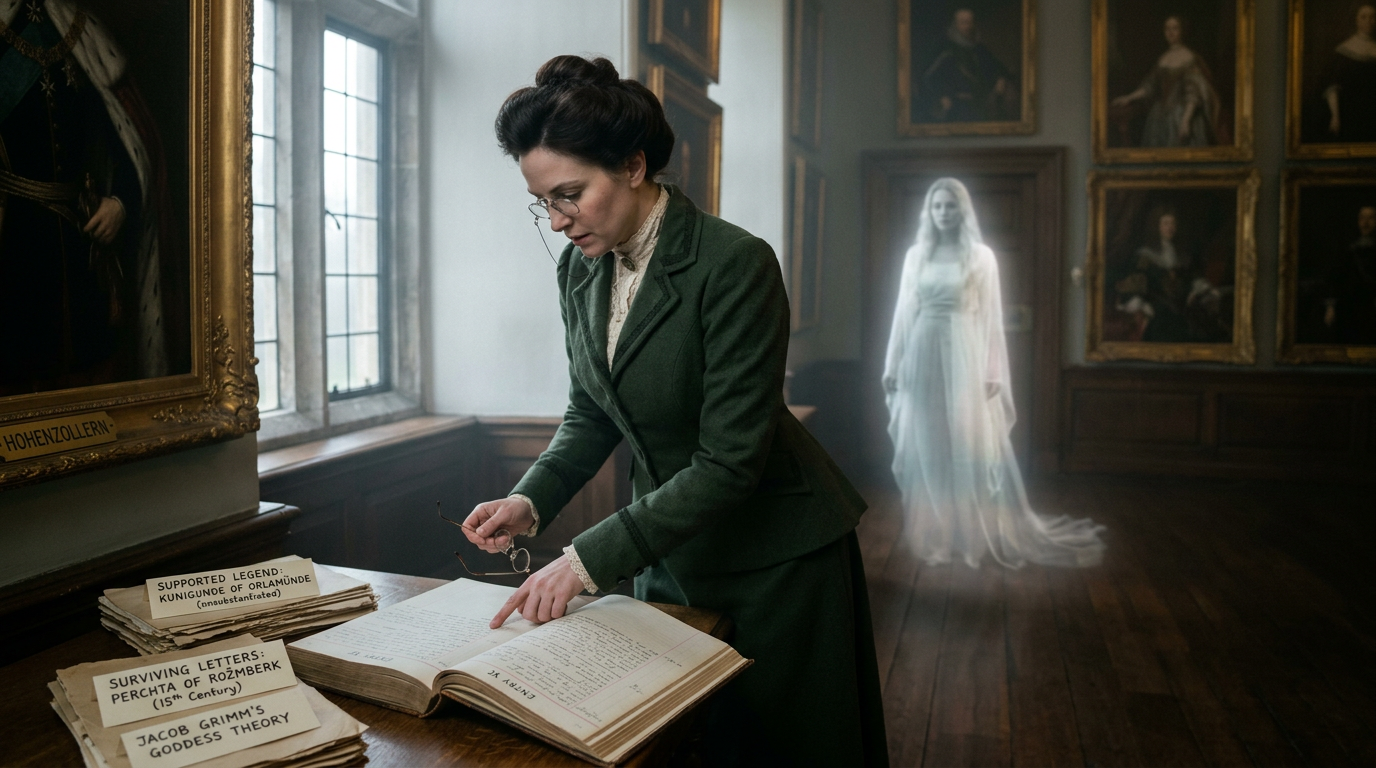
I have spent the night with the White Lady, the Weiße Frau of the German-speaking lands, and with the question of why the coming of death is so often announced by a woman. In the best-known form of her legend she belongs to the Hohenzollerns, the dynasty that rose from burgraves of Nuremberg to electors of Brandenburg, kings in Prussia, and at last German emperors. Over the early modern centuries, stories circulated that a pale woman in white was seen in the family’s residences, the Berlin Palace above all, shortly before one of them died. She did no harm. She did not speak. She appeared, and the household understood.
Who she was, the tradition never agreed, discerning collector, and the disagreement is the most instructive thing about her. One answer names Kunigunde of Orlamünde, a countess of the fourteenth century, widowed young. The legend says she hoped to marry a Hohenzollern burgrave, who remarked that four eyes stood in the way of their union. He meant his parents. She took him to mean her two children, and killed them. Refused even so, she did penance, died, and walks. It is a terrible story and, as far as I can find, an unsupported one. The historical Kunigunde was a widow who spent her later years in religious life, but no contemporary record accuses her of murder. The crime appears to have been written onto her long after she could answer for it.
Patient reader, you will know the shape. It is the shape I followed in Field Study No. VII: a mother who kills her children for the sake of a man and is condemned to wander. I do not claim that the Franconian legend and the Mexican one share an ancestor; nothing I have found suggests it, and La Llorona belongs to a living tradition whose keepers tell her in their own ways. What the two share, I think, is an old habit of storytelling in which a woman’s crime is made the explanation for a haunting, and the woman herself is lost inside the explanation.
The other answer is gentler and far better documented. Perchta of Rožmberk, a Bohemian noblewoman of the fifteenth century, was married into the Lichtenštejn family, and the marriage was wretched. We know this because her letters survive, written to her own family, describing coldness, humiliation, and want. They are counted among the earliest surviving private letters in Czech, and reading them in translation I felt something rare in this work: a woman speaking for herself across five centuries with no legend standing between us. After her death a white lady was said to walk in the castles of her kin, at Český Krumlov and Jindřichův Hradec, and some tellings carried her north into the Hohenzollern story. That inheritance is clearer in the legend than in any archive, and I record it as legend.
Beneath both noblewomen lies an older, humbler figure. The Brothers Grimm, gathering legends early in the nineteenth century, recorded white women who appeared at springs, on hillsides, and among ruins, often guarding treasure, often waiting for a deliverer who never quite completed the task. Jacob Grimm believed them the last pale traces of pre-Christian goddesses such as Holda and Perchta. It is a beautiful theory. It is also, I must say plainly, a theory, and later scholars have handled it with caution, because the evidence that would join a village tale to a goddess of a thousand years before is thin. That the folk Perchta and the Bohemian Perchta share a name I note; whether the coincidence did any work in the legend’s growth, I cannot say.
Toward dawn I returned to the ledger. The blank beside the last name had not been filled, and I understand now that it was never mine to fill. The White Lady was not a cause but an announcement, a household’s way of saying that death was near before anyone could bear to say it aloud. Two real women were pressed into that office after they died: one accused of a crime she likely never committed, one remembered less for her own words than for her ghost. The fog is thinning now. Along the gallery the portraits return one by one out of the white, and I find myself wishing the women behind the legend could come back so easily.
— A.U., Faulkenmire
❦
CATALOGUE REFERENCES
Field Study No. VII — La Llorona: The Weeping Woman
FURTHER STUDIES
Lysaght, P. (1986). The banshee: The Irish supernatural death-messenger. Glendale Press.
Editions and reprints vary; verify details against a library catalogue before citing.
UNCATALOGUED
Across the Irish Sea another woman attends the deaths of old families, and where the White Lady keeps her silence, this one is heard keening beneath the windows.
❦
This entry is preserved within the haunted archive of Wicked Dual, among the private pages the Archivist keeps beside the formal field studies.
Read the written chronicles on the blog, the Wicked Archive: www.wickeddualblog.com
Secure the physical artifacts drawn from these histories at the Wicked Dual boutique: https://www.etsy.com/shop/Wickeddual
We invite you to enter the haunted archive and secure a piece for your private collection; it is a necessary addition for those who curate the darker corners of human history.


Leave a Reply