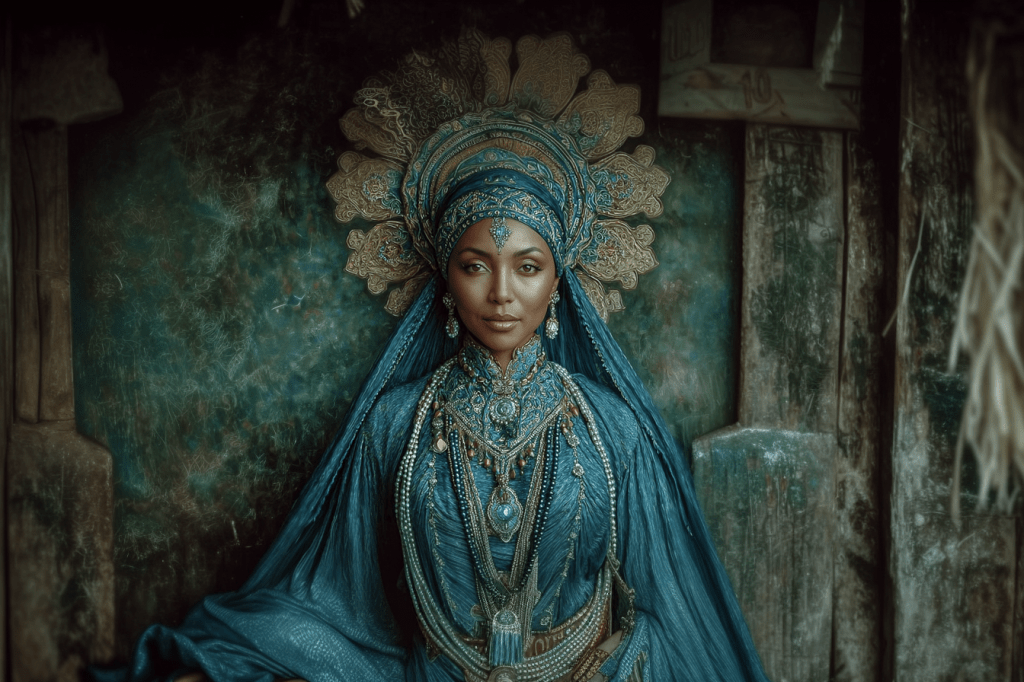
The vast, rhythmic ocean holds a profound secret within its azure depths—a mother’s love so immense it birthed gods, shaped continents, and sustained a people through the darkest of passages. This is the domain of Yemaya (Yemọja, Iemanjá, Yemayá), the mighty Orisha whose essence is the living water. From her origins in the rivers of Yorubaland to her reign over the Atlantic that bore her children to the Americas, Yemaya is more than a deity; she is the primal symbol of motherhood, resilience, and the creative, often tumultuous, power of nature. Her story is not confined to ancient myth but pulses through vibrant festivals from Bahia to Havana, a testament to an unbreakable spiritual lineage forged in the crucible of history. To know Yemaya is to understand the soul of the African diaspora itself.
The Many Names of the Mother
Her name is a prayer in itself, a contraction of Yoruba words revealing her core identity: Iyá (mother), ọmọ (child), and ẹja (fish)—collectively, “Mother whose children are as numerous as fish.” This name speaks to her boundless fertility and her sovereignty over all living things. The variations of her name are a map of her journey:
* In Yorubaland: Yemọja, Iyemọja.
* In Brazil: Iemanjá, Janaína, Mãe da Água.
* In Cuba and the Spanish Caribbean: Yemayá, Yemallá.
* In broader diasporic traditions: She is often associated with or identified as La Sirène in Haitian Vodou or linked to the widespread veneration of Mami Wata.
Venerated Across Continents
Yemaya’s worship is a powerful example of religious continuity and adaptation. Her veneration spans traditional African religion and its diasporic expressions:
* Yoruba religion (Nigeria, Benin, Togo)
* Candomblé and Umbanda (Brazil)
* Santería (Regla de Ocha) (Cuba, Puerto Rico)
* Haitian Vodou and Dominican Vudú
This cross-continental devotion was made possible through the tragic era of the Trans-Atlantic slave trade, where enslaved Yoruba people preserved her worship by syncretizing her with Catholic saints, most notably Our Lady of Regla in Cuba and Our Lady of Navigators in Brazil.
Symbols and Sacred Attributes
* Primary Symbols: Water (in all forms), the moon, cowrie shells (representing wealth, fertility, and divination).
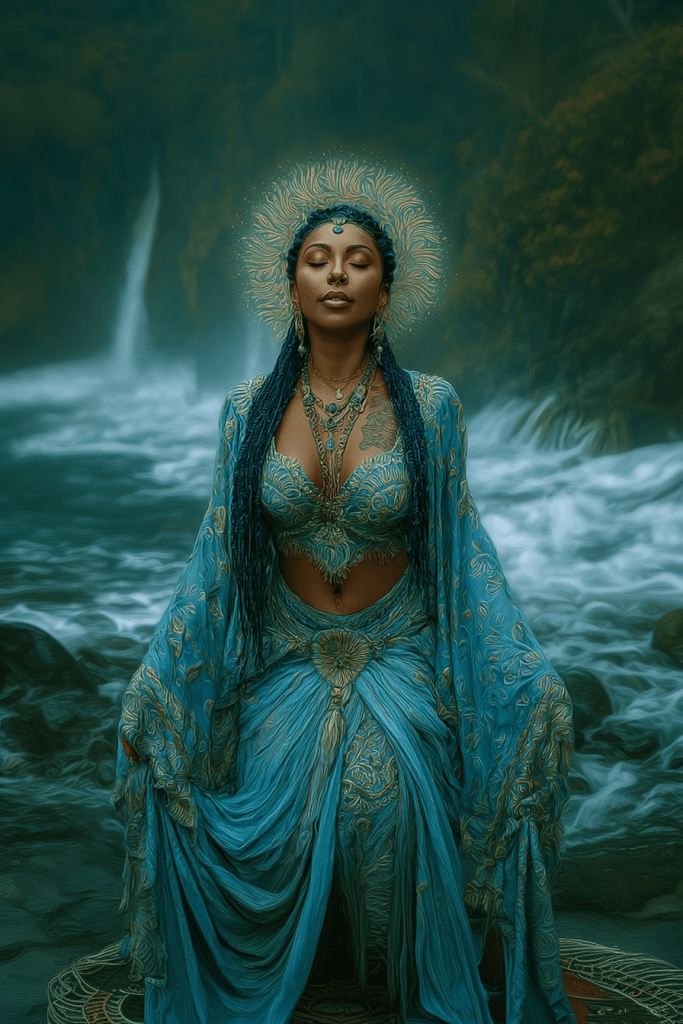
* Sacred Colors: Blue (for the sea and sky) and white or crystal (for purity, foam, and moonlight). Her ritual beads (elekes) alternate these colors.
* Sacred Number: Seven, representing the seven seas she is said to rule, often reflected in the seven skirts of her iconic dress.
* Key Regions: Yorubaland (Nigeria); with profound significance in Brazil and Cuba.
* Ethnic Heart: The Yoruba people.
A Tapestry of Equivalents
Yemaya’s archetype resonates across global spiritual traditions, finding echoes in:
* Greek: Selene (Moon Goddess)
* Roman: Luna (Moon) and Ceres (Agriculture, Motherhood)
* Bakongo (Central Africa): Nzambici (Supreme Creator, Earth Mother)
* Igbo (Nigeria): Ala (Earth, Fertility, and Morality Goddess)
* Catholic Syncretism: The Virgin Mary, specifically as Our Lady of Navigators
From Africa to the Americas: A Divine Migration
In her West African homeland, Yemaya was originally a powerful river deity, specifically the patron spirit of the Ogun River in Nigeria. She was one of several respected river Orishas, with the deep sea being the domain of the mysterious Olokun. The Middle Passage fundamentally transformed her domain. For the enslaved crossing the terrifying Atlantic, the ocean became the central, inescapable reality—a place of suffering, death, and, ultimately, a watery path to a new world. In this context, Yemaya’s protective, maternal authority naturally expanded from the rivers to encompass the entire ocean, offering solace and a spiritual tether to a lost homeland.
In the Americas, she emerged preeminently as the Queen of the Sea. This was not a rejection of her African roots but a powerful adaptation that ensured her survival and relevance for her displaced children, who now lived on different shores.
Yemaya and Olokun: Creating Balance in the Ocean
This expansion created a nuanced partnership with Olokun. In diaspora theology, they are seen as complementary forces governing the ocean’s totality. Yemaya rules the surface—the life-giving sunlight zone, the waves, the shores where humans interact with the sea. She is accessible, nurturing, and known. Olokun rules the unfathomable depths—the dark, silent abyss, the immense pressure, and the untamed, primordial power of the sea. Together, they represent the complete cycle: life and mystery, the known and the unknown, the gentle lap of waves and the crushing power of the deep. They maintain the cosmic balance of the marine world.
Yemaya as the Quintessence of Motherhood and Female Power
Yemaya is the ultimate mother figure. She is called “Iyamapé”—the Mother Whose Words Must Be Obeyed. She is the mother of the majority of the Orishas and, in many myths, the progenitor of humanity itself. Her motherhood is not passive; it is fiercely protective, abundantly fertile, and stern when necessary. She governs all aspects of women’s lives: childbirth, parenting, love, and healing. She is petitioned by those seeking children and is the guardian of all children, offering comfort and safety.
Her power embodies the full spectrum of femininity. She can be the serene, nourishing mother rocking the cradle of the waves, and she can be the warrior queen whose tempestuous rage mirrors a river’s flood. This duality makes her a potent symbol of female strength, resilience, and autonomy.
Yemaya’s Lunar Rhythm and Command of the Tides
Her intrinsic connection to the moon deepens her mastery over water. Just as the moon’s gravitational pull dictates the ocean’s tides, Yemaya’s energy is cyclical, intuitive, and emotional. She is the mistress of ebb and flow—of creative cycles, menstrual cycles, and the rhythms of life. This lunar link associates her with feminine mystery, intuition (ashe), and the subconscious. Devotees often align rituals and offerings with lunar phases, particularly the full moon, to tap into the peak of her illuminating and cleansing power.
The Wellspring of Inspiration and Creativity
As the source of all life, Yemaya is also the font of creativity and inspiration. Artists, writers, and musicians call upon her to unlock their inner depths and navigate the currents of their imagination. Her realm is the birthplace of ideas, which are said to rise like bubbles from the ocean floor to break upon the surface of consciousness. Rituals for creativity often involve offerings at the water’s edge, seeking to harness her boundless, generative ashe.
The Chromatic and Symbolic Language of Devotion
The aesthetics of Yemaya’s worship are a direct reflection of her essence:
* Colors: Blue in all shades, from sky to navy, represents her oceanic domain. White symbolizes purity, peace, the moon, and sea foam. These colors dominate her altars, garments, and offerings.
* Symbols: Cowrie shells are paramount, historically used as currency and thus symbolizing her provision and wealth. Other key symbols include silver (for the moon), peacock feathers (for beauty and elegance), ships’ anchors, nets, marine fossils, and coral.
* Offerings (Adimús): Watermelon, molasses, white flowers (especially roses), pumpkin, fish, duck, and aganjú (a type of yam). All offerings tend to be sweet, cool, and reflective of her nurturing nature.
Celebrating the Queen: Yemaya’s Feast Days
Her liturgical calendar is a vibrant patchwork of traditional and syncretic dates:
* February 2: Coincides with the Catholic feast of Our Lady of Navigators (Nossa Senhora dos Navegantes). Massive celebrations occur in Salvador, Bahia, and Montevideo, Uruguay, where millions send miniature boats with offerings into the sea.
* September 7-8: Syncretized with Our Lady of Regla in Cuba. A major procession takes place in the town of Regla, Havana.
* December 31: On New Year’s Eve across Brazil, devotees in white leap seven waves at the beach, throwing flowers and gifts into the ocean to secure Yemaya’s blessings for the coming year.
* Other Dates: June 22 (Summer Solstice) and various other days depending on the specific lineage (ilé) in Santería.
The Many Faces of the Mother: The Roads (Caminos) of Yemaya
As a complex and ancient deity, Yemaya manifests in numerous “roads” or avatars, each emphasizing a different aspect of her character:
* Ibú Okoto: The warrior aspect. She is the defender, the fierce mother who fights with a scimitar, associated with red tides and naval battles.
* Ibú Agana: A complex aspect representing betrayal and consequence, yet also one who assists in bringing rain. She serves as a messenger between Yemaya and Olokun.
* Ibú Conla: The poet and bard of the ocean, found in the sea foam and the gentle sounds of the surf, inspiring art and eloquence.
* Ibú Mayelewo: The industrious, creative merchant. She is the painter of the sky, the savvy businesswoman of the sea who holds wealth and knowledge of commerce.
These “roads” illustrate that one can approach Yemaya for needs ranging from protection in conflict to success in artistic or business ventures, all within the embrace of her maternal consciousness.
Conclusion: An Enduring Tide of Devotion
Yemaya’s journey from the Ogun River to the global ocean is the spiritual history of the African diaspora in microcosm. She represents the unbreakable bond to ancestral roots, the profound trauma of the Middle Passage, and the triumphant, creative resilience that forged new cultures in the Americas. She is not a relic of the past but a living, breathing force. Her waves crash on Brazilian shores during New Year’s prayers, her hymns rise in Cuban tambores, and her peaceful presence is invoked in healing rituals worldwide. Scholar Miguel A. De La Torre notes that Orishas like Yemaya provided a “theology of survival” for the enslaved. Today, she offers a theology of empowerment—a reminder of the deep, flowing, unstoppable strength inherent in motherhood, creativity, and cultural memory. To stand before her altar is to stand at the shore of eternity itself, witnessed by the Mother of All.

Abimbola, K. (2006). Yoruba Culture: A Philosophical Account. Iroko Academic Publishers.
Murphy, J. M. (1993). Santería: African Spirits in America. Beacon Press.
 Wicked Dual Blog