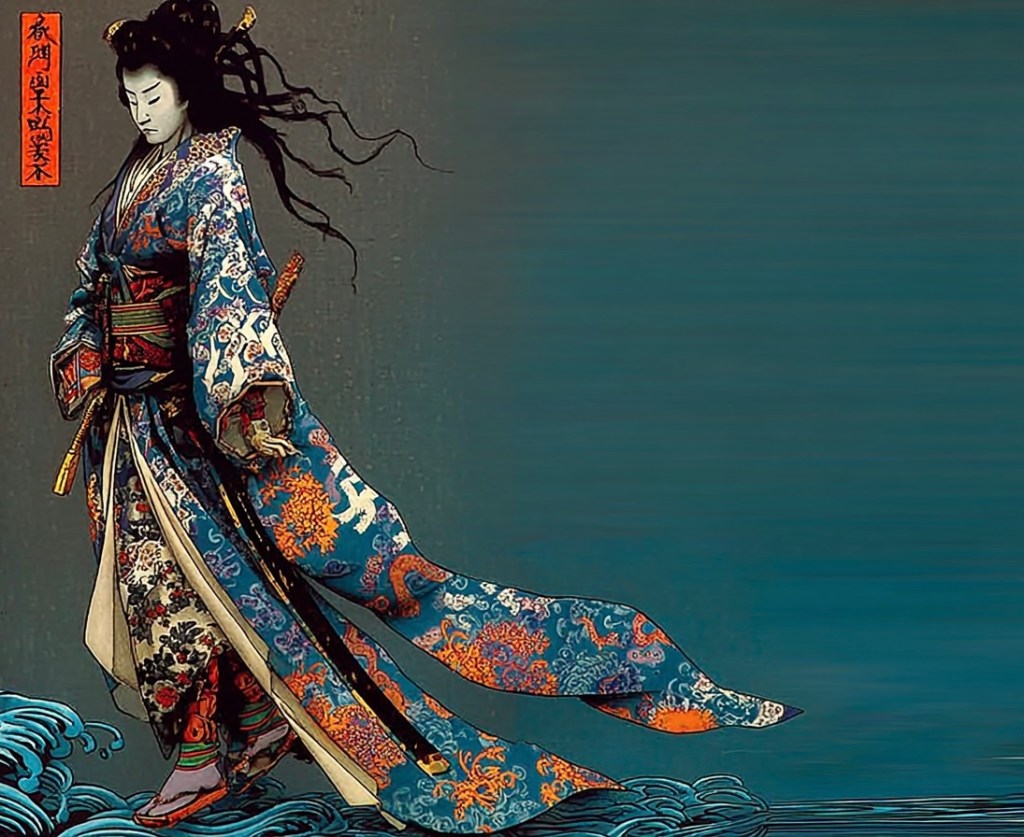
Unleashing the untold power of Japanese mythology, a deity of chaos and creation, Susanoo’s story is a journey from outcast to divine hero. This is the tale of the storm god who slayed a serpent, shaped a nation, and became a symbol of Japan’s soul.
Introduction
In the pantheon of Japanese mythology, few figures are as complex and contradictory as Susanoo, the storm god. Born from the divine breath of Izanagi, Susanoo is a deity of paradoxes—a god of chaos and creativity, destruction and protection, banishment and heroism. His story, etched into Japan’s oldest chronicles, reveals a divine rebel whose legacy shaped Japan’s spiritual and cultural landscape.
A Stormy Genealogy
Susanoo’s origin is as dramatic as his nature. In the Kojiki and Nihon Shoki, Susanoo is born from the nose of Izanagi, the creator god, while his siblings, Amaterasu (goddess of the sun) and Tsukuyomi (god of the moon), emerge from Izanagi’s eyes. From his first breath, Susanoo was destined for a turbulent existence.
As the god of storms and the sea, Susanoo’s tempestuous nature was evident from the start. Unlike his celestial siblings, he was unruly and prone to fits of rage—a reflection of the storms he represented. His very essence was tied to the uncontrollable forces of nature.
The Many Names of a Complex God
Susanoo’s names reveal his multifaceted nature. As Takehaya-Susanoo-no-Mikoto (The Brave-Swift-Impetuous-Male), he embodies heroic vigor. His alternate names—Kushimikenu-no-Mikoto (The Wondrous God of the Combs) and Gozu Tennō (Ox-Headed Heavenly King)—reflect his diverse aspects as a culture hero, protector, and deity of pestilence.
These names are not merely titles but windows into his complex character. He is both the “Brave-Swift-Impetuous-Male” and the “Wondrous God of the Combs,” a creator and destroyer who defies simple categorization.
A Mythological Reckoning
Susanoo’s mythology is a study in duality. His infamous rampage in the High Plain of Heaven, where he destroyed rice fields and desecrated his sister’s weaving hall, is a well-known tale of divine misconduct. Yet this same deity, after being exiled, performed one of mythology’s greatest heroic deeds.
The Yamata no Orochi myth remains Susanoo’s most famous exploit. The eight-headed, eight-tailed serpent had terrorized Izumo, demanding the sacrifice of local maidens. Susanoo, arriving in the land, not only defeated the monster but discovered the sacred Kusanagi sword in its tail—one of Japan’s imperial regalia. This act transformed him from a troublemaker into a cultural hero.
Divine Family Ties and Divine Rivalry
Susanoo’s relationship with his sister Amaterasu is the central conflict of his mythology. Their legendary confrontation—beginning with Susanoo’s destructive rampage and culminating in Amaterasu’s retreat to the Ama-no-Iwato cave—represents the eternal tension between order and chaos, sun and storm.
His family life reveals a more nurturing side. With his wife Kushinadahime (the princess he saved from the Orochi) and other consorts, Susanoo fathered numerous deities, including the legendary Ōkuninushi, a principal kami in Izumo mythology. His children and descendants would become major deities in their own right.
The Scholar’s Analysis
From an academic perspective, Susanoo’s myth cycle represents a profound exploration of Japanese cultural values. Unlike Western dichotomies of good and evil, Susanoo embodies the Japanese concept of amae—the interdependence of positive and negative traits within a single being.
His banishment from the heavenly realm and subsequent heroism in Izumo reflect historical tensions between the Yamato court (aligned with Amaterasu) and the Izumo region’s indigenous power. The myths may encode real historical conflicts and power struggles between ancient Japanese clans.
The Susanoo Cult and Worship
Susanoo’s worship is a complex tapestry across Japan. From the Kumano Grand Shrine to the Yasaka Shrine in Kyoto (formerly the Gion Shrine), Susanoo’s worship is often syncretic, blending Shinto and Buddhist elements. The Gion Matsuri, one of Japan’s most famous festivals, originally honored Susanoo as a protector against plagues and disasters.
Susanoo on Stage
In Noh and Kabuki, Susanoo appears as a dynamic, sometimes comic figure. The Noh play “Hakurakuten” features Susanoo as a central figure, while Kabuki has dramatized his heroic deeds. These performances reveal how Susanoo evolved from a mythological figure to a cultural symbol.
The God’s Journey Beyond Japan
Susanoo’s influence extends beyond Japan’s shores. In Korean shamanism, certain mountain gods and warrior deities show striking parallels to Susanoo’s stormy temperament. His mythic pattern—the divine outcast who redeems himself through heroic deeds—resonates with global trickster-hero archetypes from Loki to Prometheus.
During Japan’s imperial expansion, Susanoo was even appropriated for nationalist purposes, with some scholars (like Shiratori Kurakichi) claiming him as a common ancestor linking Japan and Korea. This political use of mythology reveals how ancient gods serve modern agendas.
Conclusion: The Enduring Storm
Susanoo’s legacy is a paradox—like the storm he represents, he is both destructive and life-giving, chaotic and creative. His journey from heavenly outcast to cultural hero mirrors the human experience: flawed, dynamic, and ultimately redemptive.
In modern Japan, Susanoo’s spirit endures. He appears in manga, anime, and video games, a testament to his lasting appeal. As a symbol, he represents the untamable forces of nature and the human spirit’s capacity for transformation.

* Chamberlain, B. H. (1882). The Kojiki: Records of Ancient Matters. Tuttle Publishing.
* Aston, W. G. (1896). Nihongi: Chronicles of Japan from the Earliest Times to A.D. 697. Kegan Paul.
* Bock, F. M. (1970). Engi-Shiki: Procedures of the Engl Era. Sophia University.
* Kidder, J. E. (1993). The Lucky Seventh: Early Hōryū-ji and Its Time. Asahi Shinbun.
* Statler, O. (1983). Japanese Pilgrimage. University of Hawaii Press.
 Wicked Dual Blog
[…] siblings in Japanese mythology. The story of the Three Noble Children—Amaterasu, Tsukuyomi, and Susanoo—isn’t just another creation myth. It’s the foundational narrative that explains the […]
LikeLike