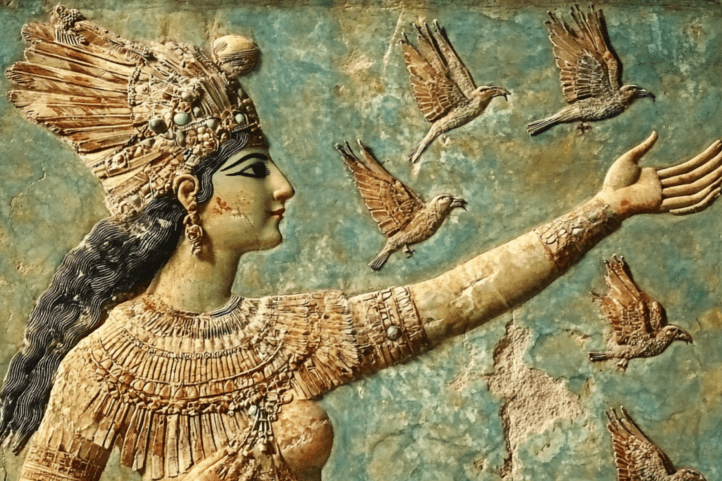
Prologue: The Lady of the Infinite Heavens
In the crimson glow of dawn, where the Tigris and Euphrates rivers carve their paths through sun-baked earth, a city once thrived. Its name was Uruk, a place of towering ziggurats and whispered prayers. At its heart stood a temple whose walls shimmered with lapis lazuli and gold, dedicated to a goddess whose voice echoed in the roar of lions and the sigh of lovers. She was the morning and evening star, a beacon of desire and destruction. Her priests spoke of her in paradoxes: a maiden who wielded lightning, a lover who devoured kings, a queen who walked willingly into the land of the dead. They called her the “Heart of Heaven,” the “Unquenchable Flame,” and in the same breath, the “Storm of Vengeance.” Yet her truest name remained unspoken until the final refrain of every hymn, a secret etched into clay and soul.
This is the story of a deity who transcended time—a goddess of such profound complexity that her essence shaped empires, inspired humanity’s first poets, and still lingers in the shadows of modern myth. Her name, reserved for the moment when the tale’s threads converge, is Inanna.
Birth of a Cosmic Sovereign
Long before Babylon’s hanging gardens or Assyria’s chariots, the Sumerians sang her into being. She emerged not from the womb of a mother, but from the collective yearning of a people who saw divinity in the storm and the harvest. To them, she was Ninanna—“Lady of the Sky”—a title that belied her earthly dominion. Her earliest hymns, inscribed on tablets now crumbling in Iraq’s deserts, reveal her dual nature: she was both the tender rain nurturing barley fields and the wildfire consuming enemy armies.
In the city of Uruk, farmers knelt in the mud of spring, offering barley cakes and honey to her altars. Warriors, too, invoked her before battle, their bronze swords glinting like her celestial twin, Venus. A hymn from the temple of Eanna captures her duality: “You are the lioness of heaven, tearing flesh, yet your hands are filled with milk for the orphan.” Here, Inanna was both nurturer and destroyer, her capriciousness mirroring the unpredictability of life itself.
As empires rose—Akkad, Babylon, Assyria—her identity expanded. The Semites named her Ishtar, grafting her onto their own pantheon, yet her core remained unchanged. She was the divine paradox: a warrior cradling an infant, a lover weeping over a corpse. Her symbol, an eight-pointed star, adorned temple walls and royal seals, a reminder that her power spanned the eight directions of the cosmos. Even Sargon the Great, conqueror of Sumer, claimed her favor, declaring, “Inanna, the Wild Cow, has chosen me to shepherd the nations.”
The Myths That Forged Civilization
The Descent: A Love Letter to Death
Her most enduring tale begins with a rebellion. Dissatisfied with her celestial throne, she turned her gaze downward, to the Kur—the sunless realm ruled by her sister, Ereshkigal. Shedding her sacred robes and jewels, Inanna descended through seven gates, each stripping her of power until she stood naked before death itself. At the first gate, her crown of lapis lazuli was torn away; at the seventh, even her skin was peeled back, leaving only raw essence. Ereshkigal, enraged by her audacity, struck her dead, hanging her corpse on a hook “like a slab of meat.”
Yet Inanna’s story did not end in darkness. Through cunning and sacrifice—her consort Dumuzi took her place in the underworld for half the year—she emerged reborn. This myth, etched on tablets in Nippur and Ur, became a metaphor for the seasons, the soul’s resilience, and the price of sovereignty. Farmers recounted it as they buried seeds in autumn, trusting Inanna’s return would coax green shoots from the soil.
The Huluppu Tree: A Garden of Shadows
In a forgotten garden, a tree grew twisted, its roots choked by serpents, its branches haunted by a demon. Inanna, ever the cultivator of order, rescued it, carving its wood into a throne and bed—symbols of her divine authority. This tale, preserved in the Epic of Gilgamesh, mirrors humanity’s struggle to tame chaos, casting Inanna as the architect of civilization. The demon Lilith, fleeing the tree’s branches, would later haunt Hebrew lore, a spectral reminder of Inanna’s unfinished battles.
Temples, Kings, and Sacred Unions
At Uruk’s Eanna Temple, her priests performed rituals as intricate as the stars. Each New Year, the king—dressed in robes spun from myth—would ascend the ziggurat’s steps to enact the Hieros Gamos, a sacred marriage symbolizing Inanna’s union with Dumuzi. Their “coupling” was no mere metaphor; clay tablets suggest it involved physical rites to ensure fertility for land and throne. A priestess, embodying the goddess, would recite: “My vulva is the horn of the cosmos, ready to plow the earth into life.”
Among her devotees was Enheduanna, history’s first named author. Daughter of Sargon of Akkad, her hymns to Inanna blurred the lines between prayer and poetry: “You flash like lightning over the high ground… Lady of all powers, you illuminate the darkness!” (ETCSL 4.07.2). Banished during a rebellion, Enheduanna wrote The Exaltation of Inanna in exile, merging her plight with the goddess’s descent into the underworld. Her words, inscribed on alabaster disks, reveal a goddess both tender and terrifying—a reflection of Enheduanna’s own political genius.
Stones That Speak Her Name
Modern explorers have unearthed her legacy. In 1849, British archaeologist William Loftus stumbled upon the ruins of Uruk, where the ziggurat’s baked bricks still bore the fingerprints of ancient laborers. The Warka Vase—a 5,000-year-old alabaster treasure—depicts offerings to her: barley, rams, and the first fruits of love, carried by nude priests in ritual procession.
In the British Museum, the Burney Relief captures her in terracotta: winged, flanked by owls, and trampling lions beneath her feet. Archaeologist Leonard Woolley, excavating Ur’s royal tombs in the 1920s, found lyres adorned with her star, their gold and lapis inlays still singing of her splendor. These artifacts are not relics but portals, whispering of a time when gods walked beside mortals.
The Immortal Flame
Inanna’s voice did not fade with Babylon’s fall. She resurfaced in Phoenician Astarte, whose sailors carved her star onto ship prows, and in Greek Aphrodite, born from sea foam and celestial strife. Even the veiled Isis of Egypt, resurrecting Osiris, echoed Inanna’s triumph over death.
Today, feminists reclaim her as an icon of agency—a deity who owned her sexuality and defied death. Authors like Diane Wolkstein reimagined her myths for modern readers, while Neil Gaiman wove her into the tapestry of American Gods, a testament to her enduring allure. At protests in Tehran and Baghdad, women invoke her name, their banners painted with the eight-pointed star.
Epilogue: The Star That Never Sets
To speak of Inanna is to speak of humanity itself—our capacity for love that ignites wars, our hunger for power tempered by compassion. She is the storm and the calm after, the seed buried in winter’s grasp, the scream of rebirth. In a world still yearning for symbols of resilience, Inanna’s star burns undimmed.
As the sun dips below Uruk’s ruins, casting long shadows over the Euphrates, one can almost hear her priests chanting: “Lady of Largest Heart, you who are the lifeblood of the world, return to us. For as long as hearts beat and stars fall, you are eternal.”
Engage with Her Legacy
– Walk the halls of the Louvre or Iraq Museum, where her statues still command reverence.
– Read Enheduanna’s hymns (ETCSL) or descend into the underworld with Wolkstein’s Queen of Heaven and Earth.
– Trace her eight-pointed star in the night sky—Venus, her celestial twin, still guides the lost.
Inanna is not a relic. She is the pulse beneath the soil, the fire in the forge, the unyielding cry for life in the face of oblivion. To know her is to remember: even gods must die to be reborn.
Foster, B. R. (2016). The age of Agade: Inventing empire in ancient Mesopotamia. Routledge.
Leick, G. (1994). Sex and eroticism in Mesopotamian literature. Routledge
Westenholz, J. G. (1997). Legends of the kings of Akkade: The texts. Eisenbrauns.
Wolkstein, D., & Kramer, S. N. (1983). Inanna: Queen of heaven and earth. Harper & Row.
 Wicked Dual Blog