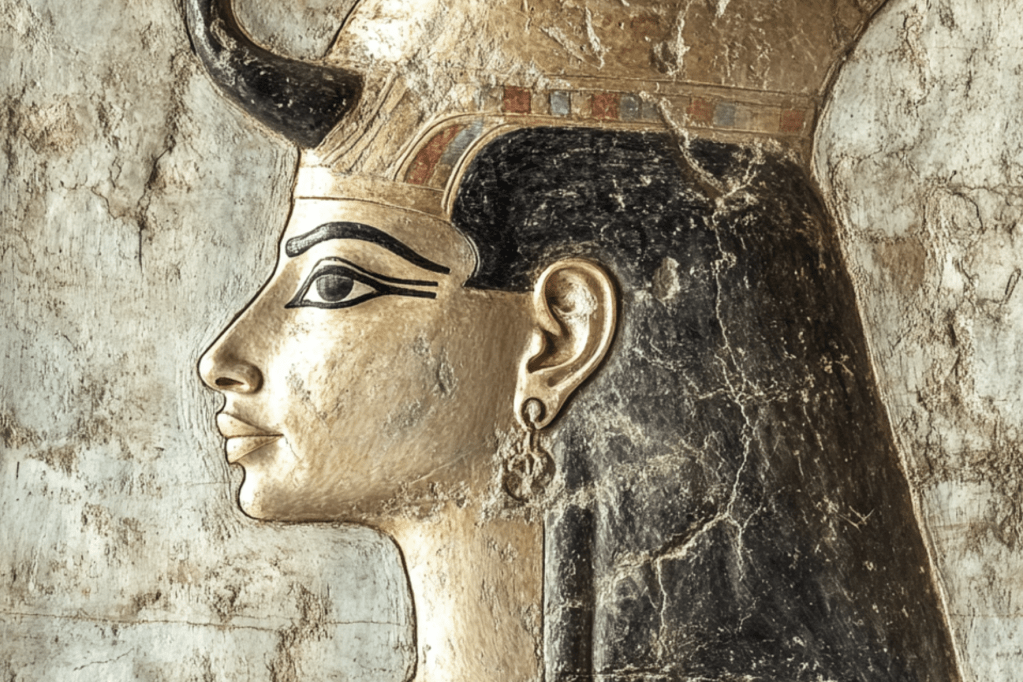
The Goddess Who Drank the Blood of Mankind
In the golden sands of ancient Egypt, where gods walked among mortals and pharaohs claimed divine lineage, there existed a deity whose laughter could birth stars—and whose wrath could drown the world in blood. Hathor, the celestial cow, mistress of music, and vengeful Eye of Ra, wove a tapestry of contradictions: she was love and war, motherhood and madness, life and destruction incarnate. Her myths and rituals transcended time, shaping Egypt’s spiritual and political landscapes. But beneath her benevolent façade lay secrets—stories of blood-stained beer, desert miners’ prayers, and pharaohs who manipulated her divine motherhood to secure power. This is the untold saga of Hathor, a goddess whose legacy challenges our understanding of ancient belief.
The Celestial Cow: Hathor’s Divine Birthright
Long before pyramids pierced the sky, early Egyptians venerated cattle goddesses whose horns cradled the heavens. The Gerzeh Palette (c. 3500–3200 BC), etched with a star-crowned bovine, hints at Hathor’s proto-forms. Yet it was during the Old Kingdom (2686–2181 BC) that she ascended to prominence, absorbing regional deities like Bat and Mehet-Weret. Egyptologist Robyn Gillam describes her as “a prism refracting the essence of femininity,” a deity whose multiplicity embodied the spectrum of womanhood.
Her symbolic power crystallized with the Narmer Palette (c. 3100 BC), where a cow-headed goddess—likely Hathor—hovers above Egypt’s first king. This imagery forged her role as the pharaohs’ divine mother, linking royalty to cosmic authority. Her iconography, from cow horns cradling a sun disk to the sistrum’s joyful rattle, reflected her duality: she was both the sky goddess birthing the sun each dawn and the patroness of fertility, music, and ecstasy.
The Eye of Ra: When Love Turned to Vengeance
Hathor’s darkest myth begins with humanity’s betrayal. In the Book of the Heavenly Cow, Ra, enraged by mortal rebellion, unleashes his Eye—Hathor—transforming her into Sekhmet, the lioness of slaughter. She ravages Egypt until fields run red, only to be pacified by Ra cunning: blood-colored beer, which she guzzles, reverting to her benevolent form. This tale, immortalized in Temple of Edfu inscriptions, explains her dual nature: life-giver and destroyer.
The myth birthed the Festival of Drunkenness, where Egyptians imbibed ritually to honor her return to grace. Yet even in her wrath, Hathor’s complexity shone. Another legend, the Distorted Goddess, sees her fleeing to Nubia as a wild lioness, lured back by Thoth’s music and dance—a testament to her cyclical dance between chaos and harmony.
Sex, Wine, and Sistrums: The Cult of Ecstasy
Hathor’s worship transcended temples, spilling into vineyards, bedrooms, and raucous festivals. Her cult thrived on sensory excess: priestesses shook sistra, their rattles echoing the rhythm of creation, while the Tekh Festival saw revelers drink to commune with the divine. Sacred sexuality underpinned her myths; her union with Horus (or Ra) symbolized cosmic balance, merging eros with celestial order.
At Dendera, her cult’s epicenter, a hidden chamber called the wabet hosted rituals where her statue “bathed” in sunlight, renewing its power. Devotees offered mirrors and menat necklaces—beaded symbols of fertility—seeking her favor. Even Cleopatra, it’s speculated, might have adorned herself with Hathor-inspired cosmetics, blending politics with divine allure.
The Queen’s Gambit: Hathor and the Politics of Power
Hathor’s bond with royalty was no accident. Pharaohs like Mentuhotep II declared themselves her sons to legitimize rule, while Hatshepsut, Egypt’s female king, fused her image with Hathor to shatter gender norms. The Beautiful Festival of the Valley epitomized this symbiosis: Amun’s statue “mated” with Hathor’s image at Deir el-Bahari, theatrically enacting the king’s rebirth.
Yet by the Ptolemaic Era (332–30 BC), Isis eclipsed Hathor, absorbing her traits into a universal cult. Clever queens like Berenice II bridged this shift, merging Hathor’s joy with Aphrodite’s allure. While Hathor’s role as “legitimizer of pharaohs” waned, her essence endured in Isis’s magic and Aphrodite’s charm—a testament to her adaptability.
Beyond Egypt: The Global Goddess
Hathor’s influence stretched far beyond the Nile. In Byblos, she merged with Baalat Gebal, patroness of Lebanon’s cedar trade. Nubian miners prayed to her as “Lady of Turquoise” at Serabit el-Khadim, leaving stelae thanking her for safe hauls. Mycenaean pendants (16th century BC) bore her face, linking her to Grecian afterlife beliefs. Even the Pyramid Texts revered her as “Hathor of the Four Faces,” a guardian watching the cardinal directions from Ra’s solar barque.
The Goddess Who Never Dies
Hathor’s legacy lingers in unexpected corners: Hindu cow-goddesses, the euphoria of music festivals, the crimson swirl of wine in a glass. Yet her decline begs questions: Was her eclipse by Isis a theological shift, a political maneuver, or humanity’s evolving thirst for divine metaphors? Perhaps her true power lay in her paradoxes—the fusion of creation and destruction, love and rage—that still resonate today.

A comprehensive overview of Hathor’s mythology, iconography, and historical evolution.
2. Lesko, Barbara S.
University of Oklahoma Press, 1999.
Explores the roles of Hathor, Isis, and other Egyptian goddesses in religious and cultural contexts.
3. Hornung, Erik
Conceptions of God in Ancient Egypt: The One and the Many.
Cornell University Press, 1982.
Analyzes the fluidity of Egyptian deities, including Hathor’s syncretic identities.
4. Teeter, Emily
Religion and Ritual in Ancient Egypt.
Cambridge University Press, 2011.
Examines temple rituals, festivals, and Hathor’s role in daily worship.
5. Metropolitan Museum of Art Online Collection
Search “Hathor” to view artifacts like sistra, statues, and reliefs depicting the goddess.
 Wicked Dual Blog