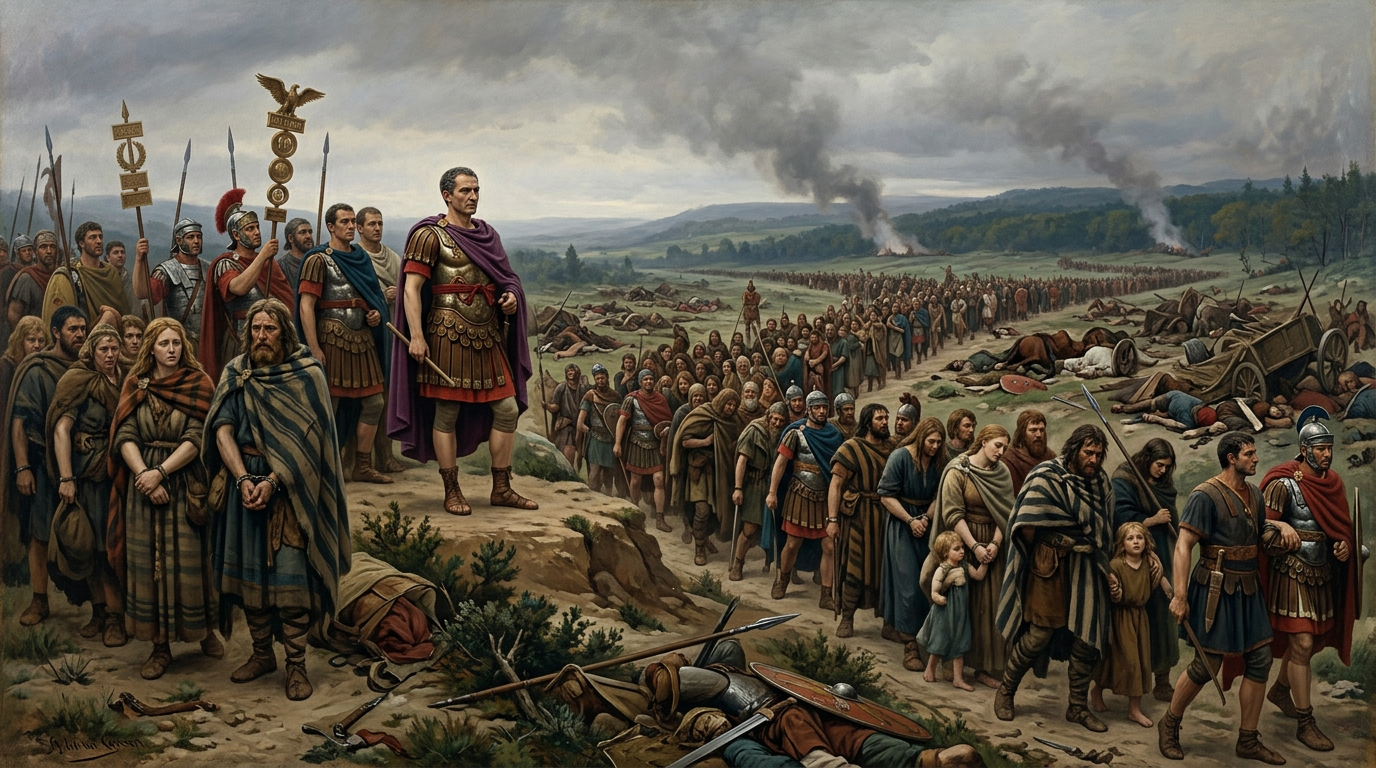
with His Life, His Scandals, and His Death

“He fought fifty pitched battles, and was the only commander to surpass Marcus Marcellus, who fought thirty-nine. For my part, I would not count it to his glory that, besides the civil wars, he killed one million one hundred and ninety-two thousand human beings.” — after Pliny the Elder, Natural History 7.92
An Archival Chronicle Prepared for the Discerning Collector
Compiled by the Archivist of the Unseen
Contents
I. The Ides of March
II. The Question and the Two Lenses
III. A Patrician Without Money
IV. The Scandals
V. Gaul, 58 to 50 BCE
VI. Field Study — The Numbers
VII. Field Study — The Ancient Lens
VIII. Field Study — The Modern Lens
IX. Across the Rubicon
X. Twenty-Three Wounds
XI. Field Study — The Ledger of Charges
XII. The Archivist’s Verdict
Summary
Bibliography
I. The Ides of March
Rome, the fifteenth of March, 44 BCE. The Senate is meeting not in its usual house but in a hall attached to the great theatre built by Pompey the Great, the man Caesar defeated four years before. A statue of Pompey stands in the chamber.
Caesar arrives late. His wife, Calpurnia, dreamed in the night that she held his murdered body, and begged him not to go. The omens at the morning sacrifice were bad. A friend, Decimus Brutus, who is one of the conspirators, has persuaded him not to disappoint the Senate. On the way, the soothsayer Spurinna, who weeks before had warned him of danger lasting until the Ides of March, is in the crowd. Caesar remarks that the Ides have come. They have come, says Spurinna, but they have not gone.
In the hall, a senator approaches with a petition and seizes Caesar’s toga. Another strikes at his neck with a dagger. Within moments he is surrounded. Senators who owe him their lives and careers stab at him, wounding one another in their haste. When he sees Marcus Brutus among them, he is said to draw his toga over his face. He falls at the foot of Pompey’s statue, and lies there, with twenty-three wounds.
Gaius Julius Caesar was fifty-five years old. He had conquered Gaul, crossed the Rhine and the Channel, won a civil war against the greatest general of his age, made himself dictator for life, and reshaped the Roman calendar. He had also, by the reckoning of ancient writers, killed more than a million people in Gaul and enslaved a million more.
This last fact has led some modern historians to ask a question that the Romans never asked in these terms: was Julius Caesar guilty of genocide?
This field study examines that question through two lenses, the standards of Caesar’s own world and the standards of ours, after setting out his life, his scandals, his wars, and his death. It is prepared for the sober student of power and its costs, who wishes neither to excuse the past nor to judge it without understanding.
❧ ❧ ❧
II. The Question and the Two Lenses
The word genocide did not exist until 1944, when the Polish-Jewish jurist Raphael Lemkin coined it to describe the Nazi destruction of peoples. In 1948 the United Nations adopted the Convention on the Prevention and Punishment of the Crime of Genocide, which defines genocide as certain acts committed with intent to destroy, in whole or in part, a national, ethnical, racial, or religious group, as such. The acts include killing members of the group, causing serious bodily or mental harm, deliberately inflicting conditions of life calculated to bring about its physical destruction, preventing births, and forcibly transferring children.
Two features of this definition matter greatly. First, the crime requires a specific intent: the intent to destroy a group as such, not merely to win a war, punish a rebellion, or seize land and slaves. Second, the definition does not include every form of mass violence. Mass killing in war, mass enslavement, and the destruction of a culture may be terrible crimes without meeting the legal definition of genocide.
The Problem of Anachronism
To apply this twentieth-century legal concept to a Roman general of the first century BCE raises an obvious difficulty. Caesar could not have broken a law that did not exist, and he acted in a world with very different ideas about war, conquest, and the rights of the defeated. Some historians therefore regard the question as meaningless. Others answer that the purpose is not to put Caesar on trial but to name what happened clearly, and that a concept developed to describe the destruction of peoples can legitimately be used to analyse the destruction of peoples in any period.
The Method
The Archivist will therefore ask two separate questions. Judged by the standards of his own world, was Caesar’s conduct in Gaul acceptable, excessive, or criminal? And judged by the modern definition of genocide, do any of his acts meet it? The answers, as will be seen, are not the same.
❧ ❧ ❧
III. A Patrician Without Money
Birth and Family
Gaius Julius Caesar was born in Rome in July 100 BCE, probably on the 12th or 13th, into the Julii, one of the oldest patrician families of Rome. The family claimed descent from Iulus, son of the Trojan hero Aeneas, and through him from the goddess Venus. For all its ancient prestige, the family was not rich and had produced few great politicians in recent generations. Its most important connection was through Caesar’s aunt Julia, who had married Gaius Marius, the great general and leader of the popular faction in Roman politics.
Defying Sulla
That connection nearly killed him. When Lucius Cornelius Sulla, Marius’s enemy, seized control of Rome in 82 BCE and published his proscriptions, lists of enemies who could be killed on sight, the teenage Caesar was in danger. He had married Cornelia, daughter of Marius’s ally Cinna. Sulla ordered him to divorce her. Caesar refused. He lost his priesthood and his wife’s dowry and went into hiding, until the intercession of influential relatives won his pardon. Sulla is said to have remarked that in this young man there were many Mariuses.
The Pirates
One of the most famous stories of Caesar’s youth concerns his capture by pirates in the Aegean around 75 BCE. According to Plutarch and Suetonius, when the pirates demanded a ransom of twenty talents, Caesar laughed and told them he was worth at least fifty. During the weeks of his captivity he joined in their games, read them his poetry, called them barbarians when they did not admire it, and told them, as though in jest, that he would have them crucified. When the ransom was paid and he was released, he raised a small fleet, captured them, and had them crucified, though, Suetonius adds, he had their throats cut first as an act of mercy. The story has surely grown in the telling, but it captures what Romans saw in him: charm, audacity, and a ruthlessness that kept its word.
The Climb
Caesar rose through the offices of the Roman state with a mixture of brilliance, extravagance, and debt. As aedile in 65 BCE he staged lavish games. In 63 BCE he was elected pontifex maximus, chief priest of the Roman state religion, after an expensive campaign; legend says he told his mother on the morning of the vote that he would return as pontifex maximus or not at all. In the same year he spoke in the Senate against executing the Catilinarian conspirators without trial, a stand that brought suspicion on him. After a governorship in Spain he returned to win the consulship for 59 BCE, through an informal alliance with the two most powerful men in Rome: Pompey the Great and Marcus Licinius Crassus. Modern historians call this alliance the First Triumvirate.
❧ ❧ ❧
IV. The Scandals
Caesar’s life was accompanied by scandal from beginning to end. Some of the stories are well attested; others were the political abuse of his enemies, which Roman politics expected and enjoyed.
The Queen of Bithynia
As a young man, Caesar was sent on a mission to King Nicomedes IV of Bithynia, and lingered at his court. His enemies claimed that he had a sexual relationship with the king, and for the rest of his life they mocked him for it: Suetonius records that he was called the Queen of Bithynia, and that his own soldiers sang about it at his triumph. Caesar denied the story, reportedly under oath. Whether it was true cannot be known. The insult lay not in the idea of a relationship between men as such but in the claim that a Roman noble had taken the submissive part with a foreign king.
Caesar’s Wife
In December 62 BCE, the rites of the Bona Dea, the Good Goddess, which only women could attend, were held in Caesar’s house, hosted by his second wife, Pompeia. A young aristocrat, Publius Clodius Pulcher, was discovered at the rites disguised as a woman, reportedly to pursue Pompeia. The scandal was enormous. Caesar divorced Pompeia but, when called as a witness at Clodius’s trial for sacrilege, said he knew nothing against him. Asked why, then, he had divorced his wife, he is said to have answered that Caesar’s wife must be above suspicion. The phrase became proverbial.
The Debts
Caesar spent with breathtaking abandon. By the time he left for his governorship in Spain he owed enormous sums, and his creditors tried to prevent his departure until Crassus stood surety for a large part of the debt. Much of Caesar’s later career, including his conquests, can be understood partly as a way of paying for his ambition. The wars in Gaul made him one of the richest men in the Roman world, much of that wealth coming from the sale of captives as slaves.
The Consulship of Julius and Caesar
As consul in 59 BCE, Caesar pushed through his laws by methods his opponents considered illegal. His colleague, Marcus Calpurnius Bibulus, tried to block him by declaring unfavourable omens and was driven from the Forum, with a basket of dung reportedly emptied over his head. Bibulus withdrew to his house for the rest of the year. Romans joked that it was the consulship of Julius and Caesar. These actions later gave his enemies grounds to threaten him with prosecution, which helped drive him to civil war.
Women
Caesar was famous for his affairs with the wives of other senators. His longest relationship was with Servilia, mother of Marcus Brutus, the man who would help kill him; the gossip that Caesar was Brutus’s father is chronologically unlikely. His most famous affair was with Cleopatra VII of Egypt, which began in 48 BCE and produced a son, Ptolemy Caesar, known as Caesarion. Caesar brought Cleopatra to Rome and installed her in his villa across the Tiber, to the scandal of Roman society, while still married to his third wife, Calpurnia.
❧ ❧ ❧
V. Gaul, 58 to 50 BCE
After his consulship, Caesar received a command of unprecedented length over Cisalpine Gaul, Illyricum, and Transalpine Gaul. Over the next eight years he conquered the whole of Gaul, the territory of modern France, Belgium, and parts of the Netherlands, Germany, and Switzerland. He recorded the war in his Commentaries on the Gallic War, written in the third person in a style of deliberate plainness, and designed to present his actions to the Roman public in the best possible light. Almost everything known about the war comes from his own account.
The Helvetii, 58 BCE
The war began when the Helvetii, a people of what is now Switzerland, attempted to migrate westward. Caesar blocked them and defeated them at Bibracte. By his own figures, records found in the Helvetian camp listed 368,000 people at the start of the migration, of whom about 110,000 returned home. The figures are almost certainly exaggerated, but they suggest the scale of death he was willing to claim.
The Usipetes and Tencteri, 55 BCE
In 55 BCE two Germanic peoples, the Usipetes and Tencteri, crossed the Rhine into Gaul, driven, Caesar says, by pressure from the Suebi. While negotiations were under way, and after a skirmish, Caesar detained their leaders who had come to his camp, and then fell upon their leaderless camp. His army killed the people in it, including women and children, who fled to the confluence of the Meuse and the Rhine and perished there. Caesar claims the two peoples had numbered 430,000, and that his own army suffered no deaths.
In 2015 the archaeologist Nico Roymans of the Vrije Universiteit Amsterdam announced that this massacre had probably been located at Kessel, in the southern Netherlands, where skeletal remains of men, women, and children with sword and spear injuries had been recovered from the old bed of the Meuse, together with weapons and a helmet. Roymans’s team suggested that the dead may have numbered well over one hundred thousand. It is one of the few places where Caesar’s narrative of mass killing can be tested against physical evidence.
The Eburones, 53 BCE
In the winter of 54 to 53 BCE, the Eburones of northeastern Gaul, led by Ambiorix, ambushed and destroyed a Roman force of about fifteen cohorts. Caesar’s response was ferocious. He ravaged their territory and invited neighbouring peoples to join in plundering it. In his own words, he wished that, for such a crime, the stock and name of the state be wiped out: stirps ac nomen civitatis tollatur. The Eburones largely disappear from history afterward.
Avaricum and Alesia, 52 BCE
In 52 BCE much of Gaul rose under the Arvernian leader Vercingetorix. At the siege of Avaricum, modern Bourges, Caesar’s troops stormed the town and, according to Caesar, spared neither the old, nor women, nor children; of some 40,000 people, he says, barely 800 escaped. At Alesia, Caesar besieged Vercingetorix with two lines of fortifications and defeated a vast relieving army. Before the end, the defenders expelled the women, children, and elderly of the town, hoping the Romans would let them pass. Caesar refused to let them through his lines, and they were left to starve between the walls. Vercingetorix surrendered and was held captive for six years before being displayed in Caesar’s triumph and executed.
Uxellodunum, 51 BCE
At Uxellodunum, one of the last centres of resistance, Caesar ordered that all who had borne arms against him should have their hands cut off and be let go, so that all might see the punishment of rebellion. The account is preserved in the eighth book of the Commentaries, completed by his officer Aulus Hirtius, which says that Caesar knew his clemency was well known and did not fear that this act would be thought cruelty.
❧ ❧ ❧
VI. Field Study — The Numbers
The ancient sources give staggering figures for the human cost of the Gallic War.
Pliny the Elder, writing about a century later, records that Caesar killed 1,192,000 people in his wars, not counting the civil wars. Plutarch says that in Gaul Caesar fought against three million men, killed one million, and took another million captive. Velleius Paterculus and other writers give comparable totals. Caesar himself supplies many of the figures for individual battles.
Can the Numbers Be Trusted?
Almost certainly not as exact figures. Ancient writers rounded freely, and Caesar had every reason to inflate the numbers of his enemies to magnify his victories. Roman commanders were entitled to a triumph only after killing a large number of enemies in a single battle, and the numbers mattered politically. Estimates of the population of Gaul at the time vary widely, but are often placed somewhere in the region of five to ten million. Even if the ancient totals are greatly exaggerated, the war killed and enslaved a very large proportion of the population of Gaul, and certain peoples suffered catastrophic losses.
The Slaves
The million captives are as important as the million dead. Captives were sold into slavery, often to traders who followed Roman armies. The sale of captives was a principal source of the wealth that Caesar and his officers brought back from Gaul. In some cases, such as the Aduatuci in 57 BCE, Caesar records selling an entire population: 53,000 people, according to the buyers’ count. Mass enslavement destroyed communities as surely as massacre, scattering families and ending the existence of peoples as distinct groups.
❧ ❧ ❧
VII. Field Study — The Ancient Lens
How did Caesar’s own world judge his conduct?
The Law of War
Roman custom, like that of most ancient states, gave a victor sweeping rights over the defeated. A city taken by storm could be sacked, its men killed, its women and children enslaved. A people that broke faith with Rome, rebelled after submission, or attacked Roman forces could expect harsh punishment, sometimes total destruction. Rome itself had destroyed Carthage and Corinth in 146 BCE. Within this framework, much of what Caesar did in Gaul, the sacking of Avaricum, the selling of the Aduatuci, the punishment at Uxellodunum, would have seemed to most Romans harsh but legitimate. The Romans believed in the idea of a just war, bellum iustum, but that idea governed the reasons for going to war, not the limits of violence once war began.
Clemency
Caesar made a political virtue of clementia, mercy. He spared enemies, especially Roman citizens in the civil war, and advertised his mercy as a mark of his greatness. The Hirtius passage on Uxellodunum shows how mercy and terror could be presented as two sides of the same policy: Caesar could afford a terrible example precisely because his clemency was famous. As Kurt Raaflaub has argued, Caesar was simultaneously a brutal conqueror and a self-consciously merciful victor.
Cato’s Protest
Even by Roman standards, however, some of Caesar’s acts went too far. After the massacre of the Usipetes and Tencteri in 55 BCE, Marcus Porcius Cato proposed in the Senate that Caesar be handed over to the Germans, to expiate the breach of faith in attacking people during negotiations. Cato was Caesar’s bitter political enemy, and his motive was partly political. But the argument he made was moral and religious: that Caesar had violated the good faith that protected envoys and truces, and that Rome risked divine anger unless it disowned him. The proposal failed. It shows that Romans could recognize conduct in war as criminal.
Pliny’s Judgement
Pliny the Elder, recording the figure of 1,192,000 dead, refused to count it to Caesar’s glory, calling it a great wrong done to the human race, humani generis iniuria. This is a remarkable judgement from a Roman writer, and it shows that the ancient world was not without voices that measured conquest in human lives.
The Silent Side
What is missing from the ancient lens is the Gallic view. The Gauls left no written history of the conquest. Everything known of their suffering comes from the conqueror’s own account, written to justify him. The ancient lens, in other words, is a Roman lens.
❧ ❧ ❧
VIII. Field Study — The Modern Lens
How does Caesar’s conduct measure against the modern definition of genocide? The answer varies by episode.
The General Conquest
The conquest of Gaul as a whole was a war of imperial expansion, aimed at subjugation, plunder, and political glory, not at the destruction of the Gauls as a people. Caesar wanted Gaul conquered, taxed, and governed, not empty. Most of its peoples survived the war and became part of the Roman provinces. Judged as a whole, the war involved mass killing and mass enslavement on a scale that modern law would classify as war crimes and crimes against humanity, but its overall purpose was not genocidal in the legal sense.
The Usipetes and Tencteri
The attack on the Usipetes and Tencteri is a harder case. Caesar attacked an entire migrating population, including women and children, while their leaders were detained in his camp, and claims to have destroyed it. If his own account is accepted, his forces killed much of two peoples in a single action, with no Roman losses, which implies slaughter rather than battle. Whether the intent was to destroy the peoples as such, or to eliminate a military threat by overwhelming violence, is debated. Many modern historians regard this episode as a massacre that comes very close to, or crosses into, genocide.
The Eburones
The Eburones present the clearest case. Here Caesar himself stated an intention that the people and the name of their state should be destroyed, and he invited neighbouring peoples to help. In the 2023 Cambridge World History of Genocide, the historian Tristan Taylor identifies this as an expression of genocidal intent, a wish to destroy a people as such. The Eburones largely disappear from the record afterward, though some may have survived and been absorbed by their neighbours. By the modern definition, which requires the intent to destroy a group in whole or in part, Caesar’s own words come very close to a confession.
Mass Enslavement
Taylor also notes that mass enslavement falls outside the modern legal definition of genocide, but that it could end a people’s existence just as effectively, by scattering them across the slave markets of the Mediterranean. The sale of the Aduatuci is an example. Modern law would treat it as a crime against humanity rather than genocide, but its effect on the people concerned was similar.
The Scholarly Debate
Kurt Raaflaub, in a 2021 article, asked whether it is fair to judge Caesar by a legal concept only recently formalized, and argued for understanding his actions within the norms of Roman and ancient imperial warfare, while not excusing them. Taylor, Ben Kiernan, and other genocide scholars have argued that the concept can be applied to ancient cases, and that specific episodes of the Gallic War meet it. The archaeological work of Nico Roymans has given new physical weight to the debate. There is broad agreement that Caesar’s conquest of Gaul was among the most violent campaigns of the ancient world; there is disagreement on whether the word genocide is the right one for all or part of it.
❧ ❧ ❧
IX. Across the Rubicon
By 50 BCE Caesar’s enemies in Rome were determined to strip him of his command and prosecute him for the illegalities of his consulship. Crassus was dead, killed at Carrhae in 53 BCE, and Caesar’s daughter Julia, who had been married to Pompey and had held the alliance together, had died in childbirth in 54 BCE. Pompey had drawn closer to Caesar’s enemies.
In January 49 BCE, the Senate ordered Caesar to lay down his command. Instead, he led a legion across the Rubicon, the small river marking the boundary of his province, into Italy. To bring an army into Italy was an act of war against the state. Suetonius reports that he said “the die is cast.” Pompey and much of the Senate fled Italy.
The Civil War
The war that followed lasted four years and was fought across the Roman world. Caesar defeated Pompey’s forces in Spain, then Pompey himself at Pharsalus in Greece in 48 BCE. Pompey fled to Egypt, where he was murdered on the orders of the advisers of the young king Ptolemy XIII, who hoped to please Caesar. When Caesar arrived and was presented with Pompey’s head, he is said to have wept.
In Egypt, Caesar took the side of Cleopatra in her struggle with her brother, and spent months in Alexandria, under siege and then in triumph. In 47 BCE he crushed Pharnaces of Pontus at Zela so quickly that he reported the victory in three words: veni, vidi, vici, I came, I saw, I conquered. He defeated the remaining republicans at Thapsus in Africa in 46 BCE, after which Cato took his own life at Utica rather than accept Caesar’s mercy, and at Munda in Spain in 45 BCE.
The Dictator
Caesar’s treatment of his Roman enemies in the civil war differed strikingly from his treatment of the Gauls. He pardoned many of those who had fought against him, including Marcus Brutus and Gaius Cassius, the men who would kill him. He reformed the calendar, creating the Julian calendar, settled veterans, extended citizenship, and planned great public works. He also accumulated powers and honors without precedent: dictator for ten years, then, in early 44 BCE, dictator perpetuo, dictator for life. At the festival of the Lupercalia in February 44 BCE, Mark Antony publicly offered him a royal diadem, which he refused; whether the episode was a test, a performance, or a provocation is still debated. To many senators, the Republic was dead in all but name.
❧ ❧ ❧
X. Twenty-Three Wounds
The Conspiracy
The conspiracy against Caesar involved some sixty senators, led by Gaius Cassius Longinus and Marcus Junius Brutus, together with Decimus Junius Brutus, one of Caesar’s most trusted officers. Their motives were mixed: devotion to the Republic, resentment of Caesar’s dominance, personal grievance, and fear for their own futures. Marcus Brutus, son of Caesar’s old lover Servilia, who claimed descent from the Brutus who had expelled the last king of Rome, was the moral figurehead of the plot. Caesar was about to leave Rome for a long war against Parthia, and the conspirators acted before he could go.
The Killing
On the Ides of March, Caesar went to the Senate despite his wife’s dreams and the omens. Mark Antony was detained outside by one of the conspirators. Lucius Tillius Cimber approached Caesar with a petition and pulled at his toga; Publius Servilius Casca struck the first blow. The conspirators fell upon him. According to Suetonius, he was struck twenty-three times. The physician Antistius, who examined the body, judged that only one of the wounds, the second, to the chest, was fatal. This is often described as the first recorded autopsy.
The Last Words
Suetonius reports that Caesar said nothing, but adds that some writers claimed that, on seeing Marcus Brutus, he said in Greek, kai su, teknon, “You too, child?” The famous Latin “Et tu, Brute?” belongs to Shakespeare’s Julius Caesar of 1599, not to any ancient source. The ancient sources agree that he covered his face with his toga as he fell.
The Aftermath
The conspirators had expected Rome to welcome its liberation. Instead, Mark Antony’s funeral oration and the reading of Caesar’s will, which left gardens and money to the Roman people, turned the city against them. The crowd burned Caesar’s body in the Forum. The conspirators fled. Caesar’s adopted heir, his great-nephew Octavian, joined with Antony to defeat Brutus and Cassius at Philippi in 42 BCE, where both took their own lives. Caesar was officially deified. Octavian, as Augustus, became the first Roman emperor. The Republic the conspirators had meant to save did not survive.
❧ ❧ ❧
XI. Field Study — The Ledger of Charges
Established by Caesar’s Own Account
The massacre of the Usipetes and Tencteri, including women and children, during negotiations; the stated wish to destroy the stock and name of the Eburones; the slaughter at Avaricum; the starvation of non-combatants at Alesia; the sale of entire populations into slavery; the mutilation at Uxellodunum.
Reported by Ancient Writers
Totals of more than a million killed and a million enslaved in Gaul, given by Pliny and Plutarch; Pliny’s judgement that these deaths were a wrong to humankind; Cato’s proposal to surrender Caesar to the Germans.
Supported by Archaeology
The probable site of the Usipetes and Tencteri massacre at Kessel in the Netherlands, with remains of men, women, and children bearing weapon injuries.
Judged by Ancient Standards
Most of Caesar’s conduct fell within the harsh customs of ancient war. The breach of faith against the Usipetes and Tencteri was condemned by some contemporaries, and Pliny condemned the scale of killing as a whole.
Judged by Modern Standards
The conquest as a whole involved war crimes and crimes against humanity on a vast scale. The destruction of the Eburones, accompanied by a stated intent to destroy them as a people, and very probably the massacre of the Usipetes and Tencteri, meet or come close to the modern definition of genocide.
❧ ❧ ❧
XII. The Archivist’s Verdict
Was Julius Caesar guilty of genocide?
By the standards of his own world, he was not a criminal in most of what he did in Gaul. He was a Roman general waging a war of conquest by the rules of ancient warfare, which allowed terrible things. Yet even his own world drew lines, and he crossed them. Cato demanded that he be handed over for breaking faith. Pliny, a century later, would not count his million dead to his glory. The ancient lens does not acquit him entirely.
By the standards of our world, the answer is more severe. The conquest of Gaul as a whole was not a genocide in the strict legal sense, because its purpose was subjugation rather than the destruction of the Gauls as such. But within it there were acts that meet, or come very close to meeting, the modern definition. In the case of the Eburones, Caesar wrote down in his own words a wish to destroy a people and its name, and acted on it. In the case of the Usipetes and Tencteri, he destroyed a migrating population, women and children included, in a single action, by his own account. If the definition of genocide is applied to the ancient world at all, these episodes belong within it.
The Archivist’s verdict is therefore this: Julius Caesar cannot be convicted of a crime that did not exist in his lifetime, and the legal question has no court. But as a historical judgement, using the modern concept as a tool of analysis rather than a charge sheet, he was responsible for at least two acts of genocidal violence within a war of conquest that, by any modern measure, involved crimes against humanity on an immense scale. That he was also a brilliant general, a gifted writer, a reformer, and a man capable of real mercy to his Roman enemies does not alter this. It only makes the contrast more striking.
He was killed by men he had pardoned, in a hall built by the rival he had defeated, at the foot of that rival’s statue. The Gauls who died in their hundreds of thousands left no account of their own. They survive only in the Commentaries of the man who killed them, in a riverbed in the Netherlands, and in Pliny’s brief refusal to call it glory.
❧ ❧ ❧
This field study is preserved as one vestige among many within the haunted archive of Wicked Dual, an artisan boutique devoted to the reclamation of history’s clandestine and silenced corners. The peoples of Gaul who perished in Caesar’s war, and who left no account of their own, are remembered here alongside the man who wrote their history.
Read the written chronicles on the blog, the Wicked Archive: www.wickeddualblog.com
Secure the physical artifacts drawn from these histories at the Wicked Dual boutique: https://www.etsy.com/shop/Wickeddual
We invite you to enter the haunted archive and secure a piece for your private collection; it is a necessary addition for those who curate the darker corners of human history.
— The Archivist of the Unseen

Bibliography
The following works include the principal ancient sources in standard translation, modern biography, recent scholarship on Caesar and genocide, archaeological work on the Gallic War, and the 1948 Convention; readers pursuing formal citation are advised to verify editions and pagination against a library catalog.
Goldsworthy, A. (2006). Caesar: Life of a colossus. Yale University Press.
United Nations. (1948). Convention on the prevention and punishment of the crime of genocide.
Related Chronicles in the Archive
Field Study No. XXVII — The Iron Maiden
Field Study No. XXIX — A Great Reckoning in a Little Room: Christopher Marlowe
Field Study No. XXXVI — The Woman at the Foot of the Stairs: Amy Robsart
Leave a Reply