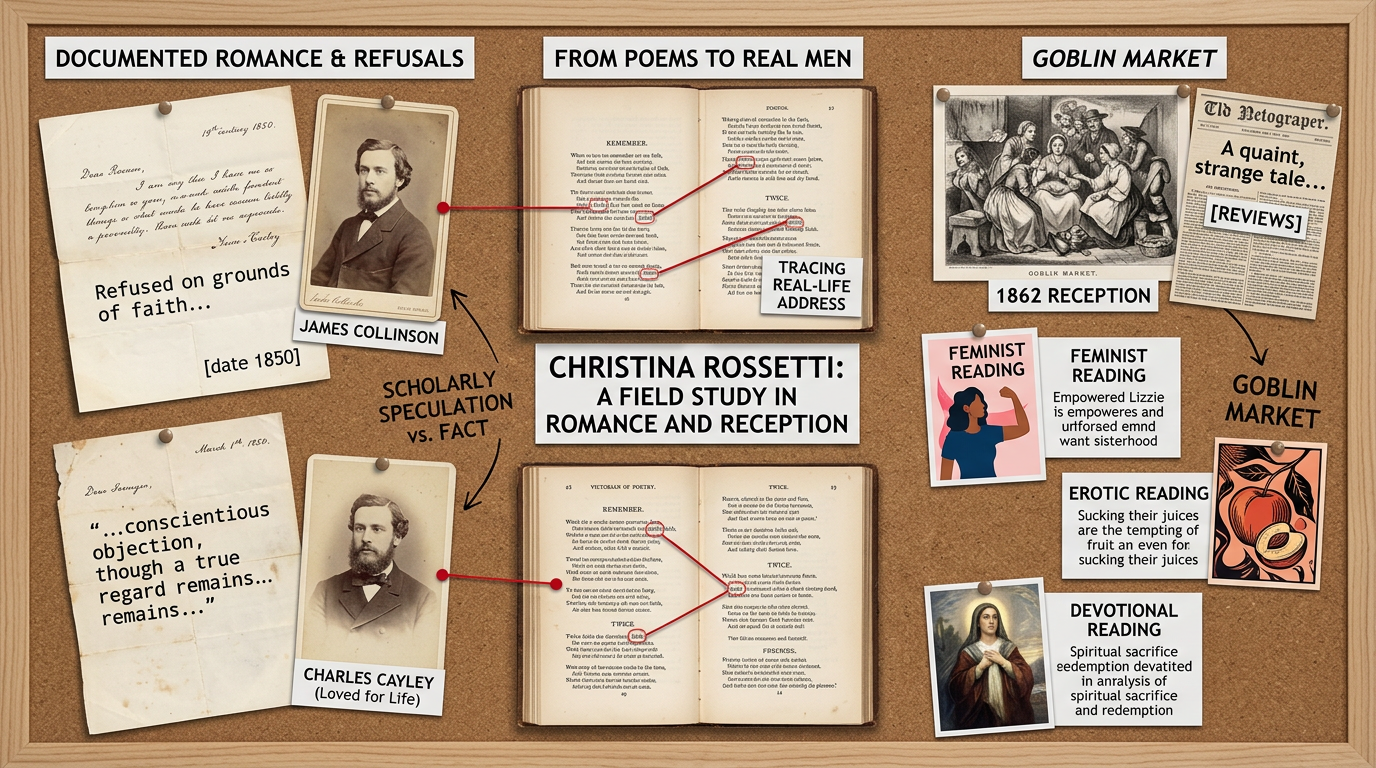
and the Forbidden Fruit of Goblin Market

“We must not look at goblin men, / We must not buy their fruits.” — Christina Rossetti, Goblin Market (1862)
An Archival Chronicle Prepared for the Discerning Collector
Compiled by the Archivist of the Unseen
Contents
I. A Parlor in Bloomsbury
II. The Question and the Method
III. James Collinson: The First Engagement
IV. Charles Cayley: The Love That Lasted
V. Field Study — The Poems That May Be Letters
VI. The Rumoured Romances
VII. The Darker Hypothesis
VIII. Goblin Market: The Poem
IX. The Reception: From the Athenaeum to Playboy
X. Field Study — Six Ways to Taste the Fruit
XI. Field Study — The Ledger of the Documented, the Probable, and the Imagined
XII. The Archivist’s Conclusion
Bibliography
I. A Parlor in Bloomsbury
London, the 1860s. A narrow house in the streets near the British Museum, full of books and Italian voices. The family is that of the late Gabriele Rossetti, exiled poet and professor of Italian, and the household is now kept by his widow and two daughters. The elder daughter, Maria, will become an Anglican nun. The younger, Christina, is already a published poet, and is about to become a famous one.
A visitor calls. He is a scholar of languages, shy, absent-minded, untidy, and gentle, who once studied Italian with Christina’s father. He is translating Dante into English. He has come, as he has come many times before, to sit with Christina, and on one of these visits he will ask her to marry him. She will refuse. She will remain unmarried for the rest of her life. And for the rest of her life, as her brother later wrote, she will love him.
Christina Georgina Rossetti, born in London on 5 December 1830 and dead there on 29 December 1894, is one of the great poets of the Victorian age. She was the sister of the painter and poet Dante Gabriel Rossetti and of the critic William Michael Rossetti, and the poetess of the Pre-Raphaelite circle. She wrote love poems of extraordinary intensity, devotional poetry of deep Anglican faith, poems for children, and Goblin Market, one of the strangest and most argued-over poems in the English language.
She also never married, refused at least two proposals, and lived a life that, on its surface, was quiet, pious, and largely domestic. The gap between that quiet life and the passion of her poetry has invited readers for more than a century to ask: was there a secret romance? Were the poems about real men? And what, exactly, was happening in Goblin Market?
This field study sets out what is documented, what is probable, and what has been imagined, and offers the thoughtful bibliophile an account of Goblin Market from its composition to its many afterlives.
❧ ❧ ❧
II. The Question and the Method
Before naming any names, two cautions are necessary, because almost every claim about Christina Rossetti’s private life depends on them.
The Poem Is Not a Diary
Rossetti wrote within a tradition of love poetry that stretches back through Petrarch and Dante to the troubadours, a tradition of longing, renunciation, absence, and the beloved who cannot be possessed. Many of her love poems use the conventions of that tradition with great artistry. A poem about lost love may be about a real lost love, or it may be a brilliant performance of a literary mode, or both. Reading every poem as autobiography leads to confident claims that the evidence cannot support.
The Brother Who Kept the Archive
Much of what is known about Christina’s inner life comes from her brother William Michael Rossetti, who edited her poems after her death, published her unpublished work, and wrote memoirs and notes identifying the occasions of many poems. He knew her intimately and is an indispensable witness. He was also an editor with his own views, and he shaped the record. Some of his identifications are firmly based; others are his interpretation. Where a link between a poem and a man rests on William Michael alone, that should be understood.
❧ ❧ ❧
III. James Collinson: The First Engagement
Christina’s first suitor was James Collinson, a painter and one of the seven original members of the Pre-Raphaelite Brotherhood, founded in 1848 by her brother Dante Gabriel and his friends.
A Question of Faith
Collinson was a convert to Roman Catholicism. When he first proposed, Christina, a devout High Church Anglican, refused him on that ground. He then returned to the Church of England, and she accepted him. They were engaged in 1848, when she was seventeen. Within about two years, Collinson reverted to Catholicism, and Christina broke off the engagement. He later withdrew from the Pre-Raphaelite Brotherhood and for a time entered a Jesuit community, though he did not remain there.
The Cost
The end of the engagement appears to have affected Christina deeply. William Michael recorded that her health declined after it, and that some time later, on seeing Collinson unexpectedly in the street, she fainted. Whether she loved Collinson as a man, or loved the idea of the engagement, is difficult to say. What is clear is the pattern it established: Christina would not marry outside her faith, however much it cost her.
The Poems of the Period
Several of Rossetti’s most famous early lyrics date from these years, including “Song” (“When I am dead, my dearest”), written in 1848, and the sonnet “Remember,” written in 1849. Both imagine the speaker’s death and ask the beloved to remember, or to forget. It is natural to read them in the light of the engagement, and some critics do. But they are also exercises in a mode Rossetti loved from girlhood, the poetry of death and remembrance, and she had written verses in that vein before Collinson ever proposed. The connection is plausible, not proven.
❧ ❧ ❧
IV. Charles Cayley: The Love That Lasted
The great love of Christina Rossetti’s life, on the testimony of her brother, was Charles Bagot Cayley.
The Man
Cayley, born in 1823 in St Petersburg to an English merchant family, was a linguist and translator, and a former pupil of Christina’s father. He translated Dante’s Divine Comedy into English in the original terza rima, a work of real distinction, and also produced versions of Homer, Aeschylus, and Petrarch. By all accounts he was learned, unworldly, gentle, absent-minded, and shabby, and the Rossetti family regarded him with affection mixed with amusement.
The Proposal and the Refusal
Christina appears to have been in love with Cayley from the early 1860s. He proposed in 1866. She refused. The reason, according to William Michael, was religious: she enquired into his beliefs and found he was not a Christian. Cayley is usually described as an agnostic. For Christina, as with Collinson, a marriage that divided husband and wife in matters of faith was impossible, whatever her feelings.
The Long Friendship
The refusal did not end the relationship. Cayley and Christina remained close friends until his death in 1883. They exchanged letters, small gifts, and occasional verses. William Michael called Cayley the man she loved deeply and permanently. After Cayley’s death, Christina visited his grave in the family plot at Hastings, where he lies in a grave on which, it is reported, his name was never carved. The Archivist notes, too, the tradition that Cayley left her a personal remembrance in his will; the details should be checked against the biographies before being repeated.
Was this a secret romance? In one sense, no: the Rossetti family knew all about it, and William Michael wrote about it openly after her death. In another sense, yes: it was a love conducted largely in private, never consummated in marriage, carried on for nearly two decades between a woman who would not marry and a man who did not cease to care for her, and expressed most fully in poems that were, in some cases, not published until after both were dead.
❧ ❧ ❧
V. Field Study — The Poems That May Be Letters
If any of Christina Rossetti’s poems were written about a real man, the strongest cases concern Cayley. Several works deserve particular attention.
Il Rosseggiar dell’Oriente
After Christina’s death, William Michael found among her papers a sequence of love poems written in Italian, which he published in 1896 under the title she had given it, Il Rosseggiar dell’Oriente, “The Reddening of the East,” that is, the dawn. The poems are personal, tender, and direct in a way her English love poetry rarely is. William Michael understood them as written for Cayley during the 1860s, and most scholars accept that identification. Written in her father’s language, kept private through her lifetime, they are the nearest thing in Rossetti’s work to love letters, and they are the strongest evidence that her poetry sometimes spoke to a real beloved.
Monna Innominata
In 1881, while Cayley was still alive, Rossetti published Monna Innominata, a sequence of fourteen sonnets subtitled “a sonnet of sonnets.” Its prose preface imagines the unnamed ladies of the old Italian poets, women like Dante’s Beatrice and Petrarch’s Laura, who were praised by their lovers but never allowed to speak, and gives one of them a voice. The sequence explores a love that cannot be fulfilled on earth, the conflict between human and divine love, and the hope of reunion after death. William Michael linked it to Cayley. Many critics read it as an artful literary work that speaks back to the male sonnet tradition. Both readings can be true: a real love may lie beneath a sequence that is also a deliberate literary argument.
Other Poems
Later poems such as “One Sea-side Grave” have been read by some in the light of Cayley’s death and burial at Hastings. Earlier lyrics of renunciation, such as “Memory,” with its image of a choice made and a loss nursed in secret, have been connected by some readers to the refusal of Cayley or of Collinson. These connections are interpretations, not documented facts, and should be presented as such.
❧ ❧ ❧
VI. The Rumoured Romances
Beyond Collinson and Cayley, two further romances have been proposed by scholars. Neither is supported by solid evidence.
William Bell Scott
In 1963 the American scholar Lona Mosk Packer published a biography arguing that Christina’s poetry concealed a long, secret, and hopeless passion for William Bell Scott, a married painter and poet and a friend of the Rossetti family. On Packer’s reading, many of Christina’s poems of guilt, longing, and renunciation were coded expressions of this love. The theory was dramatic and influential for a time. It has since been rejected by most scholars. There is no independent evidence for it, and specialists disputed the dates Packer assigned to some of the poems on which her case depended. Georgina Battiscombe called it an airy fabric of romance. It survives today mainly as a cautionary example of how far a determined biographer can read a poet’s work as a code for a hidden affair.
John Brett
Rossetti’s poem “No, Thank You, John,” written around 1860, is a brisk, teasing refusal addressed to an unwanted suitor, offering friendship instead of love. Jan Marsh, Rossetti’s most thorough modern biographer, identified the suitor as the Pre-Raphaelite painter John Brett. William Michael, for his part, appears to have doubted that the poem referred to any real person. The documentation for any romance with Brett is slight, and the identification remains a conjecture. The poem is, however, a useful reminder that Rossetti could write about love with wit and irony as well as with grief.
❧ ❧ ❧
VII. The Darker Hypothesis
One further theory deserves mention, because it appears in the most important modern biography, and because it must be handled with great care.
In her 1994 biography, Jan Marsh noted that Christina suffered a severe breakdown at about the age of fourteen, some time after her father’s health collapsed, and that much of her poetry is marked by a powerful sense of guilt, secrecy, and spiritual uncleanness. Marsh raised, tentatively, the possibility that Christina may have suffered sexual abuse in childhood, and that such an experience might help explain these themes, her breakdown, and her later choices.
Marsh presented this only as a possibility, and there is no direct evidence to support it. Reviewers have treated it as a serious and carefully considered suggestion but not as an established fact. The Archivist records it because it is part of the scholarly conversation, and because readers will encounter it, but cautions strongly against presenting it as anything more than a hypothesis. The intensity of Rossetti’s religious and moral feeling can also be understood in the context of the Anglo-Catholic piety of her time, her family’s temperament, and her own long experience of illness.
❧ ❧ ❧
VIII. Goblin Market: The Poem
Goblin Market was written in the spring of 1859, the manuscript dated April of that year, and published in 1862 by Macmillan as the title poem of Goblin Market and Other Poems. The volume was Christina’s first commercially published collection, and her brother Dante Gabriel designed its frontispiece and title page. The poem was dedicated to her sister Maria.
The Story
Two sisters, Laura and Lizzie, live together and go each evening to fetch water from the brook. At the water’s edge, goblin men, part animal and part human, cry their wares: an astonishing catalogue of fruits, “all ripe together” in defiance of the seasons. Lizzie warns her sister not to look, not to listen, and not to buy. Laura lingers. Having no money, she pays the goblins with a lock of her golden hair, and gorges herself on their fruit.
Afterwards, Laura can no longer hear the goblins’ cry, though Lizzie still can. She longs for the fruit, cannot obtain it, and begins to waste away, growing grey and withered like another girl, Jeanie, who had eaten goblin fruit and died. To save her sister, Lizzie goes to the goblins with a silver penny. When she refuses to eat with them, they attack her, trying to force the fruit into her mouth. She keeps her lips shut, and returns home covered in the juices. Laura kisses and sucks the juice from her sister’s face, suffers a terrible crisis, and is restored. Years later, both sisters, now wives and mothers, tell the story to their children and conclude that there is no friend like a sister.
The Form
The poem’s form is as unusual as its content. Its lines are short and irregular, with rhymes that come and go unpredictably and a rhythm that hurries, skips, and slows. The famous list of fruits in the goblins’ cry tumbles over itself in an incantatory rush. The effect is at once childlike, musical, and unsettling.
❧ ❧ ❧
IX. The Reception: From the Athenaeum to Playboy
Before Publication
Not everyone was enthusiastic. When Dante Gabriel sought support for his sister’s work, the critic John Ruskin is reported to have responded in 1861 that the poems were full of beauty and power but marred by irregular metre, and that she should discipline herself in conventional measures before publishing. The irregular metre he disliked became one of the poem’s most admired features.
The First Reviews
When the volume appeared in 1862, it was well received. The Athenaeum praised Rossetti as skilful and original, and found in Goblin Market an inner meaning for all who could discern it, reading it as a moral tale of temptation, repentance, and the rewards of duty, with Lizzie bringing her sister back from her fall. The Saturday Review was more puzzled. It admired the conscientious craft of the collection, but felt the title poem was probably an allegory without being able to say what the allegory was, and settled for reading it as a lesson in sisterly affection. The book established Christina’s reputation and was the first major poetic success of the Pre-Raphaelite circle.
A Poem for Children?
Rossetti’s own statements are ambiguous. She told her publisher that the poem was not intended for children, yet in other contexts she described it as written for them, and for much of the following century it was widely treated as a children’s fairy tale, printed in illustrated editions for young readers. William Michael recorded that he had heard her say more than once that she did not mean anything profound by this fairy tale. Few readers since have been willing to take that remark at face value.
The Twentieth Century
In the twentieth century, and especially from the 1970s, Goblin Market was transformed in critical estimation. Feminist critics found in it a story of women’s solidarity and of female desire, and it became one of the most studied poems of the Victorian period. Its sensuous and seemingly erotic language attracted readings its first reviewers did not voice in print. In September 1973 the poem was published in Playboy, with illustrations by the artist Kinuko Y. Craft, a choice that made explicit what many readers now saw in it, and that would have astonished its pious author.
Adaptations
The poem has inspired a remarkable range of adaptations: musical cantatas from the nineteenth century onward, including one by the composer Ruth Gipps in 1954; a stage musical in New York in 1985; circus and dance pieces; radio readings; and echoes in the fiction of Angela Carter, Jeanette Winterson, Seanan McGuire, and many others. Its goblin men and forbidden fruit have become part of the shared imagery of modern fantasy.
❧ ❧ ❧
X. Field Study — Six Ways to Taste the Fruit
Goblin Market has been read in many ways. Six interpretations are the most influential, and none excludes the others.
The Christian Allegory
The poem recalls Eden: forbidden fruit, temptation, fall, and redemption. Lizzie’s self-sacrifice, enduring assault to bring her sister the juice that heals her, has been read as an image of Christ, and her invitation to Laura to eat and drink and love her has been read as an echo of the Eucharist. For a poet of Rossetti’s deep faith, this reading carries great weight.
The Fallen Woman Redeemed
From around 1859 to 1870, Christina worked as a volunteer at the House of Charity of St Mary Magdalene at Highgate, a refuge run by Anglican sisters for so-called fallen women, women who had been prostitutes or had lost their reputation. Goblin Market was written around the time her work there began. Many critics read the poem in this light: Laura is a fallen woman who, unlike the typical Victorian fallen woman, is not left to die but is rescued by another woman and restored to respectable life. Read this way, the poem is a quietly radical argument for compassion and rescue.
The Erotic Reading
The language of the poem is intensely physical: sucking, juices, hunger, kisses, bodies. Modern critics have read it as an exploration of sexual desire and its dangers in a society that allowed women little legitimate expression of either. Rossetti probably did not intend an explicitly sexual meaning, but the poem’s imagery has made such readings irresistible.
Sisterhood and Desire Between Women
From the late 1970s, feminist and queer critics drew attention to the intimacy between the two sisters, the absence of men except as goblins and later husbands, and the passionate scene of rescue. Some read the poem as an expression of love and desire between women; others read it as a celebration of female solidarity in a world shaped by male predation. The closing praise of sisterhood is central to both.
The Market
The poem is called Goblin Market, and its goblins are merchants. Critics including Jerome McGann and Herbert Tucker have read it as a critique of the Victorian marketplace, of the marriage market in which women were bought and sold, or of the new world of advertising and consumption, in which desire is manufactured and sold back to the consumer at ruinous cost.
Addiction
Laura’s craving, her inability to find the fruit again, her wasting, and her violent crisis before recovery have struck many readers as a portrait of addiction. Victorian England knew opium well, and this reading has been developed by critics and by modern adaptations that set the poem beside the testimony of people in recovery.
A Note of Caution
Not every reading flatters the poem. Some critics have argued that the goblin merchants draw on old stereotypes of the Jewish trader, an anti-Judaic strain that feminist readings have sometimes overlooked. The poem is great enough to bear such questions, and the honest reader should ask them.
❧ ❧ ❧
XI. Field Study — The Ledger of the Documented, the Probable, and the Imagined
Documented
Christina Rossetti was engaged to James Collinson from 1848 and broke the engagement when he returned to Catholicism. Charles Cayley proposed in 1866 and she refused him for religious reasons. They remained close until his death in 1883, and William Michael Rossetti described him as the man she loved deeply and permanently. She never married. Goblin Market was written in 1859 and published by Macmillan in 1862 to favorable reviews. She volunteered at the Highgate refuge for women in the 1860s.
Probable
That the Italian sequence Il Rosseggiar dell’Oriente was written for Cayley; that Monna Innominata reflects, at least in part, her love for Cayley; that the end of the Collinson engagement affected her health and her later poetry; that her Highgate work shaped Goblin Market.
Possible but Unproven
That “Song,” “Remember,” “Memory,” and other lyrics of loss refer to Collinson or Cayley; that “No, Thank You, John” refers to John Brett; that she suffered abuse in childhood.
Imagined
A secret adulterous passion for William Bell Scott, as argued by Packer, which most scholars reject.
❧ ❧ ❧
XII. The Archivist’s Conclusion
Did Christina Rossetti have a secret romance? She had two real ones, neither of which was entirely secret, and both of which she ended herself. The first, with James Collinson, was an engagement of her youth, broken because he could not hold to her faith. The second, with Charles Cayley, was the deep and lasting love of her life, refused for the same reason, and continued for nearly twenty years as a friendship of rare devotion. The more sensational romances proposed by later scholars, above all the supposed affair with William Bell Scott, do not survive scrutiny.
Were the poems about them? Some of them, almost certainly. The Italian love poems of Il Rosseggiar dell’Oriente, kept private until her death, are the clearest case, and Monna Innominata very probably draws on her love for Cayley. But Rossetti was a supremely conscious artist working in an ancient tradition, and most of her love poetry cannot be reduced to a record of particular men. Her great subject was not any one suitor, but the experience of longing and renunciation itself, and the hope that love denied on earth might be fulfilled in heaven.
Goblin Market sits at the centre of all this. It was written by a young woman who had already refused one marriage and would refuse another, at the moment she began working with women society had cast out. Its first reviewers saw a moral fairy tale; later readers have seen sex, sisterhood, salvation, addiction, and the marketplace. Rossetti herself said she meant nothing profound by it. The poem has spent a century and a half proving her wrong.
The poet who said no to two suitors said yes, in the end, to her faith, to her work, and to the sister whose name stands at the head of her most famous poem. Whatever she withheld from the men who loved her, she gave, in full measure, to the page.
❧ ❧ ❧
This field study is preserved as one vestige among many within the haunted archive of Wicked Dual, an artisan boutique devoted to the reclamation of history’s clandestine and silenced corners. Christina Rossetti is kept here as a poet who chose renunciation, and whose refusals have proved as enduring as any romance.
Read the written chronicles on the blog, the Wicked Archive: www.wickeddualblog.com
Secure the physical artifacts drawn from these histories at the Wicked Dual boutique: https://www.etsy.com/shop/Wickeddual
We invite you to enter the haunted archive and secure a piece for your private collection; it is a necessary addition for those who curate the darker corners of human history.
— The Archivist of the Unseen

Bibliography
The following works include Rossetti’s poems, her brother’s posthumous editions, the principal modern biographies, and influential criticism of Goblin Market; readers pursuing formal citation are advised to verify editions and pagination against a library catalog.
Battiscombe, G. (1981). Christina Rossetti: A divided life. Constable.
Marsh, J. (1994). Christina Rossetti: A literary biography. Jonathan Cape.
Packer, L. M. (1963). Christina Rossetti. University of California Press.
Rossetti, C. G. (1862). Goblin market and other poems. Macmillan.
Related Chronicles in the Archive
Field Study No. XXIX — A Great Reckoning in a Little Room: Christopher Marlowe
Field Study No. XXXVI — The Woman at the Foot of the Stairs: Amy Robsart
Leave a Reply