and the Book in Which She Told Her Own Story

“I found this in the memoirs of her daughter Agrippina, the mother of the emperor Nero, who left to posterity an account of her own life and the misfortunes of her family.” — after Tacitus, Annals 4.53
An Archival Chronicle Prepared for the Discerning Collector
Compiled by the Archivist of the Unseen
Contents
I. The Ship That Was Built to Break
II. The Problem of the Witnesses
III. Daughter of Germanicus
IV. Sister of an Emperor
V. Wife of an Emperor
VI. Field Study — The Mushroom
VII. Mother of an Emperor
VIII. Field Study — The Night at Baiae
IX. Field Study — The Charges Against Her
X. Field Study — The Lost Memoir
XI. A Wicked Woman, or a Woman Before Her Time?
XII. The Archivist’s Conclusion
Bibliography
I. The Ship That Was Built to Break
The Bay of Naples, March of the year 59. A calm night, bright with stars. A richly fitted ship carries an imperial lady from her son’s villa at Baiae, where they have just dined together in apparent reconciliation, back across the water to her own house on the Lucrine Lake. He embraced her as she left, holding her longer than usual.
She reclines on a couch on deck, talking with her companion, Acerronia, about her son’s kindness. Then, at a signal, the canopy above them, weighted with lead, comes crashing down. A man beside them is crushed. The two women are saved only by the high sides of the couch. The ship is meant to fall apart, but the mechanism fails. Some of the crew try to capsize her instead.
In the water, Acerronia, thinking to save herself, cries out that she is the emperor’s mother and must be rescued. The sailors beat her to death with oars and poles. The real emperor’s mother says nothing. Wounded in the shoulder, she swims silently through the dark until fishing boats find her and carry her ashore.
She was Julia Agrippina, Agrippina the Younger, sister of the emperor Caligula, wife of the emperor Claudius, mother of the emperor Nero, and the first living woman to bear the title Augusta as wife of a reigning emperor. The ship had been designed by her son, the emperor Nero, to kill her. Within hours, his soldiers would finish what the ship had failed to do.
Agrippina is one of the most vilified women of antiquity. Ancient historians accused her of incest, adultery, and a long list of poisonings, including that of her husband the emperor. Modern historians have increasingly asked whether she was really the monster of the sources, or a woman of extraordinary ability and ambition who exercised power in the only ways available to her, and who was punished by history for doing so.
She also wrote her own account of her life. It is lost.
This field study sets out her life and her scandals, weighs the charges against her, considers whether she was a wicked woman or a woman before her time, and closes with an investigation, prepared for the devoted hunter of lost books, into her vanished memoir and the slender possibility that some part of it might yet be found.
❧ ❧ ❧
II. The Problem of the Witnesses
Almost everything known about Agrippina comes from three historians: Tacitus, writing his Annals in the early second century; Suetonius, writing his Lives of the Caesars at about the same time; and Cassius Dio, writing in Greek in the early third century. All three wrote between fifty and one hundred and seventy years after her death. All three were men of the senatorial or equestrian elite, writing for audiences that regarded female political power as unnatural and dangerous. All three drew on earlier writers, most of them now lost, some of them openly hostile to her.
Tacitus, the most brilliant and influential of the three, presents Agrippina as the embodiment of a woman who had broken the boundaries of her sex, wielding a power that he regarded as a kind of tyranny. His portrait is a masterpiece of literature and of insinuation: he frequently reports the worst rumors while claiming not to endorse them, and he shapes events to fit a moral story about the corruption of the imperial house.
None of this means the sources are simply false. Agrippina did seek and exercise power, and the deaths of many of her rivals are recorded. But it means every charge must be weighed with care, and that the most lurid stories, especially those involving sex and poison, are the most likely to have been shaped by hostility. It also means that the one source written from her own point of view, her memoir, would be of extraordinary value. That is why its loss matters so much.
❧ ❧ ❧
III. Daughter of Germanicus
Agrippina was born on 6 November in the year 15, in the Roman military settlement on the Rhine called the Oppidum Ubiorum, which would later be renamed in her honor as Colonia Claudia Ara Agrippinensium, the modern city of Cologne.
The Family
Her bloodline was the most prestigious in Rome. Her father was Germanicus, the adored general, nephew and adopted son of the emperor Tiberius and heir apparent to the throne. Her mother, Agrippina the Elder, was the granddaughter of the emperor Augustus. Through her mother, the younger Agrippina was the great-granddaughter of the first emperor, a fact that would shape her entire life.
A Family Destroyed
Her childhood was marked by catastrophe. In 19, when she was three, her father died suddenly in Syria, amid rumours of poison. Her mother, convinced that Tiberius had arranged his death, became the leader of a faction hostile to the emperor. Tiberius and his powerful minister Sejanus moved against the family. In the years that followed, Agrippina’s mother was exiled to the island of Pandateria, where she died, reportedly of starvation, in 33; her eldest brother Nero Caesar was exiled and died in 31; her brother Drusus Caesar was imprisoned and starved to death in 33. Of Germanicus’s six surviving children, only Agrippina, her two sisters, and her brother Gaius, later the emperor Caligula, survived these years. She grew up knowing that in the imperial family, power was the difference between life and death.
Marriage and Motherhood
In 28, at the age of about thirteen, Agrippina was married by Tiberius to Gnaeus Domitius Ahenobarbus, a nobleman of an ancient family and a notoriously violent reputation. Their only child, Lucius Domitius Ahenobarbus, the future emperor Nero, was born at Antium on 15 December 37. Pliny the Elder, citing Agrippina’s own writings, records that Nero was born feet first, considered an unlucky birth. Pliny also notes, as a sign of good fortune, that Agrippina had a double canine tooth on the right side of her upper jaw. Her husband is said to have remarked, on Nero’s birth, that nothing born of himself and Agrippina could be anything but detestable and a public danger.
❧ ❧ ❧
IV. Sister of an Emperor
In March 37, Tiberius died, and Agrippina’s brother Gaius, known as Caligula, became emperor. At first, the three sisters were honored as no women had been before. Their names were included in official oaths of loyalty, and they appeared on coins, standing as personifications of Security, Concord, and Fortune.
The Incest Rumors
Ancient writers claimed that Caligula had incestuous relations with all three of his sisters. The charge is a staple of ancient invective against tyrants, and it is impossible to verify. Modern historians generally treat it with great scepticism. It is one of the first of the sexual accusations that would follow Agrippina throughout her life.
The Conspiracy and the Exile
In 39, Caligula claimed to have uncovered a conspiracy against him, led by Marcus Aemilius Lepidus, the widower of his favorite sister Drusilla. Agrippina and her sister Livilla were accused of involvement and of adultery with Lepidus. Lepidus was executed. Agrippina was forced to carry his ashes in an urn back to Rome, a grotesque public humiliation, and the two sisters were exiled to the Pontine Islands, the same barren islands where their mother and brother had died. Their property was confiscated. Whether there was a real conspiracy and whether Agrippina was part of it remains uncertain; the plot may have been an attempt to replace Caligula with Lepidus, with Agrippina’s son as a possible future heir.
In January 41 Caligula was assassinated by his own guards, and his uncle Claudius became emperor. Claudius recalled his nieces from exile and restored their property. Agrippina’s first husband had died while she was in exile. She returned to Rome as a widow with a young son and a name that could not be ignored.
❧ ❧ ❧
V. Wife of an Emperor
Passienus Crispus
Agrippina next married Gaius Sallustius Passienus Crispus, a wealthy and witty orator and twice consul. He died around 47, leaving his fortune to her and her son. Later gossip, recorded in a scholium on Juvenal rather than in the major historians, claimed she had poisoned him for his money. There is no real evidence for this.
Messalina’s Fall
The emperor Claudius was married to Valeria Messalina, the mother of his son Britannicus, who was born in 41. Messalina regarded Agrippina and her son as dangerous rivals: Nero, as a descendant of Augustus through his mother, had a stronger claim to the blood of the first emperor than Britannicus. In 48 Messalina went through a form of marriage with a senator, Gaius Silius, while Claudius was away from Rome, and was executed on the orders of Claudius’s freedman Narcissus.
The Marriage to Her Uncle
Claudius now needed a wife, and his powerful freedmen each promoted a candidate. The freedman Pallas, who would become Agrippina’s close ally and, according to gossip, her lover, promoted Agrippina. The obstacle was that Claudius was her uncle, and marriage between uncle and niece was regarded as incest under Roman law. The Senate, prompted by Claudius’s supporters, passed a decree making such marriages legal. Agrippina married Claudius in 49.
The Augusta
Agrippina quickly became the most powerful woman Rome had yet seen. In 50 she received the title Augusta, the first wife of a living emperor to do so. In the same year, the colony on the Rhine where she was born was renamed in her honor, the first Roman colony named after a woman. She persuaded Claudius to adopt her son, who took the name Nero Claudius Caesar Drusus Germanicus, and who, as the elder, was advanced ahead of Britannicus. Nero was married to Claudius’s daughter Octavia in 53.
Agrippina appeared at public ceremonies in a manner unprecedented for a woman. She rode in a carpentum, a ceremonial carriage reserved for priests and sacred objects, to the Capitol. At a great spectacle on the Fucine Lake, she presided beside Claudius wearing a military cloak woven with gold. She received foreign embassies and sat on a tribunal beside the emperor before the standards of the army. Tacitus says that she claimed to be a partner in the empire her ancestors had won, and presents this with horror. To modern eyes, it looks more like the assertion of a woman who believed, with some justice, that her bloodline gave her a claim to power.
The Rivals
Agrippina’s rise was accompanied by the fall of those who stood in her way. Lucius Junius Silanus, who was betrothed to Octavia, was accused of incest with his sister, stripped of his office, and committed suicide on the day of Agrippina’s wedding. Lollia Paulina, a wealthy rival for Claudius’s hand, was accused of consulting astrologers, exiled, and then forced to kill herself; Dio adds that Agrippina had her head brought to her to identify it by her teeth. Statilius Taurus, whose gardens she reportedly coveted, was prosecuted and killed himself. Domitia Lepida, Nero’s aunt and Messalina’s mother, was condemned to death in 54. In every case, the formal accusations were brought by others, and in every case the ancient historians see Agrippina’s hand.
❧ ❧ ❧
VI. Field Study — The Mushroom
On 13 October 54 Claudius died. He was sixty-three. Nero was proclaimed emperor the same day, at the age of sixteen. The question that has followed Agrippina ever since is whether she killed him.
The Case for Murder
Tacitus, Suetonius, and Dio all say that Claudius was poisoned with a dish of mushrooms, of which he was very fond. Tacitus and Suetonius name Locusta, a notorious poisoner, as the supplier of the poison. Tacitus adds that when the first dose failed, Claudius’s physician Xenophon, under the pretense of helping him vomit, put a feather dipped in a fast-acting poison down his throat. Suetonius names several possible poisoners; Dio says Agrippina gave him the poisoned mushroom herself. The timing seemed suspicious: Claudius was said to have begun favoring Britannicus again, and to have regretted his marriage. Agrippina concealed the death for hours while arrangements were made for Nero’s succession. Nero himself is said to have joked afterward that mushrooms were the food of the gods, since Claudius had become a god by eating one.
The Case Against
The accounts disagree on important details: who administered the poison, whether it worked at once, and how. The omens and the dramatic structure of the stories have the marks of literary invention. The earliest source, Seneca’s satire the Apocolocyntosis, written soon after the death, mocks the dead emperor without suggesting poison. Claudius was old, in poor health, and had long suffered from physical problems. Some modern scholars have suggested natural causes, such as a stroke or heart failure; others have argued that his symptoms do not match the effects of deadly mushroom poisoning. The historian Anthony Barrett has observed that what mattered politically was less whether Agrippina had poisoned Claudius than that so many people believed she had.
The Verdict
The Archivist’s view is that Agrippina had motive and opportunity, that the timing is suggestive, and that the unanimous ancient accusation cannot be dismissed. But the case rests on hostile sources writing long afterward, contradicting one another in detail, and a natural death in a sixty-three-year-old man is entirely possible. The charge is plausible but not proven.
❧ ❧ ❧
VII. Mother of an Emperor
For a few months after Nero’s accession, Agrippina stood at the height of her power. On his first day as emperor, Nero gave the guard the watchword optima mater, the best of mothers. Coins of 54 showed her portrait facing Nero’s, the two heads of equal size, with her name and titles around the edge, an unprecedented image of shared authority. She attended meetings of the Senate held in the palace, listening from behind a curtain.
The Turn
Her influence was opposed by Nero’s tutor, the philosopher Seneca, and the prefect of the guard, Burrus, both of whom owed their positions to her but now sought to guide the young emperor themselves. When an embassy from Armenia arrived, Agrippina moved to take her place beside Nero on the tribunal; Seneca whispered to Nero to step down and meet his mother, avoiding a public spectacle of a woman sharing the emperor’s seat. The episode marks the beginning of her fall.
Nero fell in love with a freedwoman, Acte, and Agrippina’s opposition drove them apart. When she threatened to support Britannicus, now approaching manhood, as the rightful heir, Nero acted. In February 55 Britannicus collapsed at a family dinner and died, almost certainly poisoned on Nero’s orders. Tacitus says that Agrippina’s face showed terror, for she understood that her own protection was gone. Nero removed her guard, expelled her from the palace, and she withdrew to a separate residence.
The Last Rumors
Tacitus reports a story that Agrippina, in a final effort to recover her influence, offered herself sexually to her son. He immediately adds that his sources disagreed: one, Cluvius Rufus, said Agrippina initiated it; another, Fabius Rusticus, said it was Nero. Tacitus does not decide, and modern historians regard the story as gossip. By 58 Nero was in love with Poppaea Sabina, who could not become his wife while Agrippina lived to oppose the divorce of Octavia. Agrippina had become, to her son, an obstacle.
❧ ❧ ❧
VIII. Field Study — The Night at Baiae
Nero’s first thoughts of murder, according to Tacitus, turned to poison, but his mother was too cautious, and was said to have made herself immune by taking antidotes. The plan finally adopted was proposed by Anicetus, commander of the fleet at Misenum and Nero’s former tutor: a ship that would fall apart at sea, so that the death would look like an accident.
In March 59, during the festival of Minerva, Nero invited his mother to Baiae, received her warmly, and saw her off at the end of the evening on the deadly ship. The canopy collapsed; the ship did not break apart as planned; Acerronia was beaten to death in the water; Agrippina swam to safety.
Once ashore and taken to her villa, Agrippina understood perfectly what had happened. Tacitus writes that she decided her only hope was to pretend she did not. She sent a freedman to tell Nero that she had survived an accident by the grace of the gods, and asked him not to visit her, for she needed rest. Nero, in panic, consulted Seneca and Burrus, who agreed that it was now too late to turn back. Anicetus was sent with men to finish the work. He had a sword dropped beside Agrippina’s messenger to claim that she had sent him to kill the emperor.
Anicetus’s men surrounded her house, broke in, and found her in her chamber with a single maid, who fled. Agrippina told them that if they had come to inquire after her health, they could report that she had recovered; if they had come to commit a crime, she would not believe it of her son. A naval officer struck her on the head with a club. As a centurion drew his sword, Tacitus records, she pointed to her womb and told him to strike there. She died of many wounds. She was forty-three.
Nero sent a letter to the Senate, drafted with Seneca’s help, claiming that his mother had plotted against him and had killed herself when the plot was discovered, and listing her alleged crimes. The Senate gave thanks to the gods for his safety. Agrippina was cremated that night on a dining couch, with a simple ceremony. Tacitus says that while Nero lived her grave was not covered with earth or enclosed, though her household later raised a modest tomb on the road to Misenum.
❧ ❧ ❧
IX. Field Study — The Charges Against Her
The ancient sources accuse Agrippina of a long list of crimes. Weighed one by one, they fall into three groups.
Likely or Well Supported
That she ruthlessly pursued power for herself and for her son; that she brought about, through prosecutions conducted by allies, the fall of rivals including Lucius Silanus, Lollia Paulina, and Domitia Lepida; and that she advanced Nero over Britannicus as Claudius’s heir. These actions are consistent across the sources and fit the known political events.
Plausible but Unproven
The poisoning of Claudius; the poisoning of Marcus Junius Silanus, the proconsul of Asia, killed in 54 shortly after Nero’s accession, which Tacitus attributes to her without Nero’s knowledge; and involvement in the alleged conspiracy of Lepidus in 39.
Doubtful or Malicious Gossip
The poisoning of Passienus Crispus; incest with Caligula; incest with Nero; and the many sexual liaisons attributed to her, including with the freedman Pallas. These belong to the stock of invective used against powerful women in Roman literature.
A Note on Proportion
It is worth noticing that the men around her did comparable or worse. Caligula executed and exiled freely. Claudius had some thirty-five senators and hundreds of knights put to death during his reign. Nero murdered his stepbrother, his mother, his wife Octavia, and many others. Agrippina was ruthless, but her ruthlessness was the ordinary currency of the Julio-Claudian court. What made her unusual in the eyes of her historians was not that she killed, but that she was a woman who did so in pursuit of power.
❧ ❧ ❧
X. Field Study — The Lost Memoir
Agrippina the Younger wrote an account of her life. It is one of the most intriguing lost books of antiquity.
What the Ancient Writers Say
Two ancient authors refer to it. Tacitus, describing an incident of the year 26 in which Agrippina’s mother begged Tiberius to allow her to remarry, adds that this episode was not recorded by the historians, but that he found it in the commentarii of her daughter Agrippina, the mother of Nero, who left to posterity an account of her life and the misfortunes of her family. Pliny the Elder, writing in his Natural History, cites Agrippina’s writing as his source for the detail that Nero was born feet first.
These two references are all that survive. They establish that the work existed, that it was available in Rome in the later first and early second centuries, and that it covered both her own life and the sufferings of her family under Tiberius. The Latin word commentarii suggests memoirs or notes rather than a polished literary history, the same word used for Caesar’s accounts of his wars. She may have written it during the years after 55, when she had withdrawn from the palace and had time and motive to set down her version of events.
A Unique Book
If the memoir is correctly understood, it was the first known autobiography written by a Roman woman, and the only one of whose existence we can be confident. Its value would be immense. It would give the account of the deaths of her mother and brothers from inside the family; her version of the conspiracy of 39; her side of the marriage to Claudius; possibly her own account of his death; and her view of her son. It might also explain why so many of the most damaging stories about her family are recorded at all. Some scholars have suggested that Tacitus drew on it more extensively than he acknowledges, and that some of the details of the persecution of Germanicus’s family in the Annals derive from her account.
Why It Was Lost
Most of the literature of antiquity is lost. Survival depended on copying, and copying depended on demand. A memoir by Nero’s mother, after the fall of Nero and the end of the Julio-Claudian dynasty in 68, had little political value to later emperors and was of interest chiefly to historians. It would have existed in few copies. There is no evidence that it survived beyond the second century; Tacitus may have been among its last readers. It was not, so far as is known, ever cited by later writers or preserved in medieval libraries.
Could It Be Found?
The honest answer is that the chances are very small, but they are not zero, and they are concentrated in one remarkable place.
The Villa of the Papyri at Herculaneum, buried by the eruption of Vesuvius in 79, only twenty years after Agrippina’s death, contained a library of carbonized papyrus scrolls, of which more than a thousand have been recovered since the eighteenth century. The villa is generally associated with the family of Lucius Calpurnius Piso Caesoninus, father-in-law of Julius Caesar, and its known library is dominated by Greek philosophical works, especially those of the Epicurean Philodemus. But it also contained some Latin texts, including part of a Latin poem on the Battle of Actium. Large parts of the villa, including lower levels, have never been excavated, and some scholars believe a Latin library may still lie buried there.
Meanwhile, technology has transformed the possibility of reading these scrolls. Since 2023, the Vesuvius Challenge, combining high-energy X-ray scanning with machine learning, has begun to read carbonized scrolls that cannot be physically unrolled. In 2026 researchers announced that one scroll had been virtually unrolled and read in full, and had identified the author and title of another, a work by Philodemus. The techniques that are reading Greek philosophy today could, in principle, read a Latin memoir tomorrow, if one were found.
Is it plausible that a copy of Agrippina’s memoir was in a great aristocratic library on the Bay of Naples within twenty years of her death? It is not impossible. She died on that very bay, the villa’s owners belonged to the circles that would have read such a work, and the memoir was evidently in circulation. But it must be stressed that no evidence connects the memoir to the villa or to any other surviving collection. Other possible sources, such as the papyrus finds of Egypt, have yielded very few Latin literary texts, and a medieval palimpsest, a manuscript scraped and reused, would be an extraordinary chance.
The Archivist’s estimate is that the memoir is almost certainly lost, but that if any part of it is ever recovered, the buried rooms of Herculaneum, read by the new technologies of the twenty-first century, offer the only realistic hope. Collectors of lost books may keep watch on the villa.
❧ ❧ ❧
XI. A Wicked Woman, or a Woman Before Her Time?
The Case for Wickedness
There is no doubt that Agrippina was ruthless. She married her uncle to gain power, and she destroyed rivals who stood in her son’s path. She may have killed her husband. She pushed aside Britannicus, who was later murdered. Her ambition was relentless, and its consequences included many deaths. Even making full allowance for the hostility of the sources, she cannot be presented as an innocent.
The Case for a Woman Before Her Time
Yet Agrippina was a woman of exceptional intelligence, education, and political skill in a world that allowed women no formal political role. She could not hold office, command armies, or sit in the Senate. Her only route to power was through the men around her, as sister, wife, and mother, and she used that route with a skill unmatched by any Roman woman before her. She was the first wife of a living emperor to be called Augusta, the first woman to have a Roman colony named after her, the first to appear on coins beside a reigning emperor as an equal, and the first Roman woman known to have written her own memoirs. Modern historians such as Anthony Barrett, Judith Ginsburg, and Emma Southon have shown how much of her monstrous reputation was constructed by writers who saw female power itself as a crime.
A Caution About Both Labels
The phrase a woman before her time, though sympathetic, can be misleading. Agrippina did not seek equality for women, or a different kind of politics. She sought power for herself and her son within the Julio-Claudian system, by the methods of that system. She was a woman entirely of her time, a Julio-Claudian in blood and in method, who was judged more harshly than the men of her family because she was a woman.
❧ ❧ ❧
XII. The Archivist’s Conclusion
Was Agrippina the Younger a wicked woman? By any standard she was ruthless, and her ambition cost lives. But she was not the unique monster of the ancient histories. The emperors around her, her brother, her husband, and her son, killed more people, with less restraint, and are not remembered as uniquely evil for it. The crimes most often attributed to her, the poisonings and the incest, are the least well supported. What remains is a formidable political operator who survived the destruction of her family, exile, and the deaths of three husbands, and who, for a few years, held more power than any Roman woman before her.
Was she a woman before her time? Not in the sense of a reformer, but in the sense that the Roman world had no place for a woman of her abilities except at the side of a man, and she made that place into something close to a throne. The punishment for doing so was a killing ordered by her own son, and a reputation written by men who had never met her.
She tried to answer them. She wrote down her own story, the misfortunes of her family and the course of her life, and left it, as Tacitus says, to posterity. Posterity lost it. Somewhere, it may be, in the dark of an unexcavated room beneath the ash of Herculaneum, a charred scroll waits that might let her speak for herself. Until then, Agrippina remains what she has been for two thousand years: a woman known only through the accounts of her enemies.
❧ ❧ ❧
This field study is preserved as one vestige among many within the haunted archive of Wicked Dual, an artisan boutique devoted to the reclamation of history’s clandestine and silenced corners. Agrippina the Younger, whose own account of her life was lost, is kept here in the hope that one day she may speak for herself.
Read the written chronicles on the blog, the Wicked Archive: www.wickeddualblog.com
Secure the physical artifacts drawn from these histories at the Wicked Dual boutique: https://www.etsy.com/shop/Wickeddual
We invite you to enter the haunted archive and secure a piece for your private collection; it is a necessary addition for those who curate the darker corners of human history.
— The Archivist of the Unseen

Bibliography
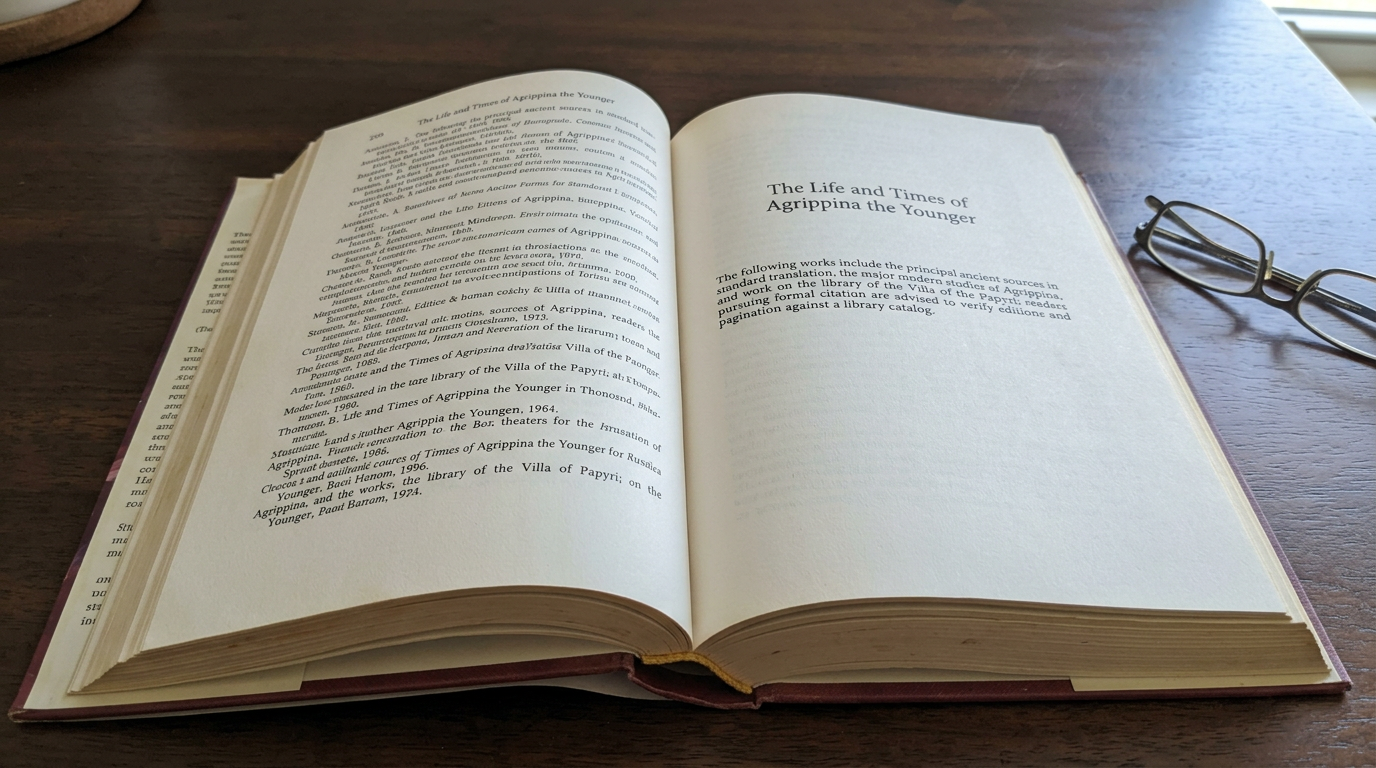
The following works include the principal ancient sources in standard translation, the major modern studies of Agrippina, and work on the library of the Villa of the Papyri; readers pursuing formal citation are advised to verify editions and pagination against a library catalog.
Levick, B. (1990). Claudius. Yale University Press.
Sider, D. (2005). The library of the Villa dei Papiri at Herculaneum. J. Paul Getty Museum.
Southon, E. (2018). Agrippina: The most extraordinary woman of the Roman world. Oneworld.
Related Chronicles in the Archive
Field Study No. XXI — The Book That Cannot Be Read: The Voynich Manuscript
Field Study No. XXXVI — The Woman at the Foot of the Stairs: Amy Robsart
Field Study No. XXXVIII — The Conqueror’s Ledger: Julius Caesar
Leave a Reply