
I. The Archive’s Threshold
There are deaths that end a man, and there are deaths that end a world. The three wounds delivered to the chest of Wenceslaus III on a sweltering Thursday afternoon in the Moravian town of Olomouc belonged, unmistakably, to the second category. When the sixteen-year-old king slumped—whether upon his bed in the deanery of Budislav or upon the sun-warmed stones of a courtyard, the sources cannot agree—the blood that pooled beneath him was not merely his own. It was the lifeblood of a dynasty that had ruled the Bohemian lands since the ninth century, a lineage that traced its mythic origin to a plowman summoned from a furrowed field to sit beside a prophetess-queen. In the span of a few violent seconds, the House of Přemysl, in its male line, simply ceased to be.
The discerning collector of historical enigmas will find in this episode a rare and troubling artifact: a regicide that remains, seven centuries on, entirely unsolved. The identity of the hand that held the knife is contested. The identity of the mind that directed it is unknown. The motive is a matter of inference and shadow. What survives is a constellation of chronicles—some sober, some embellished to the point of grotesquery—each offering a fragment of testimony, none offering resolution. The murder of Wenceslaus III is not a case that history has closed; it is a case history abandoned, half-lit, on the threshold of the knowable.
To enter this archive is to accept that certainty will not be granted. The keeper of these records can offer no confession, no recovered weapon, no reliable witness who saw it all. What can be offered is context: the melancholy architecture of a life lived under the weight of three crowns before the age of seventeen, the ambitions that circled the young king like carrion birds, and the cold arithmetic that made his death profitable to so many that the profit itself becomes a kind of clue. This is a field study of transience—of how a bloodline nine hundred years in the making was undone by a single afternoon, and of how the absence of an answer has become, over the centuries, its own peculiar form of testimony.
Let the curious visitor understand the stakes before proceeding. This was not the murder of a private man over a private grievance. This was the severing of a sovereign lineage, an act whose consequences reshaped the map of Central Europe, delivered Bohemia to the House of Luxembourg and Poland to the Piasts, and left a wound in the historical record that no chronicler, medieval or modern, has been able to fully close.
II. Childhood
Wenceslaus III entered the world in Prague on 6 October 1289, and even his birth carried the quiet melancholy that would shadow his brief existence. He was born a twin, alongside a sister named Anna who did not survive early childhood. His elder brother had already died before Wenceslaus drew his first breath, leaving him the sole surviving son of his parents—a solitary vessel into which an entire dynasty’s continuance was poured. He was the second son of Wenceslaus II, King of Bohemia, and of Judith of Habsburg, daughter of Rudolf I, King of the Romans. Into this child, from the moment of his survival, flowed the expectations of two of the great houses of Central Europe: the native Přemyslids of Bohemia and the ascendant Habsburgs of the German lands.
The young prince’s domestic world was one of early and repeated loss. His mother Judith died on 18 June 1297, when the boy was scarcely seven. He grew among sisters—another Anna, an Eliška, a Margaret, and a half-sister, Agnes—but the maternal warmth that might have tempered a childhood spent as a dynastic instrument was withdrawn early. What replaced it was the machinery of statecraft, which does not pause for children’s grief.
His father was a builder of empires, and he saw in his only son the raw material of a grander Přemyslid dominion than any of his ancestors had commanded. To this end, the boy was betrothed while still a child. On 12 February 1298, in Vienna, Wenceslaus was engaged to Elizabeth, the only child of Andrew III of Hungary—the last male member of the House of Árpád, the native royal dynasty of Hungary, whose own legitimacy rested on contested ground. In this single arrangement, the elder Wenceslaus laid the foundation for a claim upon the Hungarian throne, binding his son’s future to the fortunes of a dying Árpád line. The child was a coin his father intended to spend.
The record of the young Wenceslaus as a person is fractured, and here the archive must present its contradictions honestly, for they are part of the artifact itself. Some chroniclers describe a youth who was reasonably well-educated, modest in bearing, and fluent in as many as four languages—a prince of promise. Others draw a starkly different portrait: a teenager who devoted himself to drink and revelry, who spent more hours in dissipation than in the labor of governance, a reveler and a rake. He was called the “Younger King” even before he formally held any throne of his own, a title that hung on him like an inheritance he had not yet earned. Which of these portraits is truer cannot now be determined; likely both contain fragments of a real and unfinished character, a boy pressed into the shape of a king before he had finished becoming a person.
What is beyond dispute is the trajectory. His father, Wenceslaus II, was the first Přemyslid to sit upon the Polish throne, having been crowned King of Poland at Gniezno in late September 1300, after driving his chief rival, Władysław I Łokietek, from the kingdom. The elder king’s ambitions did not stop at Poland’s borders. When Andrew III of Hungary died on 14 January 1301, leaving no male heir, the machinery that had betrothed a child to an Árpád princess three years earlier began to turn in earnest. The boy of eleven was about to be made a king.
III. Kingship
The death of the last Árpád king cracked Hungary open like a seal broken on an old letter, and into that opening poured every ambition the region could produce. Charles I of Anjou—Charles Robert, great-great-grandson of Béla IV of Hungary and the candidate of Pope Boniface VIII—regarded himself as the lawful heir and hurried to Esztergom, where the Archbishop-elect Gregory Bicskei crowned him. But the coronation was flawed by the standards of Hungarian custom: it was performed neither at Székesfehérvár nor with the Holy Crown of Hungary, but with a provisional crown in the wrong place. The Hungarian lords, who feared above all that they would “lose their freedom by accepting a king appointed by the Church,” found the papal candidate distasteful. On 13 May 1301, the diet declared Charles’s coronation invalid.
Into this vacancy stepped the Přemyslids. It was Jan Muskata, Bishop of Kraków and advisor to Wenceslaus II, who first proposed that the elder king’s son and namesake be elected king of Hungary. The boy’s qualifications were twofold and elegant: he was himself a great-great-grandson of Béla IV, and he was the betrothed of the late Andrew III’s daughter. The elder Wenceslaus lubricated the transaction with silver drawn from the celebrated mines of Kutná Hora, and the majority of Hungarian lords and prelates, thus persuaded, offered the crown to the eleven-year-old. His father met the Hungarian envoys at Hodonín in August and accepted on his son’s behalf.
On 27 August 1301, at Székesfehérvár, with the true Holy Crown of Hungary and by the hand of John Hont-Pázmány, Archbishop of Kalocsa, the boy was crowned. He took the name Ladislaus—Ladislaus V to his Hungarian subjects—and signed all his Hungarian charters under that name. It was, on parchment, a triumph. In practice, it was a fiction. The kingdom had already disintegrated into a dozen provinces, each ruled by a powerful lord, an “oligarch,” who granted neither castle nor authority to either claimant. The Illuminated Chronicle records with bleak clarity that the Hungarian lords withheld real power from both boy-king and Angevin rival alike.
What followed was a slow attrition. The child-king’s authority was purchased, piece by piece, through desperate grants of royal estates to the very magnates whose loyalty he could not otherwise secure. Matthew Csák received Nyitra and Trencsén Counties with their castles; Ivan Kőszegi was made Palatine. Yet the buying could not keep pace with the defections. Through the first half of 1302, prelates abandoned him; even Jan Muskata, his own principal advisor, departed Hungary. In September 1302, Charles of Anjou laid siege to Buda itself and called upon its burghers to hand over the young king. The mainly German citizenry, under their mayor Werner, held faithful, and Kőszegi relieved the city—but the papal machinery was grinding forward. On 31 May 1303, Pope Boniface VIII declared Charles the lawful king and Wenceslaus-Ladislaus’s election invalid. Even Albert I of Germany, maternal uncle to both rival claimants, called upon the boy to withdraw.
In May 1304, the elder Wenceslaus came south at the head of a large army to shore up his son’s crumbling position. He captured Esztergom, but his negotiations with the local lords convinced him of the truth: the boy’s position in Hungary was beyond salvation. He resolved to take his son home to Bohemia. The young king did not formally renounce Hungary; he appointed Kőszegi as governor and, in a gesture of stubborn symbolism, carried the Holy Crown of Hungary itself back to Prague. It was a king departing with the emblem of a kingdom he could no longer hold.
Then, on 21 June 1305, Wenceslaus II died, and the boy became, at fifteen, King of Bohemia and King of Poland in his own right. He recognized what his father’s death had made undeniable: three crowns could not be held by one pair of young hands. He chose to relinquish Hungary—but not to his rival. Rather than acknowledge Charles of Anjou, Wenceslaus handed the Holy Crown of Hungary to Otto III, Duke of Bavaria, a grandson of Béla IV, at Brno on 9 October 1305. In the same season he broke his long engagement to Elizabeth of Hungary, the political purpose of that betrothal having evaporated, and married instead Viola of Teschen, daughter of Mieszko I, upon the advice of the Bohemian lords. They would have a single daughter.
The final year of his reign was a portrait of a young monarch surrounded by the wrong company and pressed by the wrong enemies. He led, by several accounts, a dissolute life, encircled by a coterie of young Czech noblemen upon whom he lavished extravagant grants of royal land. And in Poland, the old enemy would not rest. Władysław I Łokietek, who had never abandoned his claim, captured Kraków in early 1306, and the Bohemian dominion in Poland began to tremble. To secure allies, Wenceslaus granted Gdańsk and Pomerania as fiefs to the Margraves of Brandenburg in July 1306. Then he resolved upon war. He dismissed his young favorites, appointed his brother-in-law—variously named in the sources as Henry of Bohemia, Henry of Carinthia—as governor of his lands, and summoned the Bohemian and Moravian nobility to Olomouc to muster for the Polish campaign.
It was here, at the mustering-point, that the crucial friction ignited. The Czech lords proved sluggish and reluctant; war was expensive, and they had no wish to empty their purses for a young king’s ambitions. Wenceslaus’s response was sharp and, in retrospect, fatal. He reminded them of the vast properties they had received from him and declared that the time had come to repay his generosity. More ominously still, he let it be known that upon his return from Poland he would audit the records of the noblemen’s acquired estates and demand the return of some of his gifts. He was said to have prepared a list of those he intended to accuse of treason and corruption—with a certain Peter Angel, or Petr, at its head. A young king had told his most powerful subjects that when he came home, he would take back what he had given and put some of them on trial. He would not come home.
IV. Cast of Suspects
The archive now turns to the central mystery, and it must do so with methodological honesty: the roster of suspects is a study in motive without proof, in benefit without confession. Four parties stand accused across the chronicles and the scholarship. Each had reason to wish the young king dead; none has been convicted by the evidence. Let the discerning investigator weigh them in turn.
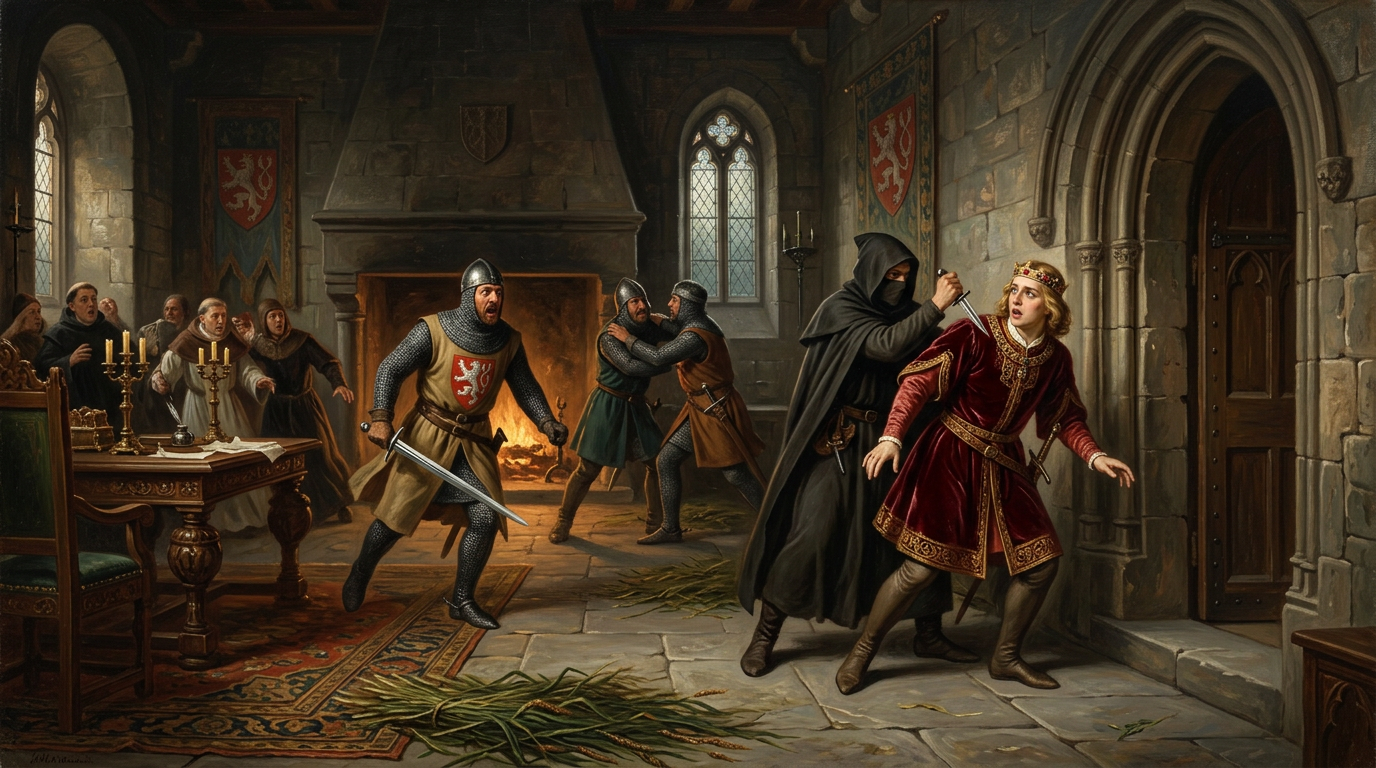
The Instrument: Conrad of Botenstein. Before considering who ordered the murder, one must consider who committed it. The chronicles converge, with unusual consistency, upon a single figure: Conrad of Botenstein—also rendered as Botenstejn or Mulhow—a German knight. He is named as the man who drove three blows into the king’s chest, whether the king was walking to take the summer air or resting in the deanery of Budislav during the hot afternoon. The contemporary Chronicon aulae regiae, the Zbraslav Chronicle, records that Conrad was seized and killed on the spot by the guards in the courtyard, beaten to death without ever being questioned. Olomouc’s own contemporary records likewise name Conrad as the killer. Yet here the archive must underline the essential doubt, for the Zbraslav chronicler himself, having named Conrad, immediately confessed the limits of his knowledge: whether it was truly Conrad or another who was guilty, he did not know, nor on whose behalf the deed was done. A slightly later source, the Chronicle of Dalimil, embellishes the knight’s death into gothic spectacle—his hand severed, hungry dogs loosed to devour him alive—but even this lurid account preserves the same core: a German knight named Conrad. The instrument, then, is named but not certain; and crucially, an instrument beaten to death before interrogation can name no master. Whoever directed the blow was protected, perhaps by design, by the very speed with which the assassin was silenced.
The First Suspect: The Habsburgs. Duke Albert—Albert I, King of the Romans and Duke of Austria—had clashed bitterly with Wenceslaus’s father and might plausibly have nursed ambitions toward Bohemian holdings. The Habsburg-Přemyslid rivalry was long and real. Yet the case against Albert dissolves under scrutiny. He had made peace with the young Wenceslaus a short time after the elder king’s death, and he was otherwise occupied with affairs in his own lands. The motive is stale, the opportunity remote. Albert’s guilt is, on the available evidence, unlikely.
The Second Suspect: Władysław I Łokietek. No man profited more visibly from the king’s death than the Piast claimant to the Polish throne. Wenceslaus had raised his levies and was, at the very moment of his murder, marching toward Poland to crush him. Władysław’s ambitions were served perfectly: within a short time he would secure the Polish crown that Wenceslaus’s death left unguarded. Benefit, here, is beyond dispute. And yet benefit is not proof, and the practical case is weak. There are no records of Władysław possessing Bohemian allies capable of orchestrating an assassination deep within Moravia, at Olomouc. Had the Piast wished the king dead by his own agents, an attempt upon Wenceslaus’s life once he had entered Poland would have been far more feasible than a strike in the heart of the Přemyslid domain. Władysław had the strongest motive and the weakest means.
The Third Suspect: The Bohemian Nobility. Here the shadow falls longest. The Bohemian magnates were ambitious, reluctant to fund a war they did not want, and—unlike any foreign power—perfectly positioned to reach the king at Olomouc. They had just been threatened, in the king’s own words, with the clawing-back of their estates and with accusations of treason and corruption. A list of the condemned was said to exist, with Peter Angel at its head. And above every immediate grievance loomed a structural temptation of enormous magnitude: Wenceslaus was the last of the Přemyslid male line. His death without a male heir would throw open the selection of the next king, and the Bohemian nobles, whose support any candidate would need to court, stood to profit immensely from the ensuing scramble. Some among them, moreover, are said to have held little respect for a young and dissolute king prone to excess. Motive, means, and opportunity converge here as they do nowhere else.
V. Who Was Most Likely the Killer?
The archive does not deal in false certainty, and so this section must open with a caveat carved in the same stone as the mystery itself: no living authority can pronounce a verdict beyond doubt. The confession was never extracted; the assassin was beaten to death before a single question could be put to him. What remains is the discipline of inference, the weighing of motive against opportunity, of benefit against feasibility. And when that weighing is done with rigor, the needle settles—tentatively but persistently—upon the Bohemian nobility.
Consider the elimination of the alternatives. The Habsburg duke, Albert, had neither fresh motive nor proximate opportunity; his quarrel was with the father, his peace already made with the son, his attention fixed upon his own realm. He may be set aside with reasonable confidence. Władysław Łokietek presents the opposite problem: motive in abundance, opportunity almost none. To strike at Olomouc, in the Moravian heartland of Přemyslid power, would have required a network of Bohemian confederates for which no record exists. The Piast had every reason to want the king dead and virtually no plausible means to accomplish it where it happened. Geography acquits him more surely than character ever could.
This leaves the men who were already in the room. The Bohemian magnates possessed what neither foreign suspect could claim: they were physically present at Olomouc, gathered by the king’s own summons. They had access to the deanery, to the courtyard, to the person of the sovereign. They had, in the king’s freshly voiced threats, a motive of the most immediate and personal kind—the preservation of their estates and, for some, their very necks. And they had, in the extinction of the Přemyslid line, a prize larger than any single estate: a decisive voice in the making of the next king. Several serious historians, including those cited in the modern Czech scholarship of Vladimír Liška, incline toward precisely this conclusion—that the initiators of the assassination were the king’s own agents, Czech nobles who feared the sanctions bearing down upon them.
The manner of the killing lends weight to this reading. The assassin, Conrad, was dispatched with a haste that borders on the suspicious—beaten to death by guards in the courtyard before any interrogation could occur. A killer who dies unquestioned protects whoever hired him. Whether that silencing was the panic of loyal guards or the design of conspirators who needed the trail to end at the corpse of a German knight cannot be known. But the effect served the interests of a domestic conspiracy far better than those of any foreign prince, who would have had no such reach over the guards of Olomouc.
The archive therefore renders its judgment in the only form the evidence permits: not a verdict but a weighted probability. The Bohemian nobility—ambitious, threatened, present, and positioned to profit above all others from a vacant throne—stands as the likeliest party behind the blade. It is a conclusion drawn in charcoal, not ink. The specific hand, the specific name, the specific meeting where the deed was resolved upon: these remain in the dark where seven centuries have kept them. What the archive can say is that when a king threatens his most powerful subjects with ruin and then dies among them, the shortest line between motive and corpse rarely runs to a foreign court.
VI. Contemporary Echoes & Modern Revivals
The murder at Olomouc did not merely end a life; it redrew the political architecture of Central Europe, and its reverberations can be traced across the centuries with the clarity of cracks spreading from a struck bell. With Wenceslaus III fell the male line of the Přemyslids, a dynasty whose legendary origin lay in the union of Přemysl the Ploughman with the prophetess-queen Libuše, founder of Prague. Nine hundred years of native Bohemian rule terminated in three knife-wounds. Save for the singular later exception of George of Poděbrady, every subsequent king of the Czech lands would descend from a foreign house.
The immediate inheritance passed to strangers. The House of Luxembourg secured the Bohemian throne when John of Luxembourg married the Přemyslid heiress Elizabeth of Bohemia in 1310, inaugurating a Luxembourg tenure that would extend, with interruptions, across the Holy Roman Empire itself until 1437. In Poland, the Piast Władysław Łokietek—whether or not his hand reached toward Olomouc—gathered the crown that Wenceslaus’s death had loosed. Two dynasties rose upon the grave of a third.
The mystery of the murder proved as durable as its consequences. The medieval chroniclers themselves established the pattern of confident naming paired with confessed uncertainty—the Zbraslav chronicler naming Conrad and immediately doubting him, the Dalimil chronicle dressing the assassin’s death in gothic horror. Modern Czech historiography has never let the case rest. The works of Vladimír Liška, who counts the affair among “the greatest mysteries of Czech history,” and of Jan Bauer, who treats it among the revolutionary events of the Czech past, demonstrate that the wound at Olomouc remains an open subject of national inquiry rather than a settled matter of record. The very lack of resolution has become a feature of the artifact, a mystery polished by centuries of handling.
There is a final, melancholy vestige. Wenceslaus III was first laid in the crypt of the Cathedral of Saint Wenceslas in Olomouc, and in 1326 his remains were transferred to the Zbraslav monastery to rest beside his father. Yet even the body could not remain intact against time: his skeleton was, at some point, simply lost. The last male Přemyslid, who inherited three kingdoms before he was old enough to govern one, whose murder ended a dynasty and remade a continent, does not now possess so much as a certain grave. The reclamation of even his mortal remains has been denied to history.
VII. Final Reflections from the Archive
What, in the end, does this artifact ask of the discerning collector who has followed its dark thread to the conclusion? Perhaps this: to sit with the discomfort of the unresolved. We are accustomed, in our chronicles and our courtrooms alike, to the satisfaction of the named culprit, the closed case, the justice however belated. The murder of Wenceslaus III offers none of these. It offers instead a motive too widely shared to fix upon one man, an assassin too swiftly killed to name his master, and a dynasty too utterly extinguished to leave behind an avenger who might have pressed for the truth.
The keeper of these records has ventured a judgment—that the Bohemian nobility, threatened and ambitious and present, most likely stood behind the blade—but that judgment is offered as the best reading of a ruined text, not as a verdict beyond appeal. The honest work of the archive is to distinguish what is likely from what is known, and to refuse the comfort of pretending the first is the second. Seven centuries have not produced the confession that would close this case, and it is improbable now that any ever will.
Yet there is something fitting in the endurance of the mystery. A dynasty that began in legend—in a ploughman called from his field to a queen’s side—ends, appropriately, in a legend of a different kind: the unsolved regicide, the vanished skeleton, the German knight torn apart by dogs in the embellished telling. The Přemyslids passed from myth into history and back into myth again, bracketed at both ends by stories that resist verification. The transience that took the last of them took even the certainty of how he died. This is the melancholy at the heart of the field study: that a man could hold three crowns and lose all record of his murderer, could rule kingdoms and lose his own bones. History does not always reward its subjects with answers. Sometimes it grants them only the dignity of an enduring question.
For the visitor who curates the darker corners of human history, the case of Wenceslaus III stands as a reminder that the most powerful artifacts are often the incomplete ones—the wound that never healed into a scar, the question that never hardened into a fact.
We invite you to enter the haunted archive and secure a piece for your private collection; it is a necessary addition for those who curate the darker corners of human history. To hold in your hands an object drawn from these forgotten narratives, visit Wicked Dual at http://www.wickeddualblog.com or explore the curated artifacts within our Etsy repository, where the histories chronicled here take physical form.

Note: This subject touches on historical violence. The bibliography above reflects credible historical scholarship; readers seeking to verify specific claims about the assassination are encouraged to consult the contemporary Chronicon aulae regiae (Zbraslav Chronicle) and the Chronicle of Dalimil in scholarly editions, as the modern secondary sources vary in their interpretations.
Leave a Reply