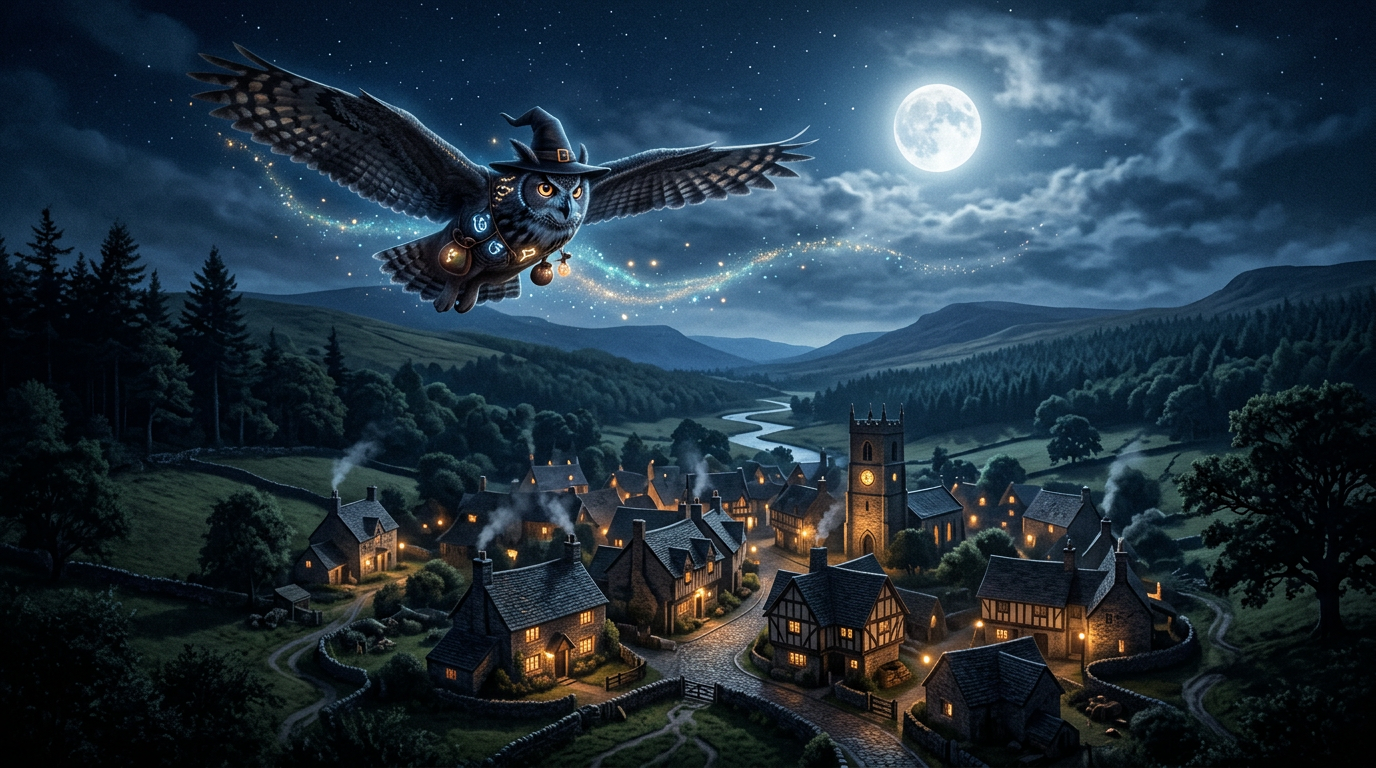

I. Crossing the Archive’s Threshold
There are creatures that belong wholly to the daylight of recorded history, and there are others that exist only in the seams between the known and the whispered—entities that resist the ledger, that thrive in the interstitial dark where a language, a landscape, and a people’s oldest fears converge. Las Lechuzas belong emphatically to the latter category. To the discerning collector of unwritten histories, they present a rare and troubling artifact: a legend that is simultaneously ornithological and theological, folkloric and forensic, indigenous and colonial, and which has persisted, unbroken, across four centuries of borderland night.
The premise, stated plainly, possesses the stark economy of the best folk horror. Somewhere along the Rio Grande, in the brush country of South Texas or the arid municipalities of Tamaulipas and Nuevo León, a woman is said to have made a bargain. In exchange for power—the power to harm, to heal, to see across distances, to move unseen—she surrendered a portion of her humanity. And on certain nights, when the moon hangs low and the chaparral goes silent, she abandons her human form altogether and takes to the air as an enormous owl, her face still uncannily that of a woman, her wingspan wide as a grown man’s outstretched arms, her cry a sound that no true bird has ever made. She perches on the rooftops of those who have wronged her. She circles the homes where children sleep. And to hear her is to understand, with the primal certainty of the lizard brain, that death or misfortune has come to roost.
This is the legend in its skeletal form. But a skeleton, as any student of the archive knows, tells us comparatively little. It is the flesh upon the bone—the regional variation, the linguistic sediment, the theological anxiety, the historical circumstance—that renders a legend legible as a document of the human condition. And Las Lechuzas, when examined with the patience the subject deserves, reveal themselves to be one of the most densely encoded pieces in the entire catalog of North American folk belief. They are a palimpsest written over by successive civilizations: the Mesoamerican cosmologies that saw in the owl a messenger of the underworld; the Iberian witch-lore carried across the Atlantic in the holds of colonial ships; the syncretic religiosity of the borderlands, where Catholic saint and indigenous spirit share the same altar; and the peculiar, sun-bleached melancholy of the Texas-Mexico frontier itself, a place where the boundary between nations has always been as porous and negotiable as the boundary between the living and the dead.
What follows is an attempt to chronicle this creature not as an entry in a bestiary but as a cultural manifestation—a vestige of the ways in which borderland communities have historically encoded their deepest anxieties about women, power, transgression, and mortality into the silhouette of a bird against the moon. The seeker of buried narratives is invited to consider that the Lechuza is not, and has never been, merely a monster. She is an argument. She is a warning. And, as the concluding sections of this study will propose, she may also be something considerably more subversive: a reclamation.
II. The Naming of the Unnamed: Linguistic Roots & Lexical Origins
To understand any folkloric entity, one must first interrogate its name, for a name is the oldest fossil in the record—it preserves the assumptions, the classifications, and the fears of those who first spoke it aloud. The word lechuza is, on its surface, an ordinary term in the Spanish language. It denotes the barn owl, Tyto alba, that pale, heart-faced nocturnal raptor whose range spans nearly the entire habitable globe. The etymology traces, most scholars agree, through the Spanish from a Latin root, with some philologists pointing toward noctua and the broader Romance-language family of owl-words, and others noting a possible pre-Roman Iberian substrate. What matters for the present study is the crucial distinction the Spanish language draws—a distinction that English speakers, possessing only the single flat syllable “owl,” often fail to register.
Spanish maintains two principal words for owl, and the difference between them is not merely taxonomic but atmospheric. There is the búho—the eagle owl, the great horned owl, the tufted and imposing bird of prey whose ear-like feather crests lend it an air of ancient, philosophical gravity. The búho is the owl of wisdom, the owl that might reasonably accompany a goddess or ornament a library. And then there is the lechuza—the barn owl, the pale ghost with the flat, dish-shaped, disquietingly human face, the silent flyer, the haunter of ruins and belfries and abandoned missions. It is no accident whatsoever that the witch-legend attached itself to the lechuza and not to the búho. The barn owl’s very physiognomy—that pale heart of a face, those dark and forward-facing eyes set in a flat disc so unlike the profile of other birds—produces in the human observer an involuntary shock of recognition. The face reads, in the low light and the peripheral glimpse, as a face. As a woman’s face. The legend, in a sense, was authored by the anatomy of the animal itself.
This is the first stratum of the name. But beneath the Spanish lies an older and richer sediment, and here the seeker must descend into the Nahuatl. In the language of the Mexica and their Nahua predecessors, the owl occupied a position of profound and specific dread. The relevant word is tecolotl, the general term for owl, which survives to this day in the Mexican Spanish tecolote. From it descends one of the most enduring proverbs of the Mexican folk tradition, a saying repeated across generations and still current in the borderlands: “Cuando el tecolote canta, el indio muere”—”When the owl sings, the Indian dies.” The proverb compresses into eight words an entire theology of the owl as psychopomp, as harbinger, as the audible signature of approaching death. To hear the owl was to receive a summons.
More specifically still, the Nahua cosmology contained the figure of the tlacatecolotl—a compound term uniting tlacatl, meaning “person” or “human being,” with tecolotl, the owl. The tlacatecolotl was, in the pre-Columbian understanding, a “human-owl,” a malevolent sorcerer or nocturnal spirit associated with the powers of darkness and harmful magic. When the Franciscan and Dominican friars arrived to catalog and, ultimately, to extirpate the indigenous religion, they seized upon this figure as a ready-made equivalent for a European concept they had brought with them across the ocean: the Devil. In the colonial-era religious texts and confessional manuals composed in Nahuatl, tlacatecolotl was frequently deployed as the translation for Satan himself. Here, in the collision of two theological vocabularies, we witness the precise moment of syncretic fusion—the indigenous owl-sorcerer and the Christian demon poured into a single lexical vessel. The Lechuza, as she would come to be known in the borderlands, is the direct descendant of this fusion. She carries the tlacatecolotl’s shapeshifting menace and the European witch’s diabolical pact in a single body.
There exists, too, a related and instructive term that illuminates the mechanism by which a woman is said to become a Lechuza: nagualismo, from the Nahuatl nahualli. The nahualli was a sorcerer possessed of the power to transform into an animal—a were-creature, in the loosest European analogy, though the concept is considerably more sophisticated than the werewolf of Continental legend. The nahualli’s animal form, or tonal, was understood as a companion-spirit, a second self through which the sorcerer could act upon the world. When a Mexican or Tejano storyteller says that a bruja “turns into” a Lechuza, they are invoking, whether consciously or not, this deep grammar of nagualism—the ancient conviction that the boundary between the human and the animal is permeable to those who possess forbidden knowledge, and that the truly powerful can slip between shapes as easily as a snake sheds its skin.
Thus the name itself, excavated to its foundations, reveals the creature to be a genuine hybrid of two civilizations. From the Spanish she takes her ordinary avian designation and the ghostly connotations of the barn owl. From the Nahuatl she inherits her association with death, her identity as a human-owl, her diabolical dimension, and the very transformational logic by which she comes into being. To speak the word lechuza on the border is to speak, unknowingly, a sentence in two dead grammars at once.
III. Cataloguing the Corporeal: Physical Manifestations & Materiality
The archive demands specificity. A ghost described only as “frightening” is no ghost at all; it is the concrete detail, the material particular, that gives a legend its terrible verisimilitude and allows it to be transmitted, believed, and feared across generations. In the matter of physical description, the accounts of Las Lechuzas display a remarkable consistency across their entire geographic range—from the ranches of the Rio Grande Valley to the sierras of northeastern Mexico—a consistency that itself constitutes evidence of the legend’s deep coherence within the folk imagination.
The first and most universally attested feature is size. The Lechuza is never described as an ordinary owl. She is enormous, monstrously so—accounts converge upon a wingspan of six to seven feet, the dimensions of a large man rather than a bird, and a body correspondingly massive, heavy enough that her landing upon a tin roof produces an audible and alarming thud. This gigantism is the first signal that the observer is in the presence of something outside the natural order. The barn owl of the daylight ornithologist is a modest creature, scarcely more than a foot in length. The Lechuza of the nocturnal encounter is a thing of nightmare scale, a shadow that blots out an unsettling portion of the moonlit sky.
The second and most psychologically potent feature is the face. Here the accounts grow specific and insistent: the Lechuza possesses the face of an old woman. Not a birdlike face, not a beaked and feathered visage, but the withered, wrinkled countenance of an aged human female, set incongruously within the plumage of the owl. Some tellings describe the face as beautiful and youthful, a snare to lure the incautious; but the dominant tradition holds firmly to the image of the crone—the vieja, the old witch-woman whose human features stare out from the body of the bird with an intelligence and a malevolence no animal could possess. The eyes receive particular emphasis. They are frequently described as glowing, catching and returning light in a manner that betrays the fire of the human—or infernal—soul behind them. To meet the gaze of a Lechuza, the accounts agree, is to know beyond doubt that one has been seen, marked, and remembered.
The materiality of the transformation itself is a subject of considerable folkloric elaboration, and here the legend reveals its most practically minded dimension—the belief that the transformation can be undone, exposed, and punished. A recurring motif holds that if one wounds a Lechuza in her owl form, one will later discover a woman in the community bearing an identical injury in the identical location. The shot that clips the great owl’s wing at midnight becomes, by morning, the mysterious arm-wound of the neighbor’s aged mother. This motif—shared with witch-lore across the Atlantic world and known to folklorists as the “witch’s mark” or the principle of repercussion—transforms the legend from a passive tale of dread into an active technology of accusation. The Lechuza was not merely feared; she was hunted, and the hunt provided a mechanism by which a community’s suspicions about a particular woman could be tested, confirmed, and acted upon.
Equally material is the vast catalog of countermeasures the borderland folk developed against her—a body of ritual practice that speaks to the seriousness with which the threat was regarded. To repel or expose a Lechuza, one was advised to tie seven knots in a length of rope, for the creature was believed compelled to stop and untie each one, delaying her malice until dawn. One might sprinkle salt, or lay down a pile of it that she would be obliged to count grain by grain. Braided cord, blessed palm from Palm Sunday, the recitation of specific prayers, the placement of a knife or scissors beneath the threshold in the form of a cross—each of these constituted a filament in a dense protective web woven around the vulnerable household. Most dramatically, the utterance of profanity was held to be efficacious; a stream of curses directed at the circling owl would, it was said, break the spell and send the creature fleeing. That the sacred prayer and the vulgar oath were understood as equally potent weapons against her tells the attentive reader a great deal about the Lechuza’s liminal nature—she stood outside both the realm of the holy and the realm of the decent, and could be repelled only by contact with one extreme or the other.
These material particulars—the impossible size, the human face, the wound that transfers, the knots and salt and blessed palm—are the load-bearing architecture of the legend. They are what allowed Las Lechuzas to remain, for centuries, not an abstraction but a presence: a thing that could land on your roof, fix you with its glowing eyes, and be fought with implements found in your own kitchen.
IV. Reading the Night Sky: Lore, Legend, & Celestial Narrative
If the previous section assembled the creature’s body, the present one must attend to her mythology—the narrative architecture within which she moves, and in particular the celestial and nocturnal framework that governs her appearances. For the Lechuza is a creature of the night sky in the fullest sense, and to understand her one must understand the cosmology of darkness that the borderland inherited from its Mesoamerican and Iberian forebears.
The essential narrative unit of Lechuza lore is the encounter, and these encounters follow recognizable patterns that the folklorist can classify. The most common is the roadside encounter: a traveler, most often a man returning home late along a lonely stretch of country road, becomes aware of an enormous owl pacing his vehicle or his horse, gliding silently alongside him at an impossible speed, matching his movements with evident intelligence. The pursuit may continue for miles. It ends, in the fortunate tellings, when the traveler reaches the threshold of his home or invokes a prayer; in the unfortunate tellings, it ends in accident, illness, or the slow wasting that follows a curse. The second pattern is the rooftop encounter: the great owl descends upon the home of an intended victim, perching upon the roof, and there emits her characteristic cry—variously described as a whistle, a screech, or the unmistakable sound of a woman weeping. The third is the crib encounter, the most dreadful of all, in which the Lechuza is said to prey upon infants and small children, either stealing their breath or carrying them away entirely, a motif that connects her to the broader family of child-threatening female spirits that haunt the folk traditions of the Spanish-speaking world.
It is here that the Lechuza’s kinship with her most famous folkloric relative becomes visible, and the seeker of connections must pause to consider the relationship between the witch-owl and La Llorona, the Weeping Woman. Both are nocturnal. Both are female. Both are associated with water, with weeping, and with threat to children. Both patrol the liminal edges of the settled world—the riverbank, the crossroads, the rooftop at the boundary of the family home. The two figures are not identical; La Llorona is a ghost, a spirit of the drowned and the guilty, while the Lechuza is a living witch in transformed shape. Yet they occupy adjacent cells in the same taxonomy of borderland dread, and in the oral tradition their attributes frequently bleed into one another. The weeping cry attributed to the Lechuza is very nearly the signature sound of La Llorona. Both, we shall see, are manifestations of the same underlying cultural anxiety—the anxiety concerning the woman who exists outside the sanctioned roles of maiden, wife, and mother.
The celestial dimension of the lore deserves particular emphasis, for the Lechuza is bound to the phases of the moon and the hours of the night with an almost astronomical precision. She is a creature of the darkest hours, most active in the deep watches between midnight and the first paling of dawn. Her appearances are held to intensify around certain calendrical points—the moonless nights when the sky offers no witness, and, in some traditions, the nights surrounding the Day of the Dead, when the membrane between the living and the departed grows thin. The owl’s silent flight, a genuine aerodynamic property of the Tyto family whose specialized feathers muffle the sound of the wingbeat, was read by the folk imagination as evidence of supernatural stealth—a bird that flew without sound was a bird that flew without belonging to the natural world at all.
There is, threaded through the celestial narrative, a persistent theme of the owl as the eye of the night sky—the watcher who sees what the darkness conceals. This connects the Lechuza to her deep Mesoamerican ancestry, for in the Maya cosmology the owl was the messenger of Xibalba, the underworld, and among the Nahua the owl was associated with Mictlantecuhtli, the lord of the dead, and with Tezcatlipoca, the “Smoking Mirror,” god of the night sky, of sorcery, and of the nocturnal jaguar. To the peoples of ancient Mesoamerica, the owl was not a neutral bird but a functionary of the death-realm, a creature whose appearance in the world of the living signaled that the underworld had turned its attention toward some mortal soul. The Lechuza inherits this function wholesale. When she circles a house, she is performing the ancient office of the tecolotl: she is the underworld’s gaze, made feathered and terrible, come to mark the doomed.
V. The Ground That Grew Her: Historical Observances
The chronicle now turns from the timeless architecture of legend to the specific soil of history—to the actual communities, periods, and social conditions within which the belief in Las Lechuzas took root, flourished, and was recorded. For a folk belief does not float free of its circumstances; it is grown in a particular ground, watered by particular fears, and the historian’s task is to reconstruct that ground.
The heartland of Lechuza belief is the region that Mexican and Tejano communities alike understand as la frontera—the borderland straddling the Rio Grande, encompassing the northeastern Mexican states of Tamaulipas, Nuevo León, and Coahuila, and the corresponding stretch of South Texas from Laredo down through the Rio Grande Valley to Brownsville. This is a landscape of brasada, the dense thornbrush country, and of vast historic ranches; a landscape of small agricultural communities, of ranchos and colonias, where families lived at considerable remove from the institutions of church and state, and where the night was genuinely, profoundly dark. It is essential to grasp the material conditions of this world in order to understand the potency of the legend within it. Before the arrival of electrification—which came late to the rural borderland, in many communities not until the middle decades of the twentieth century—the night was an unlit and formidable territory. The cry of a real owl, the silent passage of a real barn owl hunting over a real field, took on, in that ancestral darkness, a significance the modern city-dweller can scarcely reconstruct.
The demographic and cultural substrate of the legend is the mestizo population of the borderland—the descendants of the union between Spanish colonizer and indigenous inhabitant, whose folk Catholicism blended the veneration of saints with the persistent, submerged practices of the pre-Columbian world. Within this population, the Lechuza belief was embedded in a larger and coherent system of folk supernaturalism, one that included the curandero and curandera (the folk healer), the brujo and bruja (the witch or sorcerer), the concept of mal de ojo (the evil eye), the susto (soul-loss through fright), and the empacho (spiritual-digestive affliction). The Lechuza was not an isolated bogey but one node in this dense network of belief, and she was understood specifically as the nocturnal, transformed manifestation of the bruja—the witch who, having failed or been denied in her human dealings, took to the air to work her vengeance. The healer and the witch were understood to draw upon the same reservoir of power; the distinction lay in the use to which that power was put. The Lechuza represented that power at its most malevolent and most transgressive.
The historian must note that the legend served identifiable social functions within these communities, and it is in the analysis of these functions that the study rises above mere catalog. First, the Lechuza belief operated as a mechanism of social control, and its target was, overwhelmingly, women—specifically women who transgressed the boundaries of expected feminine behavior. The widow who lived alone, the woman without children, the woman skilled in herbs and healing whose knowledge shaded into the suspect, the woman who quarreled with her neighbors, the woman who was simply old, poor, unattached, and therefore threatening to the settled order of the patriarchal household—these were the women upon whom the accusation of lechucería was most readily fixed. To be named a Lechuza was to be marked as dangerous, as outside the community, as a legitimate object of suspicion and hostility. The legend thus functioned, as witch-beliefs have functioned in virtually every human society, as an instrument for the policing of women and the punishment of female autonomy.
Second, the belief served an explanatory function, providing a coherent account of otherwise inexplicable misfortune. The infant who died in the night of what modern medicine would call sudden infant death syndrome; the healthy man who sickened and wasted without apparent cause; the accident on the dark road; the run of bad luck that fell upon a household—these events, in a world without epidemiology or actuarial science, cried out for explanation, and the Lechuza supplied one. Misfortune was not random; it was authored. And an authored misfortune, however terrible, is more bearable to the human mind than a meaningless one, for the authored misfortune can be resisted, avenged, and guarded against.
The transmission of the legend was, and remains, overwhelmingly oral—passed from grandmother to grandchild, recounted in the gatherings of the extended family, deployed as a cautionary instrument to keep children indoors after dark and to enforce the codes of the community. It is precisely this oral, domestic mode of transmission that has made the Lechuza so difficult to fix in the historical record and so resistant to the sanitizing hand of institutional religion. She lived, and lives, in the intimate space of the family and the small community, in the register of the whispered warning and the fireside tale, and it is there that the collector of borderland narratives must go to find her.
VI. The Ungovernable Woman: A Scholarly Analysis of the Dark Feminine Archetype
Having assembled the linguistic, material, narrative, and historical dimensions of the subject, the study must now ascend to its interpretive summit and confront the question that lies beneath the entire phenomenon: what does the Lechuza mean? Why this creature, in this form, and why so consistently the transformation of a woman into a bird of the night? The answer requires the deployment of the analytical frameworks of anthropology, folklore studies, and the study of archetype, and it leads to conclusions that are considerably more unsettling—and more illuminating—than the legend’s surface horror might suggest.
The Lechuza is, in the most rigorous sense, a manifestation of what may be termed the dark feminine archetype—the recurring cross-cultural figure of the woman whose power exists outside patriarchal sanction and is therefore coded as monstrous. She belongs to a vast and ancient sisterhood that spans the mythologies of the world: the Greek Lamia and the strix, that owl-like night-creature of Roman superstition believed to prey upon infants and from whose very name the concept descends; the Slavic Baba Yaga; the Jewish Lilith, the first woman who refused submission and was transformed, in the folk imagination, into a demon of the night who threatens children; the numerous shapeshifting witch-women of European and African tradition. The Lechuza is the borderland’s own contribution to this genealogy, and she shares its defining structure: she is a woman who possesses power, who exists outside the roles of obedient daughter, faithful wife, and nurturing mother, and who is therefore imagined as a devourer rather than a giver of life—a woman who threatens children rather than bearing and raising them, who flies free in the night rather than remaining within the walls of the home, who takes rather than gives.
The analytical significance of the transformation into an owl specifically—rather than into some other creature—cannot be overstated. The owl is the pre-eminent symbol of the inversion of the natural order: it is awake when others sleep, it sees in the dark when others are blind, it flies in silence when other birds announce themselves. Every attribute of the owl is a negation of the daylight world and its ordered certainties. For a woman to become an owl is thus to become the perfect emblem of transgression—to trade the visibility, the domesticity, and the daylight legibility expected of the feminine for the invisibility, the wildness, and the nocturnal freedom that the patriarchal order most fears in the female. The Lechuza sees what she is not meant to see, goes where she is not meant to go, and possesses a knowledge and a power that the settled world cannot control. She is, in a word, ungovernable, and it is her ungovernability, far more than any specific act of malice, that constitutes her true offense.
The framework of nagualism, introduced earlier in this study, acquires here its full interpretive weight. The pre-Columbian nahualli was not, in origin, a purely negative figure; the power of transformation was morally neutral, available to healer and harmer alike. It was the colonial encounter—the imposition of a Christian binary of God and Devil, saint and demon, licit and diabolical—that flattened this nuanced indigenous cosmology into the stark opposition of good and evil, and that recast the shapeshifting woman unambiguously as a servant of Satan. The Lechuza, in this light, may be read as a casualty of colonization: an indigenous figure of ambiguous and multivalent power, forcibly demonized by the theological apparatus of empire and rewritten as a monster. The seeker of buried histories should recognize in her the outline of something that was lost—a conception of female power that predated its criminalization.
There is a further and more melancholy dimension to the analysis, one that concerns the transience of the human relationship to fear. The Lechuza belief flourished most vigorously in conditions of vulnerability—in the unlit night, in the isolation of the rancho, in a world without medicine or insurance or the state’s protective apparatus, a world in which the death of a child was a common and inexplicable catastrophe. The legend, for all its cruelty toward the women it accused, was also a vessel for the community’s genuine grief and terror in the face of a hostile and unmanageable world. When the Lechuza cried on the rooftop, she gave a face and a name to the formless dread of a people living at the edge of survival. To study her is thus to study not only the persecution of women but the whole emotional economy of a vanished way of life—the fears, the griefs, and the desperate ritual defenses of communities for whom the dark was not a metaphor but a nightly and literal adversary.
Finally, and most provocatively, the contemporary analyst must attend to the possibility of reclamation—to the fact that the dark feminine archetype, once a tool of oppression, has in recent decades been taken up and reinterpreted by the very populations it once policed. This reversal, which the study will examine more fully in the following section, is among the most significant developments in the modern life of the legend. For if the Lechuza was created to punish the ungovernable woman, she has become, in the hands of a new generation, a symbol of precisely that ungovernability recast as strength—the woman who flies free, who possesses forbidden knowledge, who refuses the cage of the sanctioned role. The monster, examined closely enough and held to the light at the correct angle, reveals herself to have been a heroine all along, or at least a prisoner awaiting her exoneration.
VII. The Owl That Would Not Die: Contemporary Echoes & Modern Revivals
No folkloric entity survives four centuries by remaining static, and the Lechuza’s persistence into the present day is a study in cultural adaptation—in the ways an ancient belief migrates from the unlit rancho into the electrified, digitized, and self-conscious world of the twenty-first century, transforming its meaning even as it preserves its form. The attentive collector of living traditions will find that the witch-owl is very far from extinct; she has merely changed her habitat.
In the rural borderland, the belief persists in its traditional form to a degree that may surprise the metropolitan observer. Among older generations and in the smaller communities of northeastern Mexico and deep South Texas, the Lechuza remains a genuine presence, spoken of not as quaint superstition but as reported fact. Encounters continue to be recounted—the great owl pacing the truck on the dark farm road, the cry on the roof followed by illness or death, the wounded owl and the injured old woman. The protective practices endure as well; the knots, the salt, the blessed palm, the muttered prayer or curse remain part of the living repertoire of borderland households. This continuity is itself a remarkable historical datum: a belief system substantially intact from the colonial period, transmitted orally across a dozen generations, surviving the arrival of electricity, modern medicine, mass education, and the automobile.
Simultaneously, the Lechuza has undergone a striking migration into the domain of popular and digital culture, where she has found an entirely new and vastly larger audience. The oral tale, once confined to the family gathering, now circulates through digital storytelling, through amateur and professional accounts of the paranormal, through the flourishing genre of borderland horror in fiction and film, and through the visual arts, where the image of the woman-faced owl has become a recognizable and potent icon. This migration has had a curious double effect. On one hand, it has amplified and preserved the legend, carrying it to millions who might otherwise never have encountered it and securing its survival into the digital age. On the other, it has transformed it—abstracting the Lechuza from the specific social conditions that produced her, converting a genuine instrument of communal fear and social control into an object of entertainment, aesthetic fascination, and cultural pride.
It is within this contemporary landscape that the reclamation anticipated in the preceding section has fully unfolded, and it constitutes the most intellectually significant development in the modern life of the legend. A generation of Chicana and Mexicana artists, writers, and scholars—many of them working within the frameworks of feminist and decolonial thought—has taken up the figure of the Lechuza and reinterpreted her not as a monster to be feared but as an ancestor to be honored. In this reading, the witch-owl becomes a symbol of feminine power, of indigenous knowledge suppressed by colonization, of the woman who refuses the boundaries imposed upon her. The bruja, once a slur, has been reclaimed as a badge of identity and resistance; the shapeshifting woman, once a demon, has been recast as a figure of autonomy and mystery. The Lechuza flies now not only over the dark rancho but through the pages of poetry, the canvases of gallery exhibitions, and the iconography of a cultural movement determined to recover and celebrate the very female powers that the colonial order sought to destroy.
This transformation should not be mistaken for a simple sanitizing of the legend, nor for the loss of its darkness. The most sophisticated contemporary engagements with the Lechuza retain and even deepen her shadow, understanding that her power is inseparable from her terror—that a reclaimed dark feminine must remain genuinely dark, genuinely dangerous, genuinely other, if the reclamation is to mean anything at all. The modern Lechuza is not a comforting figure. She is a reminder that the powers a society most fears in women are precisely the powers that society has most strenuously sought to suppress, and that to recover those powers is necessarily to recover something frightening. In this sense the contemporary revival is not a departure from the legend’s ancient meaning but a return to its deepest layer—to the pre-colonial understanding of the shapeshifting woman as a being of genuine and morally complex power, neither wholly good nor wholly evil, but simply, terrifyingly, free.
Thus the Lechuza endures, occupying simultaneously two worlds: the traditional world of the borderland rancho, where she remains a genuine object of fear, and the contemporary world of art and identity, where she has become a symbol of reclamation and resistance. That she can inhabit both worlds at once, meaning opposite things to different communities, is the surest possible testament to the depth and vitality of the legend—for only the most profound cultural manifestations possess the capacity to be, at one and the same moment, a warning and a celebration, a monster and a heroine, a curse and a blessing.
VIII. Closing the Ledger: Final Reflections from the Archive
The chronicle concludes, as all such chronicles must, not with resolution but with a deepened appreciation of the subject’s irreducible complexity. Las Lechuzas resist the tidy summary. They are, as this study has labored to demonstrate, a genuine palimpsest—a document written and rewritten across four centuries by the successive hands of Mesoamerican cosmology, Iberian witch-lore, colonial theology, borderland Catholicism, and, most recently, decolonial feminism. To hold the legend in the mind is to hold all of these strata at once, layered and interpenetrating, each visible through the translucency of the others.
What emerges, when the accumulated sediment is examined as a whole, is a portrait not merely of a monster but of a civilization’s relationship to its own darkness. The Lechuza is the borderland’s confession, encoded in feathers and moonlight, of everything it feared and everything it could not name: the terror of the unlit night; the inexplicable death of children; the ungovernable power of women who lived outside the sanctioned roles; the submerged and criminalized survival of an indigenous cosmology beneath the imposed structure of a colonial faith; the melancholy transience of a way of life lived always at the edge of survival. She gathered all of these formless dreads into a single terrible silhouette and gave them a shape that could be feared, resisted, and, ultimately, remembered.
And in her contemporary transformation she offers a final lesson, perhaps the most valuable the archive has to give: that the monsters a culture creates are never merely monsters. They are portraits of the creating culture’s own anxieties, its own suppressions, its own losses. The woman transformed into the owl of the night was created to police and to punish; she has become, in the fullness of time, a figure through which a wounded culture recovers what was taken from it. The curse has become an inheritance. The warning has become a celebration. And the pale, woman-faced owl who once brought only death now carries, on those enormous silent wings, the whole weight of a people’s history—its griefs and its terrors, yes, but also its endurance, its memory, and its long, patient reclamation of the powers it was once taught to fear.
The seeker who has followed this study to its conclusion will understand, now, why the Lechuza is properly regarded not as a curiosity but as an artifact of the first importance—a vestige of the human capacity to encode our deepest truths in the shapes that frighten us most. She hangs in the dark of the collective memory as she once hung in the dark of the borderland sky: watching, remembering, and refusing, across all the centuries, to be forgotten.
The physical vestiges of histories such as this one—the objects through which the darker chapters of human memory may be held, studied, and preserved—await those who understand that some knowledge is best kept close. The full collection of related artifacts may be examined at http://www.wickeddualblog.com and through the associated Wicked Dual archives, where each piece is chronicled for those who curate the shadowed margins of the historical record.
We invite you to enter the haunted archive and secure a piece for your private collection; it is a necessary addition for those who curate the darker corners of human history.

Anzaldúa, G. (1987). Borderlands/La frontera: The new mestiza. Aunt Lute Books.
Glazer, M. (1994). A dictionary of Mexican American proverbs. Greenwood Press.
Madsen, W. (1964). The Mexican-Americans of South Texas. Holt, Rinehart and Winston.
Toor, F. (1947). A treasury of Mexican folkways. Crown Publishers.
West, J. O. (1988). Mexican-American folklore. August House.
Leave a Reply