The Wicked Dual Archive · Field Study № CXVIV · The Unseen

I. The Archive’s Threshold
The Archive is open. The curator of curiosities is invited to step across the threshold, where the light is dim, and the air is heavy with the weight of history. This is not a place of entertainment but of examination. Here, the new is understood as merely the old wearing a different hat—the ghost in the machine, and the machine in the ghost. It is all connected: the fracture in the foundation, the way the evening light catches the dust on a glass vitrine, the quiet patience required to unspool a two-hundred-year-old knot. They tell the same story. The Archive does not preach, nor does it frighten. It sits with the evidence and traces the patterns.
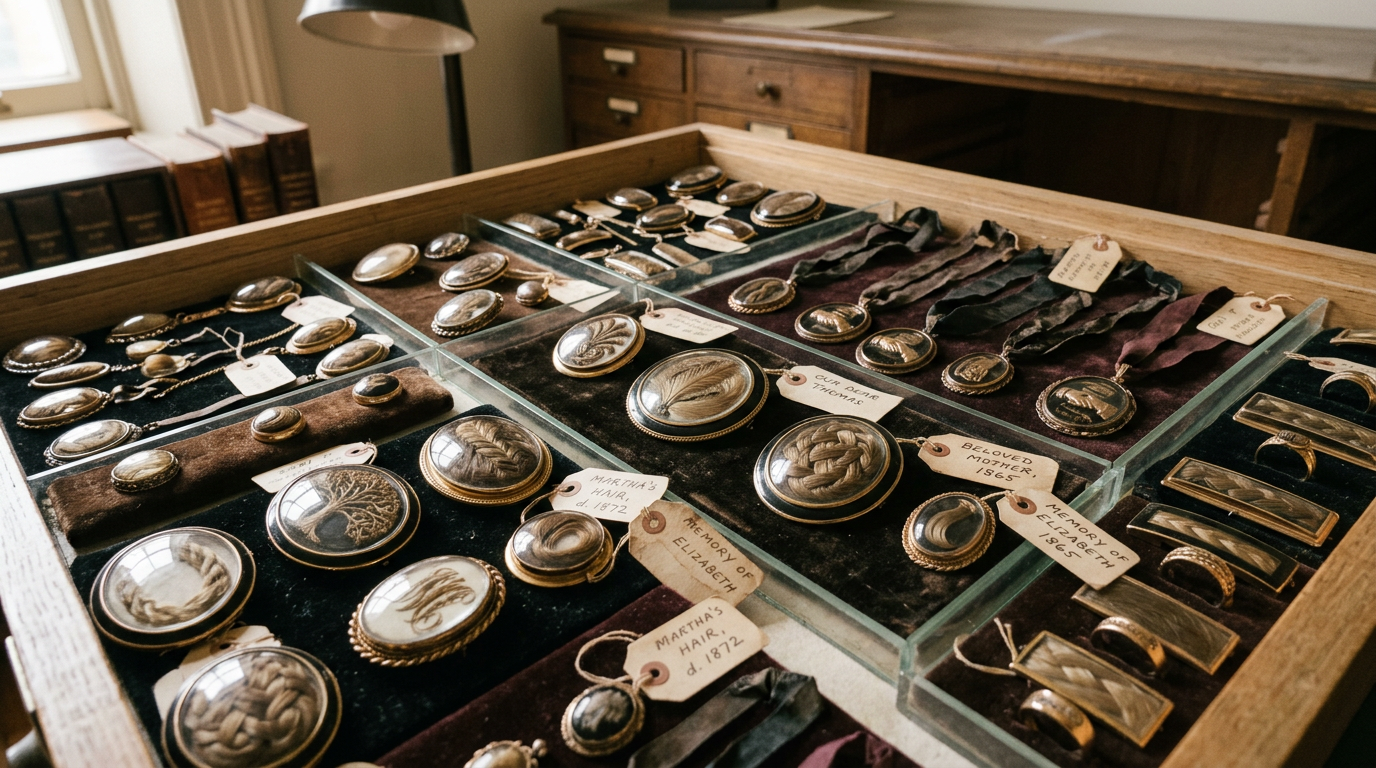
Consider, then, the case of an object no larger than a thumbnail: a mourning brooch, its gold bezel enclosing a lattice of pale brown hair worked into a lover’s knot, a spray of wheat, a weeping willow bent above nothing at all. It weighs almost nothing in the palm. And yet it carries the impossible freight of a proposition few cultures have dared to make so literally—that a fragment of the body might outrun the grave, that grief might be woven, worn, and carried against the pulse of the living wrist.
When the modern eye falls upon such a piece, it is tempted to see only the surface: a curiosity, a morbidity, a Victorian excess to be regarded with the polite distance one reserves for the customs of strangers. Yet as the evidence is examined, a different reality emerges—one defined not by sentiment alone but by an astonishing convergence of chemistry, economics, folk belief, and the human refusal to let go. The braided hair in the brooch is not decoration. It is a tether. And the study of that tether is the study of how an entire civilization attempted to negotiate the terms of its own bereavement.
This is a field study of hairwork: the intricate transformation of human hair into wearable memorial, the labor and the longing that produced it, and the slow, patient decay that now threatens to unmake it. The Archive invites the keeper of relics to sit with the evidence.
II. Hairwork
To understand the Victorian mourning brooch, one must first understand the medium itself—for the material was chosen with a precision that verges on the theological. Hairwork is, at its most literal, the craft of fashioning jewelry and artwork from human hair. It is a discipline far older than the century that made it famous, appearing throughout craft history wherever the human hand sought to make grief or devotion tangible. From the Middle Ages through the early twentieth century, memorial hair jewelry remained a persistent, quiet presence in the Western world’s material culture.
The reason for hair’s selection is not, as the casual observer might assume, mere convenience. It is a matter of endurance. Unlike nearly every other material the body offers—flesh, which corrupts; bone, which is unlovely; blood, which cannot be kept—human hair does not decay with the passing of time. Its chemical constitution, a dense keratinized protein resistant to the ordinary agents of decomposition, permits it to last for hundreds and, under the right conditions, possibly thousands of years. This is the quiet, uncanny fact upon which the entire practice rests. Hair is a remnant of the person from whom it was cut, and it is a remnant that does not rot. In an age preoccupied with transience, here was a fragment of the beloved that could, in a manner of speaking, defeat time. To braid a dead child’s curl into a ring was to hold in gold a portion of the body that the churchyard could not claim.
This incorruptibility lent hair a peculiar power in the imagination, and it is unsurprising that it should have accumulated a rich sediment of myth and legend. Because hair was understood as an extension and remnant of the self, it moved easily into the territory of sympathetic magic—the belief that a part of a person retains a living connection to the whole. In a Swedish book of proverbs, the record of the town of Vadstena, the discerning reader finds the assertion that “rings and bracelets of hair increase love.” Here the hair token is no passive keepsake but an active instrument, a charm that binds affection across distance and, one suspects, across the boundary of death itself. The hairwork object thus occupies an ambiguous and fascinating position: it is at once a decorative art, a memorial device, and a vestige of an older magical grammar in which the body’s fragments were never wholly severed from the soul.
The historical record furnishes the student of the vanished with luminous examples of this practice long predating its Victorian apotheosis. At Rosenborg Castle in Denmark survives a bracelet of precious metal set with a simple braided lock of hair—a gift from King Christian IV to his queen, an intimacy of the seventeenth century preserved in metal and keratin. More charged still are the rings that commemorated the execution of King Charles I of England in 1649. In the aftermath of the regicide, these mourning rings circulated clandestinely among his faithful supporters, each one a small treasonous grief, a portable loyalty to a beheaded king. To wear such a ring was to make of one’s own hand a reliquary and a political confession at once. Across the centuries that followed, the roster of those who owned or commissioned hair jewelry reads like an index of an age: Napoleon, Admiral Nelson, the celebrated sopranos Christina Nilsson and Jenny Lind, and—crucially, as we shall see—Queen Victoria herself and her vast and much-mourned family.
Before the great flourishing, then, hairwork was already an established language. A miniature portrait of Mrs. Gabriel Manigault—Margaret Izard—executed circa 1795, carries on its reverse the intimate token of hair, the painted face on one side and the corporeal relic on the other, a double portrait of presence and absence. The eighteenth century understood the logic of the sentimental object well. What the nineteenth century would add was scale, industry, and a grief so vast and so fashionable that it would reshape the entire economy of the human head.
III. The Victorian Period
Here the Archive lingers longest, for in the Victorian era hairwork ceased to be an aristocratic intimacy and became a phenomenon—a trade, a private craft, a domestic ritual, and finally a mania that touched nearly every class of a grief-saturated society. Although hairwork existed long before Victoria ascended the throne, her reign saw the practice flourish into full, elaborate bloom.
The forms it took were varied and, to the modern sensibility, extraordinary in their ambition. There were the intimate wearable pieces: lockets that opened to reveal a coiled lock, rings whose bezels enclosed woven plaits, bracelets braided entirely from the hair of the beloved. But the craft did not confine itself to the body. Hairwork migrated into the home as well, producing framed memorial tableaux of astonishing intricacy—the locks of loved ones worked into braids, wreaths, and woven floral patterns, or arranged into full “mourning scenes” in which gravestones and weeping willow trees were rendered entirely through the careful placement of human hair. Consider the labor and the strangeness of this: an entire elegiac landscape, a churchyard in miniature, composed of the very substance of the dead it commemorated. The medium and the message collapsed into one another. The willow was made of the mourned.
Yet it would be a distortion of the evidence to cast hairwork solely as an art of death. When unrelated to mourning, the practice persisted in a commemorative and honoring register. Hairworks were fashioned to celebrate a hair-giver’s personal achievements, or to signify a bond between friends, family, and lovers—a woven token of a living affection rather than a lost one. The exchange of hair among the living was a gesture of profound intimacy, a portion of the self given freely into another’s keeping. And the craft itself became a domestic accomplishment: a common skill taught to young women of the period, frequently interwoven, quite literally, with needlework. The parlor table where a young woman practiced her hairwork was a site of both mourning and courtship, of memorial and of hope.
The reasons for the practice’s explosive popularity deserve careful attention. Chief among them was the towering figure of the Queen herself. After the death of Prince Albert in 1861, Victoria made prolonged and demonstrative mourning the norm—a public, performed, and near-permanent bereavement that she would carry for the remaining four decades of her life. In a culture that took its cues from the throne, grief became not merely permissible but fashionable, and wearing hair jewelry became a socially legible way to carry one’s sentiments for the deceased. To mourn visibly was to participate in the moral seriousness of the age.
Beneath the sentiment, however, ran currents of hard economy and material fact—and here the Archive’s analysis grows most revealing. The incorruptibility of hair, already noted, gave the practice its philosophical foundation: a material that could genuinely outlast the flesh, offering the bereaved a tangible tether time could not sever. But labor supply was also a concern. By the nineteenth century, the wig-makers and hair artists who had once dressed the powdered perukes of seventeenth- and eighteenth-century noblemen found themselves with too little employment, their trade rendered obsolete by shifting fashion. The powdered wig had gone the way of the courts that wore it. The Victorian period of sentimentality offered these skilled craftsmen a new, unexpected livelihood: working hair not for vanity but for grief.
In its earliest and most refined form, hair jewelry was the province of the wealthy. It was produced in cooperation with goldsmiths, who mounted the hair in gold and adorned it with pearls and precious stones—beautiful, costly creations that only the higher classes could command. Such pieces, wrought by artisans from precious materials, were naturally expensive, and for a time the practice remained a luxury of the few. This changed at the middle of the Victorian period, when instructional guides became available and placed the craft within reach of the many. Hair jewelry descended the social ladder.
The economy that supplied all this hair is among the most affecting details the field study can offer—a worn-out spot in the historical fabric, handled a thousand times and rarely examined closely. Workshops that manufactured these fashionable items existed across Europe. To feed them, buyers of human hair traveled the countryside, purchasing hair from poor peasants—sometimes for coin, sometimes in exchange for scarves, ribbons, or other small luxuries a rural woman might otherwise never possess. One imagines the transaction: a length of a young woman’s hair, cut and bartered for a ribbon, destined to be braided into a stranger’s mourning and worn against a wealthier throat. The demand was compounded by a parallel market, for beyond memorial jewelry there remained the enduring need for braids and switches, the false pieces women purchased to augment their coiffures. The head of the poor became, in a quiet and unremarked way, a resource harvested for the sentiment and the vanity of others. Most memorial hairwork, it should be said, was made from the hair of a person of particular significance—a famous figure, or far more often a family member or friend—but the anonymous commercial supply flowed steadily beneath this intimate surface, and the two were not always easy to distinguish.
That difficulty gave rise to one of the period’s most telling anxieties—a fracture in the foundation of the whole practice. If a grieving widow sent her husband’s hair to a commercial jeweler, how could she be certain that the hair returned to her, braided into a brooch she would wear until her own death, was truly his? The concern was neither idle nor rare. A pervasive lack of trust in commercial manufacturers took root, founded on the suspicion that the precious hair had been substituted with common stock, the relic of the beloved quietly exchanged for the sweepings of the workshop floor. Hair-working companies fought this suspicion with advertisements stressing that they used only the hair they were sent. Yet these very assurances may have deepened the unease, for in protesting their own honesty they implied, by contrast, the dishonesty of their competitors—and thus confirmed that substitution happened. The tether to the dead, it turned out, was only as trustworthy as the hands through which it passed.
This anxiety, along with cost, drove the craft into the home. In America, the period’s popular magazines turned the domestic parlor into a workshop of grief. Godey’s Lady’s Book, the great arbiter of nineteenth-century American feminine taste, printed patterns and advertised starter kits furnished with the necessary tools. Whole volumes were devoted to the subject, chief among them Mark Campbell’s Self-Instructor in the Art of Hair Work, a comprehensive treatise on hairwork and the broader category of “fancywork,” as the era’s predominantly female crafts were known. The woman who worked her own husband’s hair at her own table could be certain, at least, that the tether was true.
Across the Atlantic, the same domestic turn produced one of the most remarkable regional chronicles in the craft’s history. In the Swedish parish of Mora, and above all in the village of Våmhus, groups of women took up hairwork with such skill and determination that they transformed the local economy of grief. Lacking the money to buy expensive gold findings, these women improvised with characteristic ingenuity: they mounted their jewelry on wooden beads, then covered them so cleverly with hair that the humble armature vanished beneath the craft. In this way they made hair jewelry affordable to those far below the wealthy, democratizing the memorial object through sheer manual mastery. Among the most celebrated of these Swedish hair-workers was Martis Karin Ersdotter, whose name survives where the names of so many anonymous craftswomen have been lost. The women of Våmhus would prove to be more than a curiosity; they would become, in time, the thread by which the entire tradition survived.
IV. The Modern Period
Every tradition believes itself permanent, and every tradition is wrong. By the closing decades of the nineteenth century, the vast machinery of Victorian mourning had begun to slow, and the cataclysm of the First World War would bring it, along with so much else, to a definitive end. The ostentatious mourning culture that had sustained hairwork could not survive the industrialized grief of the trenches; a society drowning in death lost its appetite for its elaborate performance. Hairwork went out of fashion across Europe, and for the better part of a century it lay largely forgotten, its brooches consigned to drawers and estate sales, its meaning growing opaque to descendants who could no longer read the language of the willow and the wheat.
And yet the tradition did not die entirely—and the place of its survival returns the Archive to the village already met. In Våmhus, where hairwork had been practiced with such distinction, the local community came to recognize, even after the fashion had passed elsewhere, what a treasure the knowledge of the trade truly was. The local historical society took the decisive step of introducing hairwork classes, and new generations of women learned the art from those who still remembered it. The consequence is remarkable: in Våmhus, hair art has been practiced continuously for very nearly two hundred years, an unbroken transmission from hand to hand across the span that saw the craft born, flourish, die out everywhere else, and quietly persist in a single Swedish parish. It is the great living exception to the general extinction.
The formal preservation of the craft accelerated at the close of the twentieth century. In 1994, the most active practitioners founded the Hairworkers Society, and together they have mounted many shows, exhibits, and projects, giving the ancient discipline a modern institutional home. In a parallel development suited to a new century, the Victorian Hairwork Society emerged to offer members a space to share their own work, to identify and authenticate historical pieces, and to request new work crafted in the old manner—the tradition finding, in the connective architecture of the modern age, a means to gather its scattered adherents.
The wider culture of mourning jewelry, of which hairwork was always a part, followed its own arc into the present. The general history is instructive: mourning jewelry proper emerged from the sixteenth century onward, peaked in the second half of the nineteenth century, and declined rapidly from the beginning of the twentieth. The taxonomy the field has developed distinguishes several types—reliquary jewelry, which contains actual physical remains such as hair, a tooth, or ashes; personalized or imprinted jewelry, which refers to the deceased through an engraved name, a date, a fingerprint, or a photograph; heirloom jewelry, worn by the dead and inherited by the living; and black jewelry, which expresses mourning through color alone. Hairwork belongs unmistakably to the first and most intimate of these categories. It is reliquary. The object does not merely refer to the dead; it contains them.
After the long dormancy, the late twentieth century brought a modest but genuine revival, concentrated tellingly in that same reliquary impulse. The contemporary form is cremation jewelry: the ashes of the dead incorporated into a wearable object—stored in the small compartment of a ring or pendant, or suspended within synthetic stones grown to enclose them. In its most poetic modern iteration, jewelers have captured the gases released when human ashes are heated, sealing what is described as the deceased’s last breath within a piece of adornment. The technology is new; the longing is not. It is the identical longing that drove a Victorian widow to braid her husband’s hair, and a seventeenth-century royalist to wear his martyred king against his skin. The Archive observes the new as merely the old wearing a different hat. The material tether to the dead, banished for a century as morbid, has simply returned in a chemistry the age finds more palatable. Designers at the beginning of the twenty-first century now draw open inspiration from the memento mori tradition, crafting contemporary meditations on loss, death, and mourning. The willow bends again, in new hands.
V. Long-Term Preservation
The Archive must now turn to a sober truth, and it is one saturated with irony. Hair was chosen, above all materials, because it does not decay. It was the incorruptible tether, the fragment of the beloved that would outlast the grave. And yet the objects made from it are dying—not from the failure of the hair, but from the failure of everything the hair was mounted upon.
In Victorian and older pieces, the hair itself frequently survives in fine condition, faithful to its incorruptible reputation. But the gum and adhesive substances used to hold the hair and its accompanying decorations in place have not endured as well. Over the passage of a century and more, these binders have decayed, grown brittle, and lost their grip. The consequence is a quiet catastrophe visible in countless surviving pieces: the movement of hair within the setting. The careful lattice slumps. The precise willow loosens into a tangle. The lover’s knot slips its mooring. The composition that a grieving hand arranged with such deliberation begins, slowly, to come undone behind its glass—the design dissolving even as the raw material persists. This offers a melancholy lesson for the custodian of the past. The keratin outlives the intention. The relic survives; the meaning migrates and blurs. The tether holds, but the hand that tied it, and the knot it tied, have both surrendered to time.
This is the peculiar preservation challenge the surviving corpus presents. To conserve a hairwork brooch is not primarily to conserve the hair, which requires little, but to arrest the decay of its housing—the failing adhesive, the tarnishing bezel, the crazing glass, the sepia backing that has grown foxed and fragile. It is a study in how the durable and the fragile were bound together in a single object, and how the fragile, in the end, governs the fate of the whole. The vestige endures precisely as long as its frame permits.
VI. Final Reflections from the Archive
What, then, does this evidence reveal about the human condition, and about the era that produced these braided sorrows in such profusion? When the Archive connects the incorruptibility of hair with the Victorian hunger for a tangible memorial—when it sets the anxious widow, fearful her husband’s lock had been swapped for a stranger’s, beside the peasant girl bartering her hair for a ribbon—a pattern emerges. It suggests that grief, in every age, seeks an object. The abstraction of loss is unbearable; the mourning heart demands something it can hold, wear, press against the wrist, carry into the ordinary hours of the day. The Victorians, with their characteristic literalism and their remarkable craft, gave that demand its most direct possible answer: not a symbol of the dead, but a piece of the dead, woven into the fabric of the living day.
A haunting continuity runs through this. The seventeenth-century royalist and the twenty-first-century mourner wearing an ancestor’s ashes in a synthetic stone are engaged in precisely the same act, separated only by the technology of their tenderness. The impulse to keep a tether to the departed—material, corporeal, incorruptible—appears to be among the most durable of human needs, more durable, perhaps, than any of the specific forms it has taken. The forms decay; the gum crumbles; the fashion passes; the willow loosens behind its glass. The longing does not.
The seeker of forgotten things is invited to inquisitive reflection. If a fragment of the body might be made to outlast the grave, and if the objects we craft to hold our grief will themselves decay before the relic they enclose, then what, precisely, is it that we are truly preserving when we keep such a thing—the beloved, or the memory of our own devotion? The Archive offers no final answer. It sits with the evidence, in the dim light, and traces the pattern.
The Archive remains open for inquiry.
The history examined here does not reside solely in the abstract. The physical artifacts—the vestiges themselves—may be encountered directly. Those who wish to study these objects further, and to hold in the hand what these pages have only described, may cross into the fuller collection at http://www.wickeddualblog.com and the associated Wicked Dual repositories, where each archival piece awaits its custodian.
We invite you to enter the haunted archive and secure a piece for your private collection; it is a necessary addition for those who curate the darker corners of human history.

Bibliography
Godey’s Lady’s Book. (1830–1878). Louis A. Godey.
Lutz, D. (2015). Relics of death in Victorian literature and culture. Cambridge University Press.
Ofek, G. (2009). Representations of hair in Victorian literature and culture. Ashgate.
Taylor, L. (1983). Mourning dress: A costume and social history. George Allen & Unwin.
Leave a Reply