The Wicked Dual Archive · Field Study № CXVII · The Unseen

I. Crossing into the Dim
The Archive is open. The discerning collector is invited to step across the threshold, where the light is dim, and the air is heavy with the weight of history. This is not a place of entertainment but of examination. The modern is observed here as merely the old wearing a different hat—the ghost in the machine and the machine in the ghost. It is all connected: the fracture in the foundation of a Delta town, the way the evening light falls across a faded marble headstone in a small Black cemetery, the quiet hum of a legend that outlived the woman who cast it. They tell the same story. The Archive is not here to preach, nor to frighten. It is here to sit with the evidence and trace the patterns.
There are figures in American history who exist in the seam between the documented and the sung—who left behind census forms and probate records on one side and, on the other, a trail of verses carried down the Mississippi in the mouths of blues singers. Such a figure was Caroline Tracy Dye, called Aunt Caroline, the seeress of Newport, Arkansas. She was born into bondage and died a woman of property. She could not, by her own attestation in her final will, write her own name; yet within a circle four hundred miles across, drawn with Newport at its center, it was said that more adults knew her name than knew the name of the sitting President of the United States. Consider the strangeness of that proposition, discerning collector. An illiterate Black woman in the Jim Crow South, more famous than Woodrow Wilson across a swath of the mid-continent—and remembered today chiefly because a bandleader named W. C. Handy wove her into one of the most recorded songs in the history of American music.
When one looks at Aunt Caroline Dye, one is tempted to see only the surface: the fortune-teller of legend, the spooky curiosity of a roadside historical marker, the “hoodoo woman” of the record labels. Yet as the evidence is examined, a different reality emerges—one defined not by the supernatural but by profound, worldly intelligence: a woman who converted the perceived power of prophecy into land, capital, and an autonomy almost unthinkable for a person of her origins. Let the study begin, as any proper study must, with the name and the words that surround it.
II. The Weight of Names
To speak of Aunt Caroline Dye is to enter a thicket of nomenclature, for nearly every word attached to her carries a contested history.
Begin with the honorific itself: Aunt. In the linguistic economy of the segregated South, the title was double-edged. White Southerners commonly addressed elderly Black women as “Aunt” and elderly Black men as “Uncle,” a usage that withheld the dignity of Mrs. or Mr. while feigning familial warmth—an instrument of subordination dressed as affection. Yet within the Black community the same word could be reclaimed as one of genuine reverence, marking an elder of standing and wisdom. That Caroline Dye is remembered universally as Aunt Caroline holds both meanings in suspension: the diminishment the age imposed upon her, and the authority she nonetheless commanded across the color line. The word is a fossil of its era’s whole racial grammar.
Consider next the vocabulary of her vocation, a lexicon that, in the words of the Encyclopedia of Arkansas, has been distorted and stretched across the decades. She was called a fortune teller, a soothsayer, a seeress, a prophet, a root doctor, a conjuror, a hoodoo woman, and—most evocatively—a two-headed doctor. Each term belongs to a distinct register. Seeress and prophet elevate; fortune teller trivializes; hoodoo woman and conjuror situate her within a specific African American spiritual tradition. The phrase two-headed doctor rewards particular attention. In the folk speech of the Black South, the “two heads” denoted a practitioner who possessed a second sight—one head for the visible world and one for the invisible—a doctor of both body and spirit. It is a term of art, not of derision, and its persistence in the record is a linguistic vestige of a coherent worldview.
The word hoodoo itself must be handled with care, for it is chronically confused with voodoo, and the conflation does violence to both. Hoodoo—also called conjure or rootwork—is not a religion but a body of folk-magical practice, African-rooted and syncretized with Protestant Christianity, oriented toward practical ends: healing, protection, luck, the finding of lost things. West African Vodun and its Louisiana descendant are distinct religious systems with pantheons and priesthoods. Aunt Caroline, the sources are careful to note, was a practitioner of hoodoo and emphatically not of voodoo; she worked within a Christian frame, and the distinction was not academic to her.
Even her surname flickers. She was born Caroline Tracy, taking the name of the family that held her in bondage—the common brand of American slavery, whereby the enslaved wore their owners’ names as a mark of ownership. She became a Dye through marriage to Martin Dye; and one competing account holds that the name traces instead to a Sulphur Rock merchant, Henry C. Dye, on whose land she is said to have been enslaved. That a person’s very name should admit of two irreconcilable origins is itself the signature of a life lived largely outside the reach of reliable record.
III. The Residue of a Life
A field study must be grounded in things—in the tangible residue of a life, the documents and objects handled until their meaning wears smooth. And here the collector confronts the central material paradox of Aunt Caroline Dye: a woman whose entire reputation rested upon the immaterial, yet who left behind a remarkably solid estate of paper and property.
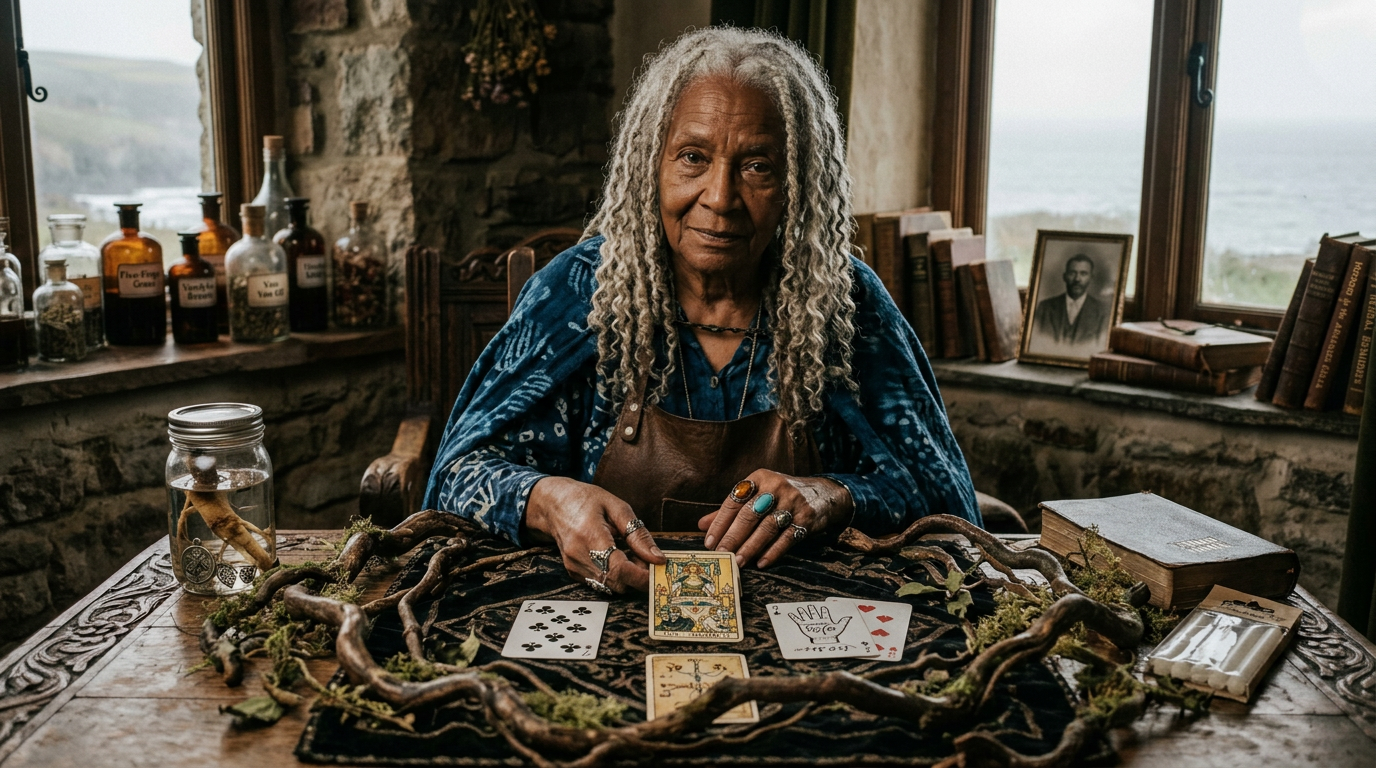
Consider first the instrument of her trade, which was almost aggressively ordinary. She used no crystal ball, no exotic apparatus, no theatrical hocus-pocus. She read an ordinary deck of playing cards, spreading them before her—by several accounts less as a genuine oracle than as an aid to concentration, a surface upon which to fix her attention while she took the measure of the person seated across from her. At other times she dispensed with the cards entirely and simply looked at a visitor and told them what they had come to hear. Something profoundly instructive lies in this austerity. The power was understood to reside in the woman, not in the props; the cards were a worn deck, handled a thousand times, and it is precisely in that worn ordinariness that the truth of her method may lie.
Consider next the documentary residue, contradictory and eloquent. The federal census forms of Jackson County, taken from 1870 through 1910, estimate her birth between roughly 1843 and 1853. Her gravestone in Gum Grove Cemetery states she was one hundred and eight at her death, which would place her birth in 1810. The U.S. Freedmen’s Bureau marriage record of June 11, 1867, lists Caroline Tracy, aged twenty, wedding Martin Dye, aged twenty-two, at Jacksonport—and gives her birth year as 1847. That a single life should generate a spread of nearly four decades in its own beginning is not carelessness; it is the characteristic imprecision that shadows the records of the formerly enslaved, for whom accurate birth years were rarely kept and often deliberately obscured.
Consider, above all, the property—for this is where the immaterial seeress becomes unmistakably real. She never set a fee, yet no visitor left without pressing money into her hand. With those offerings, and with the Civil War pension drawn after her husband Martin’s death around 1907, she did something extraordinary for a Black woman with no formal education in the Jim Crow South: she bought land and built rental houses on it, not far from Newport’s business district. She accumulated genuine wealth. And in her home, at the end, were found large stacks of cash, with persistent whispers of gold secreted in hidden places around the town—a buried fortune that treasure-seekers hunted for decades and never found. The material record thus closes on an absence, the most seductive kind: money that was rumored, sought, and never recovered, dissolving the documented estate back into the realm of legend from which the woman’s fame had first arisen.
The final artifact is the humblest. In Gum Grove, a small and weathered African American cemetery down the road from Newport’s larger Walnut Grove, stands a tidy marble headstone. Some of the surrounding stones have slipped into the side yards of the modest houses that abut the ground. The marker bears a name and an impossible age. It is a simple stone, and it has outlasted the rental houses, the cash, and the gold alike.
IV. The Word Carried Down the River
Here the Archive turns from ledger to legend, from what can be documented to what was believed—for the reputation of Aunt Caroline Dye was built on a body of prophecy-stories that circulated across the Mid-South like scripture. These narratives outran the woman herself, carried by rail and by rumor down the White River and out across the Delta, and in their telling and retelling the collector may best read what a people needed her to be.
The founding legend, repeated in nearly every account, is set at a plantation Thanksgiving table when Caroline was a child of ten, laboring as a house girl. She insisted, against all correction, that another place must be set—that “Mister Charley,” the plantation owner’s brother, would be coming to dinner, though Charley was believed to have died in the Civil War four years prior. She was dismissed, even scolded. And then Charley walked through the door, alive, bearing his tale of capture and imprisonment. The household could not deny that something miraculous attended the girl. This is the origin myth in its purest form—the moment the gift announces itself, unbidden, before a skeptical audience that is compelled to believe. That the tale’s chronology collapses under scrutiny (a four-year war cannot easily accommodate a ten-year-old born in 1810) only marks it more clearly as legend: a story shaped for meaning rather than for the calendar. Note, too, the setting the story chooses for itself. The gift declares itself not in a church or a marketplace but at the master’s table, in the very act of servitude—the enslaved child correcting the household that owns her, and being proven right. Whatever its literal truth, the tale encodes a quiet reversal of power that would define the whole shape of her life to come.
The mature legends follow a consistent and revealing pattern: the recovery of the lost. A man comes seeking his stolen hogs, and she directs him with uncanny specificity—the fifth house down the road, the stable behind the barn, the latch to leave open, and the crucial instruction to go tomorrow, not today, for the thieves would be home today and away tomorrow. Another comes, secretly doubting, after his missing mules; she sends him four miles down the Tuckerman road to a timbered hollow, to follow the sound of their braying to a barn, and to find the key resting upon a foundation block on the near side. The texture of these accounts is worth the collector’s attention. The prophecy is never vague or celestial; it is granular, procedural, almost forensic—a map rather than a mystery. Whether one reads this as genuine second sight or as the fruit of an extraordinary intelligence, richly informed by a network of servants and travelers who brought her the news of three counties, the effect upon the believer was identical.
Observe, as well, the moral architecture embedded in these recovery tales, for it is easily missed beneath the wonder. In the matter of the hogs, she does not merely locate the stolen property; she manages the confrontation, counseling patience and timing so that the wronged man might reclaim what was his without bloodshed or open accusation. In a rural society where the theft of livestock could end in gunfire and where the law offered a Black or poor complainant little recourse, such counsel was itself a kind of justice—a shadow magistracy operating outside the courthouse, dispensing not only knowledge but the prudence to use it safely. The seeress, in these stories, is also an arbiter, and her prophecies double as verdicts.
Then there is the legend of the secret clientele, which cuts to the marrow of Southern racial hypocrisy. Prominent white residents of Newport mocked her powers in the daylight and crept to her door after dark, begging her counsel before any consequential business decision and imploring her to keep their visits secret. The image is indelible and gothic to its core: the pillars of a segregated society, who would not grant her the title of Mrs., stealing to the home of a Black conjure woman under cover of night to learn what the cards foretold. She was known, moreover, to confront the skeptic directly and to prove them wrong—a woman who did not merely wait to be believed but demanded it. There is a documented residue even of this: a Newport newspaper item of March 1909 bore the headline “Delegates Return to Seeress,” a small notice hinting at how routinely, and how publicly, the ostensibly rational sought her out. The daylight mockery and the midnight pilgrimage were not contradictions in the mind of the era; they were the two faces of a single, uneasy dependence.
Finally, the legend accretes toward the treasure—the persistent tale of a hidden fortune, of gold secreted in the walls and grounds and hidden places of Newport, unrecovered at her death and hunted for decades after. Here the folklore of Aunt Caroline joins a very old and very deep vein of American story: the buried hoard, the wealth that will not be found, the map that leads always to an empty hole. The legend attached itself to her so readily. A woman who could find any lost thing became, in death, herself the keeper of the ultimate lost thing—a fortune that has slipped beyond all finding, guarded now by the very silence she spent her life dispelling. The seeress who returned the missing to the bereft withheld, at the last, the one treasure the living most wished to recover. It is the perfect and terrible symmetry that legend so often bestows upon its chosen figures.
V. Rites of the Gathering
Aunt Caroline Dye’s practice was not idle divination; it was embedded in a coherent system of belief and ritual, and cataloging its observances lets us glimpse the spiritual architecture of the African American Delta.
Foremost among her rites was healing, and the record preserves its liturgy in remarkable detail. The folklorist Harry Middleton Hyatt, who assembled a vast collection of interviews with hoodoo practitioners between 1935 and 1939, recorded the testimony of a Memphis conjure woman known as Madam Collins. She described how Aunt Caroline healed her cousin, called Lou, in Oil Trough, Arkansas—a woman who had been poisoned and could find no cure. The treatment prescribed was both material and ceremonial: rattlesnake dust, turpentine, and a precise set of ritual instructions, culminating in the sufferer turning to face the east and speaking a petition—”Lord, here am I. Take all my troubles and heal me, in the name of the Father, Son, and Holy Ghost.” Observe the fusion at work. The rattlesnake dust belongs to an African-derived materia magica; the eastward orientation echoes ancient sun-facing devotions; and the invocation is unmistakably Christian, Trinitarian, Baptist in its cadence. This is hoodoo entire: the old knowledge and the new faith braided into a single act.
For hoodoo, as Aunt Caroline practiced it, was not opposed to the church but woven through it. She believed, as most hoodoo spiritualists did, in God, in Jesus, and in the Holy Ghost, and her rootwork drew upon Black Baptist teaching. Within this tradition, the biblical framework is not decorative but foundational: Yahweh is understood as the head conjuror of all, and His great figures reinterpreted as master practitioners. The anthropologist and hoodoo researcher Zora Neale Hurston, in her novel Moses, Man of the Mountain, cast Moses as the finest hoodoo man in the world—the worker of the staff that became a serpent, the parter of the sea. In this cosmology, the Bible itself is revered as the supreme talisman, the greatest book of conjure, a compendium of spells for obtaining God’s blessings. To work the root was, for Aunt Caroline, to join a sacred order, not defy it.
This sacred order did not arise from nothing, and the collector should trace its lineage, for it is the deep root beneath the woman. Hoodoo is a survival—a body of practice carried in the memory and the muscle of the enslaved across the Middle Passage from Central and West Africa, stripped of its original theological superstructure by the violence of bondage, and re-clothed, of necessity, in the Protestant Christianity forced upon its practitioners. What emerged was not a dilution but a synthesis: an African armature of herbs, minerals, animal curios, ritual gesture, and the belief in a manipulable spiritual world, fused with biblical text and Baptist devotion. That such a system should have persisted, coherent and effective, into the twentieth century on the banks of the White River is itself a monument to cultural endurance—a spiritual reclamation achieved under conditions designed to extinguish precisely such continuities. When Aunt Caroline mixed her rattlesnake dust and set her patient facing east to invoke the Trinity, she was performing an act of transmission centuries in the making, whether or not she or her supplicants could have named its full genealogy.
Her observances were also marked by firm interdictions—the things she would not do—and these self-imposed limits form an ethical liturgy. She refused to curse. By the accounts, she would not harm others. She declined to prophesy about matters of love, and she declined to prophesy about wars. A practitioner is defined as much by her refusals as by her acts, and these refusals draw the portrait of a woman who understood her power as a stewardship to be exercised within bounds, not a license to be spent freely.
Finally, the rites of the gathering itself took on the character of secular pilgrimage. On weekends her house overflowed; visitors poured off the Rock Island trains in droves, some having traveled hundreds of miles, and made their way to her door. And Aunt Caroline, ever the practical woman, met the crowds not only with prophecy but with hospitality for sale: she cooked plates of soul food and sold them to the pilgrims who thronged her yard. The sacred and the entrepreneurial, in her hands, were never far apart.
VI. Reading the Spread of the Cards
The collector of dark history must now ask not merely what Aunt Caroline Dye did, but what her life reveals—about power, about race, about the peculiar economy of belief in the post-Reconstruction South. When the scattered facts are connected, a pattern emerges that has little to do with the supernatural and everything to do with the possible.
Set the two poles of her life side by side. At one end: a girl born into slavery, of unknown parentage, one of thirteen children owned by the Tracy family, illiterate to her dying day. At the other: a landowner and rental-property entrepreneur of substantial wealth, sought in secret by the white elite, mourned across a region, and enshrined in the national songbook. The distance between those poles was traversed by a single instrument—her reputation as a seer. This is the crux of the analysis. In a society that had sealed off nearly every avenue to autonomy for a Black woman—education, capital, the professions, even the courtesy of her own honorific—the role of the conjure woman constituted a rare and potent exception. White society could not fully regulate it because it did not fully understand it, and Aunt Caroline converted it, with evident shrewdness, into the most conventional forms of power the era recognized: deeds, rents, and cash.
Consider what those recovery-prophecies actually required. To name the stable where the stolen livestock stood, or which household would be away on which day, demands not necessarily a window into the beyond but an unrivaled command of local intelligence—of who was where, who owed whom, whose character ran to theft. A woman whose home was a constant crossroads of travelers, servants, and supplicants from three counties would have sat at the center of the finest information network the Delta could offer. Connect this to her refusals—no love, no war, no curses—and a portrait of deliberate professional discipline sharpens into view. She avoided precisely those predictions most likely to be proven false or to breed dangerous enmity, and concentrated on the recoverable, the verifiable, the practical. This is not to reduce her to a mere clever reader of situations; it is to observe that genuine gift and worldly acumen are not mutually exclusive, and that the historical record documents the second even where it can only report belief in the first.
There is, too, a dimension of gender that the analysis cannot omit, for it sharpens the achievement to its finest point. Aunt Caroline Dye was not merely a Black person accumulating wealth and authority in the Jim Crow South; she was a Black woman doing so, and largely without a husband for the last decade of her life, having been widowed around 1907. The conjure tradition was one of the few domains in which a woman’s spiritual authority might equal or exceed a man’s—the tradition speaks readily of the two-headed woman as of the two-headed man—and Aunt Caroline exploited that opening to its fullest. She held property in her own name, directed her own affairs, and disposed of her estate by her own will. That testament, dictated because she could not write, declared her to have “no heirs of my body” and divided her holdings between an adopted daughter, Irene, and a nephew, Mac Griffin—while placing a trusted friend, C. M. Erwin, in charge of the rental properties and the girl’s trust, in the frank expectation that the nephew would otherwise squander it. Even at the threshold of death, the seeress was managing outcomes, hedging against the failings she foresaw in those she left behind. The same faculty that located the missing mules was, at the last, turned upon the future of her own fortune.
What, then, does the case reveal about the era? It exposes the vast hypocrisy at the heart of segregation: a white ruling class that denied Black personhood in public and sought Black wisdom in private, that mocked at noon and knelt at midnight. It reveals the improvisational genius by which the descendants of the enslaved carved out spaces of power in the interstices of a hostile order. And it illuminates the deep continuity of African spiritual tradition, surviving the Middle Passage and slavery to flower, transformed, in a Baptist idiom on the banks of the White River. When one connects the illiterate woman to the international fame, the stolen mules to the purchased land, the cards meant only for concentration to the elite who came begging in the dark, the pattern that emerges is not a ghost story at all. It is a study in how the powerless manufacture power, and in how a society interacts with the knowledge it publicly disdains and privately cannot live without.
VII. The Name That Went On Singing
No study of Aunt Caroline Dye would be complete without tracing the extraordinary afterlife by which a Delta seeress became a permanent inhabitant of American music—for her name did not fade with her funeral; it went on singing.
The great vector of that immortality was W. C. Handy, the Memphis bandleader called the Father of the Blues. In a much-cited interview with the writer Dorothy Scarborough, Handy identified the gypsy fortune-teller of his 1914 “St. Louis Blues”—one of the most recorded songs in the history of the form—as Aunt Caroline Dye. The reference, he explained, grew from a folk saying already worn smooth in the mouths of Black Southerners: that one had to go and see Aunt Caroline Dye. He returned to her again, and by name, in his “Sundown Blues,” in which a wronged lover resolves to travel to Newport, Arkansas, to seek out Aunt Caroline, the reader, whose cards, the song insists, do not lie. That a working conjure woman should be embedded in the foundational repertoire of the blues is a fact of the first cultural importance: it means her fame was not merely regional gossip but a shared reference across the entire Black South of the early twentieth century.
It was the folklorist John Quincy Wolf who first ventured the astonishing reckoning of her fame recorded in this study’s opening—the four-hundred-mile circle, the woman better known than the President across it. What bears emphasis here is the channel of that renown. It traveled not through newspapers and photographs, which largely ignored her, but through the older and more durable currents of song, saying, and the testimony of those who had made the pilgrimage. Hers was a fame of the oral world—and the oral world, as this Archive has often had cause to note, forgets far less than the printed one pretends to remember.
The echoes multiplied. The Memphis Jug Band, led by Will Shade, recorded “Aunt Caroline Dyer Blues” in 1930, its verses describing a man’s journey to Newport for a mojo hand that will let him strut and prosper, and naming her a two-headed woman who can raise the sick, break spells, and outmatch even the famed Seven Sisters of New Orleans conjure. Johnnie Temple named her outright in his 1937 “Hoodoo Woman.” Later still, the songwriter Willie Dixon summoned her in “Wang Dang Doodle,” first recorded by Howlin’ Wolf, whose lyric calls out to Caroline Dye to join the revelry. It was Shade, too, who left the most quoted verdict on her, delivered decades after her death in an interview for the book Conversation with the Blues: white and colored alike went to her, she raised the sick from their beds, she had that much sense—and, in the paradoxical idiom of the highest praise, that she was the worst woman in the world, meaning the most formidable.
It is worth pausing to ask why the blues, of all forms, should have adopted her so completely. The answer lies in a shared spiritual geography. The blues and hoodoo grew from the same Delta soil and spoke the same symbolic language: the mojo hand and the goofer dust, the crossroads bargain, the black cat bone, the two-timing lover to be fixed or won back by conjure. When a bluesman sang of going to Newport to see Aunt Caroline for a mojo, he was not inventing a fanciful character but invoking a real and authoritative figure his listeners knew by reputation—the way a later songwriter might invoke a doctor or a judge. She lent the songs their credibility precisely because she was not fictional. In naming her, the blues borrowed the weight of an actual power operating in the actual world, and in return it granted her a permanence no deed or dollar could secure. The transaction was mutual, and it has outlasted every party to it.
The contemporary revival has moved from the phonograph to the seminar and the roadside marker. Scholarly reassessment has gathered force—from John Quincy Wolf’s 1969 study in the Southern Folklore Quarterly to a 2023 article in the Arkansas Review examining race, gender, and hoodoo through her case—alongside her entry in the Encyclopedia of Arkansas and steady attention from historians of the Delta. In these treatments the caricature recedes and the historical woman advances: the entrepreneur, the property-holder, the intelligence at the center of a web of belief. There is a quiet justice in the trajectory. The seeress who told others their futures has, in the long retrospect, been granted a future of her own in the historical record—the woman who read the world at last becomes a subject the world sits down to read.
VIII. The Lamp Drawn Low
The Archive draws its lamp a little lower now, and returns, as it must, to the weathered stone in Gum Grove and the impossible age carved upon it. More than a century has passed since Caroline Tracy Dye was laid down in the Arkansas ground. The birth year remains contested across four decades. The hidden gold, if it existed, was never found. The precise nature of her gift—whether second sight or singular sagacity—lies forever beyond the reach of the evidence, sealed with her in the dark.
The discerning collector is invited to inquisitive reflection. What is one to make of a life in which the immaterial produced the most material of results—in which the reading of ordinary playing cards was transmuted into land, and belief itself became the one currency a Black woman of the Jim Crow South could mint at will? Consider the peculiar power of the figure who stands, as Aunt Caroline stood, at the crossing of the seen and the unseen. The rational historian may explain her success by intelligence, information, and discipline; the tradition that produced her explained it by the gift of two heads, one for each world. The remarkable truth is that both explanations lead to the same place: a woman who bent a hostile world to her will and left it singing her name.
A final pattern here is worth sitting with. The society that would not call her Mrs. could not, in the end, forget her at all—while the presidents and planters and merchants of her day have receded into the gray silt of the archive, Aunt Caroline Dye rides on in the twelve-bar line, summoned nightly wherever the blues is played. History has a long memory and a strange sense of proportion. It does not always honor those it was told to honor. But it remembers, sometimes most fiercely, the ones it was told to overlook—the conjure woman at the crossroads, spreading her worn cards in the lamplight, seeing what the powerful could not, and would not, admit they had come to learn.
The Archive remains open for your inquiry. The collector is invited to examine these findings and to sit, as the Archive has sat, with the evidence and the absences alike.
We invite you to enter the haunted archive and secure a piece for your private collection; it is a necessary addition for those who curate the darker corners of human history.
To continue your study of the seeress of Newport and to examine the artifacts drawn from the world of Delta conjure and the hoodoo tradition, the discerning collector is invited to cross the threshold at www.wickeddualblog.com and to explore the curated holdings of the Wicked Dual archive.

Bibliography
Hurston, Z. N. (1939). Moses, man of the mountain. J. B. Lippincott.
Koch, S., & Brantley, M. (2005, June 30). Aunt Caroline Dye: “The worst woman in the world”? Arkansas Times. https://arktimes.com/entertainment/arkansongs/2005/06/30/aunt-caroline-dye
Encyclopedia of Arkansas. (n.d.). “Aunt Caroline” Dye (1843?–1918). Central Arkansas Library System. https://encyclopediaofarkansas.net/entries/aunt-caroline-dye-14/
Caroline Dye passes away. (1918, September 27). Newport Daily Independent, p. 2.
Note: Federal census records for Jackson County, Arkansas (1870–1910), U.S. Freedmen’s Bureau marriage records (1867), and Dye’s probated will (1918) are cited as reproduced and analyzed in the biographical sources above; specifics vary across editions and transcriptions.
Leave a Reply