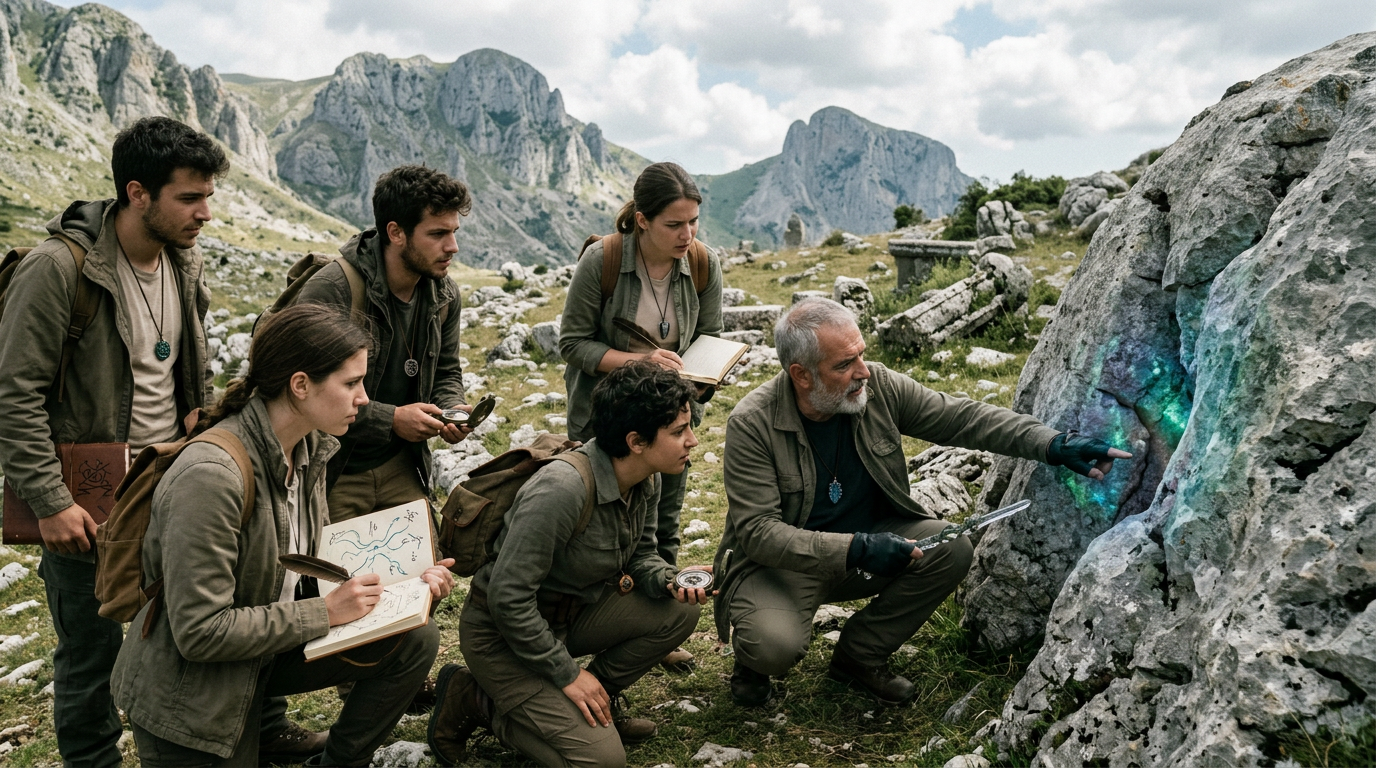
The Legend of the Land
There was, among the peoples of the ancient Mediterranean, a shared and abiding unease concerning a single northern country. Thessaly—that broad plain hemmed by Olympus, Ossa, Pelion, and the Pindus range, drained by the winding Peneus and shadowed by the seat of the gods—held in the classical imagination the distinction of being the very cradle of witchcraft. To speak of a Thessalian woman was, by the poets’ reckoning, to speak of one who might command the natural order itself. By the fifth century a long-lasting tradition had taken root that associated witches, and magic generally, with this particular region of ancient Greece.
The reputation was rooted in the land’s own character. Its isolating mountains offered the remote and transgressive heights where later folklore situated the witches’ gatherings; its fertile slopes, above all wooded Pelion where the Centaur Chiron practiced his healing arts, furnished the pharmaka—the roots, herbs, and philtres from which the sorceress drew her craft. Here the boundary between medicine and malediction dissolved entirely, for a single Greek word, pharmakeia, served for both. And across the open plains ran the ceaseless winds the pharmakides were famed to bind within knotted cord and sell to seafarers.
The Alleged Witches of Thessaly
The chronicle preserves several names. Foremost among the mythic figures stands Medea, priestess of Hecate and the archetype of the witch-queen, whose cult the ancients bound to the Thessalian city of Pherae. Yet it was the Roman poets who fixed the terrible image in the Western memory. In the sixth book of his Pharsalia, Lucan gave the world Erichtho, a Thessalian necromancer who collected the still-warm blood of the dead to reanimate a corpse and compel it to prophesy the ruin awaiting the field of battle. Of her the poet wrote that her tread blighted the seeds of the fertile cornfield, and that her breath poisoned air that before had been harmless. So indelible was this portrait that a Thessalian witch could never afterward be named without summoning the figure of Erichtho, capable of making the dead speak and of suspending the very course of the stars.
To Erichtho the tradition adds Meroë and Pamphile, the sorceresses of Apuleius. In The Golden Ass, the adventure-seeking hero is drawn to Thessaly precisely because the classical tradition regarded it as the land of magic and of sorceresses; the novelist made the towns of Hypata and Larissa the settings for tales of witches who transformed human beings into animals. Above all these figures presided Hecate—mistress of the crossroads, the moon, and the chthonic dead—whose worship lent the pharmakis her signature act. The drawing-down of the moon, according to the scholar Daniel Ogden, was the characteristic activity of the Thessalian witch and one of the most familiar commonplaces of magic in the entire Greco-Roman world.
What survives, the discerning antiquarian should note, is less a record of practice than a chronicle of fear. These women, the pharmakides, operated at the intersection of magic, medicine, and religion, and were figures marginalized within their own society—their legend, in large part, a construction of the southern Greeks and Romans who beheld the wild north from a distance and populated it with their dread.
1. The Vale of Tempe Coordinates: 39.8833° N, 22.5833° E

Tempe1, Attribution: Unknown (https://www.amazon.com/dp/0715327283?lv=shuf&channelId=500&plpRedirect=mhFallback)
Myth & Lore: Through this narrow defile between Olympus and Ossa, the Peneus carved its passage to the sea. Here Apollo sought purification after the slaying of Python, laving himself in waters the ancients deemed sacred—and yet the gorge’s remoteness surrendered it, in equal measure, to the nymphs and lesser spirits that populated the older, wilder theology.
Significance: Tempe stands as the archetypal liminal place, that threshold-country where the ordered realm dissolves into the untamed. It was upon such margins that the Thessalian pharmakis was believed to treat with the spirits of the land, and the seeker of forgotten narratives will recognize in this cleft the very geometry of transgression.
2. Mount Pelion Coordinates: 39.4333° N, 23.0500° E

Pilio, Public Domain (https://commons.wikimedia.org/w/index.php?curid=625988)
Myth & Lore: Beneath its dense canopy dwelt Chiron, wisest of the Centaurs and tutor to heroes, while from its feet the Argo was launched toward Colchis. Upon its heights the marriage of Peleus and Thetis was celebrated—the selfsame feast at which Eris cast the apple that would kindle the ruin of Troy.
Significance: Pelion is the wellspring of the pharmaka, the root and herb from which Thessalian potion-craft drew its dread renown. In the union of Chiron’s healing arts and the mountain’s abundance of botanical power, the collector finds the twin faces of the discipline: the remedy and the poison, forever indistinguishable.
3. Pherae Coordinates: 39.4620° N, 22.7680° E (modern Velestino)

Thessaly, CC BY 3.0 (https://commons.wikimedia.org/w/index.php?curid=1453547)
Myth & Lore: This eastern city is bound inextricably to Hecate, mistress of the crossroads, and to Medea—the witch-queen who, having fled the wreckage of Corinth, was said to have held dominion here at Jason’s side.
Significance: Pherae constitutes the very epicenter of the Hecate-Medea cult, the point at which the figure of the sorceress ascended to the seat of temporal power. It chronicles the pharmakis not as an outcast but as priestess of the underworld gods, enthroned.
4. The Peneus River Coordinates: 39°56′2″N, 22°43′3″E

Πηνειός-Pinios_river, By Chavakismanolis CC BY-SA 4.0 (https://commons.wikimedia.org/w/index.php?curid=79360276)
Myth & Lore: The great artery of Thessaly, its channel gouged (so the poets held) by Poseidon’s hand. The river was itself a god, and father to the nymph Cyrene.
Significance: Water drawn from places of consequence was reckoned an essential vehicle of the ritual arts. As the lifeblood of the plain, the Peneus offered a current believed to carry potency into every rite it touched—a vestige of the ancient conviction that the land itself was animate.
5. Lake Boebeis Coordinates: 39.5333° N, 22.7667° E (modern Lake Karla region)

Lake_Karla_from_Pilio By Ronnlund , CC BY-SA 4.0 ( https://commons.wikimedia.org/w/index.php?curid=99628247)
Myth & Lore: A great water, since drained, that once lay in the shadow of Pelion. Its shores were named in more than one chronicle as ground where the witches gathered their rare flora and performed their rites, and it was held sacred to the nymphs attendant upon Artemis.
Significance: The marsh and the lakeshore are liminal by their very nature—neither wholly earth nor wholly water—and were thought to be the haunt of spirits and the ideal precinct for the clandestine harvest of magical growth, far from the scrutiny of the settled world.
6. Trikka (modern Trikala) Coordinates: 39.5551° N, 21.7673° E

Κεντρική_γέφυρα_Τρικάλων_3886-HDR By C messier CC BY-SA 4.0 (https://commons.wikimedia.org/w/index.php?curid=76509656)
Myth & Lore: The reputed birthplace of Asclepius, god of medicine, and among the foremost healing sanctuaries of the ancient world.
Significance: Here the archive confronts its central ambiguity, for a single word—pharmakeia—served at once for medicine and for witchcraft. Trikka embodies the sanctioned, divinely countenanced face of the manipulation of life’s forces, and stands in deliberate counterpoise to the darker practitioners who worked the same art beyond the temple’s sanction.
7. The Plains of Phthia Coordinates: 38.900° N, 22.533° E

Phthiotis within Greece (Locator map of Fthiotida (Phthiotis) prefecture (Νομός Φθιώτιδας) in Greece),
Attribution: Unknown
Myth & Lore: The kingdom of Achilles and the Myrmidons—a fertile expanse, though scoured by ceaseless wind, and only obliquely bound to the witch-lore of the region.
Significance: Across these open plains ran the notorious winds of Thessaly, and the pharmakis was famed above all for binding those winds within knotted cord to be sold to seafarers. This location chronicles the source of that elemental commerce—the conviction that the very air might be captured, bound, and traded.
8. Mount Olympus (northern slopes) Coordinates: 40.0852° N, 22.3584° E

Olympus_National_Park_30
By kallerna – Own work, CC BY-SA 4.0 (https://commons.wikimedia.org/w/index.php?curid=139563179)
Myth & Lore: The seat of the Olympian pantheon, forming the northern rampart of Thessaly.
Significance: The mountain furnishes the archive’s essential contrast. In the shadow of the celestial gods, the witches trafficked instead with the chthonic powers—Hecate, Persephone, and Hermes Psychopompos, guide of the dead. Olympus thus underscores the sorceress’s office as intermediary with the divine, though it was the darker, subterranean face of the divine she was believed to court.
9. The Witches’ Mountain — Ossa or Othrys Coordinates: Mount Ossa: 39.7981° N, 22.6925° E

Mount Ossa: (Distant_view_of_Kissavos)
By stg_gr1 – originally posted to Flickr as KISAVOS, CC BY 2.0 (https://commons.wikimedia.org/w/index.php?curid=4340367)
Myth & Lore: Wild summits standing apart from Olympus. Here the Aloadai, giants of monstrous ambition, once heaped Ossa upon Olympus in their doomed assault upon heaven.
Significance: In the folklore of later ages, certain remote peaks of Thessaly were named as the gathering-grounds of the witches’ sabbath. These heights chronicle the inaccessible and the transgressive—the terrible margins, far from all civilization, where magic was believed to attain the summit of its power.

A Bibliography for the Seeker of Forgotten Narratives
Primary Sources (Open Access)
Apuleius. (1915). The golden ass, being the Metamorphoses of Lucius Apuleius (W. Adlington, Trans.). Loeb Classical Library. https://archive.org/details/goldenassbeingme00apuliala (Original work published ca. 160 CE)
Excerpt: The seeker Lucius, drawn to Thessaly for its notorious traffic in enchantment, meets there the witch Pamphile and the sorceress Meroë. His reckless curiosity for the magical arts culminates in a botched transformation, and he is rendered an ass—condemned to wander the land of witches in a beast’s hide.
Lucan. (1896). Pharsalia: Dramatic episodes of the civil wars (E. Ridley, Trans.). Longmans, Green. https://www.gutenberg.org/ebooks/602 (Original work published ca. 61–65 CE)
Excerpt: Upon the Thessalian plain before the battle of Pharsalus, the necromancer Erichtho gathers the warm blood of the slain and reanimates a corpse to prophesy Rome’s ruin. Lucan’s portrait fixed the image of the Thessalian witch—star-quelling, moon-drawing, sovereign over the dead—in the Western imagination forever after.
Secondary Scholarship
Fuhrer, T. (2021). Thessalian witches: An ethnic construct in Apuleius’ Metamorphoses. In J. Fabre-Serris, A. Keith, & F. Klein (Eds.), Identities, ethnicities and gender in antiquity (pp. 219–234). De Gruyter. https://doi.org/10.1515/9783110719949-012
Excerpt: Fuhrer argues that the Thessalian witch was less an observed reality than a literary and ethnic construct—a projection by which southern writers marked the northern country as alien and dangerous. Apuleius, she contends, deploys this stereotype deliberately, making Thessaly the fitting stage for his hero’s perilous descent into enchantment.
Ogden, D. (2001). Greek and Roman necromancy. Princeton University Press. https://www.jstor.org/stable/j.ctvs32rs3
Excerpt: Ogden delivers the first comprehensive survey of ancient consultation of the dead, cautioning that the evidence documents not verified rituals but the beliefs, prejudices, and fears surrounding them. His treatment of the moon-drawing Thessalian witch remains the essential scholarly reference for the collector of this shadowed and enduring tradition.
Excerpt: A curated compendium of the ancient sources themselves, gathering in translation the scattered testimonies to spells, curses, ghosts, and sorceresses. For the discerning antiquarian who would consult the primary evidence without traversing a dozen separate volumes, Ogden’s sourcebook remains the single most valuable field companion to the subject.
Clark, B. (n.d.). The witches of Thessaly [Unpublished manuscript]. https://dinitrandu.com/wp-content/uploads/2019/02/116814796-The-Witches-of-Thessaly.pdf
Excerpt: Clark traces the Thessalian reputation to the land’s own heroes—Chiron, Asclepius, and the healing arts native to Pelion—arguing that the region’s mastery of pharmaka shaded inevitably from medicine toward magic. An accessible field study connecting the mythic geography to the sorcerous legend that would eclipse it. (50 words) Tags: Secondary Scholarship, Open Access PDF, Chiron, Pharmaka, Introductory
A note for the antiquarian: the primary texts above rest securely in the public domain and may be consulted freely through Project Gutenberg and the Internet Archive. The Ogden and Fuhrer studies, being of recent scholarship, remain under copyright—the former available through JSTOR and institutional libraries, the latter through the publisher.
Leave a Reply