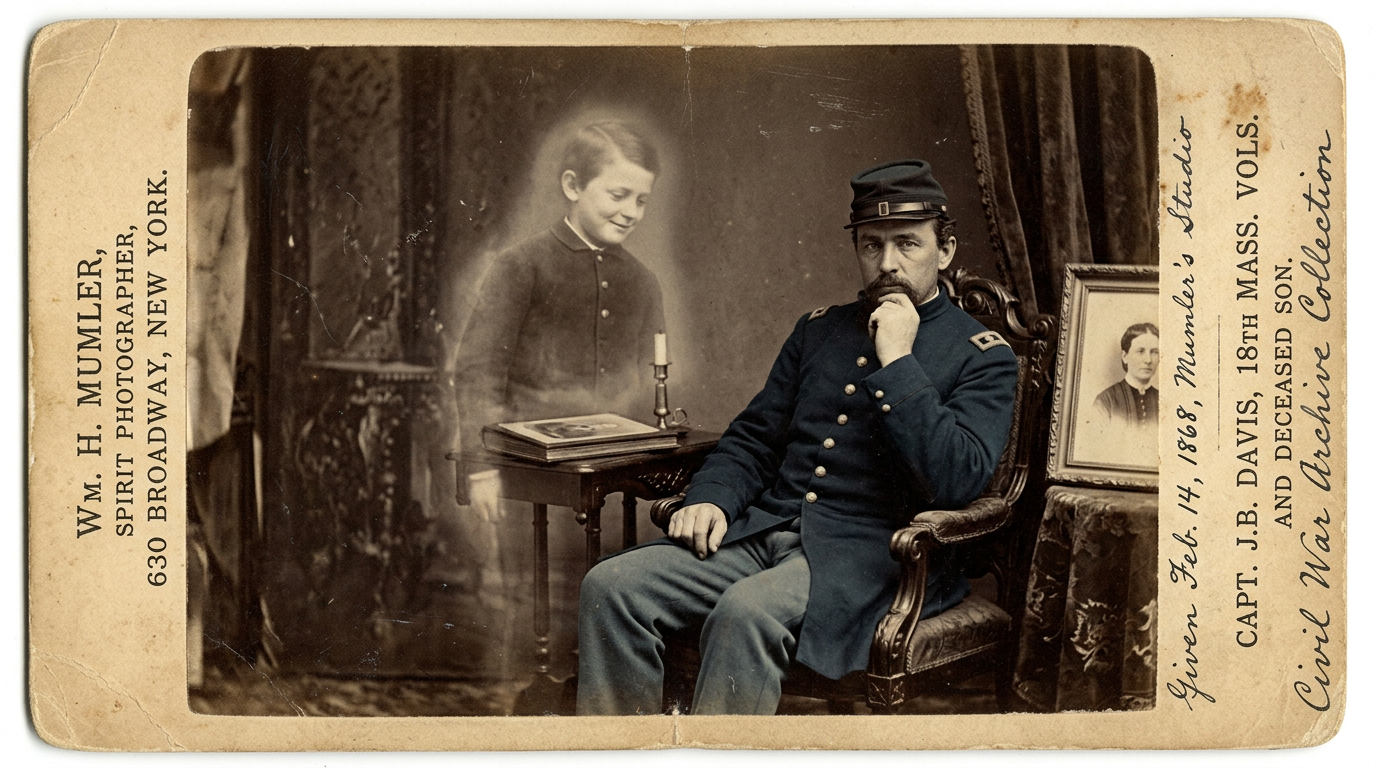
William Mumler and the Manufacture of the Departed
The Wicked Dual Archive · Field Study № CXVIII · The Unseen

I. The Archive’s Threshold
“The camera cannot lie, they said. They had not yet learned what the camera was willing to invent.”
The Archive is open. The discerning collector is invited to step across the threshold, where the light is dim, and the air is heavy with the weight of history. This is not a place of entertainment but of examination. Here, the new is understood as merely the old wearing a different hat—the ghost in the machine, and the machine in the ghost. It is all connected: the silver salts blooming on a glass plate, the widow’s black crepe gone green with age, the quiet chemical hush of a darkroom in Boston. They tell the same story. This is not a sermon, nor a séance staged to frighten. It is an invitation to sit with the evidence and trace the patterns.
Consider, then, the peculiar fragility of the photograph itself—that thin membrane of albumen and light upon which the nineteenth century pinned its faith and its fictions alike. In its earliest decades, a photograph was understood to be a species of truth. It did not editorialize as the painter did; it did not flatter or forget. It merely recorded. And it was precisely this reputation for mechanical honesty, this presumed incapacity for deceit, that made the photograph the perfect vessel for one of the era’s most elegant and profitable lies.
When the historian examines the case of William H. Mumler, there is a temptation to see only the surface—the obvious hoax, the double exposure, the grieving fool parting with coin for a smudge of chemistry masquerading as a dead husband. Yet as the evidence is examined, a different reality emerges. Mumler’s story is not principally a story about fraud. It is a story about a country that had buried three-quarters of a million of its sons in a span of four years, and about the machinery—both technological and spiritual—that a wounded civilization built to convince itself that the dead had not truly gone.
This field study proposes that the spirit photograph be treated not as a curiosity to be debunked but as an anthropological artifact to be read: a document of collective grief, of nascent technological anxiety, and of the ancient human refusal to accept the finality of the grave. The reality was never found in the grand pronouncements of the spiritualist newspapers, nor in the smug refutations of the skeptics. It was found in the worn-out spot—the human detail handled a thousand times: the way a widow’s thumb pressed against the edge of a small card, tracing the outline of a face she was told belonged to a man she had lost.
❦
II. The Engraver’s Hand
Before he photographed the dead, William H. Mumler cut metal. Born in 1832, he came of age in Boston at a moment when the American city was itself a kind of developing plate—an image resolving slowly into modernity, its wharves and countinghouses and printing shops emerging from the chemical bath of industry. He earned his living as a jewelry engraver, a trade demanding patience, a steady hand, and an intimacy with the fine gradations of light and shadow that the graver’s tool could coax from a plate of silver or gold. It is worth dwelling upon this early vocation, for the engraver’s craft and the spirit photographer’s are not so distant as they might first appear. Both are arts of the incised surface. Both traffic in the illusion of depth upon a flat plane. Both, in their way, aim to make the eye believe in something that is not, in the strictest sense, there.
Photography was, for the young Mumler, an avocation rather than a profession—the hobby of a man with mechanical aptitude and idle Sunday hours. The wet-plate collodion process, then ascendant, was a demanding and unforgiving discipline. It required the operator to coat a glass plate with a syrupy solution, sensitize it in a bath of silver nitrate, expose it while still wet, and develop it before the emulsion could dry—the whole ballet completed in a matter of minutes, often in cramped and lightless quarters reeking of ether and acid. In short, it was a process rich with opportunity for accident. And it was an accident, or so the story has always insisted, that made William Mumler famous.
The Accidental Revenant
In the early 1860s—sources place the pivotal exposure around 1861 or 1862—Mumler undertook to make a self-portrait in the Boston studio of Mrs. Helen F. Stuart. When the plate developed, a second form appeared beside his seated figure: faint, translucent, spectral. A young woman, indistinct as a memory. Mumler claimed to recognize in her features the likeness of a cousin who had been dead for twelve years. The image had not been intended. It had, he insisted, simply arrived.
The rational explanation was, and remains, unglamorous: a glass plate imperfectly cleaned of a prior exposure would retain the ghost of its earlier image, and a second exposure laid atop it would yield exactly such a double—the living and the latent, superimposed. Every practicing wet-plate photographer of the era knew this phenomenon intimately, for it was the bane of the economical operator who reused his plates. What separated Mumler from his contemporaries was not that he discovered the double exposure. It was that he understood, with the instinct of a born showman and the eye of a trained engraver, what such an image might mean to a nation in mourning.
The media sensation was immediate. Mumler abandoned the graver’s bench. Within Mrs. Stuart’s studio—and Mrs. Stuart herself is thought to have been complicit in the production of these early images—he established himself as a “Spirit Photographic Medium,” a title that fused the new technology with the old necromancy in a single, irresistible phrase. He did not sell photographs. He sold reunions.
A Household of Mediums
Mumler did not work alone, and the collector should resist the portrait of the solitary charlatan. His wife, Hannah Mumler, was herself a practicing medium of some reputation—a healing medium who conducted her own spiritual business alongside her husband’s photographic one. In the sittings, hers was often the crucial role: it was Hannah who attended the grieving client, who read the face and the black-bordered stationery and the trembling hand, who coaxed and interpreted, who—in at least one celebrated instance—encouraged a hesitant widow to recognize the shadowy form upon the plate as her own departed husband. The spirit photograph was never merely a chemical product. It was a collaborative performance, a duet of technology and suggestion, and the emulsion was only its final medium.
In time the enterprise outgrew Boston, and Mumler removed to New York City, where the market was larger and the clientele wealthier. There, his work was submitted to the scrutiny of numerous photographic experts —men who understood the craft and came prepared to expose the trick—and who, by several contemporary accounts, departed unable to demonstrate precisely how it was done. This is a detail the skeptic prefers to hurry past, but the archivist must pause. The invisibility of Mumler’s method was itself part of his genius. A crude fraud convinces no one. It was the seamlessness of the illusion—the very quality that made his acquittal possible—that made him dangerous.
❦
III. The Grammar of the Unseen
To understand Mumler, one must understand the peculiar art he is credited with founding. Spirit photography—sometimes called ghost photography—is a photographic practice whose declared purpose is the capture of images of the dead: ghosts, spirits, and the returning likenesses of the departed. It emerged in the late nineteenth century, and not in a vacuum. It arose at the precise conjunction of two great currents: a new technology that claimed to record reality without prejudice, and a religious movement that insisted the boundary between the living and the dead was porous, negotiable, and—crucially—subject to documentation.
The History
The lineage of the ghost on the photographic plate predates Mumler, and it begins not in fraud but in physics. The first practical photographic process, the daguerreotype introduced in 1839, developed its image directly upon the exposed plate. In this and other early processes, multiple exposure did not ordinarily occur, and so the accidental spirit was a rarity. Yet even the daguerreotype was not immune to the spectral. Its long exposure times meant that any figure passing through the frame, or lingering only briefly, might leave a faint and translucent trace—a person half-recorded, present and absent at once. These early cameras could capture reflections in the manner of Pepper’s ghost, that celebrated theatrical illusion in which a figure seemed to materialize upon the stage from empty air.
It was Sir David Brewster who, in 1856, first recognized that these ghostly effects might be produced deliberately rather than suffered accidentally. He observed that a figure introduced into a scene for only part of a long exposure would appear in the final image as a transparent apparition. The London Stereoscopic Company seized upon Brewster’s insight to manufacture a popular series of amusements titled “The Ghost in the Stereoscope”—parlor entertainments in which the specter was understood by all to be an artifice, a trick of the trade offered frankly as diversion. The ghost, in other words, existed as a knowing amusement before it was ever offered as evidence.
The decisive technological shift came around 1859, with the adoption of the glass-plate negative process. Unlike the daguerreotype, the negative could be reused—and a plate imperfectly cleaned would retain the residue of its former image, so that a prior exposure might bleed faintly into the next. Here was the accidental mechanism upon which the entire edifice of spirit photography would be raised. What had once been a rare curiosity became a reproducible effect. As cameras fell in price and multiplied across the culture, spirit photography boomed, though practitioners’ methods were often crude. The phenomenon would not begin its decline until the 1920s, when skeptics of formidable resolve—the escape artist Harry Houdini foremost among them—turned their energies toward systematically exposing spiritualist fraud.
But the technology alone explains nothing. A double exposure is only a mistake until a culture is prepared to receive it as a miracle. That preparation was the work of Spiritualism—the mid-nineteenth-century religious movement, born in the burned-over districts of upstate New York and spread across the Atlantic world, which held that the spirits of the dead not only survived but could communicate with the living through rappings, trance-speech, automatic writing, and the offices of gifted mediums. In the American case, a catastrophe completed that preparation.
The omnipresence of death in the Victorian period had already cultivated an elaborate culture of mourning—the jewelry woven from a dead child’s hair, the postmortem portrait of the infant arranged as if sleeping, the black crepe hung upon the door. But the American Civil War transformed this cultivated melancholy into national desperation. Between 1861 and 1865, the war consumed about three-quarters of a million lives. It killed young men by the tens of thousands in single afternoons, and it killed them far from home, their bodies often unrecovered, unidentified, unburied—vanished into the mud of Virginia and Tennessee. A mother in Massachusetts might receive word that her son was dead and never see his face again, never stand at a grave, never possess the ordinary rituals by which grief is made bearable. Into that terrible vacancy, into that nation of interrupted mournings, William Mumler offered a photograph. He offered, for a fee, the one thing the war had stolen: the face of the beloved dead, returned.
Spirit Photographers
Mumler was the first, but he was not the last, and the collector’s understanding is enriched by situating him within the fraternity—and it was very nearly a fraternity—of those who followed his method across the Atlantic world. His own emergence has already been chronicled: the 1862 photograph of his dead cousin, the studio of Mrs. Stuart, the media sensation, the removal to New York, the clientele of the bereaved seeking supernatural connection with lost relatives, so many of them children or young men consumed by the war. The apparent spirits he captured were, in the sober assessment of later analysts, double exposures—the residue of previous clients lingering upon plates that had been improperly cleaned. His most famous single image would remain the portrait of Mary Todd Lincoln posed with the purported spirit of her assassinated husband, a photograph to which this study will shortly return.
Across the ocean, the practice took root in England in 1872, issuing from the studios of the photographer Frederick Hudson. Hudson’s method was less an accident than an apparatus: he is alleged to have gimmicked his camera to hold a pre-exposed image that could be slid into place at the moment of the sitting, so that the spirit was, quite literally, loaded and waiting. The mechanism was cruder than Mumler’s exploitation of chemical residue, but the theater was the same.
In France, the practitioner Édouard Isidore Buguet operated a studio in Paris, and another in London, and his career furnishes the historian with something Mumler’s never did: a confession. Arrested in Paris in 1875 and prosecuted for fraud, Buguet confessed fully to his methods. His spirits, he admitted, were dolls—small figures wrapped in gauze, to which he affixed photographs of human faces, then exposed a second time onto the plate bearing his living sitter. The revelation was widely publicized in the French and English press, and it laid bare, with almost pitiless clarity, the mechanical banality behind the sublime effect. The beloved dead had been, all along, a gauze-wrapped doll with a paper face.
Not every celebrated spirit photograph was the work of a professional deceiver. In 1891, an amateur named Sybell Corbet photographed the library at Combermere Abbey in Cheshire, and in the developed image appeared the faint outline of a man’s head, collar, and right arm, seated in a chair. Believers took the figure to be the ghost of Lord Combermere, who had died and was being buried that very hour some miles away. The skeptical explanation was mundane and probably correct: the exposure had lasted a full hour, and a living person—very likely a servant—had entered the room, sat briefly in the chair, and departed, leaving upon the plate the transparent residue of his temporary presence. Here again is the recurring lesson of the archive: the same physical phenomenon that produced the frankly fraudulent studio spirit could, in the wild, produce a genuinely accidental apparition. The mechanism was indifferent to intent.
The paranormal investigator Joe Nickell has drawn a useful taxonomic distinction here, one the discerning collector would do well to keep in mind. Spirit photography, in Nickell’s usage, began in the studio and later extended into the séance room; in his blunt assessment, it was invariably the production of charlatans. Ghost photography, by contrast, was made in places believed to be haunted—and such images could be either deliberate fakes or genuinely inadvertent products of reflection, accidental double exposure, and the like. Mumler belongs squarely and unambiguously to the first category. He did not stumble upon the dead in a haunted ruin. He manufactured them, in a lighted studio, upon commission.
It must be recorded, too, that the exposure of these men rarely persuaded the faithful. When frauds were revealed, the true believers did not recant. Sir Arthur Conan Doyle—the creator of literature’s most ruthless rationalist, and himself, in later life, a fervent Spiritualist—refused to accept even documented confessions as proof of hoax. This is among the most instructive patterns the archive preserves: the spirit photograph was never, finally, an argument. It was a consolation. And a consolation cannot be refuted by evidence, because it was never founded upon evidence in the first place.
Modern Ghost Photographs
The impulse Mumler served did not die with the wet-plate camera. It migrated, as all such impulses do, into whatever new technology the age produced—and here the archive traces its most sobering pattern, for the same credulity that animated the 1860s persists, only its instruments have changed. As portable cameras reached amateurs toward the end of the 1880s, ghost photographs grew more frequent, no longer confined to the professional’s studio. The democratization of the camera democratized the ghost.
The twentieth and twenty-first centuries have merely supplied fresh mechanisms for old illusions. Cameras with built-in flashes produced what credulous observers took to be ectoplasm or, in the contemporary idiom, “orbs.” The great majority of modern ghost photographs fall into one of two categories: hazy, indistinct shapes that vaguely suggest the human form, or round, whitish orbs—and both, the investigators are at pains to note, can be produced with ease, whether by accident or design. The professor Annette Hill has observed that the unusual light sources once read as “ghost lights” in the era of spirit photography have, with the arrival of digital cameras, been reimagined as the orb—the same phenomenon rebaptized for a new century, debated endlessly upon the paranormal websites as evidence of spirit presence.
The material explanation, as ever, deflates. Such artifacts are simply the flash reflecting off solid particles suspended near the lens: dust, pollen, an insect, a droplet of rain, or debris within the camera itself. The manufacturer Fujifilm has described the effect frankly as a common photographic problem—not a visitation, but a defect. The investigators Kenny Biddle and Joe Nickell have catalogued the rest of the modern spectral bestiary with mordant precision: the flash reflecting off a camera strap yields a bright strand or a “spiralling vortex of spirit energy,” depending upon the strap’s material; strands of hair, jewelry, and flying insects supply others; a person’s breath in cold air, cigarette smoke, or fog, caught by the flash, becomes “ectoplasmic mist”; and long exposures produce the ethereal, see-through streaks so beloved of the ghost hunter. To assert that an image must be paranormal merely because it is unexplained, they observe, is to commit the logical fallacy of arguing from ignorance.
To this catalog Ben Radford has added pareidolia—the deep human tendency to perceive faces and figures in random arrangements, in clouds, tree bark, and the grain of wood. Radford makes a wry and telling observation: the ghosts we find in photographs are always faces, never an elbow or a foot. The mind supplies the countenance because the mind is hunting for the countenance. Radford has further noted the great irony of the digital age: as camera technology has advanced dramatically, one might expect crisper and more convincing evidence of the dead—yet the photographs remain, stubbornly, low in quality and vague in form. The ghost, it seems, retreats precisely as the lens sharpens.
A brief accounting of the modern cases confirms the pattern. In 2016, a tourist photographed a ghostly figure upon a staircase in the Stanley Hotel in Colorado, a house famous for its supposed hauntings; the camera had been in panorama mode, whose several-second capture readily produces a doubled image of a single person moving on the stairs. That same year, a 1900 photograph of Ulster linen-factory girls resurfaced online, complete with a disembodied hand resting upon one girl’s shoulder—an artifact, the investigators concluded, of the entirely ordinary period practice of retouching photographs by hand at a retouching desk, cutting a person out and filling the space with pencil and charcoal. In 2020, a “ghostly bride” drifting across a Birmingham construction site went viral in the tabloids, and proved to be a young woman in a light dress caught by an infrared camera’s flash—confirmed, in the end, by a second camera that had captured the same living woman and her companion in ordinary color.
And in our own moment, the descendants of Mumler’s craft require no darkroom at all. By 2014, more than two hundred and fifty ghost-related applications existed for a single mobile platform, including the pointedly named GhostCam: Spirit Photography, which let users insert a specter into any photograph, adjust its transparency, rotate it, and erase its edges at will. These applications have been deployed in numerous hoaxes—one such app was found to be using, without permission, a well-documented apparition photograph, and was removed following the scandal. The tools have grown infinitely more sophisticated than a poorly cleaned glass plate. The gullibility they exploit has not changed. That, perhaps, is the darkest finding the archive preserves: the technology is a variable, but the grief and the wishfulness are constants.
❦
IV. The Plates Themselves
An archive is, finally, a collection of objects, and Mumler’s legacy resolves, in the end, into a small body of specific images—cartes de visite and cabinet cards, palm-sized rectangles of albumen paper —that passed from hand to grieving hand and survive in institutional collections to this day. To examine them individually is to move from the general anatomy of the fraud to its particular, human incisions.
The Ghost of Abraham Lincoln
No photograph Mumler ever made is more famous, or more freighted with the sorrow of a nation, than the one that appears to show Mary Todd Lincoln seated with the shadowy “ghost” of her assassinated husband standing behind her, his spectral hands laid gently upon her shoulders. It is the summit of his career and, viewed with cold eyes, its most audacious act.
The sources contest the circumstances of its making, and the discrepancies are instructive, revealing how quickly legend accreted around the image. The paranormal researcher Melvyn Willin, in Ghosts Caught on Film, places the sitting around 1869 and advances the romantic claim that Mumler did not know the identity of his client—that she presented herself under a false name, a “Mrs. Tundall,” and that Mumler learned whom he had photographed only after the plate was developed and the famous face resolved beside her. The College of Psychic Studies, drawing upon notes belonging to the medium William Stainton Moses, offers a different chronology—the early 1870s—and a variant name, “Mrs. Lindall,” and adds the crucial and revealing detail that the widow had to be encouraged by Mumler’s wife, the medium Hannah, to identify the spectral figure as her husband. Mumler himself, in a letter to the Boston Record, claimed the photograph was taken in late February 1872.
The archivist need not resolve the discrepancy to appreciate its meaning. Whether the sitter came in 1869 or 1872, whether as Tundall or Lindall, the operative fact is the one the College of Psychic Studies preserves: the recognition was not spontaneous. The widow did not gasp in recognition at once. She had to be led to see her husband in the shadow. Hannah Mumler’s practiced suggestion cultivated the identification, coaxing it into being. Here is the worn-out spot of the entire affair, the human detail handled a thousand times: a grieving woman, the most famous widow in America, guided gently toward the sight she had come, in the depths of her sorrow, desperately hoping to see.
The image has, of course, been dismissed as precisely what it is—a fraudulent double exposure, the living widow and a separately obtained likeness of the martyred President superimposed upon a single plate. And yet it has circulated more widely, and endured more powerfully, than any honest photograph of its subjects. This is the artifact’s terrible efficiency. Mary Todd Lincoln had lost her husband to an assassin’s bullet, had lost sons to illness, had been driven by grief to the edge of reason. What Mumler sold her was not a lie so much as a permission—the permission to believe, for the price of a sitting, that Abraham had not entirely left her, that his hands still rested upon her shoulders in the dark. That the hands were chemistry does not lessen the weight of the longing they were made to answer.
Master Herrod
If the Lincoln portrait represents Mumler at his most historically resonant, the photograph of Master Herrod represents him at his most theatrically ambitious. Master Herrod was a young medium from Bridgewater, Massachusetts, whom Mumler photographed around 1872. The developed plate showed the youth apparently in a trance, and surrounding him—in the most elaborate composition of Mumler’s spectral repertoire—not one departed relative but a company of spirits, described as the guiding presences of Europe, Africa, and America. The photograph was formally advertised for sale in the pages of The Religio-Philosophical Journal on the twenty-fourth of August, 1872, offered to the faithful as a commodity of belief.
The Herrod image repays the anthropologist’s attention precisely because it exceeds the private grief that drove the Lincoln portrait. This was not a bereaved widow seeking one beloved face. This was a public spectacle of spiritualist cosmology—a young medium enthroned amid the personified spirits of the continents, a visual sermon on the reach of the spirit world across all the races and regions of the earth. In it one glimpses the ambition of the movement Mumler served: not merely to console the individual mourner, but to furnish Spiritualism with a visual scripture, a body of images that might do for the new faith what stained glass and altarpiece had done for the old. The spirit photograph, in the Herrod plate, aspires to iconography.
Other Photographs
Beyond these two celebrated plates, Mumler produced a considerable body of work, and its catalog reads like a census of nineteenth-century longing. His images paired living sitters with a whole taxonomy of the returned: departed relatives, of course, but also lost fiancés, deceased actresses, and spirit guides of every description. The dead came in every relation the living had ever held to them.
Two sitters beyond the Lincolns deserve particular notice, for their cases illuminate the social machinery that sustained Mumler’s enterprise. Moses A. Dow, the editor of The Waverley Magazine, sat for Mumler and received a plate that appeared to show the spirit of his assistant, a young woman named Mabel Warren; Dow’s belief was evidently sincere, and it was he who would later testify in Mumler’s defense at the trial—the satisfied client become the character witness. Fanny Conant, a well-known Boston medium, was photographed with the apparent ghost of her brother, one Charles. That a professional medium should herself sit for a spirit photograph reveals the circular, self-reinforcing economy of the movement: the mediums authenticated the photographer, and the photographer authenticated the mediums, each lending the other the credibility that neither could have manufactured alone.
❦
V. The Reckoning
Every fraud sufficiently successful eventually summons its reckoning, and Mumler’s arrived in the spring of 1869, in a New York courtroom, as a trial for fraud and larceny. The proceeding is among the most illuminating episodes in the whole history of American Spiritualism, for it staged, in the formal language of the law, the collision between the era’s credulity and its skepticism—and it did not resolve as the modern observer might expect.
The charges arose from the growing chorus of accusation that had trailed Mumler for years. He had been accused of staging the ghosts of persons who were, in fact, still very much alive—a suspicion given force when observers recognized certain supposed spirits as living Bostonians who had once sat for ordinary portraits, their images lingering upon reused plates. He had been accused, in the darker rumors, of breaking into houses to steal photographs of the deceased, the better to reproduce their faces upon his spectral commissions. The investigator Joe Nickell has summarized the exposure with characteristic economy: Mumler was undone when people recognized that some of his supposed spirits were still among the living. A ghost identified walking down Washington Street is a poor advertisement for the afterlife.
The trial’s most theatrical figure was the era’s supreme impresario of humbug, P. T. Barnum—a man who had built an empire upon the willing deception of the public and who therefore understood, better than any prosecutor, exactly what Mumler was doing. Barnum’s objection was not, one suspects, to deception as such; it was to the particular cruelty of Mumler’s variety. Barnum charged that Mumler preyed upon people whose judgment was clouded by grief—that he had taken the honest bargain of the showman, who deceives a public that half-wishes to be deceived for amusement, and perverted it into the exploitation of the inconsolable. To prove how easily such an image might be counterfeited, Barnum commissioned the respected photographer Abraham Bogardus to produce a spirit photograph of Barnum himself, standing beside the “ghost” of Abraham Lincoln. This manufactured specter was tendered as evidence, a demonstration in silver and albumen that the miracle was a parlor trick any competent operator could perform before luncheon.
Yet Mumler was not without defenders, and they were not all fools. Moses A. Dow, the magazine editor who had received his own consoling portrait, testified on the photographer’s behalf. And here the case reveals its deepest irony. Despite Barnum’s demonstration, despite the recognition of living “spirits,” despite the accumulated weight of suspicion, the prosecution could not meet the exacting standard the law demanded. It could show that spirit photographs could be faked; it could not prove beyond all doubt that Mumler, in each particular instance, had faked them. The mechanism of his fraud was too seamless, the burden of proof too high. William Mumler was acquitted.
The aftermath is recorded in contradictory registers, and the contradiction is itself worth preserving. Some sources report that the trial disgraced him, that his business collapsed and he died penniless. Others insist the opposite—that the notoriety of the proceeding was the finest advertisement he could have purchased, and that his enterprise flourished all the more for it. What is certain is that Mumler continued in photography. In his later years he turned his mechanical ingenuity to legitimate innovation, developing the “Mumler Process,” a method by which photo-electrotype plates could be produced and printed as easily as woodcuts—a genuine and useful contribution to the reproductive arts. He died on the sixteenth of May, 1884, and his obituary dwelt upon his photographic contributions in general, consigning the spirit-photography scandal to a single, almost embarrassed final line: that the deceased had at one time gained considerable notoriety in connection with spirit photographs. The man who had photographed America’s most famous ghost was buried beneath a footnote about his own.
The Synthesis
What, then, does the case of William Mumler reveal? When one connects the technological fact—that a reused glass plate retains the ghost of its prior image—with the historical fact—that a nation had just buried three-quarters of a million of its dead, most of them far from home and unmourned at any graveside—a pattern emerges with terrible clarity. Mumler did not create the hunger. The war created the hunger, and the culture of Victorian mourning had already shaped its appetites, and Spiritualism had already promised that the appetite could be satisfied. Mumler merely supplied the artifact. He was not the disease but the symptom—the precise point at which a new technology, mistaken for an instrument of pure truth, was pressed into the service of the oldest human refusal, the refusal to let the dead be dead.
This is a study, finally, in how a civilization interacts with its own grief, and in how it enlists its newest machines to fight its most ancient battles. The photograph had been welcomed as the great truth-teller of the age, the one image-maker incapable of lying. Mumler proved that the truth-teller could be taught to lie, and that its reputation for honesty made the lie only more persuasive. Every subsequent generation has repeated the lesson with fresh equipment: the flash, the digital sensor, the smartphone application that inserts a specter with the swipe of a thumb. The instrument changes. The wound it is asked to dress does not.
❦
VI. Final Reflections from the Archive
The lamp in the reading room burns low, and the plates are returned to their acid-free sleeves—Mary Lincoln and her chemical husband, the entranced boy amid his continents of spirits, the countless anonymous widows clutching the returned faces of their war-dead sons. They are frauds, every one. And yet the archivist finds it impossible to file them under mere deception, for a lie tells the truth about the liar’s world, and these particular lies tell us more about the nineteenth century’s heart than a thousand honest portraits ever could. They are the negative image of an era’s sorrow—the darkness where the light of grief was blocked, resolving into the shape of everything a wounded people could not bear to lose.
The discerning collector is invited to inquisitive reflection. If a photograph’s authority rests upon our belief that the machine cannot lie, what becomes of that authority now, in an age when any image may be conjured whole from nothing, when the specter requires neither a corpse nor a darkroom but only a willing screen? Was Mumler a criminal, or was he merely the first to understand a truth we are only now being forced to confront—that we do not believe our eyes because the image is true, but because we wish it to be? The distance between the grieving widow before the wet-plate camera and the modern viewer before the fabricated image may be far shorter than the century and a half that separates them.
The Archive remains open for the collector’s inquiry. These findings are offered not as a verdict but as an invitation to sit, a while longer, with the evidence.
The history examined here does not remain confined to the page. The darker chapters of the human record—its mournings, its manias, its beautiful deceptions—may be held in the hand as well as read upon the page. Those who curate the shadowed corners of the past are invited to continue their study among the collection’s physical artifacts at http://www.wickeddualblog.com and in the Wicked Dual repository on Etsy.
We invite you to enter the haunted archive and secure a piece for your private collection; it is a necessary addition for those who curate the darker corners of human history.

Bibliography
Faust, D. G. (2008). This Republic of Suffering: Death and the American Civil War. Alfred A. Knopf.
Harvey, J. (2007). Photography and Spirit. Reaktion Books.
Hill, A. (2011). Paranormal Media: Audiences, Spirits and Magic in Popular Culture. Routledge.
Nickell, J. (2012). The Science of Ghosts: Searching for Spirits of the Dead. Prometheus Books.
Radford, B. (2018). Investigating Ghosts: The Scientific Search for Spirits. Rhombus Publishing.
Radford, B. (2020). Big – If True: Adventures in Oddity. Rhombus Publishing.
Willin, M. (2007). Ghosts Caught on Film: Photographs of the Paranormal. David & Charles.
Leave a Reply