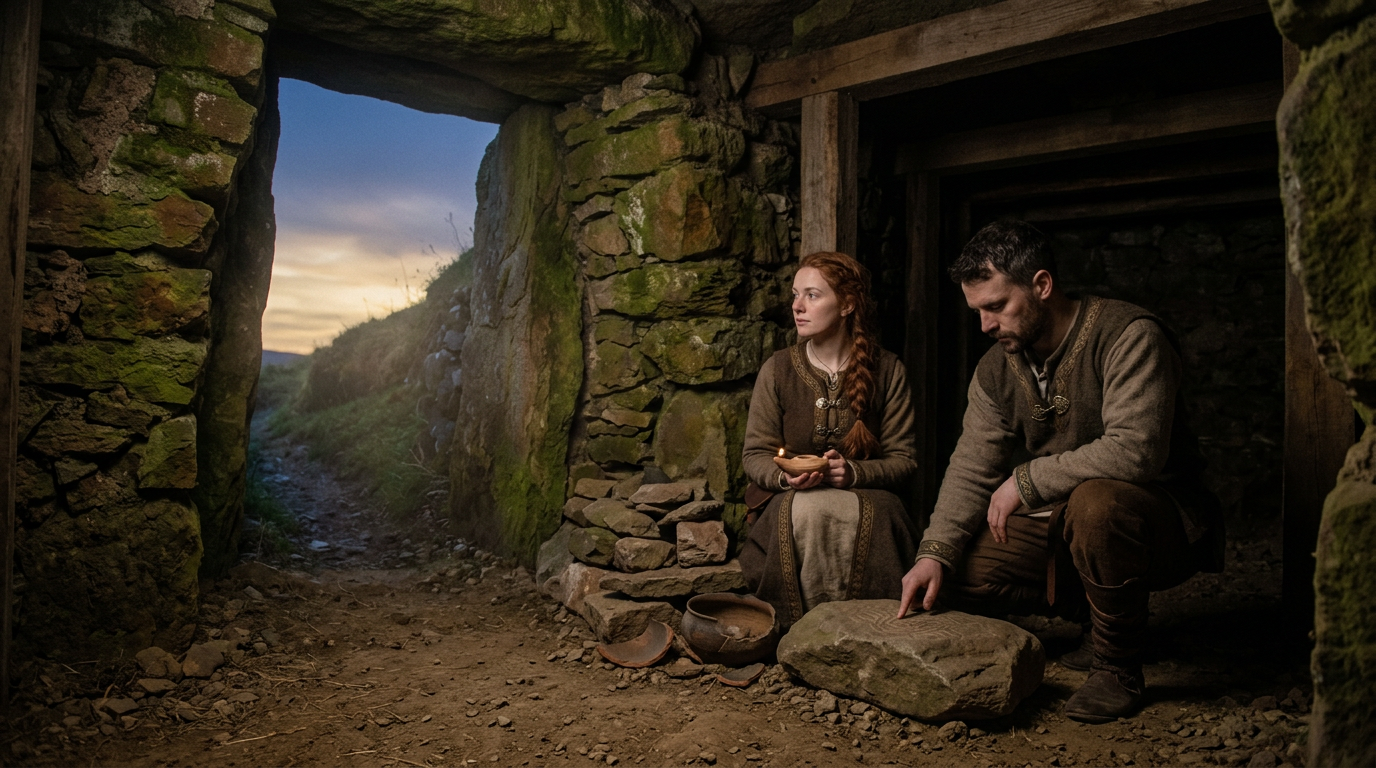

The mist clings to the Irish countryside like a shroud, damp and heavy, obscuring the jagged edges of the ancient landscape. If you are walking along a quiet lane in County Clare or traversing the rolling hills of Meath, you might find yourself drawn to a peculiar, perfectly circular mound of earth, or perhaps a solitary, gnarled hawthorn tree standing defiant in the middle of a field. To the modern eye, these are merely landscape features—geological curiosities or stubborn obstacles for a tractor. But to those who know the history of this land, they are something far more potent. They are the sídhe. They are the thresholds. And inside, or perhaps just behind the veil of reality, dwell the Aos sí.
To understand the Aos sí is to understand that Ireland is a land where the past is never truly buried; it is merely waiting. They are not the Tinkerbell-esque sprites of Victorian nursery rhymes. They are a supernatural race, a formidable, beautiful, and often terrifying reflection of the human condition, existing in a parallel state of being. They are the “Good Neighbors,” the “Gentry,” and the “Fair Folk,” and they have been watching us from their hollow hills for millennia.
The Hidden Tenants of the Hollow Hills
Linguistic Roots: Decoding the Sídhe
To speak of the Aos sí is to engage with a language that is deeply rooted in the soil of Ireland. The term itself, Aos sí, carries a weight that translates roughly to “folk of the fairy mounds.” In the older, more archaic form, we find aes sídhe, a phrase that whispers of a time when the distinction between the mortal world and the Otherworld was far thinner than it is today.
The heart of this term lies in the word sí (or sídh in its older iteration). While we translate this as “fairy mound” or “burial mound,” the linguistic roots suggest something more foundational. It derives from the Proto-Celtic sīdos, meaning “abode” or “seat.” It is a cognate of the English “seat” and “settle”—a place where one rests, or perhaps, a place where one resides permanently.
Scholars have long debated the deeper implications of this etymology. David Fitzgerald, a keen observer of Irish folklore, once posited that sídh was synonymous with immortality. He drew parallels with Old Irish terms such as síthbeo (“lasting”) and sídhbuan (“perpetual”). When we look at the tales, this makes perfect sense. The Aos sí are not merely creatures of the moment; they are creatures of long life, existing in a state of perpetual being that mocks the fleeting nature of human existence. They are the inhabitants of the sídh, and in that residency, they have claimed an eternity that we can only envy—or fear.
The Divine Hierarchy of the Middle Ages
If you travel back to the 7th century, you will find the Irish bishop Tírechán documenting his encounters with the cultural memory of these beings. He did not call them fairies; he called them dei terreni—“earthly gods.” This is the crucial key to unlocking their true nature. In the medieval Irish mind, the Aos sí were not minor spirits; they were the remnants of a divine hierarchy.
The literature of the Middle Ages frequently interchanges the terms aes síde and fír síde (“folk of the síd”) with Tuath Dé or Tuatha Dé Danann. The Tuatha Dé Danann, the “People of the Goddess Danu,” were the pre-Christian deities of Ireland. According to the foundational myths, when the mortal Sons of Míl Espáine arrived from Iberia to claim the island, the Tuatha Dé Danann did not simply vanish or die. They negotiated. They retreated. They moved into the sídhe—the mounds—and into the Otherworld, effectively partitioning Ireland between the mortal realm and the supernatural.
The 8th-century Fiacc’s Hymn provides a chillingly honest admission: the Irish people worshipped the sídh folk long before the arrival of Saint Patrick. They were the original gods of the land, and even as Christianity swept across the island, the memory of these “earthly gods” could not be erased. They were simply folded into the folklore, transformed from deities into the hidden inhabitants of the hills.
Shifting Narratives in Irish Tradition
Because Irish history is built on oral tradition, the origins of the Aos sí are fluid, shifting like the tides. Two primary narratives dominate the collective consciousness. The first, as we have seen, links them directly to the Tuatha Dé Danann. In this view, the Aos sí are the aristocracy of the old gods, living in self-imposed exile, maintaining their own courts and kingdoms beneath our feet.
The second narrative reflects the influence of Christian theology, which struggled to categorize these ancient entities. In this version, the Aos sí are fallen angels—but with a twist. They are the angels who were cast out of heaven, yet whose sins were not so grievous as to warrant the fires of Hell. Thus, they were condemned to wander the earth, occupying the liminal spaces between the divine and the damned.
Regardless of their origin, their behavior in folklore is remarkably consistent. They are the fierce guardians of their territory. They do not tolerate trespass. If you build a house over a fairy path, if you cut down a sacred whitethorn tree, or if you disturb a fairy ring, you will find yourself the target of their retaliation. This is the origin of the “changeling” myths—the terrifying belief that the Aos sí might steal a human child and leave a sickly, Otherworldly substitute in its place as punishment for human transgression.
They are most active at the “thin” times—at dawn and dusk, and during the great seasonal markers of Samhain, Bealtaine, and Midsummer. These are the moments when the veil between the mortal world and the Otherworld wears thin, allowing the aos sí to move more freely among us. They are not inherently “evil,” but they are utterly alien. They operate by a code of ethics that does not always align with human morality. To them, we are the transient, noisy neighbors; to us, they are the dangerous, invisible landlords of the land.
A Taxonomy of the Otherworld
The diversity of the Aos sí is as vast as the Irish landscape itself. They are not a monolithic group, but a complex society of spirits, each with its own domain and purpose.
Perhaps the most famous—and feared—is the bean sídhe (banshee). Her name literally means “woman of the sídhe.” She is the herald of mortality, a supernatural woman whose keening wail pierces the night, announcing that a death is imminent. She is not the cause of death; she is the witness to it, a remnant of an ancient mourning tradition inextricably linked to the sídhe.
But the roster of the Aos sí is far more extensive:
- The Leanan Sídhe: The “fairy lover,” a muse who grants artistic talent but demands a terrible price—the life of the artist.
- The Sluagh Sídhe: The “fairy host,” a terrifying, airborne legion of spirits often associated with the restless or cursed dead.
- The Cat-sìth and Cù-sìth: The fairy cat and the fairy dog, manifestations of the supernatural world that can be both helpful and deeply unsettling.
- The Púca: A shapeshifting entity that can bring either good fortune or chaos, often associated with the harvest.
From the Abhartach, a dwarf-like creature with necro-vampiric tendencies, to the Merrow, the aquatic inhabitants of the sea, the Aos sí reflect every aspect of the Irish environment. They are the personification of the land’s power—its beauty, its danger, and its deep, abiding mystery.
The Fairy Faith: A Strategy of Coexistence
The Creideamh Sí, or “Fairy Faith,” is not a religion in the formal, institutional sense. It is a survival strategy. It is the collection of beliefs and practices that have allowed the Irish people to coexist with the Aos sí for centuries. It is a quiet, persistent syncretism in which traditional folk practices coexist comfortably with Christian devotion.
In the Creideamh Sí, you do not challenge the Aos sí; you appease them. You leave a small bowl of milk or a piece of bread near a sacred spot. You speak of them with respect, using titles like “The Good Neighbors” or “The Gentry” to avoid drawing their attention or causing offense. You protect the hawthorn tree, even if it stands in the middle of a field where it is inconvenient for your farming.
This is not superstition; it is a recognition of boundaries. The Creideamh Sí acknowledges that there are forces in this world that we do not fully understand and that we cannot control. By respecting the sídhe—the mounds—and the entities that dwell within, the people of Ireland have maintained a connection to their pre-Christian past. They have kept the old gods alive, not through temples or hymns, but through the simple, daily act of acknowledging that the land does not belong to us alone.
Echoes from the Liminal Realm
As we look at the history of the Aos Sí, we are looking at the history of Ireland itself. They are the memory of a civilization that refused to be forgotten. From the medieval scholars who saw them as “earthly gods” to the rural farmers who still leave a bit of milk out for the “Good Neighbors,” the Aos sí represent the enduring power of the Otherworld.
They remind us that the world is more complex, more ancient, and far more mysterious than our modern, rationalist perspective would have us believe. The hollow hills are still there, standing against the horizon. The whitethorn trees still bloom in the spring. And somewhere, in the liminal space between the seen and the unseen, the Aos sí are watching. They are the lords of the land, the keepers of the ancient secrets, and as long as the mist rolls over the hills of Ireland, they will continue to be our neighbors—whether we believe in them or not.

* Cross, T. P., & Slover, C. H. (1936). Ancient Irish Tales. Henry Holt and Company.
* Fitzgerald, D. (1887). Popular Tales of Ireland. Folklore Journal.
* MacKillop, J. (2004). A Dictionary of Celtic Mythology. Oxford University Press.
* Yeats, W. B. (1908). The Collected Works of W. B. Yeats. Shakespeare Head Press.
Leave a Reply