
Prologue: A Poet’s Pact
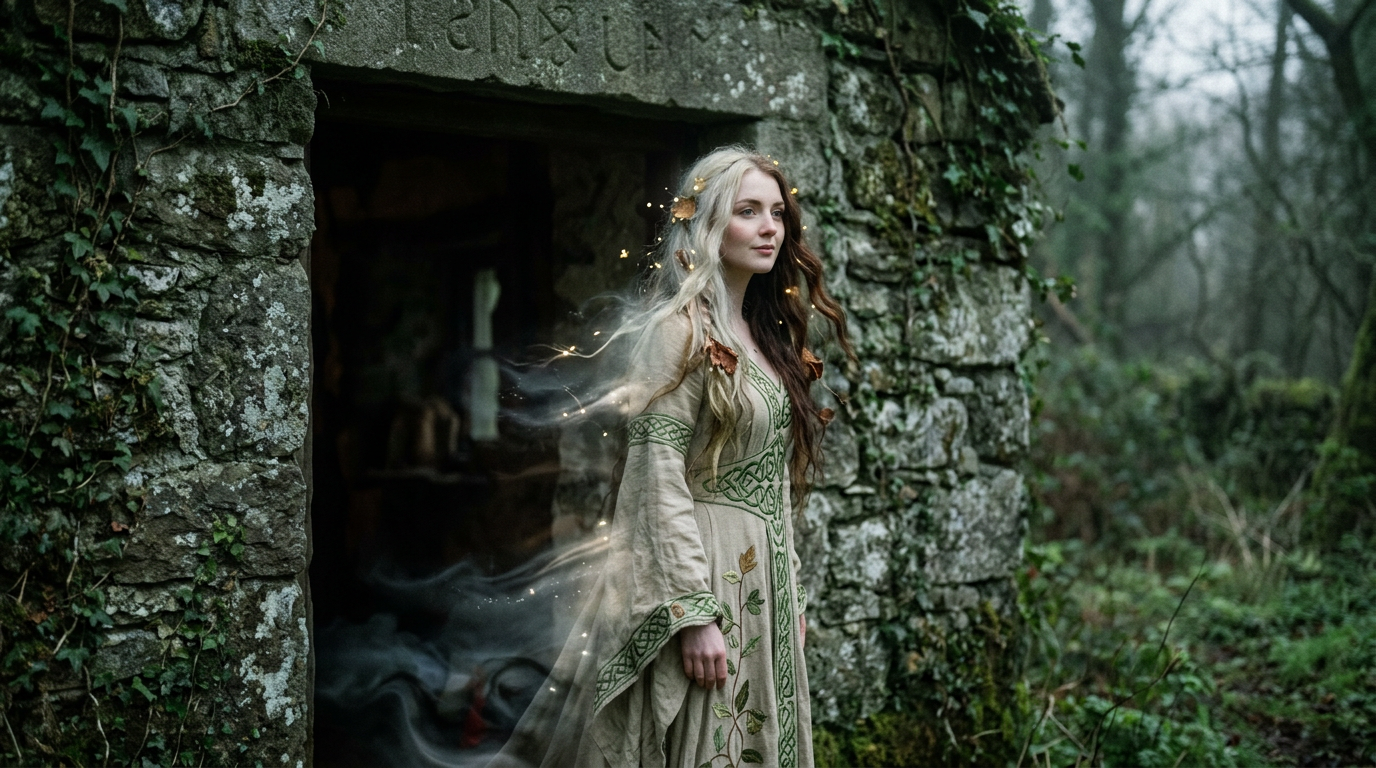
In the mist-cloaked hills of Ireland, where twilight lingers like a lover’s sigh, a weary poet once wandered. His quill had run dry, his verses stagnant, until a figure emerged from the hazel grove—a woman with hair like molten silver and eyes that held the darkness of forgotten wells. She whispered promises of inspiration, of ballads that would outlive the stars. But as the poet’s ink flowed anew, so too did his vitality wane. Such is the tale of the Leanhaun Sí, the fairy mistress who straddles the line between muse and predator, creativity and consumption.
Origins: The Blood-Price of Genius
The Leanhaun Sí (pronounced Lan-awn Shee), whose name translates to “Fairy Mistress” or “Fairy Sweetheart,” is a haunting figure in Irish mythology. Classified among the Aos Sí—the supernatural denizens of the Irish Otherworld—she is both revered and feared as a patron of poets, musicians, and artists. Yet her patronage comes at a dire cost: the gradual sapping of her lover’s life force, a vampiric exchange where art bleeds into sacrifice.
Scholars trace her roots to pre-Christian Celtic traditions, where poetic inspiration (imbas) was believed to derive from divine or Otherworldly sources. The 17th-century Annals of the Four Masters alludes to her as a bean sí (banshee) variant, though her role is distinct. Unlike the banshee, who heralds death, the Leanhaun Sí induces it through a parasitic symbiosis. Folklorist Daithí Ó hógáin notes her association with sovereignty goddesses, who often demanded blood or spirit as tribute in exchange for wisdom (Ó hógáin, 2006).
Her dual identity as muse and destroyer echoes the Celtic concept of geis—a taboo or sacred obligation. To accept her gift is to bind oneself to a fatal contract, where brilliance and mortality intertwine.
Symbolism: The Alchemy of Art and Sacrifice
The Leanhaun Sí embodies paradoxes central to human creativity. Her vampirism is not merely physical but metaphysical, reflecting the age-old trope of art as a life-draining endeavor. In feeding on her protégé’s vitality, she mirrors the artist’s surrender to their craft—the “blood of the soul” poured into verse or song.
The Cauldron of Poetic Wisdom
In Celtic myth, the cauldron symbolizes transformation and rebirth. The Leanhaun Sí’s role parallels the cauldron of Cerridwen, which bestowed prophetic insight but required enduring its scalding waters. Similarly, the Leanhaun Sí’s kiss imparts imbas forosnai (“illuminating knowledge”), a fiery enlightenment that consumes as it enlightens (MacKillop, 2004).
The Crimson Thread
Red, a recurring motif in her lore—her lips, the blood she drinks—connects to sovereignty and sacrifice. In ancient Irish rites, kingship was sanctified through symbolic marriages to goddesses, often involving ritualized blood offerings. The Leanhaun Sí’s crimson allure may echo these rites, positioning artistic genius as a regal yet fatal crown.
Comparative Myth: Echoes in the Global Shadows
The Leanhaun Sí’s archetype resonates beyond Ireland. Consider:
Succubi (European Lore): Like these nocturnal seducers, the Leanhaun Sí derives sustenance from intimacy. Yet her victims are not random; they are chosen for their creative potential.
Hulder (Scandinavia): This forest spirit offers artistic prowess in exchange for a lifetime of servitude, mirroring the Leanhaun Sí’s lethal mentorship.
Lamiae (Greek Myth): Serpentine beings who consumed children; later romanticized as tragic lovers. Both figures blur the line between eroticism and predation.
Notably, the Leanhaun Sí lacks the overt malice of vampires like the Slavic upir. Her predation is transactional, even melancholic—a “necessary evil” to preserve cultural memory through art.
Modern Rebirth: From Folklore to Feminism
In contemporary culture, the Leanhaun Sí has been reinterpreted through feminist and psychoanalytic lenses. Author Patricia Lysaght frames her as a subversive figure challenging patriarchal norms: a woman who wields power over life and art in a mythos dominated by male heroes (Lysaght, 1986).
Neopagan circles honor her as a goddess of inspired madness, while urban fantasy novels recast her as a tragic antiheroine. Yet her core paradox endures: Can creativity exist without destruction? The Leanhaun Sí’s answer is etched in the shadows—a whisper that art, like love, demands a pound of flesh.
Epilogue: The Unwritten Verse
The Leanhaun Sí lingers in the liminal spaces—between muse and monster, gift and curse. She is a reminder that every masterpiece bears a hidden signature: the ghostly imprint of the Crimson Muse, forever thirsty, forever inspiring.

MacKillop, J. (2004). A dictionary of Celtic mythology. Oxford University Press.
Lysaght, P. (1986). The banshee: The Irish death messenger. Roberts Rinehart Publishers.
Leave a Reply