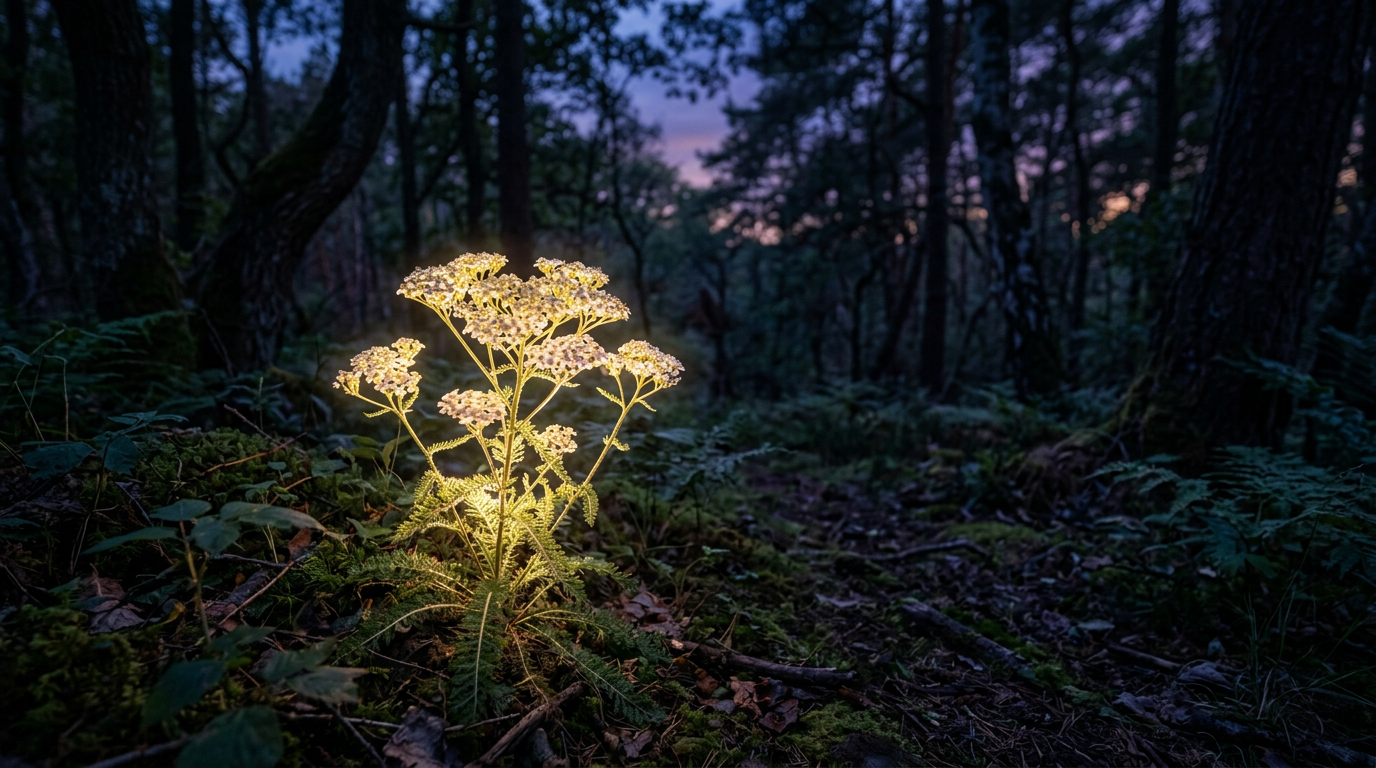

Prologue: A Blade of Healing on the Battlefield
In the smoldering aftermath of the Trojan War, as warriors groaned beneath the weight of wounds inflicted by bronze, a humble plant emerged as their salvation. Achilles, the famed Greek hero, is said to have carried yarrow (Achillea millefolium) to staunch the bleeding of his soldiers—a legacy etched into its very name. Yet yarrow’s story transcends the battlefield, winding through the annals of herbalism, myth, and mysticism. With feathery leaves like the whispers of ancient spells and clusters of white blooms resembling celestial constellations, this plant has long been a talisman for healers, seers, and wanderers of the unseen realms.
I. Myth and the Mortal Realm: Yarrow’s Divine Pedigree
Yarrow’s mythic roots stretch across cultures. In Greek tradition, the centaur Chiron taught Achilles to harness the plant’s healing powers, immortalizing it in Homeric lore. The Chinese I Ching, a divination system over 3,000 years old, relies on dried yarrow stalks to commune with cosmic wisdom, reflecting its association with clarity and prophecy. Among Native American tribes like the Navajo, yarrow was a “life medicine,” used in rituals to ward off evil and heal both body and spirit.
Even in Celtic lore, yarrow (called luibh na fola, “herb of blood”) was linked to the Otherworld. Druids bundled their stems for weather magic, believing it could summon rain or break curses. Such tales reveal a universal truth: yarrow bridges the mortal and divine, a plant as pragmatic as it is sacred.
II. Symbolism: Feathers, Blood, and the Veil Between Worlds
Yarrow’s physical form encodes its symbolic language. Its fern-like leaves, resembling a thousand tiny blades, evoke a sense of protection and resilience. The white flowers, often tinged with pink or yellow, symbolize purity, spiritual awakening, and the liminal space between life and death.
In Victorian floriography, yarrow signified eternal love—a nod to its enduring healing properties. Yet darker symbolism lingers: in European folklore, hanging yarrow above a cradle guarded against malevolent fairies, while carrying it in a sachet was believed to summon courage or attract a soulmate. This duality—gentle healer and psychic sentinel—defines yarrow’s essence.
III. Herbalism: From Battlefields to Modern Apothecaries
Yarrow’s medicinal prowess is well-documented. Dioscorides, the Greek physician, praised it in De Materia Medica (70 CE) for treating wounds and inflammations. Modern science validates its use: sesquiterpene lactones and azulene within its oils offer anti-inflammatory and antimicrobial benefits.
- Wound Care: Yarrow’s astringent properties constrict blood vessels, making it ideal for poultices.
- Fever Reduction: As a diaphoretic, it induces sweating, breaking fevers in traditional “cold and flu” teas.
- Digestive Aid: Bitter compounds stimulate bile production, easing indigestion.
However, caution is key. Overuse may cause photosensitivity, and pregnant individuals should avoid it due to uterine-stimulating effects.
IV. Green Witchery: Yarrow in Ritual and Craft
For modern green witches, yarrow is a cornerstone of magical practice. Its association with the element of air makes it ideal for rituals involving communication or divination. A simple spell might involve:
- Placing yarrow under a pillow to invite prophetic dreams.
- Brewing it into a tea for courage before a ritual.
- Braiding stems into a protective wreath for sacred spaces.
In hedgewitchery—a tradition bridging the physical and spiritual realms—yarrow is ingested as an “ointment of the eyes” to enhance psychic sight. Folk names like “Devil’s Nettle” hint at its power to repel negativity, while love charms using yarrow petals echo its romantic symbolism.
V. Mysticism: Stalks, Stars, and the Seventh Sense
Yarrow’s role in divination is unparalleled. The I Ching uses 50 dried stalks to generate hexagrams, each casting a mirror to the cosmos. Similarly, European cunning folk scattered yarrow to read omens in its patterns. Alchemists classified it as a “Venus herb,” aligning it with feminine energy and emotional balance.
In astral travel, yarrow tea is consumed to “lighten” the spirit, easing the soul’s journey beyond the body. Its connection to the crown chakra underscores its use in meditation for mental clarity—a practice mirrored in traditional Chinese medicine’s focus on yarrow for “opening the heart-mind.”
Epilogue: The Everlasting Bloom
Yarrow thrives in disturbed soil, a resilient witness to humanity’s struggles and triumphs. Today, it grows along highways and in cottage gardens alike, a living testament to its timeless allure. Whether clasped in a soldier’s hand, a witch’s charm, or a philosopher’s divination stalks, yarrow remains a bridge between worlds—rooted in earth, reaching toward the stars.
To walk with yarrow is to walk with history itself. May we gather it with gratitude, honoring the wisdom of those who came before.
The wise man learns from the plant, the warrior from the wound, and the mystic from the stars.

– Dioscorides, P. (70 CE). De Materia Medica [Book].
– Grieve, M. (1931). A Modern Herbal. Dover Publications.
– Moerman, D. E. (1998). Native American Ethnobotany. Timber Press.
– Ratsch, C. (2005). The Encyclopedia of Psychoactive Plants. Park Street Press.
– Wilhelm, R. (1967). The I Ching or Book of Changes. Princeton University Press.
Leave a Reply