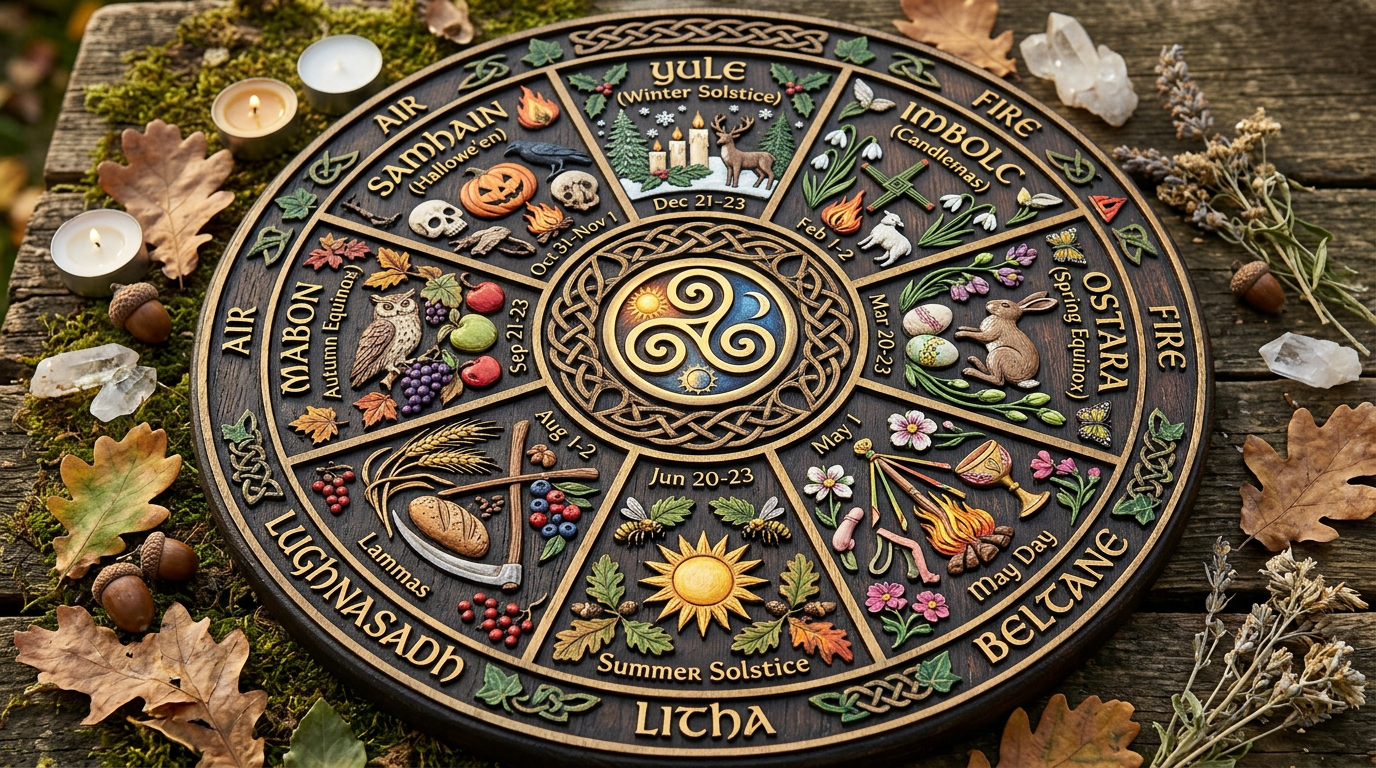

The Rhythm Beneath Our Feet
Have you ever felt a deep, almost primal pull as the long nights of winter finally begin to shorten? Or an inexplicable surge of energy when the first green shoots defiantly break through the thawing earth? These sensations are not mere imagination; they are echoes of an ancient pulse, a sacred rhythm that has guided human celebration for millennia. Beyond the confines of modern calendars, a profound cyclical calendar persists, observed by contemporary pagan and nature-based spiritual paths. This is not a single, monolithic tradition, but a vibrant tapestry of practices that honor the turning seasons, solar milestones, and the agricultural heartbeat of the year. It’s a living tradition where the old ways are reinterpreted, creating a meaningful bridge between our ancestors’ relationship with the land and our modern search for connection. This exploration delves into the scholarly roots and diverse modern expressions of this annual cycle, revealing how eight seasonal festivals form a framework for ritual, reflection, and reverence.
The Ever-Turning Circle: Historical Threads in a Modern Tapestry
The contemporary observance of an eight-fold seasonal cycle is a fascinating product of mid-20th century syncretism, primarily emerging from British neopagan movements. Its foundation, however, is woven from much older threads. Scholars identify two primary ancient European patterns of seasonal marking. Many Germanic and Anglo-Saxon peoples primarily celebrated the four solar stations: the two solstices (the year’s longest day and longest night) and the two equinoxes (when day and night are balanced). These were key astronomical events critical for timekeeping and agriculture.
Conversely, the Insular Celtic peoples of the British Isles placed greater emphasis on the four midpoints between these solar events. The Gaelic calendar famously marks these as Imbolc (around February 1), Beltane (May 1), Lughnasadh (August 1), and Samhain (November 1). These “cross-quarter days” were deeply tied to pastoral and agricultural cycles—the beginning of lactation in ewes, the moving of cattle to summer pastures, the first harvest, and the final harvest and slaughter.
The fusion of these two systems—the four solar “quarter days” and the four Celtic “cross-quarter days”—into a single, coherent eight-spoked wheel is a distinctly modern innovation. Key figures in this development were Gerald Gardner, founder of modern Wicca, and Ross Nichols, founder of the Order of Bards, Ovates and Druids. Legend, as noted in neopagan lore, suggests they harmonized these calendars during a retreat in the 1950s or 1960s. This synthesis was popularized by Gardner’s early covens and Nichols’ Druidic order. The very phrase “Wheel of the Year” to describe this cycle came into common use by the 1960s.
Further lexical development occurred in the 1970s. Wiccan writer Aidan Kelly proposed names for the solstices and equinoxes that drew from Germanic and Welsh lore: Litha for the summer solstice, Ostara for the spring equinox, and Mabon for the autumn equinox. These names, promoted through publications like Green Egg magazine, gradually gained widespread acceptance alongside the older Celtic and Anglo-Saxon terms. Thus, the modern pagan festival calendar is a conscious, creative revival, blending Celtic, Germanic, and Anglo-Saxon elements into a new, yet deeply historical, spiritual framework.
Eight Sacred Pauses: The Festivals of the Cycle
The annual cycle is visualized as a wheel, symbolizing perpetual renewal. Each festival, or sabbat in Wiccan terminology, represents a spoke marking a specific point in the sun’s journey and the Earth’s seasonal response.
- The Winter Solstice (Midwinter/Yule): Around December 21st, the sun reaches its nadir. This is the longest night, a time of profound stillness and introspection. Historically marked by Anglo-Saxons and Norse peoples (as Mōdraniht and Jól), it celebrates the rebirth of the sun. Practices include bringing in evergreen boughs (holly, ivy, pine) as symbols of enduring life, feasting, gift-giving, and lighting fires or candles to welcome the returning light. In neo-Druidry, it is called Alban Arthan.
- Imbolc (Candlemas): Around February 1st-2nd, the first faint stirrings of spring are felt. In the Gaelic world, it was associated with ewe lactation. Dedicated to the goddess Brigid, it is a festival of purification, inspiration, and the return of warmth. Traditions include lighting candles (hence Candlemas), spring cleaning, and crafting Brigid’s crosses. It is a traditional time for initiations and rededications in many traditions.
- The Spring Equinox (Ostara): Around March 20th, day and night stand in perfect equilibrium, with light gaining ascendancy. Named for a conjectured Anglo-Saxon dawn goddess, Ēostre, it is a festival of balance, new beginnings, and burgeoning life. Eggs as symbols of potential, seeds, and planting rituals are common. Neo-druids call it Alban Eilir.
- Beltane (May Day): Celebrated on April 30th or May 1st, this fire festival heralds the peak of spring and the beginning of summer. It is a time of unbridled fertility, passion, and joy. Ancient practices included lighting great bonfires, driving cattle between them for purification, and dancing around the maypole—a potent symbol of the sacred union between the divine masculine and feminine. The Welsh name is Calan Mai.
- The Summer Solstice (Midsummer/Litha): Around June 21st, the sun reaches its zenith, the longest day. This is a peak of solar energy, strength, and abundance, but also a turning point, as the light now begins to wane. Celebrations are outwardly focused, with large communal gatherings, bonfires, and all-night vigils to honor the sun at its height. Neo-druids term it Alban Hefin and famously gather at Stonehenge.
- Lughnasadh (Lammas): Around August 1st, the first harvest is gathered. Named for the Celtic god Lugh, it is a festival of sacrifice (the god symbolically gives his life as the grain is cut) and thanksgiving. The Anglo-Saxon Lammas (“Loaf Mass”) focuses on the blessing of the first grain and the baking of bread. It is a time to enjoy the fruits of labor and acknowledge the impending autumn.
- The Autumn Equinox (Mabon/Harvest Home): Around September 22nd, balance is achieved again, but now darkness begins to increase. This is the second, main harvest festival, a time of gratitude, abundance, and preparation. The name Mabon, from Welsh mythology, is a modern adoption. It involves giving thanks for the harvest, making preserves, and recognizing the need to share resources for the coming winter. Neo-druids know it as Alban Elfed.
- Samhain (Halloween): Celebrated from October 31st to November 1st, this is the Celtic New Year and the most somber of the festivals. It marks the final harvest and the beginning of the dark half of the year. The veil between the worlds of the living and the dead is believed to be at its thinnest, making it a potent time to honor ancestors, reflect on mortality, and let go of the past. Divination and setting places for the departed are common practices.
Living the Cycle: Modern Practice and Adaptation
Modern observance of these festivals is as diverse as the pagan community itself. While the thematic core of each festival remains, practices are adapted to personal belief, cultural focus, and local environment.
- Timing and Hemisphere: Purists may celebrate on the exact astronomical date, while many groups observe on the nearest weekend for communal convenience. A significant adaptation occurs in the Southern Hemisphere, where practitioners typically shift the entire cycle by six months so that Yule aligns with their June winter solstice.
- Ritual Forms: Celebrations often involve creating a sacred circle, calling upon deities or elemental forces, sharing ritual foods and drinks (cakes and ale, mead, seasonal produce), and performing symbolic acts like lighting candles, jumping over small fires at Beltane, or sharing stories of the dead at Samhain.
- Offerings: A central practice across many traditions is the giving of offerings. Unlike ancient animal sacrifice, modern offerings typically consist of grains, herbs, milk, wine, incense, baked goods, or flowers. These are burned, buried, or left in nature as gifts to deities, spirits, or ancestors, fostering reciprocity and connection.
- Symbolic Color Correspondences: Many traditions employ a symbolic color palette to visually align with each festival’s energy. It is crucial to note that these associations are not universal but are common in many Wiccan and eclectic pagan paths. They are used for altar cloths, candles, ritual wear, and decorations.
- Yule: Red (abundance, prosperity), Dark Green (evergreens, the Oak King), Gold (the sun, gifts).
- Imbolc: White (purity, snow, milk, Brigid) and Gold (candle flames, returning light).
- Ostara: Light Green (new spring, balance), Yellow (spring flowers), Pink (blossoms).
- Beltane: Red (passion, vitality, fire), Light Green (wild energy of nature).
- Litha: Yellow (the sun, joy), Light Green (harmony, peak of growth).
- Lughnasadh/Lammas: Yellow (sun-ripened grain).
- Mabon: Orange (changing leaves, fading light), Brown (fallen leaves, earth).
- Samhain: Black (the spirit world, mystery, the dead) and Orange (fires, connection to spirit).
- Tradition-Specific Additions: Different pagan paths incorporate their own layers. Heathens (following Germanic traditions) may add Days of Remembrance for heroes from the sagas. Celtic Reconstructionists might focus intensely on the language and folklore specific to the four Gaelic fire festivals. Eclectic Wiccans often blend elements from various cultures into their celebrations.
Stories Woven in Time: The Myths That Guide the Turn
The festivals are not just dates on a calendar; they are embedded within rich mythological narratives that explain the cycle’s spiritual meaning. These narratives vary significantly between pagan paths.
- The Wiccan Narrative: Central to many Wiccan traditions is the sacred drama of the God and Goddess. The God is born at Yule, grows into a youth at Ostara, courts and impregnates the Goddess at Beltane, reigns as the Sun King at Litha, sacrifices himself as the grain at Lughnasadh, descends into the underworld at Mabon, and becomes the Lord of the Dead at Samhain, before being reborn again. The Goddess transitions through her triple aspects of Maiden, Mother, and Crone in tandem with this cycle. Another common motif is the eternal battle between the Oak King (ruler of the waxing year) and the Holly King (ruler of the waning year), who duel at the solstices, ensuring the endless turnover of seasons.
- The Slavic Narrative: Slavic mythology provides a different cosmic story centered on the conflict between Perun (god of thunder, order, sky) and Veles (god of the underworld, waters, chaos). Their battle influences the seasons. The key is the story of Jarilo (god of vegetation) and Morana (goddess of winter and death). Jarilo is stolen by Veles but returns at spring to marry Morana, bringing fertility. After the harvest, Morana kills the unfaithful Jarilo, causing winter’s descent, and the cycle of his abduction and return begins anew.
- The Celtic Perspective: It is crucial to note that a single, unified “Celtic myth” for the entire year is a modern romanticization. Historically, the Celtic festivals were less about a continuous narrative and more about honoring the specific energies of each threshold—the safety of the herd at Beltane, the power of the ancestors at Samhain. Modern Celtic traditions often focus on the unique myths and deities associated with each individual festival, such as Brigid at Imbolc or Lugh at Lughnasadh.
The Spiral Continues: A Legacy of Earthly Connection
The modern pagan engagement with the eight-fold seasonal cycle represents a powerful, conscious effort to re-inhabit time in a sacred manner. It is neither a perfect replica of ancient practice nor a frivolous invention. It is a living, evolving spiritual framework that uses historical fragments, mythological inspiration, and direct engagement with the natural world to create meaningful ritual life. By marking these eight points, practitioners align their own lives with the Earth’s rhythms, finding in the decay of Samhain a necessary prelude to the hope of Yule, and in the abundance of Lughnasadh a reminder of the gratitude due at Mabon. In an age of climate crisis and disconnection, this wheel offers a map back to a worldview that sees humanity not as separate from nature, but as a participant in its eternal, turning dance. The wheel turns, the stories are retold, and the sacred relationship between people, land, and sky is honored once more.

Gardner, G. B. (1954). Witchcraft Today. Rider and Company.
Graves, R. (1948). The White Goddess: A Historical Grammar of Poetic Myth. Faber & Faber.
Grimm, J. (1883). Teutonic Mythology (Vol. 1, J.S. Stallybrass, Trans.). George Bell and Sons.
Murray, M. A. (1921). The Witch-Cult in Western Europe. Clarendon Press.
Leave a Reply