
Intro
In the silent, shadowed corners of ancient Greek history, few figures command as much immediate, visceral attention as Medusa. She is not merely a monster of myth; she is a visual paradox. Whether rendered as a grotesque, fanged beast or a hauntingly beautiful maiden, her image has stared back at humanity for millennia. To look upon her is to engage with a symbol that is simultaneously a threat and a shield, a creature of chaos harnessed to maintain order.
My Art inspiration

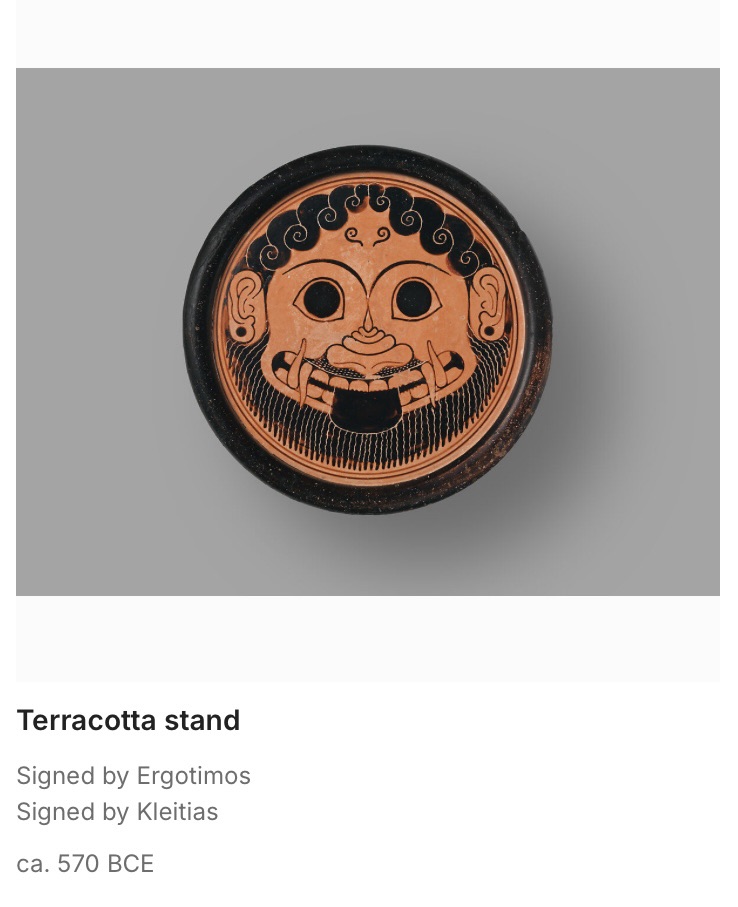
My recent creative process involved a small wood engraving, a tactile attempt to capture the raw, ancient energy of the Archaic period. I drew my inspiration from the intricate terracotta stands of the mid-sixth century BCE, specifically those bearing the signatures of the potter Ergotimos and the painter Kleitias. Working in colors of terracotta, white, and black, I sought to channel the stark, uncompromising aesthetic of that era. There is a profound weight in those early lines—a deliberate, frontal stare that seems to challenge the viewer, demanding a recognition of the power inherent in the Gorgon’s visage.
Description of Medusa

Medusa is an instantly recognizable figure from ancient Greek art, yet her appearance underwent a dramatic metamorphosis. During the Archaic period (ca. 700–480 BCE), she was the embodiment of the monstrous: a round face, bulging eyes, a beard, and a gaping mouth with sharp, gnashing teeth. This gorgoneion was not intended to be beautiful; it was an apotropaic device, a powerful amulet designed to ward off evil by projecting an even greater, more terrifying threat. By the Classical and Hellenistic periods, her form shifted toward the human, shedding the beard and fangs for a more idealized, feminine countenance. Yet, regardless of the era, one element remained constant: her piercing, frontal gaze. Unlike most figures in Greek art, who interact with one another in profile, Medusa confronts the viewer directly, creating an inescapable, supernatural encounter.
Mythology
The narratives surrounding Medusa are as varied as her artistic depictions. Hesiod’s Theogony identifies her as the only mortal among the three Gorgon sisters, born of the primordial sea gods Keto and Phorkys. The most famous account of her demise—the heroic quest of Perseus—is a masterclass in divine intervention. Aided by Athena’s polished shield, which allowed him to avoid her petrifying gaze, Perseus decapitated the Gorgon, inadvertently giving birth to the winged horse Pegasos and the giant Chrysaor from her neck. Later authors, like Ovid, introduced a more tragic dimension, casting Medusa as a beautiful maiden transformed by Athena’s wrath after a desecration in her temple. These stories were not mere fairy tales to the Greeks; they were part of a shared, quasi-historical record, a world where the boundaries between the human and the divine were dangerously thin.
Conclusion
Medusa remains a testament to the ancient Greek need to define and control the “other.” She was a foreign, dangerous, and potent force, yet she was also ubiquitous, appearing on everything from architectural pediments and drinking vessels to the aegis of Athena herself. By placing her image on armor and thresholds, the Greeks did not just record a myth; they weaponized it. Medusa serves as a permanent reminder that even the most terrifying threats can be harnessed to protect, provided one has the courage to look at them—if only through a reflection.

Leave a Reply