

Intro: A Shadow in the Canopy
Deep within the dense, primordial rainforests of West Africa, where the light filters through a thick green ceiling and the air hums with life and mystery, stories are woven into the very fabric of the landscape. Among the Akan people—whose cultural and political influence spans southern Ghana, eastern Côte d’Ivoire, and Togo—the forest is not just an ecosystem. It is a realm of spirits, ancestors, and profound moral order. To violate that order is to invite consequences, often personified by its most fearsome enforcer: the Sasabonsam (or Asanbosam). This is not a simple ghost story; it is a complex cosmological entity, a being that straddles the line between archetypal ogre and supernatural vampire. Its legend, carried across the Atlantic in the memories and trauma of enslaved Akan people, took root in 18th-century Jamaica, mutating and adapting to a new, brutal landscape. This is the story of the Sasabonsam, a creature of iron and shadow that embodies the rules of the forest, the fears of a people, and the indomitable survival of cultural memory.
Etymology: The Name in the Leaves
The name itself, Sasabonsam or Asanbosam, is deeply rooted in the Twi language of the Akan. While precise etymological breakdowns can vary among scholars and oral historians, the consensus points to a construction that evokes the creature’s essence. The prefix “Asa-“ or “Sasa-“ is often linked to the Twi word asase, meaning “earth” or “land,” but in a wild, untamed sense—the wilderness beyond the village. The component “-bonsam” is unequivocal. Bonsam (or abonsam) in Akan cosmology is a category of malevolent forest spirits or demons, often invoked to explain misfortune, illness, and evil witchcraft. Therefore, Sasabonsam can be understood as “the wilderness demon” or “the evil spirit of the wild earth.” This naming immediately places the creature outside the sphere of human community and within the domain of the chaotic, powerful, and morally ambiguous forest. Among the Asante subgroup in particular, the term asasabonsam is the most precise identifier for this iron-toothed tree-dweller, distinguishing it from other forest beings like the mmoatia (dwarves) and, as a more general term, sasabonsam, which refers to evil spirits in some contexts. The name is a warning label, a linguistic boundary marker between the safe, ordered world of the village and the perilous, rule-governed world of the deep woods.
The Physical Description of the Sasabonsam
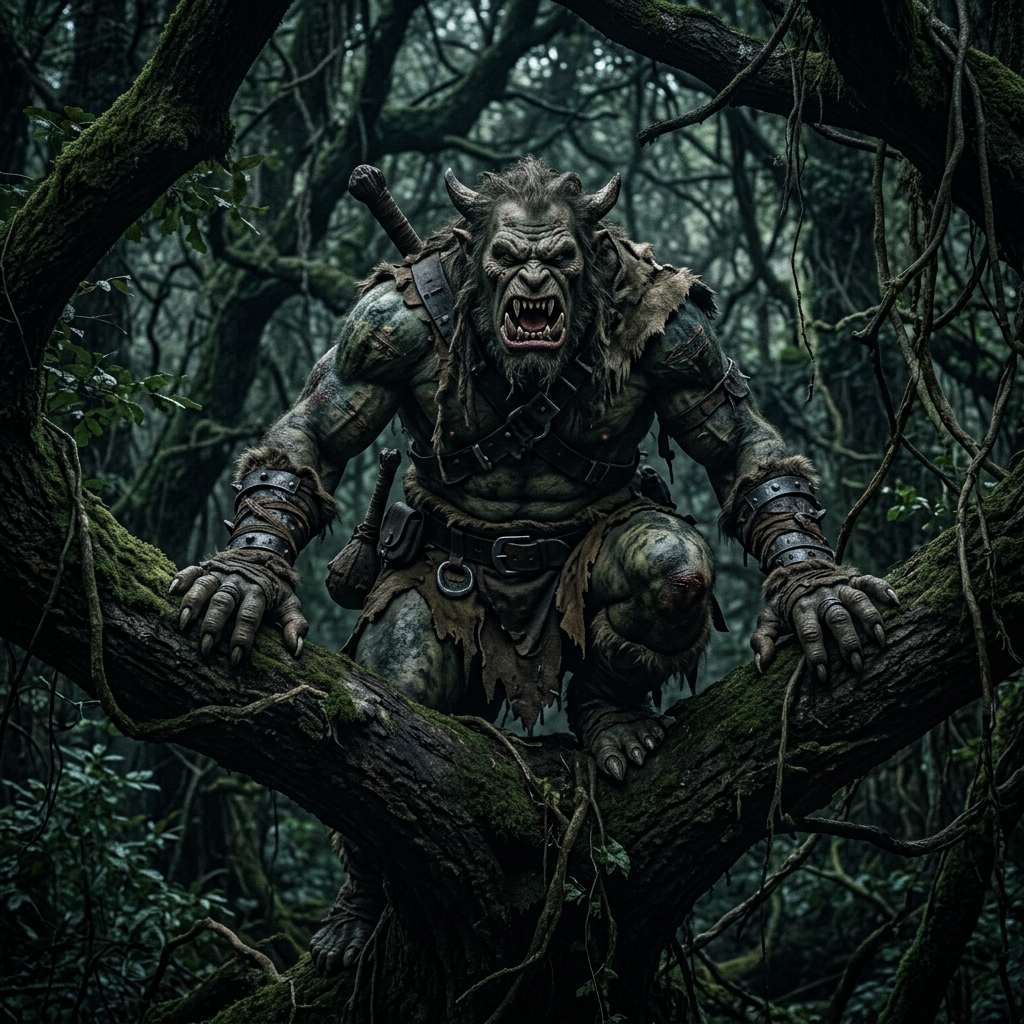
The physical description of the Sasabonsam, consistent across vast regions of Akan influence, is a masterclass in crafting a predator perfectly adapted to its domain. It is a composite nightmare, blending human, bat, and elemental features into a form designed to hunt from above.
- The Form: It is fundamentally humanoid, allowing it to mimic a person enough to inspire uncanny dread, but its humanity is grotesquely distorted. It is often described as exceptionally hairy, with large, bloodshot eyes that gleam in the dark forest. Its most famous and chilling anatomical feature is its legs. Reports consistently describe them as long, but with a horrific twist: the feet are said to point in both directions. This reversible-foot anatomy serves a clear folkloric purpose—it confuses hunters or travelers, making its tracks impossible to follow and its direction of travel uncertain. It is the ultimate symbol of disorientation in its territory.
- The Arsenal: Its iron teeth are its defining weapon. Unlike the fangs of European vampires, these are not merely pointed; they are made of cold, unbreakable metal. This detail speaks volumes. Iron was a material of immense cultural and practical significance in West Africa, associated with strength, warfare (via blacksmithing), and spiritual power. For a creature to have iron teeth transforms it from a mere animal into a being wielding a perversion of human technology and spiritual force. It doesn’t just bite; it shears and crushes.
- The Domain: The Sasabonsam is an arboreal sovereign. It does not lurk in caves or graves but makes its home in the high, thick branches of the largest forest trees, particularly the silk-cotton tree (Ceiba pentandra), which is itself often considered a dwelling place for spirits. From this vantage point, it becomes a territorial apex predator. Crucially, it is frequently described as possessing bat-like features, including leathery wings with an immense span—reportedly up to twenty feet wide. This winged aspect fuels its “vampire” characterization, suggesting a kinship with creatures of the night that feed on blood. A remarkable material representation of this being resides in the British Museum: a wooden sculpture carved around 1935, likely in Ghana. This figure captures the essence of the Sasabonsam—its hunched, humanoid posture, its exaggerated limbs, and its aura of watchful menace—freezing the oral tradition in a tangible, chilling form.
Mythology: The Ogre and the Vampire
In the taxonomy of world mythology, the Sasabonsam plays a dual role, seamlessly merging two archetypes: the Ogre and the Vampire.
As an ogre, it fits the global pattern of a large, cannibalistic, and often dim-witted monster that preys on humans, frequently through trickery. The Akan narratives perfectly align with this. The creature’s “favorite trick,” as noted in sources like A Dictionary of World Mythology, is to sit on a high branch and dangle its long, reversible legs. An unwary hunter or traveler walking beneath might brush against them, mistaking them for vines or roots. In an instant, the legs snap shut like a trap, ensnaring the victim and hoisting them into the canopy to be consumed. This action frames the Sasabonsam not just as a predator, but as an enforcer. The forests of West Africa were governed by unwritten but deeply understood “rules of renewal”—taboos about hunting certain animals, harvesting specific plants, or entering sacred groves at forbidden times. The Sasabonsam was the punitive agent for these breaches. To wander too far, to hunt without respect, to violate the sacred space was to place oneself in its jurisdiction.
Its vampiric attributes, while sometimes more emphasized in diaspora contexts, are inherent to its original conception. The bat-like wings, the dwelling in shadowy places, and the consumption of human life force (whether through flesh or, in some variants, blood) align it with global vampire myths. However, the Akan vampire is distinct. It is not a reanimated corpse, nor is it concerned with seduction or aristocracy. It is a wild, elemental force. Its vampirism is one of ecological balance and territorial sovereignty. It “feeds” on those who transgress the natural order, making it a manifestation of the forest’s retributive justice.
Interpretations: Symbol, Psyche, and Diaspora
The Sasabonsam is a rich text open to multiple, intersecting interpretations.
- Ecological and Social Enforcement: At its most literal, the myth functioned as a sophisticated tool for environmental and social management. By personifying the dangers of the deep forest, it enforced practical conservation rules, protecting vulnerable species and sacred spaces. It also served as a boundary keeper, discouraging people from straying too far from the community into potentially dangerous or uncharted territory, thereby reinforcing social cohesion.
- Psychological Archetype: The creature embodies profound psychological fears: fear of the unknown wilderness (horror vacui), fear of predation from above (a primal anxiety), and fear of inversion/disorientation (the reversible feet). It represents the “shadow” of the ordered human world—all that is chaotic, amoral, and wild within the untamed psyche and the untamed land.
- The Diasporic Transformation | 18th-Century Jamaica: The transatlantic slave trade forcibly relocated Akan people (often referred to as “Coromantees” by British colonists) to plantations in Jamaica and elsewhere. They brought their cosmology with them. In the new, brutal environment of Jamaican sugar plantations, surrounded by unfamiliar forests and under the yoke of an incomprehensible evil in the form of chattel slavery, the Sasabonsam myth adapted. It syncretized with other African beliefs and possibly influenced emerging Caribbean folklore. The creature’s characteristics likely blended with those of the obayifo (the Akan witch/vampire who could fly and suck life from crops and people) and other entities. In this context, the Sasabonsam may have transformed from an enforcer of forest rules into a symbol of the terror of the plantation and the surrounding “cockpit country” wilderness—a manifestation of the trauma of displacement and the pervasive, lurking violence of the slave society. It became a diasporic memory, a piece of cultural resistance that insisted the old world’s monsters had followed them, taking up residence in the mangroves and mountains of the new.
Conclusion: More Than a Monster
The Sasabonsam is far more than a simple monster story to scare children. For the Akan people of Ghana, Côte d’Ivoire, and Togo, it was a vital component of a living cosmology—a narrative embodiment of natural law, social boundaries, and the consequences of transgression. Its terrifying visage, with iron teeth and reversed feet, was a mnemonic device for survival in both a physical and moral landscape. The journey of its legend to 18th-century Jamaica highlights the resilience of cultural memory under the horrific strain of slavery. The Sasabonsam survived the Middle Passage, not as a passive relic, but as an adaptable symbol, speaking to new terrors in a new world. To study this being is to understand how a people used narrative to map their world, manage their environment, and ultimately, preserve their identity. It remains, suspended in the collective memory like the creature itself in its treetop perch—a powerful, watchful, and indelible part of West African heritage and its enduring Atlantic legacy.

Cotterell, A. (Ed.). (1999). A Dictionary of World Mythology. Oxford University Press.
Herskovits, M. J. (1937). Life in a Haitian Valley. Alfred A. Knopf.
McCaskie, T. C. (1995). State and Society in Pre-Colonial Asante. Cambridge University Press.
Parrinder, G. (1967). African Mythology. Hamlyn.
Rattray, R. S. (1927). Religion and Art in Ashanti. Clarendon Press.
Sarpong, P. (1974). Ghana in Retrospect: Some Aspects of Ghanaian Culture. Ghana Publishing Corporation.
Leave a Reply