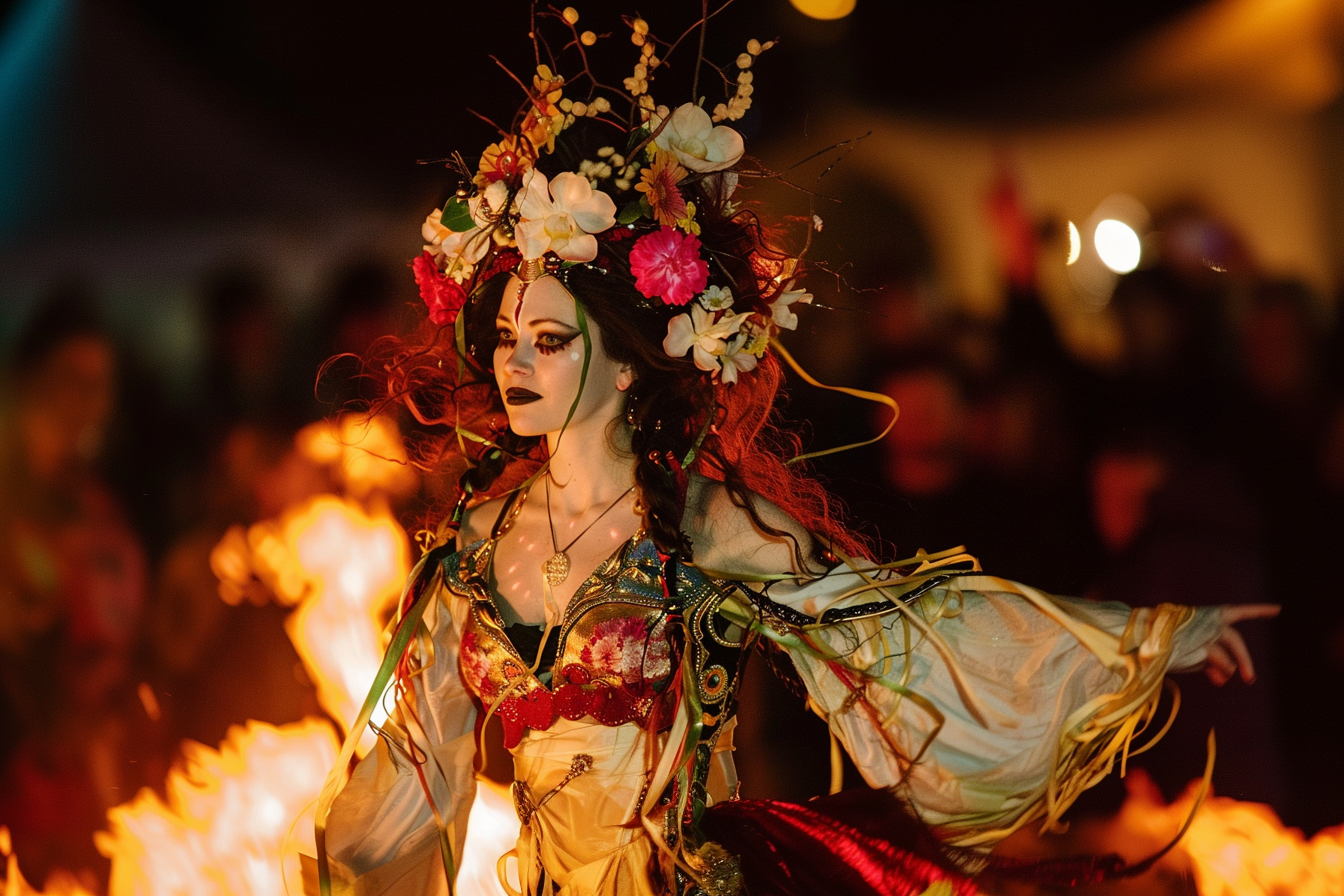

The Whispers of Beltane
Within the enchanting days leading up to May 1st, the air would carry the whispers of ancient traditions as villagers ventured into the woods, guided by ancient wisdom, to gather the nine sacred woods essential for the Beltane bonfires. An old 13th-century Irish poem known as the “Song of the Forest Trees” reveals the reverence bestowed upon these woods, which include Rowan, Briar, Oak, Alder, Holly, Elder, Birch, Aspen, and Yew. But the customs of Beltane did not end with the gathering of woods; they blossomed into a tapestry of vibrant traditions. “May Boughing” or “May Birching” was a cherished ritual where young men adorned the windows and doors of their beloveds with garlands of greens and flowers, as these delicate offerings conveyed profound symbolism and ignited negotiations of the heart. Amidst the festivities, communities would elect a May Queen, representing the transition from Maiden to Motherhood, and her consort, known by various names such as Jack-in-the-Green, Green Man, May Groom, or May King, symbolizing the eternal cycle of fertility and the awakening of a renewed world.
As the eve of Beltane arrived, a palpable sense of anticipation filled the air. The Beltane celebration would commence at sundown on April 30th, with the extinguishing of all hearth fires, symbolizing the completion of the old and the preparation for the new. Two sacred Beltane fires would then be kindled atop hilltops, glowing warmly upon the land. It was a moment of purification and fertility, as villagers guided their livestock between the fires three times, an act believed to ensure their prosperity and fecundity for the coming summer before they were sent to the lush pastures of the season. Following this solemn livestock ritual, the focus would shift to celebrating human fertility. As the night unfolded, joyous dances would circle around the bonfires while social norms gradually loosened their grip. It was a time when young couples embraced the symbolism of Beltane, venturing into woods and plowed fields to test the fertility waters of love, awakening ancient desires within their hearts.
A Legacy of Celebration, Connection, and Fertility
Throughout the ages, Beltane remained a steadfast celebration, even as the influence of Christianity reshaped the world. The transition from pagan handfasting to Christian marriage traditions brought its own changes, yet the spirit of Beltane endured. During its sacred embrace, the festival continued with an astonishing temporary suspension of all marriage vows. Though concerns were expressed by some priests regarding the fervor of youthful encounters, the belief persisted, whispered among the people, that babies conceived from these Beltane unions were blessed by the very Goddess herself, carrying within them the promise of abundant life.
Embodied in the sacred woods, vibrant festivities, and dance of human desire, Beltane’s spirit beckons us to honor our connection to nature, celebrate the eternal rhythms of life, and embrace the transformative power of fertility and rebirth. As we delve deeper into Beltane’s tapestry, we shall discover its profound significance etched within its rituals and its enduring legacy on the human spirit.
Beltane, a magical festival that announces the advent of summer, and Samhain, a mystical gathering that signals the beginning of winter, were revered as the most significant Celtic celebrations. Although these events may have carried little significance for European farmers, they held tremendous importance for the wandering herdsmen. Sir James George Frazer’s observations suggest that the division of the year on May 1st and November 1st originated when the Celts heavily depended on their herding practices.
Ancient Rituals, Mythical Legends, and Enduring Traditions
The ancient literature of Gaelic Ireland, such as Sanas Cormaic and Tochmarc Emire, provides us with the earliest records of Beltane. According to these texts, Beltane was observed on May 1st and symbolized the arrival of summer. Fascinatingly, the accounts depict druids conducting elaborate rituals, conjuring two fires through potent incantations. These fires aimed to safeguard the livestock from ailments, compelling them to pass through the sacred flames.
In the 17th century, Geoffrey Keating, a historian, chronicled a magnificent assembly that reportedly took place at the hill of Uisneach in medieval Ireland during the Beltane festivities. According to Keating, a sacrifice was offered to the deity Bel, and bonfires were kindled in every region to safeguard the cattle from harm. However, it is essential to note that no concrete historical records of such a gathering exist. Nevertheless, the medieval Dindsenchas recounts a legend of a heroic figure who ignited a sacred fire on Uisneach, which burned for an incredible seven years. Ronald Hutton suggests that this legend may preserve an ancient tradition of Beltane ceremonies. Yet, Hutton also highlights the possibility that Keating merged this tale with information from Sanas Chormaic, creating a piece of fabricated history or pseudo-history.
However, the excavation of Uisneach in the 20th century unearthed compelling proof of substantial fires and burned remains, suggesting that it has served as a sacred ritual site since ancient eras. Scholars speculate that it functioned as a sanctuary where flames were meticulously maintained or ignited at specific intervals, and animals were ceremoniously sacrificed.
Medieval Scottish literature also references Beltane, with the poem ‘Peblis to the Play‘ from the Maitland Manuscripts shedding light on the festive celebrations of Beltane in the town of Peebles during the 15th and 16th centuries.
From the late 18th to the mid-20th century, folklorists and writers meticulously recorded numerous accounts of Beltane customs. John Jamieson’s Etymological Dictionary of the Scottish Language (1808) provides insight into some fading Beltane customs still observed in some areas of Scotland during the 18th and early 19th centuries.
Ancient Agrarian Rhythms and Spiritual Renewal
Beltane symbolizes the arrival of the enchanting summer season, a time when livestock are guided to bountiful pastures. During this period, rituals are conducted to protect them from any potential harm, whether from natural forces or supernatural entities, with a strong focus on the ceremonial use of fire. These rituals extend beyond livestock welfare to safeguarding crops, dairy products, and the well-being of people while simultaneously nurturing growth and abundance. The aos sí, commonly known as spirits or fairies, are believed to be particularly active during Beltane, much like during the Samhain festivities, and appeasing them becomes a central objective of these rituals. Many scholars view the aos sí as remnants of ancient pagan deities and nature spirits. Beltane encompasses a celebration of hopefulness in spring, where fertility rituals once again take center stage, possibly connected to the increasing power of the sun.
The origins of Beltane can be traced back to ancient agrarian societies, where its significance was closely tied to the practicalities of early farming communities. Approximately 6,000 years ago, as hunter-gatherer societies in Northern Europe transitioned to settled agricultural lifestyles, they recognized the importance of acknowledging and celebrating the changing seasons. With the shift towards agriculture, it became necessary to establish methods of regulating farming and herding practices. This led to the creation of regional agricultural calendars based on celestial movements, notably the sun and the moon. These calendars served as crucial guides for determining the optimal times for planting, harvesting, and managing livestock, ensuring the success and sustenance of these early agrarian societies.
The Celtic calendar emerged as an agricultural calendar in Ireland, the United Kingdom, and the Isle of Man. However, its name predates the arrival of the Celts by approximately 2,500 years. Archaeological evidence, such as stone circles and pre-Celtic sites, indicates a strong correlation between these ancient structures and significant dates on the Celtic calendar, despite their construction predating the arrival of the Celts in the region.
One notable example is the Balnuaran of Clava cairns in Scotland, which dates back at least 3,800 years. These cairns align with the solstices and equinoxes and display distinct markings associated with the “Celtic” quarter days. Independent scholar David Trevarthen’s research, published in the Cambridge Archaeological Journal, highlights these connections. This suggests that the customs and traditions associated with Beltane have been observed for thousands of years, even preceding the rise of Celtic culture.
While Beltane has evolved over time and acquired cultural and spiritual significance, its origins lie in the practical needs of early agrarian societies to mark the seasons and regulate agricultural activities.
Fire Rituals, Feasting, May Bushes, and Flower Symbolism
Beltane is steeped in ancient customs and rituals practiced by early agrarian societies. After the bonfire died, people would dab themselves with its ashes and sprinkle them over their crops and livestock, believing that the fire held protective powers. Burning torches from the bonfire were taken home and used to relight the hearth, symbolizing the continuation of warmth and light in their homes. These fire rituals were thought to imitate the sun and ensure a bountiful supply of sunshine for all living beings while symbolically burning away harmful influences.
Food played a significant role in Beltane celebrations as well. In the Scottish Highlands, a feast featuring lamb was held, and in earlier times, this lamb would be sacrificed. A caudle made from eggs, butter, oatmeal, and milk was cooked on the bonfire in other regions. Some of the mixture was poured on the ground as a libation, and everyone would then take an oatmeal cake called a Beltane bannock. Each person would face the fire, break off a knob from the bannock, and throw it over their shoulder as an offering to protect their livestock and ward off predators. Afterward, the caudle would be enjoyed by all.
Various rituals and customs were associated with the May Bush or May Bough, a small tree or branch decorated with flowers, ribbons, painted shells, or eggshells. The May Bush was often paraded through towns, and gold and silver hurling balls called May Balls were hung on the branches. In some areas, the May Bush was stolen, and its theft became a playful competition between neighborhoods. The May Bush symbolized fertility and renewal, and its decoration and presence brought luck and prosperity to the community.
Flowers held significant symbolism during Beltane. Yellow and white flowers like primrose, rowan, hawthorn, gorse, hazel, and marsh marigold would be placed at doorways and windows, hung on cows and equipment, and used in various decorations. These flowers evoked the power of fire and were believed to bring good fortune and protect against harmful spirits.
Beltane customs were also intertwined with beliefs in fairies or the aos sí. Many rituals were performed to ward off the fairies and prevent them from stealing dairy products. Offerings of food or milk were left at doorsteps and locations associated with the aos sí. Holy wells were visited, and the first water drawn on Beltane was considered potent and brought good luck. Maidens would roll in the Beltane morning dew or wash their faces with it, which was believed to enhance attractiveness and maintain youthfulness.
Other beliefs and practices surrounded lighting fires, putting out ashes or clothes, giving away coal or ashes, and various superstitions linked to May Day.
Modern Celebrations and Ancient Traditions
Once a vibrant festival, Beltane had faded away by the mid-20th century. However, remnants of its customs continued, and in certain regions, it has been revived as a cultural event. Beltane fires were common in Ireland until the mid-20th century, but today, the tradition only survives in County Limerick and Arklow, County Wicklow. The lighting of a communal Beltane fire, from which each household’s hearth fire is relit, is still observed in some parts of the Gaelic diaspora. Although, in most cases, it is a cultural revival rather than an unbroken continuation of the ancient tradition. Newfoundland still upholds the custom of decorating the May Bush.
The town of Peebles in the Scottish Borders hosts a traditional week-long Beltane Fair every year in June. During this fair, a local girl is crowned the Beltane Queen on the steps of the parish church. Like other festivals in the Borders, it includes a Common Riding.
Since 1988, Edinburgh, Scotland, has held a Beltane Fire Festival every year on April 30th on Calton Hill. While inspired by traditional Beltane, this celebration is a modern interpretation of the beginning of summer and draws influences from various sources. The festival features fire dances, a procession of costumed performers led by the May Queen and the Green Man, and culminates in the lighting of a bonfire.
Butser Ancient Farm, an open-air archaeology museum in Hampshire, UK, has organized a Beltane festival since the 1980s. This festival combines historical reenactment with folk influences and showcases a May Queen and Green Man, living history displays, reenactor battles, traditional craft demonstrations, folk music performances, and Celtic storytelling. The festival concludes with a 30-40 foot wicker man burning, featuring a new design inspired by history or folklore each year.
In Ireland, a similar Beltane Festival has occurred annually since 2009 at Uisneach. The festival ends with a torchlit procession, with participants dressed in costumes and some on horseback, followed by the lighting of a large bonfire at dusk. In 2017, the President of Ireland, Michael D Higgins, ignited the ceremonial fire.
The song “Ride a White Swan” by Marc Bolan and his band T.Rex, released in 1970, includes the line “Ride a White Swan like the people of the Beltane.”
Neopagans also celebrate Beltane in various ways, and their celebrations can differ significantly due to the diverse forms of Neopaganism. Some Neopagans strive to recreate the historic festival as faithfully as possible, while others draw inspiration from multiple sources, the Gaelic festival being just one of them.
Generally, Neopagans celebrate Beltane from April 30th to May 1st in the Northern Hemisphere and October 31st to November 1st in the Southern Hemisphere, starting at sunset. Some Neopagans celebrate it at the astronomical midpoint between the spring equinox and summer solstice or the full moon closest to this point. In the Northern Hemisphere, this midpoint occurs when the sun’s ecliptic longitude reaches 45 degrees.
Celtic Reconstructionists focus on reconstructing ancient Celtic religion and based their religious practices on research and historical accounts, adapting them to suit modern life. They avoid mixing practices from unrelated cultures. Celtic Reconstructionists typically celebrate Beltane when local hawthorn trees are in bloom. Many observe the traditional bonfire rituals to the extent possible in their respective locations. This may involve passing themselves, their pets, or livestock between two bonfires and bringing home a candle lit from the bonfire. If bonfires are not feasible, candles may be used instead. Homes may be adorned with a May Bush, branches from blooming thorn trees or equal-armed rowan crosses. Some Celtic Reconstructionists also visit holy wells and make offerings to the spirits or deities associated with them. Traditional festival foods may be prepared as well.
Wiccans refer to their May Day celebrations as Beltane or Beltain. It is one of the annual Sabbats in their Wheel of the Year, following Ostara and preceding Midsummer. Unlike Celtic Reconstructionism, Wicca is syncretic and combines practices from various cultures. The Wiccan Beltane shares similarities with the Germanic/English May Day festival, emphasizing fertility and featuring rituals such as maypole dancing. Some Wiccans perform a ritual union of the May Lord and May Lady.
Traditionally celebrated on May 1st, Beltane is a festival that marks the halfway point between the vernal equinox and the summer solstice. However, due to shifts in the earth’s axis, the actual midpoint now falls closer to May 5th. Nonetheless, May 1st remains the preferred date for Beltane celebrations. An interesting astronomical phenomenon associated with Beltane is the rising of the Pleiades star cluster just before sunrise, symbolizing the beginning of summer. In contrast, the Pleiades rising at sunset marks the beginning of winter, celebrated during Samhain. The Pleiades, also known as the Seven Sisters, is a cluster of stars in the constellation Taurus.
Fires of Renewal, Fertility, and Ancient Traditions
May Day is another name for Beltane, sometimes called Cetsamhain or Roodmas. The Church Fathers attempted to redirect people’s attention from the Maypole, a symbol of life, to the Holy Rood, the Christian Cross. Some Beltane rituals were incorporated into Christianity, and the festival became known as the Feast of the Finding of the Holy Cross. Priests would conduct outdoor services around a bonfire to bless the land.
In the days leading up to May 1st, villagers would venture into the woods to gather the nine sacred woods required for the Beltane bonfires. As mentioned in the 13th-century Irish poem “Song of the Forest Trees,” these woods include Rowan, Briar, Oak, Alder, Holly, Elder, Birch, Aspen, and Yew. Another tradition associated with Beltane is “May Boughing” or “May Birching,” where young men decorate the windows and doors of their love interests with garlands of greens and flowers. The choice of flowers and branches carried symbolic meanings, and it was a time for negotiation and courting. Many communities would also elect a May Queen to lead processions and songs. The May Queen represented the virgin Goddess on the cusp of transitioning from Maiden to Motherhood. She would unite with her consort, Jack-in-the-Green, Green Man, May Groom, or May King, symbolizing the fertility and rebirth of the world.
The Beltane celebration would begin at sundown on April 30th, with the extinguishing of all hearth fires in the village. Two Beltane fires would then be lit on hilltops. Villagers would drive their livestock between the fires three times to purify and ensure their fertility for the upcoming summer before sending them to summer pastures. Following the livestock ritual, the human fertility ritual would commence. As the night progressed, people would dance around the bonfires, and social norms would loosen. It was expected that young couples would venture into the woods or plowed fields for romantic encounters, symbolically testing the fertility waters. Even after the shift from pagan handfasting to Christian marriage traditions, the Beltane ritual persisted, temporarily suspending all marriage vows during the festival. While some priests expressed concerns about the number of virgins engaging in such activities, the belief persisted that babies born from Beltane unions were blessed by the Goddess herself.
Fire played a central role in Beltane celebrations, as it was believed to possess purifying qualities that revitalized both the land and the people. On the night of Beltane, Druids would kindle fires using nine different types of wood in sacred places. According to Celtic reckoning, the Beltane celebration began on April 30th, as the Celts counted their days from sundown to sundown. The lighting of the great Bel-fires was a significant event, often taking place on hills. Many place names in Scotland indicate their association with Beltane, such as Tullybelton in Perthshire (Tulach Bealltuinn – Beltane Hill) or Tarboltan in Ayrshire (Tor-Bealtiunn – Beltane Hillock). These “need fires” were believed to possess healing properties, and people would jump through the flames for protection.
Celtic mythology has various associations with May 1st. According to the ancient Irish ‘Book of Invasions,’ the first settler of Ireland, Partholan, arrived on May 1st, followed by a plague that ultimately wiped out his people. Centuries later, the Milesians defeated the Tuatha De Danann on May Day. Welsh mythology recounts the perennial battle between Gwythur and Gwyn for the love of Creudylad, which took place each May Day. On May Eve, Teirnyon also lost his colts and found Pryderi. May Eve was associated with a fearful scream heard throughout Wales, one of the three curses of the Coranians lifted by Lludd and Llevelys.
Beltane fires continued to burn throughout Scotland until the 19th century. While some fires were assimilated into Christian practices, many symbolized Celtic rituals. Many Beltane celebrations involved making and sharing a large Beltane Bannock or cake. This particular cake was made of eggs, milk, and oatmeal. It was traditionally made on the eve of Beltane, believing it should not come into contact with steel during preparation, as steel was considered harmful to the faery folk. The bannock served magical and ritual purposes, with markings such as nine raised nipples or scalloped edges representing the nine sacred kinds of wood used in the needfire. Pieces of the bannock would be thrown into the fire with an exhortation to bless homes, cattle, or individuals. In some areas, one piece of the cake would be blackened with charcoal and distributed along with the other pieces. Whoever drew the blackened piece would have to leap three times through the flames. This custom is believed to have originated in the late Bronze Age and evolved from the practice of having a designated Beltane Carline or “scapegoat” who would bear any misfortune, sparing the rest of the people. It is now understood that the Carline was not burned as a human sacrifice, and the association likely stemmed from Christian attempts to condemn Beltane’s festivities. Later, customs called for the Carline or Fool to leap through the Beltane fire three times, while earlier customs banned the Fool from participating in Beltane activities. In all recorded histories, the “sacrifice” was never carried out.
Bridging Worlds, Cultivating Magic, and Celebrating Nature’s Rhythms
Beltane, like Samhain, is believed to be a time when the veil between the worlds is thin, making magic possible. While Samhain is associated with wandering souls of the dead, Beltane is a time to watch for Fairies. It is believed that on Beltane night, the queen of the fairies rides out on her white steed to entice humans away to Fairyland. If one hears the bells of the Fairy Queen’s horse, it is advised to look away to avoid being enticed. Leaving bannocks for the Fairies in hopes of gaining their favor on this night was also a common practice.
Dancing around a maypole is the most traditional way of celebrating May Day.
While the origins of Beltane were likely created out of necessity, Beltane, an ancient festival originating as an agricultural calendar, holds deep roots in the cultural tapestry of Ireland, Scotland, the Isle of Man, and surrounding areas. Its significance predates the arrival of the Celts, with sacred sites aligning with essential dates on the Celtic calendar. As one of the four quarter days, Beltane marked the beginning of summer and played a vital role in the agricultural practices of moving livestock and initiating the growing season. The symbolic Beltane fires, associated with purification, may have originally served as a means to clear fields and pastures. The inclusion of fertility rituals further enriched the festival’s agricultural significance. Over time, Beltane’s date became fixed, aligning with other flower-and-fire festivals celebrated across ancient Rome and Central Europe. These rites emphasized the cyclicality of seasons and the importance of timing in agricultural pursuits.
Beltane inspires and influences modern culture, rituals, and societal beliefs. Its themes of renewal, fertility, and union with nature resonate with individuals seeking to reconnect with their roots and embrace the rhythms of the natural world. Beltane rituals and practices are enduringly important because they can foster a sense of community, spiritual reflection, and appreciation for the cycles of life.
Remember and honor this ancient festival’s rich heritage and wisdom as we commemorate Beltane. By embracing its traditions and carrying them forward, we celebrate our connection to the land, cultivate a deeper understanding of our place in the world, and nurture a collective belief in the enduring power of nature’s cycles. May the spirit of Beltane continue to inspire and bring joy, growth, and harmony to contemporary society, serving as a reminder of our shared human experience and the enduring relevance of ancient traditions.

2. Danaher, Kevin. “The Year in Ireland: Irish Calendar Customs.” Mercier Press, 1972.
4. Wood, Juliette. “The Wisdom of the Celts.” Random House UK, 2004.
5. Valiente, Doreen. “Witchcraft for Tomorrow.” Robert Hale, 1978.
Leave a Reply