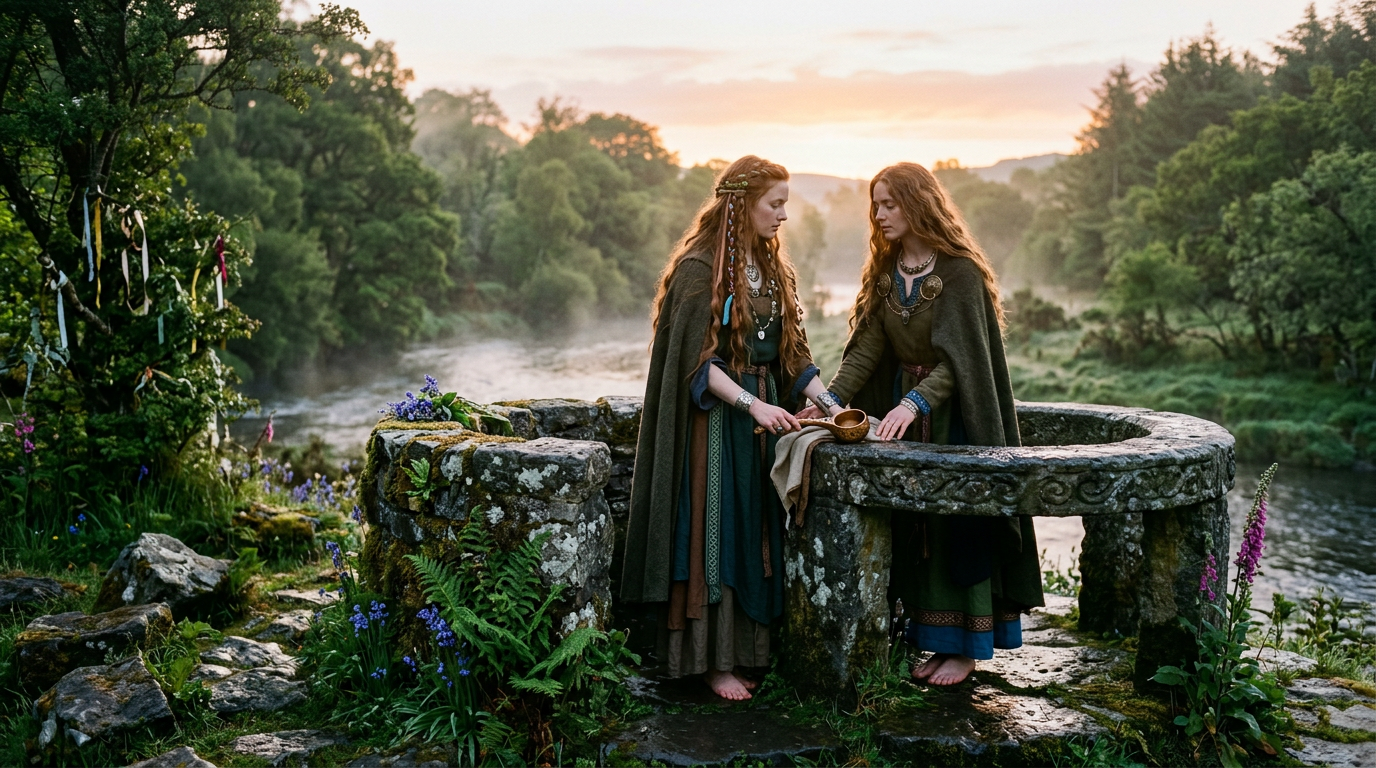


The Whisper in the Water
If you stand today on the banks of the River Boyne in County Meath, Ireland, you feel more than just the flow of water. You feel a presence. The river winds through the landscape with a serene, powerful grace, cradling within its curves the great Neolithic tomb of Newgrange—a site older than the pyramids. This is not merely a river; in the Irish imagination, it is the physical embodiment of a goddess, a divine woman whose story is one of desire, transgression, creation, and ultimate sacrifice. Her name is Boann, and she is the Sovereign of the Boyne. To understand her is to dive into the very heart of the Celtic worldview, where landscape and legend are inseparable, and where the actions of the gods literally shape the world we walk upon.
This exploration moves beyond a simple retelling of myths. We will delve into the scholarly depths of her name’s origin, unpack the complex narratives of her life and deeds from medieval manuscripts, and examine how her ancient power is reinterpreted in modern spiritual practice. Boann’s tale is a masterclass in how the Celtic mind perceived divinity: not as distant and omnipotent, but as intimately connected to the forces of nature, human passion, and the cyclical rhythms of the cosmos.
The Name That Murmurs: Unpacking the Etymology of Boann
To begin with, Boann is defined by her name, a key that unlocks her fundamental nature. Etymology here is not dry linguistics; it is the first clue to her divine identity. The most widely accepted interpretation, stemming from the medieval Irish Dindsenchas (the “Lore of Place Names”), is that Boann derives from the Old Irish Bó Find, meaning “White Cow” or “Bright/Blessed Cow”.
This is not a trivial association. In the Celtic world, and particularly in Ireland, the cow was paramount. It was the primary unit of wealth, a symbol of abundance, sustenance, and prosperity. A white cow held special, almost sacral significance, often connected to the Otherworld and sovereignty. The river’s ancient name, recorded by the 2nd-century geographer Ptolemy as Bouvinda (Greek: Βουουίνδα), supports this, likely coming from the Proto-Celtic Bou-vindā, “white cow.” Thus, the goddess and her river are intrinsically linked to the concept of fertile, life-giving bounty.
An alternate and equally potent name for her is Segais, connected to the Tobar Segais, the Well of Segais. This well, often conflated with Connla’s Well, was the mythical source of all wisdom in Ireland, surrounded by nine sacred hazel trees. The hazelnuts of knowledge would fall into the well, eaten by the salmon who lived within it. Boann’s association with this well ties her directly to the themes of sacred knowledge, inspiration, and the source of primal, sometimes dangerous, wisdom. Furthermore, some textual sources intriguingly note that another name for the goddess Étaín (or Eithne) was Boann, suggesting a possible conflation of sovereign goddess figures in the complex tapestry of Irish myth. Her name, therefore, is a multi-faceted gem: she is the White Cow of earthly plenty and the Keeper of the Well of cosmic wisdom.
The Mythology of Boann: Desire, Creation, and Catastrophe
The medieval Irish manuscripts, particularly the Lebor Gabála Érenn (Book of Invasions) and the Dindsenchas, paint a vivid and sometimes contradictory portrait of Boann’s mythology. Her stories can be grouped into three powerful cycles: her love affair and the birth of a god, her act of world-shaping transgression, and her role as a protective kin figure.
The Divine Affair and the Sun-Stood-Still
Boann’s most famous myth concerns the conception of her son, Aengus Óg (Aengus the Young), god of love, poetry, and youth. As told in the tale Aislinge Óenguso (The Dream of Aengus), Boann was the wife of Elcmar (or Nechtan), a lord of the síd (Otherworld mound) of Brú na Bóinne (the modern Newgrange). The great father-god, The Dagda, the “Good God” of skill and magic, desired her.
The Dagda, embodying cunning, used his power not through force but through temporal manipulation. He sent Elcmar away on a day-long errand and, with a mighty spell, made the sun stand still in the sky for nine months. In this suspended, magical time, he and Boann conceived Aengus. When Elcmar returned, he perceived only a single day had passed, and Boann’s pregnancy—and the subsequent birth of her son—was hidden.
This narrative is dripping with cosmological symbolism. Scholars like Máire Herbert and others have compellingly linked it to the winter solstice phenomenon at Newgrange. For a few days around December 21st, a narrow beam of sunlight penetrates the long, dark passage tomb, illuminating the inner chamber for approximately 17 minutes. This event can be described as the sun “standing still” (the literal meaning of solstice) at its lowest point before rebirth. In the myth, the Dagda (the sun) enters the chamber/womb of Boann (the earth, the síd) at the moment of solar standstill, and Aengus (the new, reborn sun) is the result. The story is thus a profound mythic encoding of an astronomical event, portraying the rebirth of the solar year as a divine love child.
The Challenge at the Well: Creating the Boyne
If one story defines her through creation via love, another defines her through creation via catastrophe. This is the tale of how the River Boyne itself was born. Boann, wife of Nechtan (keeper of the Well of Segais), was forbidden to approach the well, for its waters were too powerful and sacred for any but Nechtan and his cupbearers.
Driven by curiosity, pride, or perhaps a divine imperative, Boann challenged the well. She walked around it tuathal—against the sun, in a counter-clockwise or “unlucky” direction, an act of profound ritual transgression. The well’s waters, enraged by this violation, surged up violently and chased her across the land. Boann fled, but the torrent overtook her. In the flood, she lost an arm, a leg, and an eye, and was ultimately drowned, giving her life in the process. The rushing waters carved a permanent course to the sea, becoming the River Boyne.
This is a classic Dindsenchas tale, explaining a landscape feature through divine action. But it’s more than an origin story. It portrays creation as a violent, sacrificial act. Boann’s dismemberment mirrors that of other primal beings in Indo-European myth (like the Norse Ymir), whose bodies become the world. Her maiming—the loss of an arm, leg, and eye—parallels the wounds of the king-god Nuada, linking her to sovereignty and sacrifice. The poem lists the many glorious, poetic names for the new river, equating it with the world’s great waters like the Tigris and Euphrates. Boann becomes the river; her body is the landscape, her life-force the flowing water. She is the ultimate genius loci, the spirit of the place.
Protector and Kin: Boann in the Táin Bó Fraích
Beyond these cosmic roles, Boann appears in a more human-scale narrative in Táin Bó Fraích (The Cattle Raid of Fráech). Here, she is the maternal aunt of the mortal hero Fráech. When Fráech seeks to woo the formidable Queen Medb, his family advises him to seek the “raiment of the Sídhe” from his aunt Boann. She bestows upon him staggering wealth: fifty ornate mantles, fifty jeweled spears that shine like the sun, fifty horses with golden bells, swords, hounds, musicians, and jesters. This arsenal of Otherworldly splendor is not for battle but for display and diplomacy, allowing Fráech to present himself as a man of sublime, divine-backed power.
This role casts Boann in the familiar Celtic goddess role of the Sovereignty Queen and Divine Kin. She is the source of legitimacy and tangible power for her mortal nephew, a protector who empowers the hero through her connection to the riches of the Otherworld. It shows her integrated into the social and heroic world of the myths, not just as a natural force, but as an active, familial patron.
Buan: The Enduring Echo of a Mythic Pattern
The threads of Boann’s story intertwine with another enigmatic figure: Buan, whose name means “enduring” or “lasting.” The Dindsenchas tells of the “hazels of Buan” surrounding a well in Tír na nÓg, feeding five salmon. This is a clear parallel to the nine hazels around the Well of Segais. The narrative pattern of a sacred well, hazelnuts, salmon, and a female name connected to wisdom and endurance suggests these may be variant traditions of the same archetypal myth.
Another tale of “White Buan” tells a tragic love story of two youths, Baile and Ailinn, who die of broken hearts after being tricked by a specter (likely Manannán mac Lir). From their graves grow a yew tree and an apple tree, whose wood is later carved into tablets. When the tablets are brought together, they clasp like lovers. This story of love, death, and arboreal transformation echoes the themes of passion and natural embodiment found in Boann’s saga, reinforcing the deep Celtic link between emotion, destiny, and the living landscape.
Boann in Modern Neopaganism and Celtic Spirituality
In contemporary Pagan and Neopagan practice, Boann has been rediscovered and embraced as a potent goddess figure. Her appeal is multifaceted, drawing from the rich imagery of her myths.
Modern devotees often honor her as a goddess of rivers, water, and the flow of inspiration. Practitioners might perform rituals by riverbanks, make offerings to flowing water, or call upon her when seeking creativity or navigating periods of profound personal change, mirroring her catastrophic yet creative act at the well. She is seen as an emblem of sacred curiosity and the courage to challenge boundaries, even at great personal cost.
There is a common, though scholastically unattested, syncretism in some modern circles that identifies Boann as the mother of the great goddess Brigid. While no ancient Celtic source makes this connection—Brigid’s father is the Dagda, and her mother not explicitly named—the conflation is understandable. Both are powerful female deities associated with wisdom, inspiration (poetic and craft), and a life-giving principle. In the desire to create a more connected divine family, modern practitioners sometimes weave together threads from different parts of the mythic tapestry. It is crucial, however, for those engaged in historically-informed practice to recognize this as a modern innovation, born of devotional creativity rather than medieval tradition.
For many, Boann’s greatest power is her role as the spirit of the Boyne Valley itself. Pagans on pilgrimage to Newgrange, Knowth, and Dowth (collectively, Brú na Bóinne) often seek to connect with her as the guardian of that sacred landscape. Her story provides a mythic lens through which to view the solstice alignment, transforming an archaeological wonder into a living temple of a divine drama.
Conclusion: The Enduring Flow of the White Cow
Boann, the White Cow goddess of the Boyne, is a figure of remarkable depth and resonance. She is not a single-note deity but a symphony of interconnected themes. She is the lover whose union under a spellbound sun explains the rebirth of the year. She is the transgressor whose defiant act shatters a well of wisdom and creates a river, embodying the terrifying, creative power of nature. She is the sacrificial body that becomes the landscape, and the bountiful aunt who dispenses Otherworldly wealth.
Her study requires us to hold multiple truths at once: the philological truth of her name, the narrative truth of her medieval manuscript portrayals, the astronomical truth hinted at in her myths, and the living truth of her continued resonance. She exemplifies the Celtic vision of a world alive with personified divinity, where every hill, forest, and river has a story, and every story shapes the soul of the place.
The River Boyne continues to flow to the sea, just as it did when Ptolemy wrote its name. And in its murmuring waters, for those who listen, the story of Boann—of desire, daring, creation, and sacrifice—continues to be told. She reminds us that the landscape is not a passive backdrop but an active participant in our history, our mythology, and perhaps, in our spirituality.

Gwynn, E. (Ed. & Trans.). (1903-1935). The metrical Dindshenchas (Vols. 1-5). Royal Irish Academy.
Koch, J. T., & Minard, A. (Eds.). (2012). The Celts: History, life, and culture. ABC-CLIO.
Leave a Reply