Good King Wenceslas looked out
On the Feast of Stephen
When the snow lay round about
Deep and crisp and even…
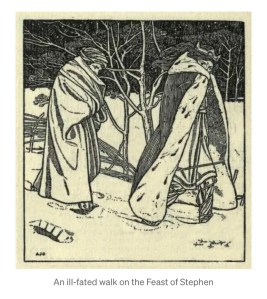
Do you know the true story behind this famous Christmas song?
Wenceslaus I, also known as Saint Wenceslaus, was a prominent figure in the history of Bohemia (present-day Czech Republic) during the 10th century. His life and legacy have been immortalized in various forms, including a popular Christmas carol known as “Good King Wenceslas.” This article aims to delve into the historical background, the song’s origins, and the true story of Wenceslaus I, Duke of Bohemia.
Wenceslaus I was born in 907 AD, the son of Vratislaus I, the Duke of Bohemia. He ascended to the throne at a young age following his father’s death. Wenceslaus faced numerous challenges during his reign, including political rivalries, religious conflicts, and external threats from neighboring tribes.
Despite the turbulent times, Wenceslaus was known for his commitment to Christianity and his efforts to promote Christian values in Bohemia. He actively supported the spread of Christianity and sought to establish a strong Christian presence in his realm. Wenceslaus’ piety and devotion to his faith earned him the title of “Good King Wenceslas” among his subjects.
The song “Good King Wenceslas” is a popular Christmas carol synonymous with the holiday season. The lyrics of the song were written by John Mason Neale in the 19th century, while the melody is based on a 13th-century spring carol called “Tempus adest floridum.” The song tells the story of Wenceslaus I and his act of charity on the Feast of Stephen (December 26th).
The song “Good King Wenceslas” speaks of one particular incident. Which is a blend of historical facts and legends. According to historical accounts, Boleslav, Wenceslaus’s brother, made the decision to rid of him. In order to carry out this plan, Boleslav extended an invitation to his brother to accompany him to church on September 27, followed by a shared meal. While Boleslav and his companions indulged in feasting and revelry, Wenceslaus maintained his commitment to Christian temperance and moderation. The following morning, on September 28, 929, Wenceslaus arose early to attend church again. Boleslav, accompanied by three loyal supporters, set out to follow him. Historical accounts differ regarding whether Wenceslaus was aware of the impending trouble. Some assert that he was oblivious, while others claim that he placed his trust in God’s protection.
As Wenceslaus approached the entrance of the church, he turned and noticed Boleslav trailing behind him. Addressing his brother, Wenceslaus remarked, “Yesterday, you were a loyal subject to me.” Boleslav, his brother, allegedly retorted, “And now, I intend to be an even better one,” as he swung his sword towards Wenceslaus’s head. Wenceslaus attempted to flee and seek sanctuary within the church, but his brother’s accomplices outnumbered him and were too swift. They struck him down on the threshold of the sacred building. On that fateful day, Boleslav ascended to the position of duke, while Wenceslaus became revered as a saint and a hero among his people, a status he still holds today. Furthermore, he was posthumously bestowed with the title of king by the German emperor as a gesture of respect and honor.
He was venerated as a martyr and later canonized as a saint by the Catholic Church. His feast day is celebrated on September 28th.
The song “Good King Wenceslas” serves as a testament to the enduring legacy of Wenceslaus I, Duke of Bohemia. It encapsulates his commitment to Christian values, his acts of charity, and his dedication to the welfare of his subjects. While the song may have taken some artistic liberties, it remains a beloved Christmas carol that continues to inspire and remind us of the importance of compassion and generosity, especially during the holiday season.
 Wicked Dual Blog