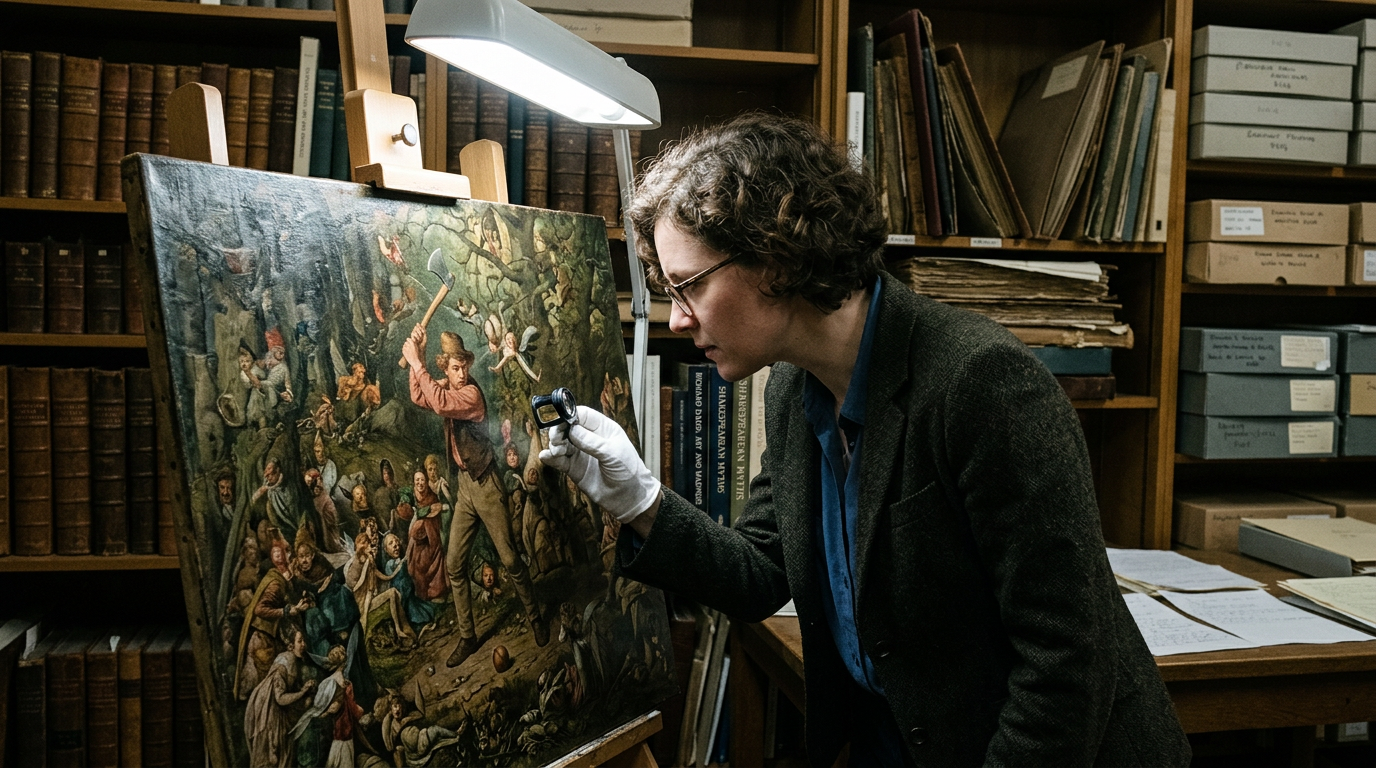

Written at Faulkenmire, in the long gallery, with a magnifying glass and a reproduction no larger than a ledger page, the light failing early.
The painting is small. That is the first thing no one tells you. The Fairy Feller’s Master-Stroke measures roughly twenty-one inches by fifteen, and I have spent three evenings inside it with a lens, and I have not reached the bottom of it.
Its painter was Richard Dadd, born at Chatham in Kent on 1 August 1817, the son of a chemist. He entered the Royal Academy Schools in 1837 and fell in with a circle of young painters who called themselves The Clique. By his early twenties he was known for fairy subjects drawn from Shakespeare, among them Titania Sleeping and Come unto These Yellow Sands. He was talented, well liked, and expected to go far.
In July 1842 he went abroad as draughtsman to Sir Thomas Phillips, a former mayor of Newport, on a tour through Europe, Greece, Turkey, Syria, Palestine and Egypt. Somewhere on that journey his mind began to change. He grew suspicious and violent in thought, and he came to believe he was receiving messages from the Egyptian god Osiris. He returned to England in the spring of 1843 visibly unwell.
On 28 August 1843, at Cobham Park in Kent, he killed his father, Robert Dadd, convinced that the man beside him was the Devil in disguise, or a demon that had taken his father’s place. He fled to France, where he attacked a fellow traveller with a razor before he was seized. He was brought home and committed in 1844 to the criminal wing of Bethlem Hospital in Lambeth. In 1864 he was moved to the new asylum at Broadmoor. He died there on 7 January 1886, having spent more than forty years confined. Read today, his symptoms sound most like schizophrenia, though a diagnosis across two centuries is a guess, careful reader, not a finding.
What the asylums did not take from him was the brush. His physicians allowed and even encouraged him to paint, and in Bethlem the steward, George Henry Haydon, asked him for a fairy picture. Dadd began it in 1855. On the back he wrote that it was painted for Haydon “quasi 1855–64,” a “sort of” nine years. He still considered it unfinished when he left for Broadmoor; the lower left corner is only sketched.
Here is what the lens shows. In a clearing seen from the height of a beetle, through a lattice of grass stalks and daisies, a crowd of tiny figures waits. At the center a fairy woodsman, the feller, stands with his axe raised over a hazelnut. A white-bearded patriarch in a tall gold crown lifts a hand, about to signal him to strike. Around them stand soldiers, peasants, winged fairies, a crane fly blowing a trumpet, and above, Oberon and Titania. Everyone is watching the nut. The blow has not fallen. In nine years of painting, Dadd never let it fall.
The mythology behind it is older and more specific than most viewers realise. Dadd’s starting point was Mercutio’s speech in Romeo and Juliet, in which Queen Mab rides in a chariot that is “an empty hazelnut, made by the joiner squirrel or old grub.” The feller, then, is a fairy carpenter, splitting the nut to build a new carriage for the queen of the fairies. The hazel itself carries a long freight in British and Irish lore, as a wood of fairies, divining rods and wisdom; in Irish tradition the nuts of the hazels around a sacred well fed the salmon of knowledge. Whether Dadd intended all that, I cannot prove. He knew his Shakespeare, and he knew his fairies.

In 1865, at Broadmoor, he wrote a long poem titled “Elimination of a Picture & its Subject — called The Feller’s Master Stroke,” giving the figures names and purposes, many drawn from English folklore and nursery rhyme. The row of figures across the top, for instance, can be read as “soldier, sailor, tinker, tailor.” The poem explains a great deal and, in the end, very little.
And so the interpretations multiply. The most persistent reads the canvas as the crime, refracted: a patriarch commanding a blow, an axe raised over a seed, a moment of violence suspended forever. Some see in a small figure at the upper right a likeness of his murdered father, a chemist, holding a mortar and pestle. The writer Adam Roberts calls the whole picture an allegory of parricide. Others, including the historian Nicholas Tromans, warn against reading it as autobiography at all, and see instead a study in deferral and isolation: groups of figures who never quite meet, a seed that is never split. The grass stalks have been read as the bars of a cell. I set down each reading as a reading, not a fact.
What is fact is what happened to the picture. It passed from Haydon to the collector Alfred Morrison, and through his family to the poet Siegfried Sassoon. In 1963 Sassoon withdrew it from auction and gave it to the Tate, in memory of his friend and fellow officer Julian Dadd, a great-nephew of the artist, and of Julian’s two brothers, who died in the First World War. It hangs in Tate Britain now. In 1974 Freddie Mercury, who had stood before it, used words from Dadd’s poem for a song by Queen that carries the painting’s name.
I put the lens down near midnight. I have looked at a great many images of violence in this house. This is the only one I know of in which the violence is withheld, held up in the air for nine years by a man who had already struck once, and could not bring himself to paint the second blow.
— A.U., Faulkenmire


CATALOGUE REFERENCES
Field Study No. XX — The Clay and the Cage: Rodin and Camille Claudel
FURTHER STUDIES
Allderidge, P. (1974). The late Richard Dadd, 1817–1886. Tate Gallery.
Martineau, J. (Ed.). (1997). Victorian fairy painting. Merrell Holberton.
Tromans, N. (2011). Richard Dadd: The artist and the asylum. Tate Publishing.
Editions and dates should be verified against a library catalogue.
UNCATALOGUED
A visitors’ ledger from the old Bethlem at Moorfields, where Londoners once paid at the door to look upon the confined.
—
This entry is preserved within the haunted archive of Wicked Dual, where a fairy axe has hung above a hazelnut for nine years and will hang there still.
Read the written chronicles on the blog, the Wicked Archive: www.wickeddualblog.com
Secure the physical artifacts drawn from these histories at the Wicked Dual boutique: https://www.etsy.com/shop/Wickeddual
We invite you to enter the haunted archive and secure a piece for your private collection; it is a necessary addition for those who curate the darker corners of human history.
Leave a Reply