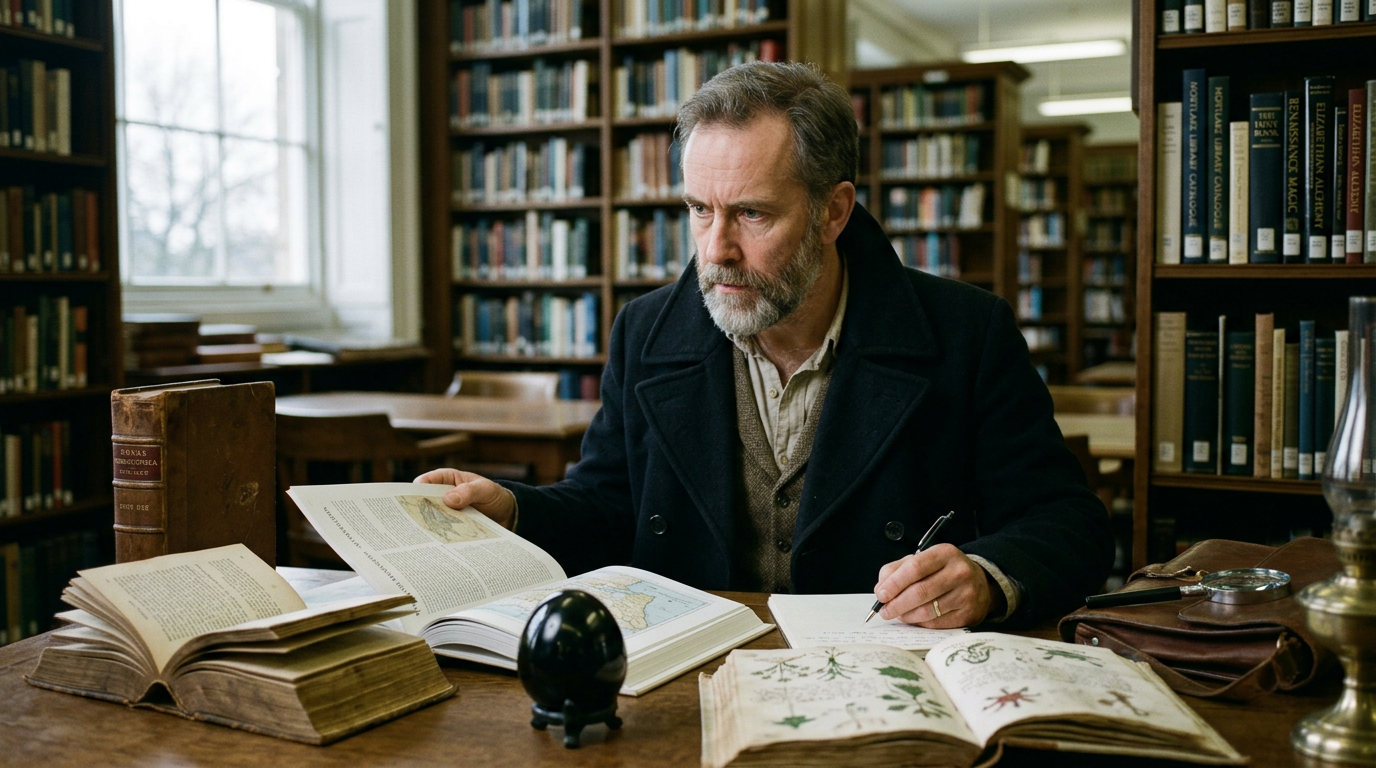

Written in the map room, the empty Mortlake box on the table before me, rain against the river side of the house.
The box labeled “Mortlake” is still empty. I have decided to fill it with what I can prove.
John Dee was born on 13 July 1527 in Tower Ward, London, the son of a Welsh-descended mercer at the court of Henry VIII. He went up to St John’s College, Cambridge, in November 1542, at fifteen, and in 1546 became one of the original fellows of the new Trinity College. In 1548 he crossed to Louvain to study under the mathematician and cartographer Gemma Frisius. He came home one of the most learned men in England.
His learning nearly killed him. In 1555, under Mary I, he was arrested for “calculating and conjuring”: he had cast horoscopes for the queen and for her half-sister, Princess Elizabeth. The charge was raised to treason. He was cleared in the Star Chamber, then handed to Bishop Bonner for examination of his religion. He survived that too.
When Elizabeth took the throne, Dee chose the date of her coronation by the stars. For the next three decades he was her consultant on navigation, geography and the shape of an English claim to the seas. He is often credited with coining the phrase “British Empire,” though Humphrey Llwyd had used it in 1568. He wrote the Monas Hieroglyphica (1564), a single mystical symbol meant to contain the cosmos, and the “Mathematical Preface” to the first English translation of Euclid (1570), still admired as a defense of mathematics.
At Mortlake, on the Thames west of London, he built the house that gives my box its name, and in it one of the largest libraries in England. He catalogued it himself in 1583, before he left for the Continent; the figure usually given is some 3,000 printed books and 1,000 manuscripts (approximate). In 1578 he married Jane Fromond; she was twenty-three, he fifty-one. They would have eight children.
In September 1583 Dee, his family and his scryer Edward Kelley left with the Polish nobleman Albert Łaski for Poland and Bohemia. They had audiences with the Emperor Rudolf II at Prague Castle and with King Stephen Báthory of Poland, and lived for a time under the protection of the Rožmberk family at Třeboň. When Dee returned to Mortlake in 1589, Kelley stayed on as Rudolf’s alchemist. Dee came home to find the house vandalised and the library plundered.
The last years are the saddest pages in the box. In 1595 Elizabeth made him warden of Christ’s College, Manchester, a post he found miserable. Jane died of plague in Manchester in 1604. He went back to Mortlake, poor, selling his books to eat, cared for by his daughter Katherine. He died there in December 1608 or March 1609, aged eighty-one. No one knows where his grave lies.
To understand Dee, careful reader, I have had to set aside the word “occultist” and take him at his own estimate. He was a devout Christian. He was also steeped in the Hermetic, Platonic and Pythagorean philosophy of the Renaissance, which held that number, geometry and the stars were the grammar in which God had written creation. For Dee there was no wall between mathematics and the divine. To measure the world was to read it.
His largest hope was a healed Christendom: a single, universal religion that would close the wound between Catholic and Protestant by returning to what he believed was the pure, original theology of the ancients. Books alone had carried him as far as they could. By the early 1580s he believed only heaven could take him further.
So he sought the angels. He could not see them himself; he needed a scryer, someone to gaze into a polished stone or mirror and report what appeared. In 1582 he met the man who would fill that role, Edward Kelley, a figure of doubtful past who had, by tradition, lost his ears for forgery. For roughly seven years Kelley gazed and Dee wrote. The records of these sessions survive, among them the Five Books of Mystery (covering roughly 1581 to 1583). Through Kelley, the angels dictated whole books in a language of their own, which later readers named Enochian, believed by Dee to be the tongue of Adam before the Fall. A black obsidian mirror long associated with Dee, Aztec in origin, is now in the British Museum.
Whether Kelley believed in the voices, invented them, or something between, no one can now say. What is certain is how it ended. In 1587, in Bohemia, Kelley reported that the angel Uriel had commanded the two men to share their wives. Dee was in anguish; the surviving records suggest the pact was carried out, and soon afterward he broke off the conferences. A son, Theodore, was born on 28 February 1588. Within a year Dee was on his way home, and he never again had such a partner.
I do not record this to mock him. Dee spent his fortune and his reputation on the conviction that God would speak to a man who asked humbly enough. It is the oldest wish in this house’s stacks, and it rarely ends well.
I came to this question hoping the answer would be yes. It is, on the evidence, almost certainly no. Dee’s name is attached to the Voynich manuscript because one twentieth-century bookseller needed a story, and the story was too good to let go.
The manuscript itself, now Beinecke MS 408 at Yale, has a firmer history than its legend. Radiocarbon testing of its vellum at the University of Arizona in 2009 dated the skins to roughly 1404 to 1438 (approximate). The first owner who can be named with certainty is Jacobus Horčický de Tepenec, Rudolf II’s physician and chemist, whose name appears on the first folio in its ennobled form, so the inscription was written after 1608. The book later passed to Georgius Barschius in Prague, then to Johannes Marcus Marci, who sent it to the Jesuit scholar Athanasius Kircher in Rome in the 1660s. Wilfrid Voynich bought it from the Jesuit college at Frascati in 1912.
The Dee link rests on one letter and three threads.
The letter is Marci’s, sent with the manuscript in 1665 or 1666. It reports a rumor that Rudolf II had paid 600 ducats for the book and believed its author to be Roger Bacon. Marci himself added that on this point he “suspended judgment.” Dee does not appear in it at all.
The threads were Voynich’s. First, Dee’s diary for 17 October 1586 records a sum of 800 florins, about 630 ducats; Voynich read this as Rudolf’s payment for the manuscript. But Dee had already been banished from Prague by then, and the entry concerns money involving the Italian Francesco Pucci, not the emperor. Second, the folio numbers were said to be in Dee’s hand; closer study of the numerals, his figure eight above all, does not support it. Third, Dee’s son Arthur, years later, remembered seeing in Prague a book “containing nothing but hieroglyphics”; this is more likely one of Dee’s own angelic books, which he says he burned. Voynich first put Dee’s name forward in a 1919 letter and published the theory in 1921. Specialists today largely reject it, and the Beinecke says research has cast serious doubt on it.
So the honest entry reads this way. Dee was in Prague, he met Rudolf, he owned strange books and would have prized this one. There is no evidence he ever touched it. The Roger Bacon attribution, which drew Voynich to Dee in the first place, is itself, in the Beinecke’s words, “pure speculation.”
I put nothing about the Voynich into the Mortlake box. It stays a little emptier, and a little more honest.
— A.U., Faulkenmire
CATALOGUE REFERENCES
Field Study No. XXI — The Book That Cannot Be Read: The Voynich Manuscript
Field Study No. XXIX — A Great Reckoning in a Little Room: Christopher Marlowe
FURTHER STUDIES
Clemens, R. (Ed.). (2016). The Voynich manuscript. Yale University Press.
Clulee, N. H. (1988). John Dee’s natural philosophy: Between science and religion. Routledge.
Parry, G. (2011). The arch-conjuror of England: John Dee. Yale University Press.
Editions and dates should be verified against a library catalogue.
UNCATALOGUED
In Prague, after Dee went home, the scryer stayed behind to make gold for an emperor, and an emperor is not a patient man.
—
This entry is preserved within the haunted archive of Wicked Dual, where the magus’s empty box waits beside the book that was never his.
Read the written chronicles on the blog, the Wicked Archive: www.wickeddualblog.com
Secure the physical artifacts drawn from these histories at the Wicked Dual boutique: https://www.etsy.com/shop/Wickeddual
We invite you to enter the haunted archive and secure a piece for your private collection; it is a necessary addition for those who curate the darker corners of human history.


Leave a Reply