
The Journal of the Archivist of the Unseen
Written at Faulkenmire, in the front house, on the night after the autumn sweeping, with the door shut and the lamp turned low.
Every autumn, before the river fog settles in for the winter, I sweep the front house. It is the only cleaning Faulkenmire permits me; the deeper wings keep their own dust. This year I set aside a box of things I meant to be rid of: a cracked lacquer bowl from the Tidewater wing, an umbrella with three broken ribs, a lantern from the hemlock wing whose paper had split, a single worn sandal that belongs to no one, and a tea kettle with a hole rusted through its base. I left the box by the front door for the ferryman. I did not think of it again until a little after midnight, when I heard it move.
I want to set down the facts before I set down what I saw, as I always try to, careful reader. The Japanese phrase hyakki yagō, or hyakki yakō, means the night procession of a hundred demons. The hundred is a figure of speech, meaning a great many; the demons are oni and the larger family of uncanny beings that Japanese folklore calls yōkai. The idea is old. Tales of a nocturnal procession of spirits through the streets of the capital appear in the setsuwa, the story collections of the late Heian and Kamakura periods: the Konjaku Monogatari-shū, the Ōkagami, the Uji Shūi Monogatari, and others. To meet the parade was to risk death or worse.

The old tales are mostly tales of narrow escapes. In one story in the Konjaku, a young nobleman out at night meets the procession, and the demons turn and flee because his nurse had sewn a Buddhist spell, the Sonshō Darani, into his clothing. In another, the boy who would become the great diviner Abe no Seimei is riding behind his teacher, Kamo no Tadayuki, when he sees demons approaching and wakes him in time for them both to hide. In the Uji Shūi, a traveling monk sleeping in an abandoned temple is surrounded by a hundred strange beings; one of them, finding the monk in his usual seat, carries him outside, and when dawn comes he finds himself on the far side of Japan. The medieval encyclopedia Shūgaishō lists the nights of the year on which the parade was thought to walk, reckoned by month and by the zodiac sign of the day, and advises that on those nights the prudent stay indoors or recite a protective verse.
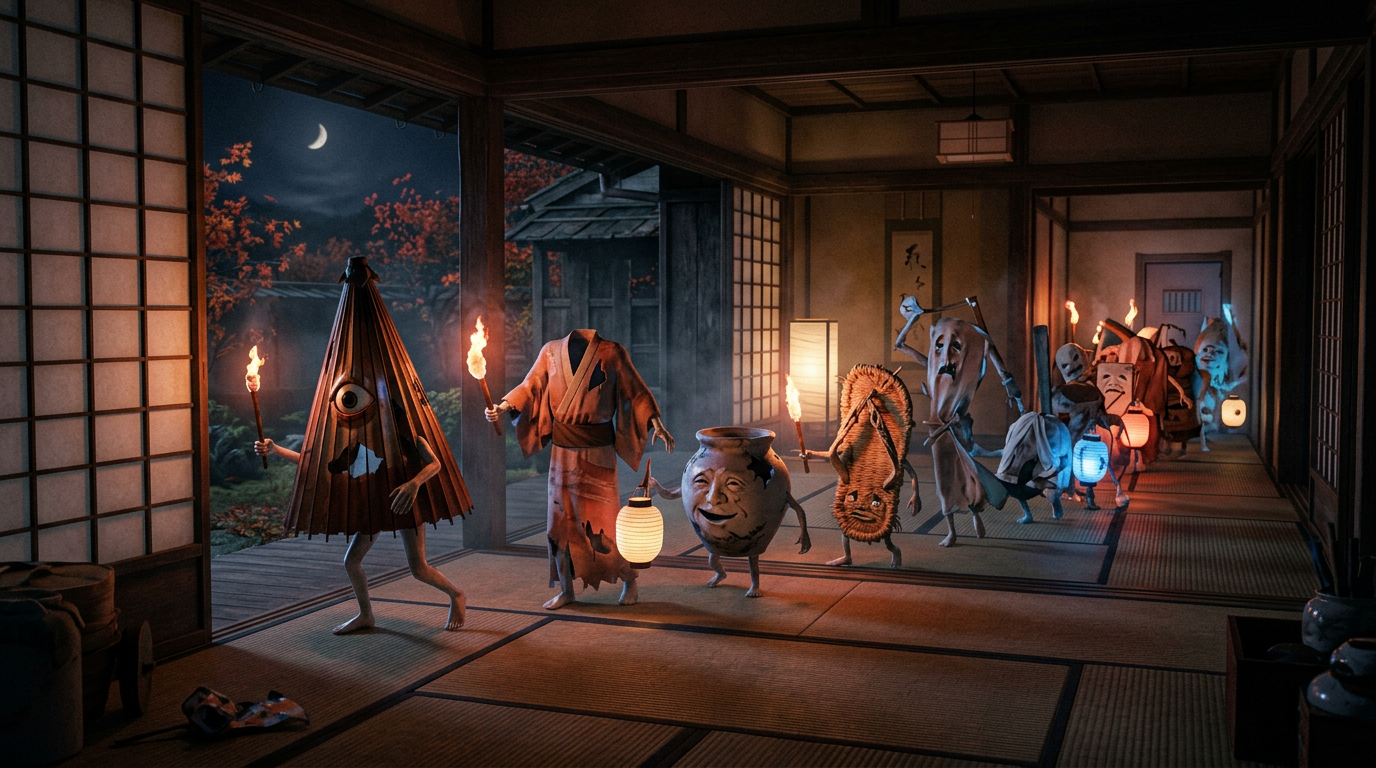
What the parade looked like came later, and it came in pictures. The best known is a handscroll held at Shinju-an, a subtemple of Daitoku-ji in Kyoto, painted in the sixteenth century. It was long attributed to the court painter Tosa Mitsunobu; scholars no longer accept that attribution with confidence, and I file it as traditional. The scroll is a riot. Many of its marchers are not horned oni at all but household things grown legs and faces: pots, ladles, umbrellas, sandals, a lute, a robe walking without a body. At the end, a great fiery disk breaks the parade apart and sends its members scattering. Some read the disk as the rising sun; others as the light of a sacred spell. The painter, characteristically, does not say.
Those walking objects have a name and a story of their own. They are tsukumogami, the spirits of old things, and a Muromachi-period tale called the Tsukumogami-ki explains them. Tools and vessels, it says, gain a spirit after a hundred years of use. Households in old Kyoto threw out worn things at the year-end cleaning, the susuharai or soot sweeping, and in the tale a heap of discarded objects, cast out just short of their hundredth year, wakes resentful at its treatment, takes monstrous shapes, and turns on the people who threw it away. The story ends with the objects turning to Buddhist practice. Whatever its date and origin, the lesson in it is plain: a thing that has served you for a lifetime is not nothing, and should not be thrown away as if it were.
I did not open my door. I am not a fool, and the Shūgaishō is clear. But the front house has an old keyhole, and I am an archivist. Through it I watched them pass in the lamp-dark of the hall: the lacquer bowl rolling on its rim, the umbrella hopping on its one remaining leg, the lantern lit from inside by nothing at all, the sandal slapping along at the back. They were not alone. Behind them came things I had never set aside, things from every wing of the house: a jar from the Jar Room with its label half peeled, a Tidewater ledger walking on its spine, a pair of spectacles, a sewing basket, a child’s chair. They went down the hall toward the river door in no hurry at all, and the whole procession smelled of camphor and old leather, which is the smell of the Keeper. I counted to a hundred and lost track.
I will tell you what frightened me, and it was not the walking bowl. It was that I had nearly broken the oldest rule of this house. Nothing leaves Faulkenmire unless something of equal weight is left in its place. I had put five things out by the door as though they weighed nothing, and the house had taken offense on their behalf. The parade did not go out the river door. It turned at the end of the hall and went back up the stairs, into the wings, and I heard doors closing one by one until the house was still.
In the morning, the box by the front door was empty. The bowl was on its shelf in the Tidewater wing; the lantern hung in the hemlock wing with its paper whole again; the umbrella stood in the stand with its ribs straight. In the bottom of the empty box lay a receipt the color of weak tea, written in the Keeper’s hand: Kept, not thrown. Nothing further is owed.
A word, before I close, on the living tradition. Yōkai are not a dead mythology. They are woven through Japanese art, festivals, and popular culture today, and a shopping street along Ichijō in Kyoto, said in local tradition to lie on the parade’s old route, has hosted yōkai processions of its own in recent years. The kindness to old things at the heart of the tsukumogami tales lives on, too, in memorial rites for worn-out objects, such as the hari-kuyō, at which broken sewing needles are laid to rest in soft tofu or konnyaku and thanked for their service. I have no wish to make a horror of any of it. The night parade is frightening, but it is also funny, and tender, and, I think, just.
I have put the box away. Next autumn I will sweep, as I always do. But the broken things will stay where they are.
— A.U., Faulkenmire


Catalogue References
Field Study No. XXXV — The Builders of a Single Night: The Menehune of Hawaiʻi
Field Study No. XL — The Black Horse of November: The Púca of Ireland
Further Studies
Editions and reprints vary; verify details against a library catalog.
Uncatalogued

In 1889 the painter Kawanabe Kyōsai, who called himself a demon of painting, died, and the next year his own night parade was published in woodblock, ending at dawn with a one-eyed priest, a kappa, and a Buddha whose eyes hang loose. I have begun to look for a copy.
This entry is preserved within the haunted archive of Wicked Dual, among the private papers of the Archivist of the Unseen.
Read the written chronicles on the blog, the Wicked Archive: www.wickeddualblog.com
Secure the physical artifacts drawn from these histories at the Wicked Dual boutique: https://www.etsy.com/shop/Wickeddual
We invite you to enter the haunted archive and secure a piece for your private collection; it is a necessary addition for those who curate the darker corners of human history.
— The Archivist of the Unseen
Leave a Reply