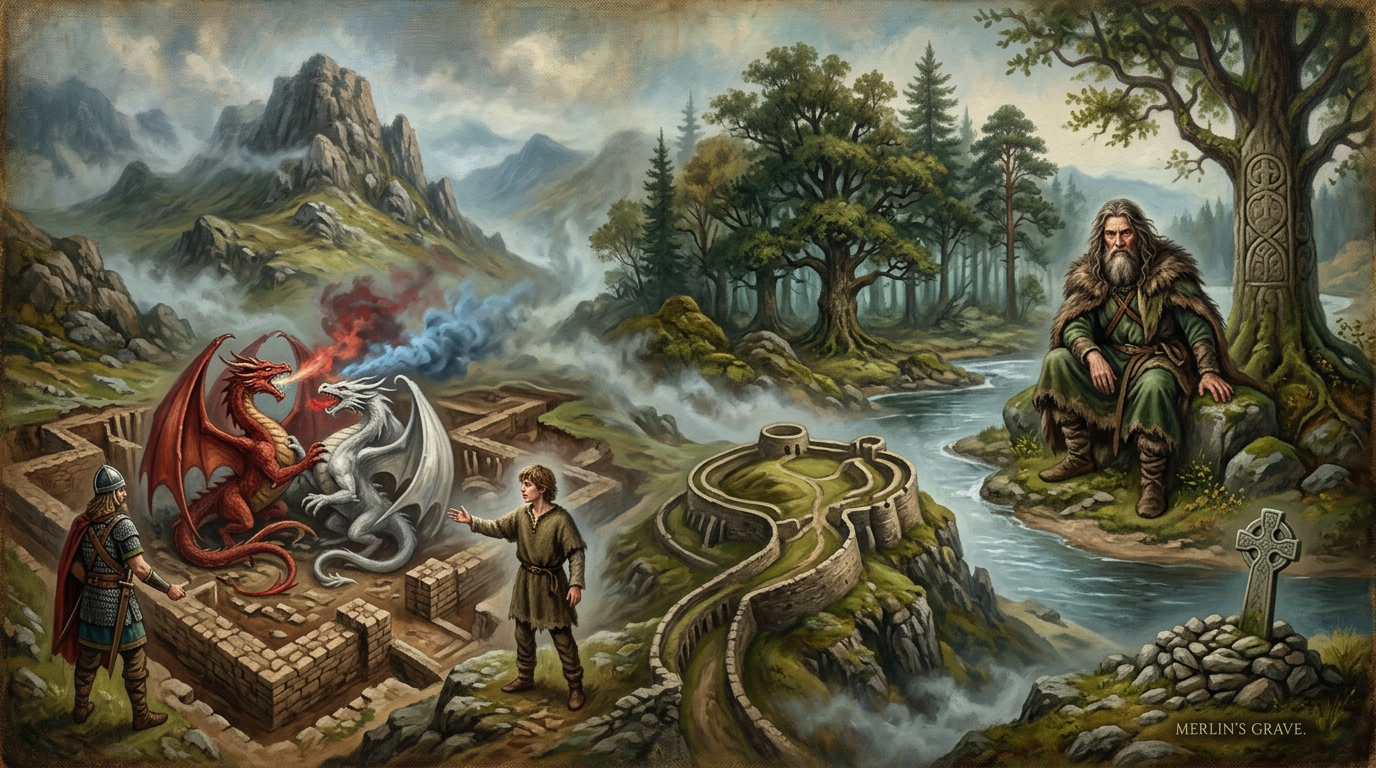

There is a particular quality to the light in the borderlands of Wales and the old North—a silvered, uncertain illumination that seems to belong to neither day nor dusk. It is in precisely this liminal light that the figure of Merlin must be sought, for he was never a man of the noonday sun. He belongs to the threshold, to the moment between the pagan world’s dying and the Christian world’s ascendance, to the fault line where recorded history fractures into legend. To pursue the historical Merlin is to walk into that half-light knowingly, aware that one will emerge not with a portrait but with a palimpsest—layer upon layer of invention, each generation writing its anxieties and its hungers over the faint script of what came before.
The discerning student of forgotten things will understand from the outset that this is not a search for a single man. It is an excavation of a cultural phenomenon, a chronicle of how a name accrued meaning across a thousand years, how disparate figures collapsed into a single silhouette, and how the medieval imagination manufactured a prophet to answer its own melancholy longing for a vanished sovereignty. What follows is a field study of that manufacture: the raw ore of history, the alchemy of legend, and the enduring vestige that persists into the present hour.
I. The Problem of the Sixth Century
To understand Merlin, one must first understand the darkness from which he emerged—and here the word darkness is no mere rhetorical flourish. The period in which the historical figures underlying Merlin are said to have lived, roughly the late fifth through the sixth centuries of the common era, constitutes one of the most poorly documented epochs in the history of the British Isles. The Roman administrative apparatus had withdrawn from Britain by approximately 410, and with it departed the institutional machinery of literacy, taxation, and record-keeping that had, for nearly four centuries, imposed a legible order upon the island. What followed was not a sudden collapse but a slow unraveling, a gradual fading of the written word into an oral twilight from which only fragments would survive.
This is the fundamental predicament that haunts every honest inquiry into Merlin’s origins. The century in which his prototypes lived produced almost no contemporary written testimony. The archaeological record speaks of abandoned villas, of the decay of urban centers, of the arrival of Germanic material culture along the eastern and southern coasts. Yet stone and pottery cannot record a name, cannot preserve a prophecy, cannot testify to the existence of a wild seer wandering the northern forests in a state of visionary madness. The men who may have inspired the legend of Merlin lived precisely in the interval when Britain went silent, and it is from that silence that the legend would later be summoned.
The one substantial voice that reaches us from near this period belongs to a British cleric named Gildas, whose treatise De Excidio et Conquestu Britanniae, composed in the mid-sixth century, delivers a scathing jeremiad against the moral failings of the British rulers of his day. Gildas is a moralist rather than a historian, and his account is maddeningly vague on names and dates. He mentions no Merlin, no Arthur by name, though he does reference a British victory at a place called Mons Badonicus, a battle that would later become entangled with the Arthurian mythos. The absence of Merlin from Gildas is instructive: the seer we seek did not yet exist as a discrete figure in the surviving consciousness of the sixth century. He would later have to be assembled from scattered materials.
II. Myrddin of the Woods: The Northern Wild Man
The earliest identifiable stratum of the Merlin tradition does not concern a courtly advisor to kings at all. It concerns a broken man in a forest.
In the Welsh poetic tradition, preserved in manuscripts of considerably later date but drawing upon materials of significant antiquity, there survives a cluster of poems associated with a figure called Myrddin. These compositions—among them the poems known as Yr Afallennau (“The Apple Trees”) and Yr Oianau (“The Greetings”)—present a figure utterly unlike the sagacious enchanter of later romance. This Myrddin is a gwyllt, a wild man, driven to madness by the horror of battle and dwelling in the Caledonian Forest of the old North, that region encompassing what is now southern Scotland and the northern reaches of England.
The narrative embedded in these poems is one of profound trauma and desolation. Myrddin, according to the tradition, fought at a battle called Arfderydd—generally identified with Arthuret, near Carlisle, and tentatively dated to the year 573 by the Welsh Annals. In the carnage of this conflict, he witnessed the death of his lord, and possibly of his own kin, and the shock of it shattered his reason. He fled into the wilderness, where he lived among the beasts, endured the bitterness of winter beneath the apple trees, conversed with a piglet as his only companion, and acquired, through his very affliction, the terrible gift of prophecy.
Here the discerning antiquarian encounters one of the most resonant motifs in the entire tradition: the intimate marriage of madness and vision. The wild man of the woods is not merely pitiable; he is dangerous, sacred, set apart. His exile from human society has purchased him a knowledge that ordinary men cannot bear. This pattern has deep roots in the folklore of northern Europe and beyond—the seer whose sight is the wound left by his suffering, the prophet whose gift is inseparable from his ruin. The melancholy of the Myrddin poems is not incidental atmosphere; it is the very substance of the figure. He is a man who has seen too much, and the seeing has undone him.
Crucially, this northern wild man was almost certainly not originally called Merlin at all, and the transformation of his name into the form we recognize is itself a chronicle of scholarly and literary intervention that will be examined in due course. What matters here is recognizing that beneath the enchanter of the round table lies a far older and stranger figure: a traumatized survivor of a forgotten battle, weeping among the apple trees, speaking prophecies to the wind.
III. The Twin from the Wild: Lailoken and the Wider Pattern
The wild-man-seer of the north was not the exclusive property of the Welsh tradition. A remarkably similar figure appears in the hagiographical materials surrounding Saint Kentigern, also known as Mungo, the patron saint of Glasgow. In these Scottish sources, preserved in Latin, there wanders a madman named Lailoken, a naked and lamenting creature of the wilderness who has been driven to insanity by a vision witnessed during a battle, and who prophesies his own peculiar threefold death.
The parallels between Lailoken and Myrddin are too numerous and too precise to be dismissed as coincidence. Both are wild men of the northern forests; both were driven mad by the trauma of a specific battle associated with the region of the Solway; both possess the gift of prophecy; both are haunted by their visions and estranged from the community of ordinary men. Scholars of the tradition have long recognized that Lailoken and Myrddin are, in all likelihood, regional variants of a single underlying figure or figure-type—the homo sylvestris, the man of the woods, whose madness is the price and the proof of his sight.
The motif of the threefold death that attaches to Lailoken deserves particular attention from the collector of dark narratives, for it recurs throughout the Celtic imaginative world with an almost ritualistic insistence. The prophet foresees that he will die simultaneously by three incompatible means—by falling, by drowning, by piercing, in various combinations—a death so improbable that it seems a mockery, and yet one that comes to pass through a grotesque convergence of circumstance. This triple death carries the residue of ancient sacrificial practice, the echo of a religious world in which the victim was offered to multiple deities through multiple methods, and its presence in the Merlin tradition marks the figure as a survival from a pre-Christian sacred order only imperfectly overwritten by the new faith.
What emerges from a careful comparison of these northern sources is a picture of Merlin’s true origin that is far removed from the towers and tournaments of later romance. The seer began as a shamanic figure, a wounded prophet of the old North, whose story circulated in variant forms across the Brittonic-speaking peoples of the region, attaching itself now to one name and now to another, before it would be gathered up and transformed by a single ambitious cleric into the founder of a national myth.
IV. Geoffrey of Monmouth: The Architect of the Legend
Every chronicle has its author, and the chronicle of Merlin as the world came to know him has one above all others: Geoffrey of Monmouth, a cleric of Welsh or Breton extraction working in Oxford in the first half of the twelfth century. It is scarcely an exaggeration to say that Merlin, as a figure of European literature and imagination, was born in Geoffrey’s inkwell around the year 1130.
Geoffrey’s principal work, the Historia Regum Britanniae (“The History of the Kings of Britain”), completed around 1138, purports to be a sober account of the British monarchy from its legendary Trojan founder down to the coming of the Saxons. It is, in truth, a masterwork of imaginative fabrication dressed in the robes of scholarship, and it would prove to be one of the most influential books of the entire medieval period. Within its pages, Geoffrey installed the figure he called Merlinus at the very heart of the British national story, and in doing so he fused several distinct traditions into a single, enduring character.
Geoffrey carefully constructed the name. The Welsh Myrddin, had it been rendered directly into Latin, would have yielded a form uncomfortably close to a vulgar term in French, the language of Geoffrey’s Norman patrons. To avoid this indelicacy, Geoffrey altered the terminal consonant, producing Merlinus—and thus the seer of the apple trees acquired the name by which he would be known for all the centuries to follow. It is a detail at once faintly comic and deeply revealing: the character’s entire subsequent history rests on a euphemistic emendation, a small act of linguistic delicacy that betrays the artificiality of the whole construction.
Yet Geoffrey did more than merely rename the northern wild man. He introduced Merlin first in a separate work, the Prophetiae Merlini (“The Prophecies of Merlin”), which he later incorporated into the Historia. In this text, Merlin delivers a series of dense, symbolic prophecies—of red and white dragons locked in battle beneath the earth, of boars and lions and eagles, of Britain’s fortunes rendered in a bestiary of veiled political allegory. These prophecies proved enormously popular and were read, interpreted, and reinterpreted for centuries as though they contained genuine foreknowledge of coming events, a testament to the medieval hunger for hidden meaning and prophetic reassurance.
In the Historia itself, Geoffrey wove Merlin into the reigns of the British kings. He appears as a fatherless boy of prophetic power, summoned before the tyrant Vortigern, whose tower will not stand because it is built above a hidden pool in which two dragons sleep. Merlin reveals the dragons and interprets their struggle. Later, Merlin employs his arts to transport the great stones of Stonehenge from Ireland to Salisbury Plain—an aetiological myth accounting for the monument’s inexplicable grandeur—and he orchestrates, through magical transformation, the union of Uther Pendragon and Igerna that will produce the great king Arthur.
Thus the wild man of the woods was transfigured into the kingmaker, the architect of dynasty, the prophet who stands at the cradle of the nation’s greatest hero. Geoffrey had taken the wounded seer of the north and given him a new role entirely: not the victim of history but its secret author.
V. The Boy Without a Father: Ambrosius and the Merging of Traditions
The scene of the fatherless boy and the tower of Vortigern, which Geoffrey renders so vividly, was not entirely his own invention. Here the diligent researcher must turn to an earlier source, the Historia Brittonum, a compilation traditionally attributed to a Welsh monk named Nennius and dating to the early ninth century, some three centuries before Geoffrey took up his pen.
In the Historia Brittonum, an episode strikingly similar to Geoffrey’s account appears. The tyrant Vortigern seeks to build a fortress, but the structure repeatedly collapses. His counselors advise that the foundations must be sprinkled with the blood of a boy born without a father. Such a boy is duly located—but rather than submitting to sacrifice, he confounds the king’s advisors by revealing the true cause of the tower’s instability: the hidden pool and the two contending dragons, red and white, symbolizing the British and the Saxons. In this earlier version, however, the boy is not called Merlin. He is called Ambrosius—in Welsh, Emrys—and he is associated with the historical figure of Ambrosius Aurelianus, a Romano-British war leader mentioned by Gildas as a champion of the Britons against the Saxon incursion.
The significance of this cannot be overstated. Geoffrey of Monmouth, in constructing his Merlin, deliberately grafted the prophetic tower-episode of Ambrosius onto the persona of the northern wild man Myrddin. He created, in effect, a composite figure, welding together two entirely separate traditions: the shamanic seer of the Caledonian forest and the fatherless prophet-boy of the Vortigern legend. To acknowledge the seam in his own creation, Geoffrey even bestowed upon his character the double name Merlinus Ambrosius, a scar left visible upon the surface of the invention, betraying the two bodies from which the single figure had been assembled.
This act of literary fusion is the central mechanism by which the legend of Merlin came into being. The seer we recognize is not the survival of any single historical individual but a deliberate amalgamation, a creature stitched together from the folklore of the north, the pseudo-history of the Welsh chronicles, and the political and artistic ambitions of a twelfth-century cleric. The collector of historical curiosities may find in this a lesson of considerable weight: that some of the most enduring figures of the Western imagination are not discoveries but constructions, assembled deliberately to serve the needs of the moment and then set loose to acquire a life of their own.
VI. The Vita Merlini: Geoffrey’s Return to the Wild
Some years after completing the Historia, Geoffrey of Monmouth returned to his creation in a curious and revealing manner. Around 1150 he composed a Latin poem, the Vita Merlini (“The Life of Merlin”), which presents a version of the seer markedly different from the kingmaker of the earlier work—and markedly closer to the original northern tradition of the wild man.
In the Vita Merlini, Merlin is a king of the Britons who, upon witnessing the slaughter of his companions in battle, is overcome by grief and madness and flees into the Caledonian Forest. There he lives as a wild man, lamenting, prophesying, observing the stars, and enduring the seasons in isolation. The poem is suffused with a profound melancholy, an elegiac sorrow for the transience of human fortune and the ruin that war visits upon the mind. It draws directly upon the Welsh Myrddin material, restoring to the figure the trauma and the wildness that the Historia had largely suppressed in favor of political prophecy and dynastic machination.
The existence of these two contradictory portraits from the same author illuminates the fundamental instability at the heart of the Merlin tradition. In the Historia, Merlin is the confident architect of Arthurian destiny; in the Vita, he is the broken seer of the forest, undone by the horror of what he has seen. Geoffrey, it appears, had access to more of the underlying Welsh tradition than he chose to deploy in his historical fiction, and in his later work he permitted the older, wilder, sadder figure to reassert itself. The scholar confronting these two Merlins must conclude that the character was never coherent, never singular, but always a site of competing possibilities—prophet and madman, kingmaker and exile, master of destiny and its victim.
VII. The French Enchanter: Romance and the Making of the Wizard
If Geoffrey of Monmouth gave Merlin his name and his historical scaffolding, it was the French romancers of the late twelfth and early thirteenth centuries who gave him the character that the modern imagination most readily recognizes: the wise and somewhat sinister enchanter, master of shape-shifting and illusion, mentor to kings, and ultimately the victim of his own desire.
The poet Robert de Boron, writing around the turn of the thirteenth century, Christianized and moralized Merlin, giving him an elaborate origin as the intended Antichrist—conceived by a demon upon a virtuous woman as part of an infernal scheme to counter the redemption wrought by Christ. The plot is thwarted by the woman’s piety and the intervention of a confessor, so that the child, though he retains the supernatural knowledge of his demonic paternity, is turned instead toward the service of good. This ingenious theological framing accounts for Merlin’s uncanny powers while safely subordinating them to the Christian order, transforming a pagan shaman into a redeemed instrument of providence.
The vast prose romances of the thirteenth century, particularly the interlinked cycle of texts known as the Vulgate or Lancelot-Grail, further elaborated Merlin’s role. He became the indispensable architect of Arthur’s kingdom: the deviser of the test of the sword in the stone, the founder of the Round Table, the counselor whose foresight guides the realm through its perils. And it was in these romances that the tradition developed the melancholy account of Merlin’s end—his enthrallment by a woman variously called Nimue, Viviane, or the Lady of the Lake, to whom he teaches his own arts, and who uses that very knowledge to imprison him forever within a tower of air, a cave, or a hawthorn tree, depending upon the version.
This final episode carries a dark and instructive irony that the discerning reader will not fail to appreciate. The prophet who could foresee all things foresaw his own imprisonment and yet was powerless to prevent it, undone by desire and by the transmission of his own knowledge to another. The all-knowing seer is defeated not by force but by love, and the master of enchantment becomes the enchanted. It is a fitting terminus for a figure so thoroughly defined by the marriage of power and vulnerability, of vision and its costs.
VIII. Malory and the English Consolidation
The English-speaking world received its definitive Merlin through the labors of Sir Thomas Malory, whose Le Morte d’Arthur, completed around 1470 and printed by William Caxton in 1485, gathered the sprawling French and English Arthurian traditions into a single coherent narrative. Malory, composing his great work reportedly from within a prison cell, drew upon the earlier romances to present Merlin as the wise counselor of the young Arthur, the agent of his conception and coronation, and the prophet whose warnings the king too often failed to heed.
In Malory’s telling, Merlin’s function is largely completed in the early portions of the narrative. He establishes Arthur upon the throne, procures for him the sword Excalibur, warns him of the doom that will come from his incestuous union with his sister, and then departs the story through his fatal infatuation with Nimue, who traps him beneath a great stone. His removal from the narrative is necessary, for the tragedy of Arthur’s fall requires that the king be deprived of his prophetic guardian; the kingdom cannot come to ruin so long as the seer remains to guide it. Thus Merlin’s imprisonment is not merely a personal tragedy but a structural necessity, the removal of the one figure whose foresight might have averted the catastrophe to come.
Through Malory, and through the printing press that preserved and disseminated his work, the figure of Merlin passed into the permanent inheritance of English literature. Every subsequent treatment—the Merlin of Tennyson’s Victorian Idylls of the King, the Merlin of modern fantasy and popular entertainment—descends ultimately from this consolidation, filtered and transformed by the preoccupations of each successive age.
IX. The Regional Ground: Landscape and the Rooting of Legend
A figure such as Merlin does not float free of the earth. He is anchored, in the imaginative geography of Britain, to specific places, and studying these places reveals much about how legend takes root in landscape and how communities lay claim to a share of the mythic past.
The Welsh town of Carmarthen has long asserted a special connection to the seer, its very name understood by folk etymology to derive from Merlin—Caerfyrddin, the fort of Myrddin—though the linguistic reality is that the town’s name predates and gave rise to the association rather than the reverse. For centuries, a particular ancient oak, known as Merlin’s Oak, stood in the town, protected by a local prophecy that held the town would fall should the tree be destroyed. The persistence of such beliefs into the modern era testifies to the tenacity with which legend embeds itself in the physical world and to how a community will defend its claim upon a fragment of the mythic.
Far to the north, the landscape of the old British kingdoms of the Solway region preserves the memory of the wild-man tradition. The forest of Celyddon, the battle-site of Arfderydd, the haunts of Lailoken along the rivers of what is now the Scottish borders—these places tether the earliest and wildest stratum of the Merlin material to a specific and knowable terrain. The atmospheric weight of these northern landscapes, with their long winters and brooding forests, seems to have impressed itself upon the very character of the legend, lending the wild seer his particular quality of desolate isolation.
In the southwest, the county of Cornwall claims its own portion of the Merlin geography, most notably in the sea-cave beneath the cliffs of Tintagel, the castle-site that Geoffrey of Monmouth named as the place of Arthur’s conception. The cave, known as Merlin’s Cave, floods with the tide and empties again, a threshold place between land and sea, fitting for a figure who dwelt always upon the border between worlds. The Victorian imagination, and the tourism it fostered, seized on these associations and elaborated them, showing that the making of the Merlin legend did not cease in the Middle Ages but continued into the modern period, each age adding its own vestige to the accumulated whole.
X. The Anthropology of the Seer
To step back from the particulars of text and place is to perceive in Merlin the outlines of a figure far older than any of his named incarnations: the archetype of the seer, the shaman, the intermediary between the human community and the powers that lie beyond it. The anthropological study of such figures across cultures reveals a consistent pattern into which Merlin fits with remarkable precision.
The seer is characteristically set apart from ordinary society, whether by physical exile, by madness, by some mark of difference, or by an origin that places him outside the normal order of birth—as Merlin is set apart by his fatherlessness or his demonic paternity. The gift of vision is frequently purchased at the price of suffering; the shaman’s initiation is often an experience of dismemberment, death, and rebirth, and the seer’s madness in the wilderness follows this same pattern of destruction preceding illumination. The figure mediates between the living and the dead, between the present and the future, between the mundane world and the sacred, occupying always the threshold, the border, the liminal space.
Merlin, in this light, appears as the British manifestation of a universal human intuition: that true knowledge lies beyond the ordinary, that it must be sought at the margins and paid for in pain, and that those who possess it are both revered and feared, drawn upon in extremity and yet never fully trusted. The wild man of the Caledonian forest, weeping among the apple trees with only a piglet for company, is kin to the ecstatic seers of many traditions, and his transformation into the courtly enchanter of romance did not entirely efface this deeper resonance. Beneath the wizard’s robes there remains always the naked madman of the woods, and beneath the confident prophecies there remains always the terrible cost at which such vision was obtained.
There is, too, the matter of the transition the figure embodies at the level of history. Merlin stands at the hinge between the pagan and the Christian worlds, a repository of the old knowledge who is nonetheless bent, in the later tradition, to the service of the new order. Robert de Boron’s careful Christianization of the seer—demon-fathered yet redeemed—is emblematic of a broader cultural labor by which the pre-Christian sacred was not simply abolished but absorbed, reframed, and set to work within the dominant faith. The figure of Merlin thus preserves, in encrypted form, the memory of a religious world that Christianity displaced, a clandestine survival of the old ways beneath the surface of the new. To study him is to glimpse that submerged inheritance, that reclamation of pagan material by a Christian imagination unable either to embrace it fully or to let it go.
XI. The Question of Historicity Reconsidered
Having traced the assembly of the legend, the honest inquirer must return to the question with which such investigations inevitably conclude: was there, at the root of all this accumulated invention, a real man?
The answer must be given with the precision that the subject demands. There was almost certainly no single individual named Merlin who performed the deeds ascribed to the legendary figure. The Merlin of Geoffrey of Monmouth and the romancers is a literary construction of demonstrable artificiality, assembled from disparate sources in the twelfth century and elaborated thereafter. To search for the man who moved Stonehenge or contrived the conception of Arthur is to search for a phantom that never possessed material existence.
And yet the matter does not end there. Beneath the constructed figure lie the fainter outlines of the northern tradition—the wild man Myrddin, the madman Lailoken—and these traditions may well preserve the memory, however distorted, of a real sixth-century figure or figures: a bard, a seer, a warrior driven mad by the trauma of the battle of Arfderydd, whose story circulated in the oral culture of the old North and attached itself to a name. The battle of Arfderydd itself appears to be a genuine historical event, recorded in the Welsh Annals with a specificity that lends it credibility, and it is not unreasonable to suppose that among its survivors or its casualties was a figure whose reputation for prophecy outlived him and became the seed from which the later legend grew.
The most defensible conclusion, then, is a layered one, appropriate to a figure who is himself constituted of layers. At the deepest level there may lie a historical individual, unknowable in any detail, a traumatized seer of the sixth-century North. Above this lies the folkloric tradition of the wild man, elaborated over centuries of oral transmission. Above this lies Geoffrey of Monmouth’s deliberate literary fusion of the northern seer with the Welsh prophet-boy Ambrosius. And above this lies the vast edifice of romance, poetry, and popular imagination that continues to accumulate to the present day. Merlin is not a man but a sediment, a stratified deposit of a thousand years of human longing, fear, and invention. The archaeology of the figure yields not a body but a sequence of imaginative acts, each preserved within the next like the rings of an ancient tree.
XII. The Enduring Vestige
What, finally, accounts for the extraordinary persistence of this constructed figure? Why does Merlin endure, when so many of the inventions of the medieval imagination have crumbled into obscurity?
The answer lies, perhaps, in the very completeness with which he embodies a set of enduring human preoccupations. He is knowledge and its price; he is power and its limits; he is the intoxicating promise of foresight and the sorrow of a foresight that cannot save. He stands at every threshold that matters—between paganism and Christianity, between history and legend, between the wild and the civilized, between madness and wisdom, between the human and the more-than-human. He is the figure who knows what is coming and cannot prevent it; that is, he is the figure of tragic consciousness itself, the awareness of doom that defines the human condition.
The melancholy that suffuses the oldest layers of his story—the wild man weeping in the winter forest, the prophet imprisoned by his own knowledge and his own desire—has never entirely departed from the figure, even in his most triumphant incarnations. There is always, in Merlin, a shadow of loss, a sense of the transience of all sovereignty and all glory, an intimation that the kingdom he labors to build is destined to fall and that he himself will be removed from the world before its ruin. He is a figure of autumn, of endings foreseen and mourned in advance, and in this he speaks to something permanent in the human experience of time.
To hold the legend of Merlin in the mind is thus to hold a chronicle not of a man but of a civilization’s dreaming—of the way a people, having lost the historical memory of their own dark age, reconstructed from folklore and invention a figure who could stand at the origin of their national story and lend it the weight of prophecy and destiny. He is the ghost that the Middle Ages summoned to haunt the silence of the sixth century, and he haunts us still, precisely because he was never real and therefore can never quite die.
The pursuit of Merlin ends, as it began, in the silvered half-light of the threshold. He recedes as one approaches, dissolving into his constituent layers, revealing himself at last not as a man to be found but as a phenomenon to be understood—a manifestation of the enduring human need to place, at the fault line where history fails, a figure who knows. The vestige he leaves is not a relic but a resonance, and it persists in every object, every text, every fragment that carries forward the memory of the old dark ages and the wild seers who wandered through them.

For the collector who curates the darker corners of human history, the tangible remnants of such legends—the artifacts, the volumes, the objects that carry the atmospheric weight of these forgotten narratives—offer a way of holding a piece of that half-light in one’s own keeping. The physical objects related to the histories chronicled here may be found within the collections of Wicked Dual, at http://www.wickeddualblog.com and through its associated repositories, where each piece is preserved as a fragment of the unseen past.
We invite you to enter the haunted archive and secure a piece for your private collection; it is a necessary addition for those who curate the darker corners of human history.

Barber, R. (2004). The Holy Grail: Imagination and belief. Harvard University Press.
Goodrich, P. H. (Ed.). (2003). Merlin: A casebook. Routledge.
Higham, N. J. (2002). King Arthur: Myth-making and history. Routledge.
Knight, S. (2009). Merlin: Knowledge and power through the ages. Cornell University Press.
Lacy, N. J. (Ed.). (1996). The new Arthurian encyclopedia (Rev. ed.). Garland.
Padel, O. J. (2013). Arthur in medieval Welsh literature. University of Wales Press.
Leave a Reply