The Wicked Dual Archive · Field Study № CXVI · The Unseen

I. Crossing into the Dim
The Archive is open. We invite you, discerning collector, to step across the threshold, where the light is dim, and the air is heavy with the weight of a century’s unanswered questions. We are not here to entertain, but to examine. We observe the modern true-crime obsession as merely the old wearing a different hat—the campfire warning dressed now in the language of the podcast and the streaming serial, the ghost in the machine and the machine in the ghost. It is all connected: the fracture in the foundation of a small mountain town, the way the July light falls green and heavy through a canopy of elm and maple, the quiet hum of a millpond that has kept its secret for well over a hundred years. They tell the same story. We are not here to preach, nor to frighten. We are here to sit with the evidence and trace the patterns.
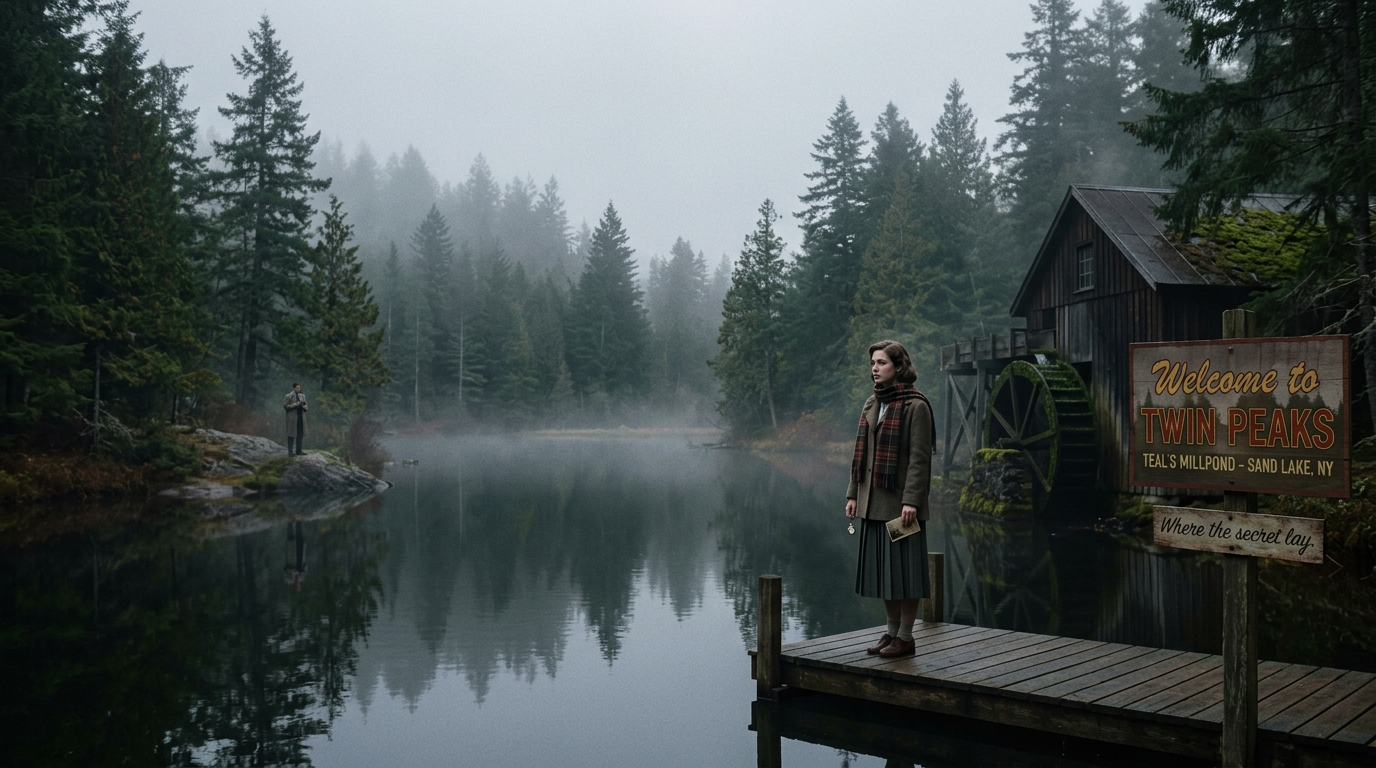
Consider the water first. There is a particular species of dread reserved for still water in wooded places—water that does not rush or announce itself, but merely waits, dark and patient, receiving whatever the land above it chooses to surrender. Teal’s Pond, in the township of Sand Lake in Rensselaer County, New York, was such a place: a manmade impoundment in the folds of Taborton Mountain, ringed by trees, some ten miles east of Albany, where charcoal burners plied their trade and squirrel hunters and bait-fishermen kept the wagon roads faintly worn. It was a working landscape, unglamorous and remote, the kind of terrain that a century of American storytelling has taught us to regard with a shiver.
On the eleventh of July, 1908, a party of boys walking near the pond saw something pale surface in the shallows—a young woman’s body, floating face down, bloated by four days of summer heat, her features so distorted that she could be named only by her clothing and by the gold fillings glinting in her teeth. Her skull had been crushed at the back by a blunt instrument that was never found. Her name, once it was recovered, was Hazel Irene Drew. She was twenty years old.
This is the case we lay upon the table today. It is a case that was covered from coast to coast in the summer of 1908, that filled the columns of The Washington Post and drew the pens of celebrated journalists, and that then—as such things do—slipped beneath the surface of public memory and lay there, undisturbed, for the better part of a century. It is a case that would almost certainly have been forgotten entirely, dissolved into the anonymous silt of unsolved provincial deaths, had a boy not spent his childhood summers on that same mountain, absorbing a ghost story his grandmother told to keep him out of the woods after dark. That boy grew up to be Mark Frost, and the drowned girl of Taborton became, by a long and strange transmission, the seed of Laura Palmer. But we get ahead of the evidence. Let us begin, as any proper study must, with the name itself.
II. The Weight of Names
Before we examine the death, we must examine the words that surround it, for a case such as this survives not as a body but as a vocabulary—a lexicon of place-names, surnames, and period phrases that carry within them the sediment of the world that produced them.
Begin with Taborton, the mountain and the road that climbs it. The name descends from the biblical Mount Tabor, a naming impulse common to the devout settlers of upstate New York, who scattered scripture across their maps as freely as they cleared their fields. To speak the word is to invoke, however faintly, a landscape of prophecy and transfiguration—an irony not lost upon the archivist, given what the road would come to signify. Sand Lake, by contrast, is plain and descriptive, a settler’s flat account of the terrain. Between the two names lies the whole tension of the region: the sacred aspiration and the mundane material fact, the mountain of God and the sandy shore.
Then there is Teal’s Pond itself. The pond bore the name of a local family, as such small bodies of water often did, its designation a matter of property and proximity rather than poetry. Yet the word teal—a small dabbling duck, a shade of blue-green suspended between the two—lends the place an accidental melancholy, the coloration of stagnant water under a clouded sky. Language does this: it hands us metaphors we did not ask for.
The surname Drew is of Norman and Old English derivation, associated with the given name Drogo and, in some readings, with the Old English for “trusty” or “beloved.” Hazel’s people were, by the accounts assembled by her modern chroniclers, a large working-class family of Irish and Methodist extraction, farming folk from East Poestenkill—another name worth pausing upon, a Dutch survival meaning roughly “bubbling creek,” a linguistic fossil of the region’s seventeenth-century Netherlandish settlement. To read the map of Rensselaer County is to read the palimpsest of American migration: Dutch beneath English beneath the borrowed Hebrew of the pious.
The vocabulary of the case, as reported, also deserves the collector’s attention, for the newspapers of 1908 spoke a dialect now largely extinct. Hazel was described as prepossessing, her hair worn in a pompadour, her manner vivacious. She was a domestic, a governess—words that encoded an entire architecture of class and service now nearly invisible to us. The men who would fall under suspicion were rendered in the era’s blunt taxonomy: the half-witted farmhand, the charcoal peddler, the recalcitrant uncle. These are not neutral descriptions. They are the linguistic instruments by which a community sorted its members into the trustworthy and the suspect, and they shaped the investigation as surely as any physical clue.
Even the central image—the girl risen from the water—carries a lexical weight worth naming. The dead who emerge from ponds and lakes occupy a distinct chamber in the vocabulary of folklore: the drowned maiden, the lady of the lake, the revenant who will not stay submerged. When Hazel Drew rose to the surface of Teal’s Pond, she entered not only a police blotter but a very old story, and the language of that story would cling to her ever after.
III. The Residue of a Life
A field study must be grounded in things—in the tangible residue of a life and a death, the objects handled a thousand times until their meaning wears smooth. Let us attend, then, to the materiality of Hazel Drew: what she wore, what she carried, what she left behind, and what the water did to her.
Consider first the hat. On the evening of the seventh of July, 1908, Hazel walked up Taborton Road dressed with a deliberate care that the heat did not warrant. The temperature had climbed above ninety degrees for the third consecutive day, yet she wore Victorian boots, white gloves, and a triple-layered black skirt, and she carried—idly swinging it from one gloved hand—a black straw hat trimmed with three large plumes and fixed with a monogrammed pin bearing the letter H. This is the worn-out spot of the whole archive: the human detail, handled and re-handled by every chronicler who has come after, because it is so precise and so poignant. A young woman, dressed for an occasion no one could later name, swinging her fine hat along a rocky wagon road in the suffocating heat of a summer evening. It is the last confirmed image we possess of her alive.
Consider the clothing more broadly, for her wardrobe is itself a mystery in fabric. Hazel had, that very Friday, sewn herself a new shirtwaist for a much-anticipated weekend excursion to Lake George—a trip that was, for reasons never explained, abruptly canceled the following morning. She was known throughout Troy for dressing beyond her apparent means: tailored garments, expensive eyeglasses, the accouterments of a life more comfortable than a governess’s wages could plausibly furnish. When her belongings were examined, they yielded not only letters but two kimonos—an exotic and faintly scandalous luxury for a working girl of her station. The clothes did not fit the salary. That discrepancy, stitched into every seam, is among the most eloquent pieces of evidence the case affords.
Consider the trunk. Locked away among Hazel’s effects, investigators under District Attorney Jarvis P. O’Brien discovered dozens of postcards and letters—a correspondence with numerous acquaintances identified only by their initials, a lattice of clandestine connection that no one who knew her had suspected. Here the material record and the human mystery converge: a physical object, a wooden trunk, containing the paper evidence of a secret interior life. One cannot help but note the uncanny rhyme with the fiction it would inspire, in which a murdered girl’s private diary becomes the engine of the entire investigation. Life supplied the trunk; art would supply the diary.
And consider, finally, the body, and what the pond did to it. Four days in July water is a violent chemistry. The features that had drawn admiring comment from strangers along the road were, by the eleventh, effaced beyond recognition; identification rested upon garments and dental gold. The autopsy recorded the cause of death plainly: repeated blunt trauma to the back of the head, the skull crushed. There were no defensive wounds widely reported, no clear weapon recovered. The materiality of the crime is, in the end, an absence—the missing instrument, the vanished witness, the blank where a confession ought to be. The pond gave back the body but kept everything else.
There is one further object, humble and enduring, that closes the material record: a gravestone in Brookside Cemetery in the hamlet of Barberville, not far from the water that took her. It is a simple stone. It bears a name that outlived its bearer by more than a century, though not in the way any stonecutter could have foreseen.
IV. What the Mountain Whispered
Here the archive turns from the documented to the whispered, from the coroner’s ledger to the campfire—for the death of Hazel Drew did not remain a mere police matter. It became a story the mountain told about itself, and stories, once loosed, obey laws of their own.
The essential mechanism of the legend is the cautionary tale. In the decades after 1908, the drowned girl of Teal’s Pond entered the oral tradition of Sand Lake and Taborton as a warning wrapped around a ghost: do not go into the woods at night. Her spirit, it was said, walked the shore of the pond, searching still for the man who had shattered her skull—a restless revenant of the classic type, denied peace because denied justice. This is folklore performing its oldest social function: converting an unbearable, unresolved horror into a portable rule for the protection of children. The unsolved murder becomes the reason one stays close to the fire, the reason one does not wander down the dark wagon road after dusk.
It is worth dwelling on the figure of the storyteller here, because the transmission is specific and documented. A woman named Betty Calhoun, who kept a summer home on Taborton Mountain, told these tales to her grandchildren, framing Hazel’s death as a ghost story meant to keep young ones from straying. Among those grandchildren was a boy who inherited her flair for narrative and would carry the drowned girl down from the mountain and out into the wider culture. The legend, in other words, was not a static thing preserved in amber; it was a living inheritance, passed hand to hand across a family, embellished in the telling, until it became something larger than the facts that spawned it.
The regional folklore surrounding the case drew, too, upon the atmosphere of the place—an atmosphere that seemed almost to conspire in the making of legend. The mountain’s omnipresent cloak of trees, the generally gray and drizzly climate that hung over the region, the isolated hunting camps and the shuttered sawmills: these furnished the natural stage-set of the American gothic. Into it the imagination poured its familiar cast—the hermit by the mill, the odd man in the mountain cabin, the figures a little off-kilter who lived beyond the edge of respectable town life. Hazel’s death gathered these ambient shadows to itself and gave them a center.
We must also record the darker rumors that circulated at the time, for they belong to the lore even where they resist the facts. There were whispers of a nearby resort or camp—associated with an Albany man of means—where women were said to be held against their will, where cries were reported to have carried through the woods near the time of the murder, where, in the fevered imagination of the press, orgiastic goings-on were alleged. Whether any of this bore upon Hazel’s fate has never been established. But the rumor itself is a cultural artifact of the first importance: it reveals what a community was prepared to believe about the intersection of wealth, appetite, and vulnerable young women in the summer of 1908. The legend of Hazel Drew is, in part, the legend of a provincial paradise with something rotten breathing in its woods.
V. Rites of the Grieving Crowd
The word devotional may seem ill-suited to a murder, yet every death that grips a public summons its own observances—its rites of mourning, of spectacle, of inquiry—and Hazel Drew’s death summoned a great many. Let us catalog them as the anthropologist would catalog the ceremonies of any culture confronting mortality.
Consider first the rite of the crowd. Hazel’s death was not a private grief but a public event, attended with an almost pilgrim intensity. The case drew daily coast-to-coast press coverage for weeks; reporters traveled from New York City and from as far as the American West to file breathless dispatches. Among them came figures of national reputation, including the celebrated newspaperwoman Elizabeth Meriwether Gilmer, who wrote under the name Dorothy Dix, and the journalist William M. Clemens. The remote pond most Americans had never heard of became, for a season, a shrine of morbid attention, a destination for the national appetite. This is a devotional rite in its way: the gathering of the many around a single death, the transformation of a working-class girl into an object of collective fascination.
Consider the rite of the inquest. The formal machinery of the state performed its own liturgy over Hazel’s body: the autopsy, the interviews with parents and relatives and former employers, the accumulation of testimony, and at last the grand coroner’s inquest at which witnesses were gathered to render their definitive accounts. The inquest ruled the death a homicide. Yet the ceremony, for all its solemnity, produced little illumination; the witnesses added scant new light, and the proceedings ended abruptly, the rite concluding without the catharsis of a named culprit. Here the observance failed in its deepest purpose—for the function of an inquest is not merely to record a death but to resolve it, to restore the community’s sense of order, and in Hazel’s case the order was never restored.
Consider, too, the more intimate observances: the burial at Brookside Cemetery, the simple stone, the family’s grief compounded by the peculiar horror of a death that would not be explained. Hazel’s parents, when questioned, revealed how little they truly knew of their daughter’s life—a poignant detail that speaks to a whole generation of young women who left the family farm for the city and, in a sense, disappeared into lives their parents could not follow. The mourning of Hazel Drew was the mourning of a stranger by those who loved her, which is among the loneliest observances a family can be made to keep.
And consider the long devotional afterlife: the century of retellings, the amateur investigators and the ghost-hunters, the pilgrims who to this day seek out the pond and the grave, the recent chroniclers who spent years scouring newspapers, census reports, and city directories in the libraries of Troy and Albany. Each retelling is a kind of rite, a lighting of a candle for a girl who was never given the peace of an answer. We ourselves, in composing this field study, perform such an observance. The archive is a form of devotion.
VI. Reading the Shape in the Water
We now arrive at the synthesis, where the collector of dark history must ask not merely what happened but what it means—what Hazel Drew’s case reveals about the era, the landscape, and the enduring architecture of the human condition. Let us proceed by connecting the scattered facts and observing the patterns that emerge.
Begin with the central discrepancy: the girl who dressed above her station. When we set Hazel’s modest wages as a domestic servant beside her tailored clothes, her expensive eyeglasses, her frequent rail journeys to Albany, Boston, Providence, and New York, and the two kimonos folded among her effects, a pattern insists itself. Someone, it would seem, was subsidizing a life that a governess’s salary could not sustain. Connect this to the trunk full of letters signed only with initials, to the abrupt and unexplained resignation from her final post in the household of Professor Cary of the Rensselaer Polytechnic Institute mere days before her death, to the canceled Lake George excursion—and a shape begins to form in the water. It is the shape of a secret entanglement, a clandestine relationship or web of relationships that Hazel maintained in careful concealment from parents, employers, and friends alike.
Here, the modern investigators of the case advance their hypothesis, and the archivist presents it as a hypothesis rather than a settled fact. Having worked in the homes of some of the most influential families of a politically powerful community—a stronghold, it must be noted, in an era and county where political machines guarded their interests jealously—Hazel may have come into possession of knowledge, or into a relationship, that threatened someone’s reputation or position. From this premise, her chroniclers construct a scenario of murder to silence: a girl who knew too much, or loved unwisely across the boundaries of class, removed to prevent a scandal, with the possibility of official indifference or worse shielding the guilty. Certain names are put forward; certain overlooked clues—a borrowed wagon, a couple’s report of two furtive men near the pond, testimony never pursued—are marshaled into an argument. The collector should weigh this carefully. It is a plausible reconstruction assembled from genuine gaps in the original investigation. It is not a confession, and no court has ever tested it.
What, then, does the case reveal? Consider the symbolic inquiry. Hazel Drew stands at the intersection of several of the era’s great fault lines. She was a woman of the servant class moving, by dint of her beauty and her ambition, through the households of the wealthy—a permeable figure crossing a membrane that the social order preferred to keep sealed. Her death exposed, as such deaths do, the secret machinery beneath the placid surface of provincial respectability: the appetites of powerful men, the vulnerability of women who possessed neither wealth nor protection, the ease with which an investigation might be allowed to founder when the interests of the prominent were at stake. As one of her modern chroniclers observed, she came from no prominent family, and in an age with little sympathy for female victims of her sort, she may simply have been given short shrift.
This is the deeper pattern, and it is not confined to 1908. The case is a study in whose deaths a society chooses to solve and whose it permits to dissolve. It suggests that the machinery of justice has always been calibrated, in part, by the social weight of the victim—that a poor girl from a farming family, however vivacious, however beloved along the road, might rise from a pond and still not command the full attention of the law. When we connect the fact of Hazel’s obscurity to the fact of her unsolved death, the pattern that emerges is not merely a whodunit but an indictment. It is a study in how we interact with our own history, and in whom that history is willing to forget.
VII. The Drowned Girl’s Second Life
No field study of Hazel Drew would be complete without tracing the extraordinary second life the drowned girl was granted—for hers is a rare case in which a forgotten provincial death was resurrected, transfigured, and installed at the center of a landmark of American art.
The channel of transmission, as we have noted, was a single family and a single mountain. Mark Frost, who would co-create Twin Peaks with the filmmaker David Lynch, spent his boyhood summers on Taborton, where his maternal grandmother told him the ghost story of the girl in the pond. Genealogy deepens the strangeness: the reinvestigators of the case discovered, threaded through the historical record of Sand Lake, the name of Thomas Lawson—who would in time become Frost’s maternal grandfather. The storyteller’s family was rooted in the very soil of the mystery. The legend was, quite literally, a family inheritance before it became a cultural one.
When Frost and Lynch sat in a Los Angeles coffee shop conjuring the image that would open their series—a young woman’s body washing up on the shore of a small-town lake—it was Hazel who surfaced, transmuted, as Laura Palmer. Frost has said as much: that hearing all through his growing up about the girl who supposedly haunted that stretch of the lake was where Laura came from. The parallels run deep and are worth setting side by side, as the collector of correspondences must. Both were small-town beauties, one a homecoming queen of seventeen, the other a domestic servant of twenty. Both led lives of apparent innocence that unraveled, under investigation, into networks of secret lovers and sordid entanglements. Both left behind a private text—Laura’s diary, Hazel’s trunk of initialed letters—that became the key to a hidden self. Both investigations rippled outward, exposing the corruption beneath a placid community. And both stories drew their power from the same regional atmosphere: the smothering forest, the gray and drizzly sky, the sense of danger breathing in the woods. Sand Lake, tied, like its fictional counterpart, to the vanished fortunes of the logging industry, the grand hotel, and the isolated hunting camps, stands as a northeastern doppelgänger of the Pacific Northwest town Lynch and Frost imagined.
Yet the collector must also mark the crucial divergence, for it is the most instructive echo of all. Twin Peaks was compelled, over its creators’ resistance, to reveal Laura Palmer’s killer; a network demanded resolution. Hazel Drew had no such advocate. There were no executives to force an ending, no author to supply the missing confession. Her investigation simply exhausted itself and stopped, and the water closed over the question. In this, fiction and life part company: art can promise the catharsis of an answer, but the historical record often withholds it, and Hazel belongs finally to the withholding.
The contemporary revival has not ended with the television series. In recent years the case has drawn renewed and rigorous attention—a book-length reinvestigation assembled from years of archival labor, podcasts and documentaries, and a steady traffic of the curious to the pond and the grave. Each revival restores Hazel a little further from the anonymity that nearly swallowed her. There is a melancholy justice in this. The girl who was too obscure to have her murder solved has become, in death, one of the most quietly influential figures in the history of American popular storytelling. She did not receive justice. She received, instead, a strange immortality—which is not the same thing, and which she can no longer be asked whether she would have wanted.
VIII. The Lamp Drawn Low
The Archive draws its lamp a little lower now, and we return, as we always must, to the water. More than a century has passed since the boys walked out to Teal’s Pond and saw the pale shape rise. The instrument was never found. The furtive men in the wagon were never made to answer. The letters signed with initials never gave up all their names. The inquest ruled a homicide and then fell silent, and the silence has held.
We invite your inquisitive reflection. What does it mean that a death can be so thoroughly documented—covered from coast to coast, examined by a district attorney, reconstructed a century later from the very newspapers that once cried out for an answer—and still remain, at its core, unknowable? Consider the peculiar power that resides in exactly this incompleteness. A solved crime closes; it becomes a matter of record, filed and forgotten. An unsolved one remains open, a wound that will not seal, and in remaining open it keeps its subject alive in a way that justice, paradoxically, might not have. Hazel Drew endures because we do not know. The mystery is the engine of the wonder, and the wonder is what draws us, still, down the dark road toward the pond.
There is a final pattern here worth sitting with. The girl who was deemed too unimportant to warrant a solution has outlasted nearly everyone who was deemed important enough to protect. The prominent families whose interests may have been shielded, the officials who may have let the leads go cold, the whole apparatus of provincial power that closed ranks in the summer of 1908—these have crumbled into the same historical silt that nearly took Hazel. And Hazel remains, risen from the water, swinging her plumed hat along the road in the last light of a July evening, refusing to be forgotten. History has a long memory and a strange sense of proportion. It does not always solve. But it does not always forget, either—and sometimes it remembers most fiercely the ones it once tried hardest to overlook.
The Archive remains open for your inquiry. We invite you to examine these findings and to sit, as we have sat, with the evidence and the absences alike.
We invite you to enter the haunted archive and secure a piece for your private collection; it is a necessary addition for those who curate the darker corners of human history.
To continue your study of the drowned girl of Taborton and to examine artifacts drawn from her era and landscape, the discerning collector is invited to cross the threshold at www.wickeddualblog.com and explore the curated holdings of the Wicked Dual archive.

Frost, M. (2016). The secret history of Twin Peaks. Flatiron Books.
/
Leave a Reply